
Text resize: A A
Change contrast

Uncovering the paradoxes of values in Ukrainian Society

This past February was seven years since the climax of the Maidan and the sniper shootings. From today’s perspective those events are intrinsically connected to the attempted annexation of Crimea by Russia and its aggression in eastern Ukraine. When we now ask people about their feelings to those events, we cannot disregard everything we now know and all that has happened since.

Different values and attitudes and their prevalence in different societies are probably one of the most popular topics to study in social science in general and sociology in particular. Quite often we even tend to think about other societies in terms of cultural stereotypes. Data collected from a number of surveys and opinion polls over the last two years suggest some noticeable changes towards values and attitudes within Ukrainian society. Eighteen per cent of people in Ukraine think they are very happy and 60 per cent see themselves as rather happy, according to the latest edition of the World Value Survey; these numbers are 10 per cent higher than the previous edition in 2011. Similar trends are seen in other surveys with different methodologies.

June 23, 2021 - Anna Osypchuk - Hot TopicsIssue 4 2021Magazine

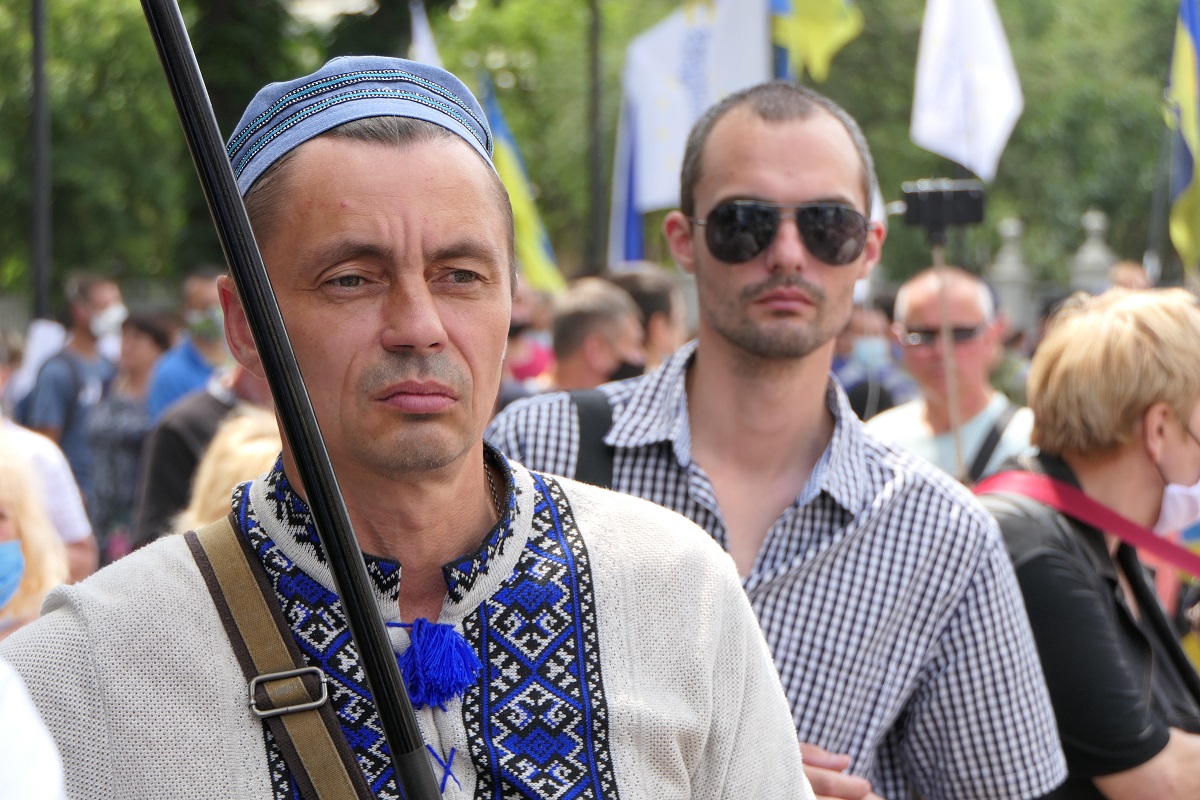
In Ukraine, an absolute majority are dissatisfied with “the way things are going now”, but only about 30 per cent are ready to protest or think that protest is plausible in the foreseeable future. Photo: Oleksandr Polonskyi / Shutterstock


One of the most important value-orientations is a reliance on one’s own efforts versus paternalistic expectations. Though there are more people with individualistic attitudes today, almost half (49%) of respondents still think the state should take responsibility for their wellbeing. Only 22 per cent have a clearly individualistic orientation and 28 per cent fall “in-between”. Another interesting fact is that parents regard the importance of independence (35%) and obedience (33%) in their children about the same, but value assertiveness more (46%). It is also important to understand that a majority thinks one’s efforts should pay off and thus the amount of individual input should be clearly mirrored in the benefits one gets.

Social trust

Probably one of the most persistent stereotypes about Ukraine is that it is a society with low levels of social trust. But is this true? Social scientists often talk about trust in different ways. It is not only about whether people trust social institutions such as the government or public institutions, but about trusting neighbours and those who live in the same community or country. When we say Ukraine is a country with low social trust, we usually mean the former – institutional trust. Indeed, recent surveys clearly show that the most trusted institution is its army – with a difference difference between trust and distrust close to 50%, while 74% of Ukrainians proclaim their trust in it. The army is followed by religious institutions: 72 per cent trust them while the difference is around 45 per cent. That is probably not all that surprising when we take into account that, by different estimates, around 56 per cent of Ukrainians say “that God is important in their lives” and around 80 per cent proclaim they “believe in God”. The only other institutions with a positive difference of social trust are the “educational system” and civil society organisations such as NGOs (positive balances around 20%). It is interesting to note that if army volunteers are listed as a group they are trusted slightly higher than the army itself. All other public or state institutions – including the parliament, political parties and the national government – hold low public trust.

These trends have been observed since at least 2014, when volunteers, civil society and the Armed Forces of Ukraine received a sudden boost of public trust. Regarding other institutions, low levels of trust in the media and political establishment has been a persistent trend since the early 1990s.

All this suggests there is an absence of social trust in Ukraine. But does it mean Ukrainians do not trust their fellow citizens? Surprisingly, if we look at “interpersonal” trust, Ukrainians fell into the European median: around one-third of respondents in the most recent World Values Survey said they believe “the majority of people could be trusted”, which is higher than France, Poland, Italy, the Czech Republic, Croatia and Hungary. Ukraine scored relatively high level in interpersonal trust which also partly explains why the most trusted institutions are those closely connected with interpersonal relations and everyday life – such as the church, local schools and clubs. And it helps to better understand the lens through which the armed forces are now seen as the “people’s army” rather than the official machine and hierarchy of generals and officers.

Contradictions

How does all this translate into practice? The first thing that comes to mind is the civic and political engagement of Ukrainians themselves. There are some paradoxes here. On the one hand, an absolute majority are dissatisfied with “the way things are going now”, but only about 30 per cent are ready to protest or think that protest is plausible in the foreseeable future. Among the reasons given as valid to protest are high unemployment, high taxes, inflation and access to medical care. At the same time, since independence over three decades ago the only protests that were successful were those that had political or civic claims, not the ones looking for extra resources.

Another contradiction is the difference between knowledge or attitudes and practice. For example, over two-thirds of Ukrainians say it is important to sign petitions, vote in elections, write complaints to authorities if they do not perform their duties, be active in communities and local civic organisations or self-government structures, etc. Yet less than ten per cent routinely engage into such actions except for electoral voting, where around 35 per cent voted in the last local elections (which is also less than those who said it is important to vote, and they are going to do so). Are people lying or giving socially approved answers? Or is there a need for a subtler, more in-depth explanation that will account not only for social desirability but for factors of trust in the political system?

Another paradox is the prevalence of populist attitudes among Ukrainians. Not surprisingly, close to 70-80 per cent demonstrate some kind of populist attitudes, including juxtaposing of the “elite” and “ordinary people’s” politicians, the idea that “all important state-level decisions should be approved by people via referenda or polls” and “parliament should not pass a law that is not supported by the people”. Still, 63 per cent believed that people can mistakenly support a wrong decision in a referendum. When asked if parliament should pass laws imposing on someone’s constitutional rights, 74 per cent said no and that parliament should uphold constitutional rights.

Why do we get such contradictory results? Maybe there are no contradictions and just different levels of reflection and association. When everyone thinks about their decision being the one that should be supported and passed as “the will of ordinary people”; yet any law which imposes on someone’s rights could backfire and take one’s own rights away. All this might be connected to the fact that though most Ukrainians (79%) value living in a democratic country, only one in three think Ukraine is governed in a democratic way. To compare, 54 per cent think that human rights are not respected and upheld properly in Ukraine, against 45 per cent who think there are no problems there. Still, 82 per cent are proud to be Ukrainian (“citizens of Ukraine”). Questions of social trust, political engagement and civil rights inevitably bring us back to the past civil protests in Ukraine, and more particularly to the Revolution of Dignity.

Attitudes to the Maidan

This past February marked seven years since the climax of the Maidan revolution and the sniper shootings. From today’s perspective those events are intrinsically connected to the attempted annexation of Crimea by Russia and its aggression in eastern Ukraine which few had foreseen then. Now when we ask people about their attitudes towards those events, we cannot disregard everything we now know and all that has happened since. It seems such a commonplace to say this, but it is really important to remember if we are to discuss the results of any surveys or interviews on the Revolution of Dignity or the Maidan.

In a joint survey conducted by the Razumkov Centre and the Democratic Initiatives Fund presented on February 20th 2020, almost half of respondents (45.5%) said the Maidan was “the Revolution of Dignity”, 23 per cent had the opposite opinion, that is of it being an “anti-state coup”; another 18 per cent stated that “it was a change of power by not fully legitimate means but under compulsion”. Even more profoundly, 59 per cent would not want to return to life before 2014, with 27 per cent saying they would prefer life before 2014. In the third and final question on whether they would support the Maidan if it were today, 38 per cent agreed with it, 10 per cent would support the anti-Maidan and 39 per cent would support neither (around 13% refused or found it hard to answer in all three of these questions).

Of course, these are not easy data to analyse as there could be multiple interpretations. One of the most obvious is about the intrinsic interconnectedness of the Maidan and the war in the public and personal perceptions – which, to be sure, makes it harder not to see the war as a result of the Maidan and the Revolution of Dignity, at least in some way. Another interesting point is that an estimated 10-15 per cent of Ukrainians support the Russian occupation of Crimea or parts of Donbas. Of course, we cannot say these are the same people who would support the anti-Maidan, but it could be a valid hypothesis for further research.

Nevertheless, it is still important to talk about the Maidan and the Revolution of Dignity today and to ask about it in sociological research. These issues are still open and an unfinished story for many, including those who have yet to process their experiences of witnessing a relatively peaceful society fall into civil unrest, conflict and war. On a personal level, this was a turning point for many of us, and as such there is a need for deeper reflection. On the other hand, the Maidan is already “history book material” and a battleground of competing narratives is being fought. Can we really allow ourselves to lose it, and what are the meanings and implications of a loss or victory in such a war?

Anna Osypchuk is the director for research at the School for Policy Analysis with the National University of Kyiv-Mohyla Academy.

, , ,

Partners

Terms of Use | Cookie policy | Copyryight 2026 Kolegium Europy Wschodniej im. Jana Nowaka-Jeziorańskiego 31-153 Kraków
Agencja digital: hauerpower studio krakow.
We use cookies to personalise content and ads, to provide social media features and to analyse our traffic. We also share information about your use of our site with our social media, advertising and analytics partners. View more
Cookies settings
Accept
Decline
Privacy & Cookie policy
Privacy & Cookies policy
Cookie name Active
Poniższa Polityka Prywatności – klauzule informacyjne dotyczące przetwarzania danych osobowych w związku z korzystaniem z serwisu internetowego https://neweasterneurope.eu/ lub usług dostępnych za jego pośrednictwem Polityka Prywatności zawiera informacje wymagane przez przepisy Rozporządzenia Parlamentu Europejskiego i Rady 2016/679 w sprawie ochrony osób fizycznych w związku z przetwarzaniem danych osobowych i w sprawie swobodnego przepływu takich danych oraz uchylenia dyrektywy 95/46/WE (RODO). Całość do przeczytania pod tym linkiem
Save settings
Cookies settings