
Text resize: A A
Change contrast

A timeline, interrupted

The politics of today’s populist leaders is nearly always the eternal return to the past. 1989, however, represents a normative stop they would prefer to skip.

The past does not exist. It is what one makes of it. From a purely axiological point of view, every one of us is constructed of different pasts and we have different memories at our disposal. The non-existence of the past as a tangible point of reference is a subject of individual or collective creation and interpretation; it is the founding assumption of any sociological research devoted to mnemonic subjects.

November 17, 2020 - Mateusz Mazzini - Hot TopicsIssue 6 2020Magazine

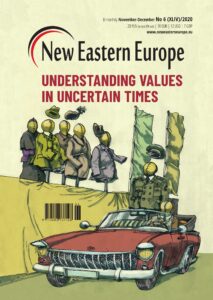
Illustration by Andrzej Zaręba

That is the case because, put simply, we all have a past – and it does not matter how that past came about in our minds. It has been somehow socially constructed. It is a result of much more than a mere sum of our individual memories.

As observed by all the great theoreticians of collective memory – ranging from the early writings of Emile Durkheim to our contemporary Jeffrey Olick – memory is inherently plural and inherently social. Collectivities, argues Olick, have memories just like they have identities. The relation between the two is of mutual intertwining – they construct each other and they are mutually complementary. What makes the content of both is, however, beyond the control of an individual, especially if the past employed in the process is a past which we have no direct recollection of.

Thick and thin

References to historical events, instances of their reconstruction through faithful or imagined visions of the past and political arguments based on normative links between previous statesmen and contemporary leaders became a leitmotif of populist policymaking in Central and Eastern Europe over the last decade. For purposes of conceptual clarity, populism is understood here as a “thin” ideology that considers society to be ultimately separated into two homogenous and antagonistic groups: the pure people and the corrupt elite. It argues that politics should be an expression of the volonte generale of the people.

It is thin, drawing on Michael Freeden’s framework of thick and thin ideologies, because it has the potential to attach itself to more powerful ideological concepts. Hence it is not a definitional mistake to name  populist politicians who started out on the extreme left or extreme right. Populism can appear in both and co-exist with nationalism inasmuch as with Marxism. Hungary’s Viktor Orbán is a populist, but so is Jeremy Corbyn (the former leader of the British Labour party) – they differ in postulates, norms and values. Their worldview is, however, dichotomous, even though the sides of that dichotomy can take on different labels.

Cas Mudde, the political scientist whose definition of populism I presented above, specifies that its variations differ because of thickening agents: context-dependent phenomena that make the populist message sharper, more vigorous, fitting and ultimately more effective in a given society. Mudde singles out two such concepts. The first is authoritarianism, or “the belief in a strictly ordered society in which infringements are to be punished severely”, paired with disregard for the democratic process. Second is nativism, which Mudde defines as “an ideology that holds that scares should be inhabited exclusively by members of the native group (the nation) and that non-native (or alien) elements whether persons or ideas, are fundamentally threatening to the homogenous nation-state”.

Jan Kubik and Marta Kotwas, in turn, point out that the thickening of populism can also take place in symbolic dimensions. When a society operates with a limited number of symbols and rather simple connotations between them, populists find it hard to use those as tools of separating the people from the elite. However, when new symbols are added, with narrow modes of interpretation offered by their authors – politicians, cultural or religious leaders – the symbolic realm of a given collectivity thickens. As Kubik and Kotwas put it: “The resulting thick symbolic system offers a narrower definition of collective identity and thus attracts a narrower group of people.” Consequently, it contributes to the ultimate aim of populism, which is strengthening the binary divide of reality.

Empirical research from Central and Eastern Europe, however, points to another possible thickening agent of populism – memory, and its usage in politics. From a mnemonic perspective, illiberal populist regimes do not just bow to historical reconstructions. They are historical reconstructions themselves. Marcin Napiórkowski, a Polish researcher on symbols, rightly refers to populist politics as a cult of the past which evolves into its compulsive repetition and re-enactment. Populist leaders all over the world, not just in Europe, refer to the past as a safe haven, an imagined place that harbours the true visions of the nation and the true values by which it should conduct itself.

This could be said of Donald Trump in the United States, Jair Bolsonaro in Brazil and Nigel Farage in the Leave campaign ahead of the Brexit referendum. Napiórkowski calls it the “politics of eternal return”. Anne Applebaum defines it as “elegiac nostalgia”. In more practical terms, it is a simple manifestation of historical revisionism. A selective application of historical events to the process of creating collective narratives often based on non-cognitive principles. The aim of such fabricated misrepresentation of the past is simple – to manifest an imagined greatness rooted in a previous time period of which current strongmen claim to be heirs. Most importantly, it refers to greatness forged in battle with an existential enemy. We were once great, they say, but our greatness faded away when we moved away from our origins, a milieu where the true nation resides. We adopted principles that dilute our identities, but we did not do that upon our own volition – they were imposed on us by new enemies and new threats to the survival of the nation.

Selective memory

Populists, curiously enough, never set a specific date or a point in history where past greatness peaked. The reason for this is simple. The past does not exist – it is what they make of it. Thus it is easy to shape along partisan lines. In Central and Eastern Europe, however, there is a time cut-off they all share. The changes that happened in 1989, and the democratic transitions that followed, all represent a moment that contemporary populist leaders despise. Politically, it might even match their agenda. The victory over a foreign-imposed totalitarianism, usually paired with the reestablishment of patriotic symbols and the spotlight position of the Church, it all plays well into the dichotomous vision of eternal freedom fighters restoring their nations’ greatness.

Axiologically, however, it was a disaster. A triumph of the universality of human rights, the rule of law, the dominance of institutions, and the unpredictability of the democratic process all stand in direct contrast to the vision of the populists. There, the law is inferior to the volonte generale, and so are institutions, deprived of any durability or stability. Equality is not a must, nor is it a given. Not everyone has to have an equal chance in the democratic race, and not everyone has to enjoy equal protection from the state. But why would they – if they do not belong to the true people, they simply do not merit such privileges. That is why, in the populist trip down memory lane, 1989 is a stop erased from the timeline.

Revisionist collective memory narratives thicken populism, because they are selective. They encompass only those events from the past which fit the binary representation of reality. Moreover, in constructing them, populists employ a tactic referred to as memory layering. It imposes a linear, consequential interpretation of historically distant events, even if they do not stem from one another or have minimal chronological commonalities. In other words, in populist memory there is no place for anyone to have multiple identities or to change them. A communist or a fascist will always remain one, just like a freedom fighter or democratic activist will forever occupy the right side of history. Ideological makeshifts are not allowed, divisions remain sharp forever. Again, here lies the incompatibility of 1989 with the populist zeitgeist. The democratic transitions were consensual and led to a compromise, for populists an outcome perennially inferior to constant struggle.

For that simple reason, this period of time falls short of useful historical and mnemonic inspiration. 1989 does not thicken their populism. For some, it does not constitute a remotely important moment in time. As Orbán himself, or his prominent acolytes – such as the historian Mária Schmidt, director of Budapest-based House of Terror Museum and the leading apostle of Hungary’s current historical revisionism – claim, there is no point talking about those transitions. “What transitions?”, they would say. No real change was introduced at the turn of the 1990s, other than a change of labels and slogans. Old enemies replaced their crude totalitarian postures with tailored-made slim suit jackets and continued their servitude to foreign-imposed regimes. Whether the command centre was moved from Moscow to Brussels or Berlin is largely secondary. What matters are that is does not lie in the hands of the volonté generale of the nation’s true people.

Ahistorical parallels

Populist politicians prefer to draw inspiration from much simpler events from a much more distant time. The Cold War and the wartime occupation are easier to re-enact under populism because they constitute the blueprint for the reality populists strive to create. A binary, dichotomous world in which there is moral clarity. Compromise, negotiation, peaceful settlements under institutional supervision were not values to embrace. And nor should they be today, populists would argue. After all, we are under siege again. Existential threats to the nation – not the state as it is a materialisation of rotten, dehumanised and elitist institutions – hide behind every corner.

Liberal democracy and all its principles, ranging from the rule of law to citizens’ equality before it, are not homegrown solutions. The same can be said about the primacy of procedures and institutional independence. There is no time for lengthy deliberations when the future of the people is at stake. That is why so many of Central and Eastern Europe’s parliaments have become mere rubber-stamping bodies for laws proposed by the strongmen themselves, written in haste and incompatible with national constitutions. Populists, heirs to the freedom fighters of the past, see no problem with this. Previous generations did not fight the enemy with democratic procedures; they will not do so either.

Ahistorical parallels between today’s nostalgia-filled populists and monumental figures from the past are plentiful in Central and Eastern Europe. Both Viktor Orbán and Jarosław Kaczyński declared their respective countries the final frontiers of Christendom in Europe, religious frontiers under siege by liberalism and cosmopolitan moral sleaze. The Polish Catholic community has considerable support from prominent figures in national politics  and sponsorship on behalf of state-controlled enterprises. In 2017 it organised a literal embodiment of that belief – a social event entitled “The Rosary to the Borders”, in which groups of believers gathered to pray with their rosaries alongside the physical borders of the Polish state. Gathering over a million participants in October 2017, it was meant to create some kind of holy protection of the Polish nation from anti-Christian forces.

This belief that Poland, Hungary or other nations of the region constitute a final, yet unbreakable, barrier in defence of Christianity is obviously grounded in history. In past centuries, they did defend themselves from an Islamic invasion of the Ottoman Empire. Needless to say this is not the case today, as no invaders are on the country’s doorstep. The Ottoman soldiers of the 16th and 17th centuries are modern-day refugees, as well as progressives and liberals – all whose actions and values are incompatible with traditional Christian values. The “Rosary to the Borders” event is a perfect example of both the symbolic and mnemonic thickening of populism. Through reproducing a binary historical reality – good Christians against morally corrupt invaders – and reinforcing it with powerful symbolism, such as the rosary prayer, the ultimate aim of populists is readily achievable. The world becomes black and white, the social postures and their moral consequences are clearly defined, and there is no room for interpretation and ambiguity.

Redemption

Such a high saturation of everyday politics with mnemonic and symbolic thickening has, however, consequences for both sides of the dichotomous reality of populism. If today’s populist strongmen are heirs to medieval knights, wartime resistance and anti-communist activists, then identical measure has to be applied to their ideological rivals. Those, in turn, become an extension of all the evils from the past. Current ideological enemies are, therefore, mere continuators of Islamic invaders, Nazi occupants and communist oppressors. As such, they do not deserve the full scope of human rights. They are not equal participants of the democratic process. After all, why should they? They are the enemies of the nation and the people.

Be that as it may, pushing the values of the 1989 transitions on the margins of normative heritage and historical policy is not only on the populists. Illiberal politicians advance with their revisionist agenda without being met with any resistance. Liberals and progressives stood by, watching – initially not noticing that the version of history gradually introduced to the mainstream was not the history they remembered or took part in. Mnemonically, they acted as abnegators, or actors who deem historical policy irrelevant for party politics and state governance. Why? Because history was supposed to have ended in 1989. It has run its course. Linear timelines were, ironically, a thing of the past. It was not just simple for policy-making, it was liberating for consciousness.

Thomas Bagger, a German diplomat and ministerial director, identifies this within Germany’s post-1989 politics, but his assumption could be easily extended to all post-transitional governments. What made Francis Fukuyama’s end of history so attractive to Europeans, writes Ivan Krastev and Stephen Holmes in commentary to Bagger’s works, was the ultimate freedom, from both the burden of the past and the uncertainty of the future. Everything was said and done and everyone was finally on the right side of history. 1989 brought freedom, but also redemption.

Both, however, proved to be ephemeral. The past has not only caught up with the present – they merged into one. Old symbolic and axiological categories were restored as measures for contemporary conflicts. Historical policy returned atop the everyday policy-making agenda. The fact that political conditions are now radically different than in 1989 is taken as relativised opinion, not as historiography. The past is applied selectivity as the building block of the present.

Can this process be stopped? Most certainly. Can it be reversed? Absolutely. How? Through mnemonic counteraction. What is the reason for such optimism? It is, bluntly speaking, our past. After all, it does not exist. It is what one makes of it.

Mateusz Mazzini is a doctoral candidate at the Polish Academy of Sciences and formerly a visiting doctoral scholar at University College London. His research project focuses on the collective memory of the non-democratic past in Central and Eastern Europe and Latin America.

, , , ,

Partners

Terms of Use | Cookie policy | Copyryight 2025 Kolegium Europy Wschodniej im. Jana Nowaka-Jeziorańskiego 31-153 Kraków
Agencja digital: hauerpower studio krakow.
We use cookies to personalise content and ads, to provide social media features and to analyse our traffic. We also share information about your use of our site with our social media, advertising and analytics partners. View more
Cookies settings
Accept
Decline
Privacy & Cookie policy
Privacy & Cookies policy
Cookie name Active
Poniższa Polityka Prywatności – klauzule informacyjne dotyczące przetwarzania danych osobowych w związku z korzystaniem z serwisu internetowego https://neweasterneurope.eu/ lub usług dostępnych za jego pośrednictwem Polityka Prywatności zawiera informacje wymagane przez przepisy Rozporządzenia Parlamentu Europejskiego i Rady 2016/679 w sprawie ochrony osób fizycznych w związku z przetwarzaniem danych osobowych i w sprawie swobodnego przepływu takich danych oraz uchylenia dyrektywy 95/46/WE (RODO). Całość do przeczytania pod tym linkiem
Save settings
Cookies settings