
Text resize: A A
Change contrast

Playing for high electoral stakes in Kyrgyzstan

Kyrgyzstan likes to portray itself as Central Asia’s only democracy – but dog-whistle politics and dirty tricks deployed in the October 2017 presidential election muddied its democratic credentials.

“It’s like a game of poker,” said Medet Tursaliyev, a young man emerging from a polling station in Bishkek, the leafy laidback capital of Kyrgyzstan. “They’re playing all in – for high stakes.”

As Kyrgyzstan went to the polls on October 15th last year, Tursaliyev had hit the nail on the head: it was a high-stakes political battle of a type never witnessed before in Central Asia. His country made history by staging the first ever truly competitive presidential election in a region ruled by strongmen who usually cling to power for decades.

January 2, 2018 - Joanna Lillis - AnalysisIssue 1 2018Magazine

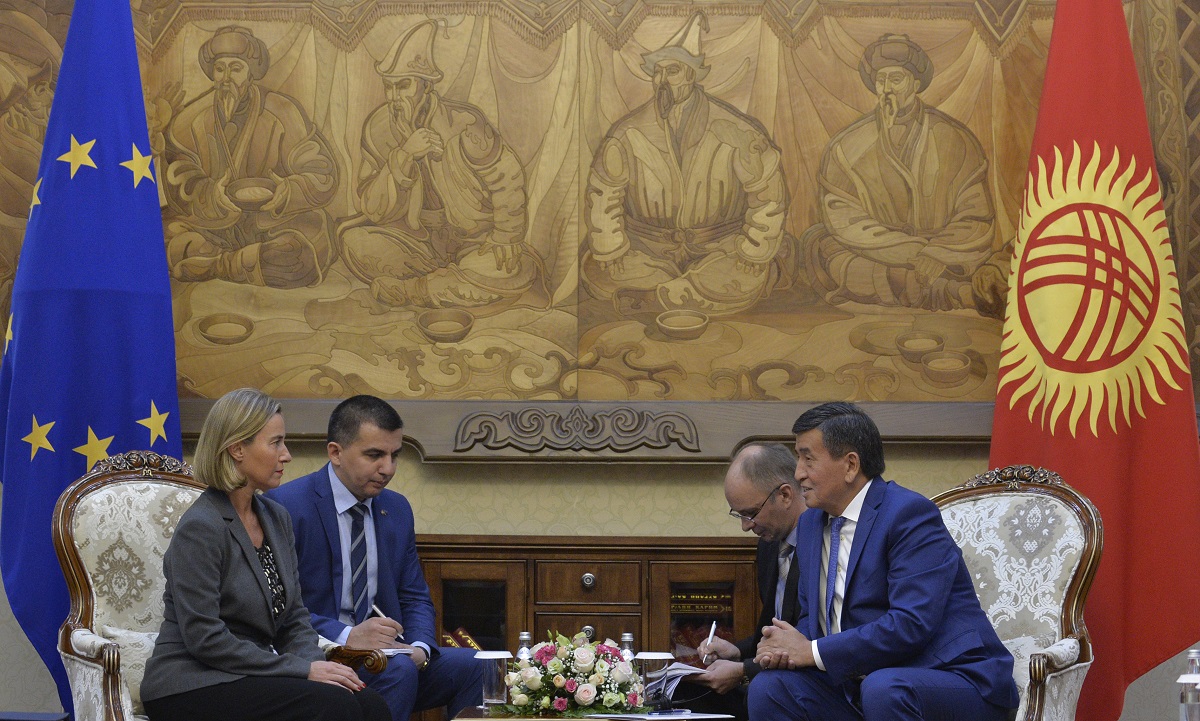
Sooronbay Jeyenbekov, Kyrgyzstan’s new president, meets with the EU’s Federica Mogherini in December 2017. Photo courtesy of the European Commission


On December 1st, Almazbek Atambayev stepped down as president after serving one six-year term, as the constitution dictates – another first in a part of the world where autocrats usually rewrite the rulebooks to entrench themselves in office for life. Taking over the reins of power was Sooronbay Jeyenbekov, a stubborn and taciturn apparatchik lacking political flair, who scored a surprise first-round victory in a hard-fought election that was expected to go to a second round. “These days it’s a question of who will win, not by how much,” said Igor Shestakov, co-chairman of Bishkek’s Pikir (Opinion) club of political scientists, before the vote. “This makes this election historic for Central Asia.”

 A vote for stability

Jeyenbekov cleared the 50 per cent threshold to avoid a run-off, winning 55 per cent of the vote – a comfortable victory, albeit more modest than the 98 per cent wins scored by his Kazakh and Turkmen neighbours in their most recent re-elections. Jeyenbekov left his chief rival, media-savvy millionaire businessman Omurbek Babanov, in the dust. The challenger came second with 33 per cent of the vote, despite running a slicker campaign and outspending his opponent. But where Babanov had deeper pockets, Jeyenbekov had a more powerful tool to propel him to victory: the might of the state machine pushing him first across the finish line. Jeyenbekov is the personally-anointed successor of Atambayev – and the outgoing president was determined to ensure his man won.

“This is a very, very, very competitive election,” said Edil Baisalov, a Babanov supporter and civil society activist, a few days before polling day. “[Babanov] is the candidate of change – it’s a two-way race – and the slogan of Jeyenbekov, he couldn’t be clearer: continuation.” Kyrgyzstan’s three million voters plumped for continuity, voting for a man presented as the status-quo choice, who described his job as to “preserve what has been achieved, to strengthen what has been started”. This was a vote for stability – a powerful impulse in a country that has toppled two presidents in revolutions in the last 12 years: Askar Akayev in 2005 and Kurmanbek Bakiyev in 2010.

The two main candidates in this election (which featured nine others) are former prime ministers, but their political style could not be more different: Babanov, a 47-year-old oligarch who made his fortune as a post-Soviet oil trader, oozed dynamism while Jeyenbekov, a 58-year-old former collective farmer who started his political career in the Soviet Communist Party, came across as an old-style apparatchik. Yet that did him no harm, because, as Medet Tiulegenov, chair of the Department of International and Comparative Politics at Bishkek’s American University of Central Asia, put it: “We’re not comparing one personality versus another personality. We’re comparing one personality versus the system. The voters who are thinking of voting for Jeyenbekov are not really voting for Jeyenbekov, they’re voting for something like a stable system.”

Bearing out this theory, Jeyenbekov supporters in Bishkek spoke of him as a safe pair of hands. “I’m voting for stability,” said Irina Asanbekova, who was waving a Jeyenbekov flag at a concert to promote him on the last day of campaigning. “He’s a good, honest, hardworking man,” said Jannur Kubashev, another middle-aged flag-waver. “He’ll keep taking us forward on the same path.” With Jeyenbekov backers spurred on by a desire to maintain the status quo, Babanov voters were fired up by the exact opposite: change. “I voted for Babanov because I think he’s promising,” said Tilek, a young man boasting an armful of trendy tattoos. “Young people mostly support Babanov because they think he has a different outlook… I think he’ll give the economy a boost.” “I’m for Babanov,” said Guljamal, a 27-year old office clerk strolling down a green Bishkek boulevard a few days before the election. “I think he’s a very progressive politician.” (Both Babanov supporters declined to provide their surnames.) Yet she did not believe her candidate would win, because the state machine was lined up against him. “Unfortunately we have the administrative resource, so I do not think he has a chance. It might be possible, but it’s unlikely. Jeyenbekov will probably win.”

The “administrative resource” is shorthand for harnessing the trappings of power to swing elections, a practice common in former Soviet states – and there is little doubt the “administrative resource” swung this one for Jeyenbekov. International observers from the Organisation for Security and Cooperation in Europe’s Office for Democratic Institutions and Human Rights (OSCE/ODIHR) noted “credible reports of misuse of public resources and pressure on voters” as officials strong-armed public-sector workers into supporting Atambayev’s chosen successor. “Teacher, doctor, police officer, soldier – all those who receive money from the public purse – are definitely supposed to vote for the pro-government candidate, and persuade their families to do so,” said Roza Otunbayeva, who was Atambayev’s predecessor as president, a caretaker leader installed for one year after the 2010 revolution. In one blatant case, Duyshenbek Zilaliyev, a deputy prime minister, was filmed on a mobile phone urging civil servants to vote for Jeyenbekov.

 Dirty tricks

Election day was “a celebration for me”, declared the outgoing Atambayev after casting his ballot, “because I have given so much – both nerves and health – for the sake of fair elections”. Atambayev styles himself as a dyed-in-the-wool democrat running the only Central Asian state that can call itself a democracy – yet critics complained of an atmosphere of intimidation hanging over this election unseen in Kyrgyzstan since the overthrow of the dictatorial Bakiyev in 2010.

“The election campaign was peaceful, but took place at the same time as several criminal cases against opposition politicians,” noted Ambassador Alexandre Keltchewsky of the OSCE/ODIHR observation mission. In August opposition leader Omurbek Tekebayev was jailed for eight years on corruption charges, which many linked to a desire to muzzle him before the vote, and during the campaign MP Kanatbek Isayev and three other Babanov supporters were detained on spurious charges of plotting a violent seizure of power. During a TV debate, Jeyenbekov promised to jail Babanov on corruption charges, and on the election day Atambayev made further veiled threats about throwing more people behind bars. “There is no fair election today,” lamented Babanov as voting day progressed. He conceded defeat gracefully the following day, dispelling fears that a disputed result could spark political turmoil and public unrest.

Egregious problems singled out by international observers included vote buying and bias in the media. Kyrgyzstan has a biometric voting system that has helped eliminate the type of electoral fraud rampant elsewhere in Central Asia: as Gulnara Shabdanaliyeva, an observer from a Kyrgyz civil society group, put it on election day: “This system works really well. It prevents ballot stuffing, carousel voting (when voters are bused between polling stations to vote multiple times) and family voting.” Yet observers said vote counting had been assessed negatively in more than one third of polling stations, and tabulation in nearly half, suggesting there is still room for electoral fraud. “Kyrgyzstan has demonstrated a generally positive example for holding competitive elections and a peaceful transfer of power, but some concerns remain,” Azay Guliyev of the OSCE/ODIHR mission said.

As the going got tough in what was, in Shestakov’s description, “an aggressive, tense campaign with a lot of black PR”, the tricks got dirtier. Jeyenbekov’s supporters “unleashed the nationalist factor,” said Mars Sariyev, an independent political analyst. “They’re saying that Babanov is not pure-blooded. All this is being done to take his electorate away on a nationalist wave, so this plays in favour of Jeyenbekov. It’s a very intense battle.”

Babanov fell victim to a smear campaign which portrayed him as unfit to lead Kyrgyzstan – he is half-Kyrgyz (his mother was an ethnic Turk deported to Central Asia from the Soviet-ruled Caucasus under Stalin in the 1940s). Dog-whistle politics did the trick for some voters. “I’m going to vote for Jeyenbekov, because he’s Kyrgyz,” said history student Azamat Kalenov. “Babanov’s not even Kyrgyz, he’s got mixed blood. I think the president of this country should be Kyrgyz himself.”

Babanov was even portrayed as a dangerous rabblerouser, after video of one of his rallies was selectively edited to appear as if he was fanning ethnic tensions among the Uzbek minority in southern Kyrgyzstan – an inflammatory tactic, given that Kyrgyz-Uzbek clashes there in 2010 caused hundreds of deaths.

Turbulent times ahead

Babanov was also depicted as a lackey of neighbouring Kazakhstan, after a meeting he held with Nursultan Nazarbayev, Kazakhstan’s president, during the campaign; it was interpreted by an irate Bishkek as Astana’s endorsement of the opposition candidate. One popular meme showed Babanov – who once held a Kazakh passport and whose wife is Kazakh – as a dog on a Kazakh leash. The furious diplomatic row that blew up between Bishkek and Astana after Atambayev derided Nazarbayev (the former Soviet Union’s longest serving leader, in power since 1989) as a corrupt president clinging onto power played out on the Kazakh-Kyrgyz border, where Kazakh-imposed controls caused long delays and severe disruptions to Kyrgyzstan’s trade with Kazakhstan and the outside world.

Kazakhstan thus became the surprise international player in an election otherwise notable for the hands-off approach of regional heavyweights Russia and China, which both had a close eye on the election but refrained from interventions. Russia stands accused of electoral meddling in western countries such as the United States, but in Kyrgyzstan Moscow was just “an observer – it will wait and see how things play out”, said Shestakov. Russia had no need to meddle, because all candidates were pro-Russian: Kyrgyzstan depends on the Kremlin for everything from security to the hundreds of millions of dollars sent home in remittances every year by migrant labourers that prop up Kyrgyzstan’s sluggish economy, so anything else would be electoral suicide.

Atambayev was determined to install his handpicked successor in order to ensure his own security after stepping down, analysts say, and Jeyenbekov was chosen for his loyalty and seeming lack of ambition. This has sparked speculation that Atambayev – for all his talk about voluntarily giving up office – intends to remain the power behind the throne. “I like to call it a regency,” said Baisalov, the Babanov-supporting civil society activist, scathingly.

Kyrgyzstan has a parliamentary system, uniquely in a region where an omnipotent president is the norm – yet Atambayev has usurped plenty of power in his six-year rule, says Otunbayeva, the ex-president who was once the outgoing leader’s political ally but is now a fervent critic. “Atambayev doesn’t have that much power in the constitution, but he’s seized it, and there is no resistance to him, because the institutions are weak.”

She predicts turbulent times ahead amid “tussles over the continuation of the parliamentary direction or a reversal” – and Bishkek will have to work with Babanov’s Respublika-Ata Jurt party, parliament’s second largest after the ruling Social Democratic Party of Kyrgyzstan, that of Atambayev and Jeyenbekov. Pundits also say that the politician to watch is Sapar Isakov, the recently-appointed prime minister, seen by many as Atambayev’s real political successor.

“We are proud to have such competitive elections for the first time in Central Asia and perhaps in the whole former Soviet Union,” says Otunbayeva – but she adds a caveat: “Of course these are not free elections, these are not fair elections.”

Yet there are still some grounds for optimism in the only Central Asian state where voters are offered a genuine political choice. “I’ve been to other countries in the region and people think that their vote is not meaningful and that they can’t really change something,” said Tursaliyev, the young man who compared this election to a high-stakes poker game. He ticked the “against all” box on the ballot paper, in protest at the dirty tricks and mudslinging that marred the campaign (a choice shared by 0.7 per cent of voters) – yet this young man still believes his vote counts. “My country, Kyrgyzstan, is the most democratic in this region, and people really think – not hope but really think – that they can bring change, that their vote matters.”

Joanna Lillis is a journalist based in Kazakhstan reporting on Central Asian affairs.

, ,

Partners

Terms of Use | Cookie policy | Copyryight 2025 Kolegium Europy Wschodniej im. Jana Nowaka-Jeziorańskiego 31-153 Kraków
Agencja digital: hauerpower studio krakow.
We use cookies to personalise content and ads, to provide social media features and to analyse our traffic. We also share information about your use of our site with our social media, advertising and analytics partners. View more
Cookies settings
Accept
Decline
Privacy & Cookie policy
Privacy & Cookies policy
Cookie name Active
Poniższa Polityka Prywatności – klauzule informacyjne dotyczące przetwarzania danych osobowych w związku z korzystaniem z serwisu internetowego https://neweasterneurope.eu/ lub usług dostępnych za jego pośrednictwem Polityka Prywatności zawiera informacje wymagane przez przepisy Rozporządzenia Parlamentu Europejskiego i Rady 2016/679 w sprawie ochrony osób fizycznych w związku z przetwarzaniem danych osobowych i w sprawie swobodnego przepływu takich danych oraz uchylenia dyrektywy 95/46/WE (RODO). Całość do przeczytania pod tym linkiem
Save settings
Cookies settings