Whose hostages?
A review of Hostages. A film written and directed by Rezo Gigineishvili, Georgian-Russian-Polish co-production, 2017.
October 4, 2017 -
Yulia Oreshina
-
Books and ReviewsIssue #5/2017Magazine
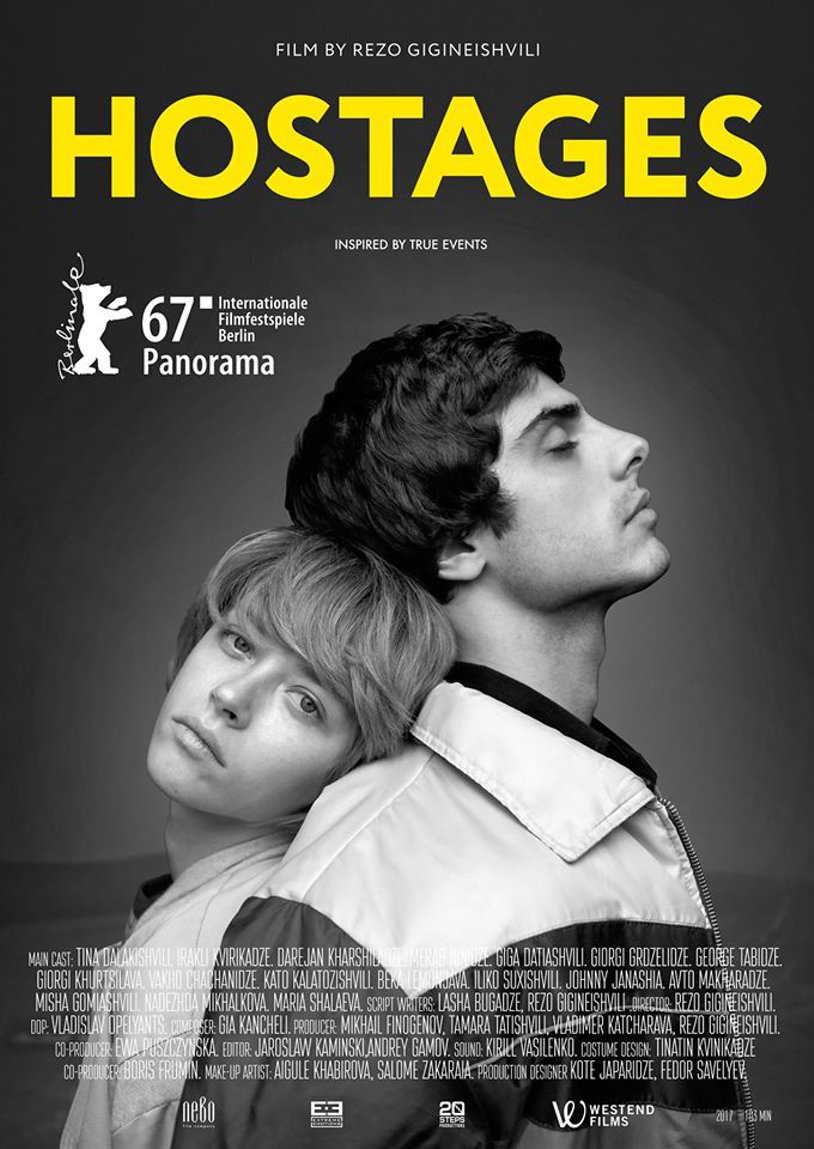
The world premiere of the film Hostages took place during the 67th Berlin International Film Festival on February 10th this year. It is the first feature film based on the real events of Aeroflot Flight 6833, a scandalous skyjacking attempt which took place in Soviet Georgia, and is considered to be the most serious work of Rezo Gigineishvili, an up-and-coming Georgian film director. In June the film was award for best director and best cinematography at the Sochi Open Russian Film Festival “Kinotavr”.
Young rebels
On November 18th 1983 a group of seven young people, representatives of the Georgian gilded youth, made an attempt to hijack a TU-134 airplane heading from Tbilisi to Leningrad with an intermediate stop in Batumi. The hijackers’ goal was to land in Turkey and to then escape to the United States. However, the crew resisted the attack and the plane landed back in Tbilisi. The details of the events that unfolded on board the aircraft remain unclear. During the clash between the hijackers and the crew, seven people died: a flight attendant, two pilots, two passengers and two of the hijackers (one of which died on the plane during clashes with the crew and the other due to blood loss since he wasn’t given any medical assistance). In despair, one more attacker died by suicide when the plane landed in Tbilisi. The aircraft was taken by storm by the elite Alpha Group, and the rest of the hijackers were arrested and put on trial. The fact that the plane was shot with 108 bullets during the attack provokes speculation that some of the victims might have been shot during the storm.
It comes as no surprise that this action received conflicting evaluations in Georgia at the time. But the cruel court verdict came as a big surprise for everyone. Tina Petviashvili received a 14-year jail sentence as a co-participant in the crime – she was the only one to survive. All the other participants were sentenced to death, together with an Orthodox priest who was declared to be the leader and inspirer of the hijack attempt despite the lack of evidence. A number of Georgian intellectuals organised a campaign demanding that the court reverse the death sentence for a less severe punishment. A petition was signed by intellectuals, artists and writers (including Nodar Dumbadze, who was the biggest name in Georgian literature at that time), but without success. In October 1984 all four men were killed by firing squad and the place of their burial is unknown until today.
Political instrumentalisation
The assessment of the 1983 events had never been an easy topic in Georgia. Some parts of society have already forgotten about this incident or see it in the distant past. Others remember it as a pointless rebellion of bored children of the Soviet elite. While others pity the hijackers and contritely call their actions stupid and childish, for which a very high price was paid. Some see the hijackers as victims of the Soviet system who strived to escape its claustrophobic reality using brutal methods. And yet others, mostly younger people who have learnt about the hijack attempt from a fiction book written in 2000s, romanticise the young rebels as brave freedom fighters. However, almost everyone agrees on one thing – the hijackers were unreasonably punished.
It is clear that such cruel punishment was used as a demonstration by Eduard Shevardnadze, who was then the leader of the Georgian communist party, to prove his loyalty to the Soviet system – meaning zero tolerance against enemies of the USSR. Shevardnadze was known to be a powerful member of the communist nomenclature – a social climber who was not able to risk his career’s development in the name of morality. In 1985 he became foreign minister of the Soviet Union – an extremely powerful person in the country.
Thirty-four years after the incident, Gigineishvili brings the topic of the Aeroflot Flight 6833 back into the public discourse, not only in Georgia but around the world, since the film has been translated to several languages. This time, the most frequently raised question is not the evaluation of events, but its political instrumentalisation. Not all the archives regarding this case are open in Georgia and many details still remain unclear, but a gradual process of rehabilitation of the hijackers, together with a re-evaluation of Shevardnadze’s legacy, can be observed.
Gigineishvili is not the first Georgian artist to tackle the topic. David Turashvili’s book Jeans Generation from 2009 and a play based on the book, as well as Zaza Rusadze’s documentary Bandits (2003), are the most obvious examples. Even though Gigineishvili had personal consultations with both Rusadze and Turashvili at the early stages of filming, Hostages is not based on those previous works. The film script was written by Gigineishvili himself, in co-authorship with Georgian novelist Lasha Bughadze. The names of the characters were changed to allow for a certain level of artistic freedom.
Personal ties
Nevertheless, a peculiar symbolic connection between Gigineishvili’s film account and the real events is created by the presence of two actors: Giorgi Tabidze and Merab Ninidze. Both have personal ties, though of different nature, to Aeroflot Flight 6833. Ninidze’s role in Tengiz Abuladze’s infamous Repentance, which brought the actor fame, was supposed to be played by one of the hijackers, Gega Kobakhidze, and who even participated in the first part of the film but was later removed. Giorgi Tabidze’s father left his wife and young son to join the hijackers and was killed during the shooting on the airplane. The actor did not try to replicate his father, whom he does not remember well, but rather developed an independent character.
The Georgian premiere of Hostages took place on April 20th 2017. “Why should we go for this film, this is a film without an idea”, says a young Georgian activist to me on our way to the cinema, at least “one famous critic gave such an evaluation”. During the premiere, the cinema was full, made up mostly of young people. After the screening, there was silence in the cinema hall. Some people were crying. On my way out, I tried to pick up snippets of the other viewers’ conversations: “A movie without an idea”; “I didn’t understand the director’s point of view”; and “You can’t get what’s going on unless you know the story beforehand”. The film received various reactions from the Georgian audience and sometimes very critical reviews by some Georgian intellectuals.
The Georgian audience had expected Gigineishvili to take a side in the incident, to choose a particular character through the eyes of which the tragic events would be shown, and to express his own position on the topic – which he does not. Moreover, the film does not follow the path established by earlier account which had a tendency to romanticise the young rebels. However, it does not condemn them either. Instead, the director tries to distance the viewer from both the side of the hijackers and the Soviet authorities. He shows the cruelty of both parties and perfectly communicates the mess and confusion of the whole situation. Almost the entire film is shot in an enclosed space and the camera operator seems to constantly use close-ups, evoking a sense of experiencing cramped conditions and a lack of oxygen, symbolising the restrictions of the Soviet state.
Instead of passing judgement on the events, Gigineishvili uses the example of the 1983 skyjack attempt as a reason for further reflection on eternal questions, such as the understanding of the value of freedom and the thin line between the struggle for one’s own freedom and the crimes committed against others. Every part of this tragic story is a hostage – not only in the direct meaning (hostages on the plane) but allegorically as well – the hijackers themselves, their parents and friends are hostages of the Soviet system and its restrictions. Bringing the events of 1983 back to contemporary public discourse, the film reminds us of the dangers and limitations of natural human rights resulting from the formation of an authoritarian regime of any sort.

Yulia Oreshina is a social anthropologist, translator and lecturer in cultural memory studies at Georgian American University in Tbilisi.