
Russia at war with COVID-19, again!
Many Russians have refused to get vaccinated for COVID-19. Several factors explain this. First, people do not trust the authorities or the Russian vaccine. Second, the pandemic is now considered history by many who see no need to get vaccinated. Third, disinformation has created a lot of uncertainty surrounding the vaccine.
In early July 2021 a new wave of COVID-19 hit Russia. This time it came in the form of the more transmissible Delta variant. As a result, Russia began reporting new infections and the largest number of deaths (nearly 800 per day in early August) since the beginning of the pandemic in March last year. At the same time, vaccination rates have remained extremely low, especially when compared to countries in the European Union and the United States. In fact, Russia is the only vaccine producing country with such low vaccination rates. A mere 19 per cent of Russians have gotten fully vaccinated since December 2020.
September 12, 2021 -
Agnieszka Legucka
-  Hot TopicsIssue 5 2021Magazine

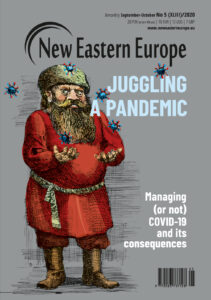
Illustration by Andrzej Zaręba
Why are Russians against vaccination? Is this their way of showing passive resistance to the authorities? And why is it that, when the world is starting to slowly recover from the pandemic, the Russian authorities are announcing mandatory vaccinations?
Let’s start with successes
In a way, the outbreak of the COVID-19 pandemic worked well for the Russian authorities. In February 2020 Russia quickly closed its border with China, which halted the rapid spread of the virus onto its territory. Russian media were meticulously reporting on the catastrophe happening in Italian and Spanish hospitals, often implying that democratic states were not able to cope with the health crisis. In addition, the Russian public was receiving all kinds of assurances that the virus would not affect their “unique Russian spirit”. This, among other things, explains why, still today, as many as 55 per cent of Russians, according to the independent research organisation the Levada Centre, are convinced that they will not catch the virus.
State media were eager to show China and Russia as successful countries which have controlled the virus; it compares them with western states, unable to respond to the demand for masks, protective gear and vaccines. Russia came “to the rescue”. In March 2020, at the request of the Italian government, the Russian ministry of defence sent medical equipment to Italy as part of its “from Russia with love” campaign. The propaganda machine that accompanied this was astonishing. It included online videos showing Italians removing EU flags from their homes and singing Russia’s national anthem.
In August 2020, Russian President Vladimir Putin triumphantly announced that Russia was the first country in the world to register an effective COVID-19 vaccine, called Sputnik V. However at the time of the announcement, Sputnik had not gone through the full testing and approval process. Later, the authorities boasted about producing other vaccines: EpiVacCorona by the Vektor State Research Centre of Virology and Biotechnology and CoviVac by the Chumakov Centre. There was also a single-dose version of Sputnik, called Sputnik Light.
All these vaccines were supposed to serve as testimony to the success of the Russian state and show the superiority of its technology and science over the West. “Russia has won the vaccine race”, the authorities and media claimed. As a result, vaccine orders from all over the world were expected. It was also believed that western states would eventually lift the onerous sanctions they imposed on Russia after the annexation of Crimea.
Thus, vaccines became a tool of Russia’s soft power. The Russian authorities, with their rhetoric, skilfully used a humanitarian narrative about helping protect the rest of the world against a dangerous virus. According to some estimates, around 35 countries received Sputnik vaccines. However in its own neighbourhood, the Kremlin’s vaccine diplomacy was less successful. In Europe demand for Sputink V and other Russian vaccines remained low. It was ordered by three countries: Hungary, Serbia and Slovakia; Slovakia returned its supply a few months after receiving it. With only 6,000 people willing to take the Russian vaccine, public demand was interpreted as too low.
Slovaks were not the only ones that were not interested in the Russian vaccine. Only seven per cent of Europeans trusted Sputnik V. This is probably because none of the Russian vaccines have been recognised by the World Health Organization (WHO) or the European Medicines Agency (EMA). The EMA delayed Sputnik V’s approval due to Russian failure to submit the required data and documentation on time.
Communication chaos and disinformation
Domestically in Russia, trust in COVID-19 vaccines remains low as well. One of the reasons given is poor public communications. During the first wave of infections contradictory messaging and chaotic decisions were coming from state officials. The most illustrative example was the obligatory two-week quarantine on anyone who wanted to meet with Vladimir Putin, who was hiding in his Novo-Ogaryovo estate. People jokingly referred to this as his “bunker”, while opposition activist Alexei Navalny called Putin a “grandpa in a bunker”. To reduce his distance from the public, Putin issued six appeals to the nation between March and May 2020. It was more than the three previous years together, but did not help. In April 2020, his approval rating dropped below 60 per cent for the first time. Though Putin managed to avoid catching COVID-19 (unlike Prime Minister Mikhail Mishustin or Kremlin spokesman Dmitry Peskov), many still did not like his behaviour. They felt the authorities neglected them at this very challenging time.
In addition, regional and local authorities, whom Putin passed responsibility for pandemic management onto, were reluctant to provide direct financial assistance to residents and small and medium-sized enterprises. In some cases they even introduced drastic restrictions. Such was the decision of Chechnya’s leader Ramzan Kadyrov, who closed the border between the republic and the rest of the Russian Federation.
According to the Levada Center, as many as two out of three Russians do not trust the official pandemic related statistics. From the outset, low mortality rates were the result of an adopted methodology, which was based on an artificial distinction between “COVID-19 patients” and “patients with COVID-19”. In terms of recording deaths, only the former are included in official figures. The Moscow Health Department issued a statement confirming that over 60 per cent of COVID-19 deaths were the result of “other causes” such as heart attacks, strokes, incurable cancers or other diseases. Official figures reflect this as well: while 143,000 Russians are reported to have died of COVID-19 since March 2020, the country’s excess fatality count reached 483,000, according to the Moscow Times. This means that, both in absolute terms and per capita, Russia has one of the highest COVID-19 death rates in the world.
Conspiracies
Meanwhile, Russian media and Kremlin propaganda in particular has continued praising Russian vaccines and slandering western alternatives. In one event, where Putin had met with a group of young people, he claimed that a dozen or so in Switzerland died after having received the Pfizer vaccine. Known for his praise for the regime, state media journalist and TV host Dmitry Kiselyov, scared his audience with information that the AstraZeneca vaccine could turn them into monkeys. The film director Nikita Mikhalkov released a video on YouTube asserting that the pandemic was a conspiracy created by Bill Gates to implant chips into Russians. In several TV programmes, doctors – or at least people dressed in white uniforms – confidently declared that there would be no subsequent waves of infection in Russia, and that the lockdown only favoured the spread of the virus. The argument in the latter was that a family locked up in one apartment or house is in close proximity with each other. In addition, a plethora of disinformation from other sources (including Chinese ones) was successfully spread on social media.
Throughout the pandemic, the English-language TV channel directed at foreign audiences, currently known as RT (previously Russia Today), constantly reported about the failures of western governments. On its website, for instance, there were several statements expressing anger at the restrictions various western governments imposed on their citizens. RT also widely reported on anti-COVID demonstrations organised in other countries. As a result of these contradictory signals, state authorities and pro-Kremlin media had almost no choice but to say that Russians cannot depend on anybody and need to take responsibility on their own.
On June 21st 2020 in an interview with Rossiya-1, Putin announced that Russian authorities have “managed to complete the task and defended Russian citizens against this infection”. Putin clearly needed a victory, even a symbolic one, over COVID-19. That is why he issued this statement just before the popular vote on the constitution, which gave him the right to run in the next election and rule until 2036. The proposal naturally passed in the referendum.
However, the success of the propaganda strategy to convince the public that the pandemic was under control led many to conclude that there was no point in vaccinating. Putin himself did not get vaccinated until March 2021. And, moreover, there was no video or photo of the act, a common practice in many countries where political leaders were recorded getting the vaccine. Evidently, at the time of Putin’s vaccination there were no cameras, no photos, no flashes. The mystery was only dispelled three months later when it was confirmed that Putin was vaccinated with Sputnik V. Yet the opportunity to get vaccinated was not offered to every citizen.
The announced victory over the pandemic was to be final. Occasionally, public health concerns were used to crack down on the opposition. It was very easy to accuse the opposition of breaking restrictions during mass demonstrations, like those held in support of Navalny, his brother Oleg and his associate, Lyubov Sobol. However different standards were applied during events organised by authorities – for example, the seventh anniversary of the annexation of Crimea, organised at Luzhniki stadium in Moscow. During this event only a tiny minority of the 80,000 attendees wore protective masks. On stage, Putin once again declared the greatness of the Russian state.
Turning the clock again
When the third wave of the pandemic hit Russia, Kiselyov announced that “Russia was at war” and it was the fault of citizens for not getting vaccinated. Proposed incentives such as lotteries and vacations did prove alluring enough to increase the uptake. Neither did vaccination points set up in shopping malls. Even RT workers were offered extra bonuses if they got vaccinated.
Many Russians still refuse to get vaccinated. In July it was estimated that 54 per cent of the population have no intention of getting the jab. Several factors explain this reluctance. First, people do not trust the authorities or the Russian vaccine. Second, the pandemic has now been recognised as largely over and many see no need to fear it anymore. Third, disinformation has effectively created a lot of uncertainty around vaccines.
For the first time, the pandemic has ceased to favour Putin. In September this year Russians will be electing members of the Duma in national elections. With declining support for the ruling party, United Russia, authorities will not impose another lockdown. Like elsewhere, the most difficult situation is in densely populated cities, such as Moscow and St Petersburg. To counteract it Sergei Sobyanin, Moscow’s mayor, introduced compulsory vaccinations for service workers employed in public transport, restaurants and beauty salons. As a result, as many as 60 per cent of these employees are to be vaccinated. Access to restaurants and public events, like concerts, are also closed to those without a QR code certifying vaccination. Moscow’s lead was followed by 20 other republics.
In response to these restrictions, many Russians have obtained fake vaccination certificates. They are becoming increasingly more popular given that the majority of the population (58 per cent) do not support compulsory vaccinations. Their attitude was best expressed by the actor Yegor Beroyev, who performed on stage with a yellow Star of David pinned to his jacket. He spoke about “waking up in a world where being vaccinated has become a sign of whether you are a citizen … whether you can visit institutions and take part in events, or you can enjoy your rights and benefits”. He received huge applause. Meanwhile, psychologist Aleksey Shustov argues that it would be better if the Kremlin would stop lying about the statistics and stop spreading disinformation about the “vaccination threat”.
Agnieszka Legucka is a professor at Vistula University in Warsaw and an analyst with the Polish Institute of International Affairs (PISM). In her work she focuses on the foreign policy of the Russian Federation.
 Conspiracy theories, COVID-19, pandemic, Russia, Vladimir Putin