
Text resize: A A
Change contrast

Revolution in Belarus. Surprisingly female?

The unexpected female dimension of the Belarusian opposition has made it fresh, emotional and empowering. These three women who did not give up after the most popular candidates were eliminated from the election race gave people “a last hope for change”. The women were authentic, they told personal stories, talked about love and asked people to believe in themselves.

Inspiring images of the Belarusian revolutionary female trio of Sviatlana Tsikhanouskaya, Maria Kalesnikava and Veranika Tsapkala as well as the numerous images of women peacefully protesting after the falsified August election, seem to have reached every corner of the globe. International audiences admired their strength, courage and wholesomeness. The high visibility and important role of women in the mass protests is not unique to Belarus, however.

November 17, 2020 - Olga Dryndova - Hot TopicsIssue 6 2020Magazine

Photo by Siarhey Dostan

We can observe it in Latin America, the United States and during the Arab Spring. There is also a global trend showing that women protests tend to be less violent, larger in scale and more diverse.

Yet, what exactly stands behind these actions? Can we call it a feminist revolution in Belarus? Are these consequences of a long-lasting tendency? Or is it a totally unpredictable phenomenon, even for the Belarusians?

Women in power

Statistically speaking, Belarus does well when it comes to gender equality. For instance, it ranks 27 out of 189 in the Gender Inequality Index-2019 (which is the same as the UK, and higher than Russia and the US). The Global Gender Gap Report 2020 places Belarus at 29th position (out of 153), while in the section titled “economic participation and opportunity” for women, Belarus performs better than all European states, except for Iceland. Its rankings in women’s political empowerment, however, are below the world average (position 81).

In 2018 the share of seats occupied in Belarusian parliament by women was 33 per cent and has not changed much over time – this was twice as high as Russia and higher than Germany, the UK and the US. Also, a 30 per cent representation quota for female MPs was declared by Alyaksandr Lukashenka back in 2004. Obviously, the Belarusian parliament cannot be treated in the same way this institution is treated in democratic systems, but the truth is that Belarusian women are represented in politics, at least in theory. Furthermore, the Belarusian National Report on Sustainable Development for the period until 2030 mentions that 70 per cent of civil servants and 68 per cent of judiciary sector employees are women.

The picture changes abruptly when we look at high government positions where only one woman is currently in charge of the 24 ministries in Belarus. The position of Natallya Kachanava, who is the head of the presidential administration, is rather an exception.  Neither have women had the chance to build an independent political group with their own agenda in Belarus. On the opposition side, however, there have been quite a few female politicians. Back in 2016, out of 110 candidates, two independents – Hanna Kanapackaya and Alena Anisim – unexpectedly entered the House of Representatives (the lower chamber of the Belarusian parliament). The authorities allowed them to be “elected” so that the West could see a degree of liberalisation taking place in Belarus. However, these women did not gain much popularity among the public.

One female candidate who became truly popular during 2015 election was Tatsiana Karatkevich, the first female presidential candidate in Belarus. She was the co-head of the Tell the Truth movement and, according to independent polls, received about 20 per cent of the vote (about one million votes). In her campaign Karatkevich emphasised the peaceful nature of change and gained popularity by travelling to regions and talking to people about their problems. Most importantly, her popularity contradicted the popular belief that Belarusians are not ready for a female leader.

Such messages are yet commonly expressed by state authorities. Lidziya Yarmoshyna, who is the head of the Central Election Commission, is known to have said that she did not see a place for women in politics, despite herself holding a high position for over 20 years. She is someone who, in the past, said: “women would be better off cooking soup then going to protests” (2010); “women are not as creative as men and thus cannot make unexpected and brave decisions” (2015); and “women are apolitical by their nature” (2016).

Lukashenka, in turn, often praised women as “the great creation of nature”, “the beautiful half of humanity” and “custodians of family values”. In his view, “a woman’s vocation is to decorate the world, while a man’s is to protect the world and women”. However, his two statements where he said that the “Belarusian constitution is not written for a woman” and “if this burden (of power) is placed on a woman, she will collapse, poor thing” were truly scandalous. These words, uttered in May this year, generated huge anger among many Belarusian women who filed complaints to the prosecutor’s office against the president.

Even though it is clear that the views of the president have not changed, it is likely that the Belarusian society has. In 2011 similar remarks made by the president did not generate much reaction. He was able, with ease, to say things like: “I would not give up the presidential chair to a representative of the ‘weaker sex’”. Yet patriarchal hierarchies and sexism – in public spaces, workplaces and at home – are still present in Belarus. Women who are successful in their professional careers often face inequality in their families. As a result, women continue to be subject to gender-based stereotyping and discrimination. At the same time, Belarusian women seemed to have less patriarchal views than men: research by IPM (2018) showed that women disagreed more than men with the assumption that men are better political leaders, directors and businessmen than women. However, before the last presidential election these issues were on the margins of debate, where as much as 70 per cent of Belarusians did not know that the phrase “gender inequality” existed or did not understand what it meant. The same research, conducted by Pact in 2019, showed that only 3.9 per cent of men and 6.9 per cent of women admitted having experienced gender inequality personally. Such low figures suggest that gender issues were not mainstreamed in Belarus.

Political reality show

What was named by many as a “female revolution”, was not originally planned as such. All women of the revolutionary “female trio” were, in a certain way, representing three non-registered male presidential candidates: YouTube blogger Siarhei Tsikhanouski, the ex-head of the High-Tech Park, Valery Tsapkala, and the ex-head of Belgazprombank, Viktar Babaryka. The question that appears is how Sviatlana Tsikhanouskaya, a housewife who spent the last years taking care of her children, turned out to be the only registered “candidate of hope” among the five candidates?

Her decision in May to submit documents for registration of an initiative group to gather signatures, after her husband was arrested, was a spontaneous decision. It was an act of despair and solidarity with her husband. Unexpectedly, the following weeks turned into a kind of political “reality show” with thousands of people, from different social backgrounds, lining up in long queues to voice their support for “anybody but Lukashenka”. This was the case both in the Belarusian capital and regions. The massive support for Tsikhanouskaya, even though people did not always know her name or profession, was evident. Despite arrests of members of her initiative and anonymous personal threats, she managed to gather the needed 100,000 signatures in her support and was registered as a presidential candidate. This act is evidence that, once again, the authorities did not recognise her potential as they were calmed by the fact that popular male figures were either deprived of registration and/or arrested.

Allegedly it took only 15 minutes for the team of the three women, representing the non-registered male candidates, to agree on a united front, showing that “women can agree faster than men”. During their first press conference, they talked not about their political ambitions but the common good of the society. The main points of their campaign included: the release of political prisoners and the organisation of free and fair elections after a possible victory of Tsikhanouskaya.

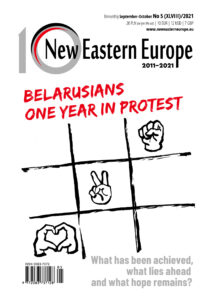
The spontaneous symbol of their election campaign – a heart (Babaryka), a fist (Tsikhanouskaya) and a victory-sign (Tsapkala) – went viral and inspired women rights advocates in Belarus and around the world. It is, however, more interesting to see how these women presented themselves in the campaign as their self-image and public statements combined messages of traditional values and female leadership.

Sviatlana Tsikhanouskaya primarily focused on family values. In her speeches, she always referred to her husband’s arrest as the main reason for her political activity. With time, she stood not only for his freedom, but for the freedom of all Belarusians. She saw herself as a weak and “plain” woman, who got stronger after meeting thousands of people during the three weeks of pre-election rallies. As a registered candidate, she admitted not being interested in continuing her political career, even after her victory. Her views did not change much even after the election when she was forced to leave Belarus and became an internationally known opposition figure.

Maria Kalesnikava looked like an opposite to Tsikhanouskaya. She saw herself as a free global citizen and talked about feminism in her interviews. Kalesnikava made a successful career in the arts and worked as a musician and art director before the election. Born in Belarus, she lived and worked in Germany and other European countries for a long time and learned the values of democracy and freedom. She became visible while being a part of Babaryka’s team. Her empowering and empathetic messages (“We are legitimate!”, “Belarusians, you are incredible!”) reached the broader public. Out of the three women, she was the only one who stayed in Belarus after the election and even tore up her passport during an attempt by the security services to transport her outside of Belarus, which led to her arrest.

Veranika Tsapkala was somehow a combination of both Tsikhanouskaya and Kalesnikava: a self-confident successful manager working for Microsoft and a loving wife and mother. During their first press conference, she made it clear that the Belarusian constitution was written for women as well (opposing the words of Lukashenka) and that the women of Belarus are equal to men. At the same time, she supported Tsikhanouskaya as a mother and wife – that was what “women’s solidarity” meant for her. Finally, during interviews she stressed that “there is only one politician in our family, and that is my husband”. She said these words despite being an excellent public speaker. After the election, when she joined her husband and children abroad, she accompanied him during political meetings rather as a wife, although she was actually among those who contributed to the popular uprising. 

Last hope for change

These three women had just three weeks to reach voters before election day. In an unprecedented way, and against the overwhelming time pressure, they became extremely popular both in Belarus and abroad. In fact, none of the presidential candidates in Belarus has ever gotten so much international attention before. Thus, the story of the “three women fighting against the dictator” turned out to be a perfect political strategy. During the campaign, they visited 13 cities in three weeks and attracted up to five per cent of locals to their rallies in the regions. This was remarkable for the traditionally passive Belarusian electorate. They were being treated like rock stars.

How was this all possible? It would be incorrect to say that the fact the candidates were females was the only thing that mobilised the public. Belarusians were already politicised before the election. The economic stagnation, inadequate state reactions to the pandemic, and a tiredness of the same face for 26 years radicalised people and united them against Lukashenka. In this sense the public turned into a protest electorate which was ready to vote for any strong figure opposing the incumbent president.

Still, the unexpected female dimension made the campaign very fresh, emotional and empowering. The reasons behind it were, first, the fact that the three women did not give up after the most popular candidates were eliminated from the election and thus gave people a “last hope for change”. Their campaign was very emotional. They were authentic, they told personal stories, they talked about love and asked people to believe in themselves. As a result, the traditional slogan of the opposition “We believe – We can – We will win” was exchanged into a female version: “We love – We can – We will win”.

Second, they mobilised people for election observation and election participation. The results of that were massive queues outside polling stations on election day and thousands deprived the right to observe the counting of votes. Electoral fraud thus became a prevalent issue. Additionally, 500,000 Belarusians sent pictures of their voting ballots to a newly developed online platform which made it easier to identify falsifications. Even their “appeals of consciousness” addressed to members of election commissions worked in about 100 polling stations: votes were counted there, protocols showing the victory of Tsikhanouskaya were made public (something like this never happened in Belarus before).

To be fair, one has to admit that both strategies (empathy and mobilisation) came originally from Babaryka’s team. The heart was the symbol of his campaign. As opinion polls showed, Belarusians did not believe their actions would result in any change. Babaryka’s team addressed this issue and changed the narrative from “authorities are bad” to “people are good”. After his arrest, Kalesnikava went on to push this message further.

Finally, the combination of traditional and feminist values in the women’s speeches seems to have played a crucial role for their popularity among the broader public. Feministic and empowering messages of Kalesnikava and Tsapkala got admiration by adherents of women’s power, while the shy and loving Tsikhanouskaya was a perfect prototype for the traditional part of Belarusian society, which is significant. According to the IPM research (2018), nothing was more important than motherhood (84.8 per cent) and fatherhood (77.4 per cent) for a vast majority of Belarusians. The fact that Tsikhanouskaya did not want to stay in power for long persuaded also those who were still not ready to vote for a housewife. Their percentage should have been considerable – even local well-known male experts reacted sharply on the female trio. “What can three beautiful women do?”, “The political part of the campaign is over now” – to give just a few examples of the first reactions.

The popular trust put into Tsikhanouskaya, who became a kind of a “political Cinderella”, was unbeatably high. People supported her out of solidarity, compassion and admiration for her courage. Reports of independent election observers suggest she could have even gotten the electoral majority. For many voters, supporting her meant supporting new fair elections. Despite her statements about lacking political ambitions, she turned out to be an extremely important political actor.

Female face of the protests

A second wave of women’s activities started two days after the election, or on the fourth day of protests against electoral fraud. The scale of repressions was shocking. The police used stun grenades and rubber bullets against protesters. Information about the first deaths and the hundreds of others injured or tortured quickly reached the public. Clashes with the police took place mostly in the evenings or at night. On August 12th and 13th several hundred women built solidarity chains in Minsk in protest against police violence. The first group was wearing white clothes and holding flowers, while the second group was dressed in white, barefoot and sang the Belarusian lullaby “Kalyhanka”. Within hours, reports about these “white women chains” spread across the country and other cities joined in.  The main cause for these actions was the inhumane violence carried out by riot police – women wanted to show this was not a “Belarusian way” of transformation. The message of non-violence was sent to Belarusians in contrast to the pictures of night battles with “terrorists” on state television.

Another aim of the protests was to make them appealing to large numbers of people, especially women. In other words, solidarity chains, which were organised during the daytime, were viewed as safer civic actions than night confrontations with the police. Men also joined the chains which were then followed by solidarity chains and rallies of other social and professional groups: doctors, students and the elderly. Consequently, new forms of non-violent protest were introduced where they found fertile ground. Through these protest chains, women also wanted to express their solidarity with those protesting at night. Finally, many called for the release of political prisoners, the prosecution of those responsible for election fraud and violence, as well as new elections.

Interestingly, the first initiatives in Minsk did not have a political centre. Women organised themselves through their own contacts and social networks (especially Telegram-chats). They were not connected to other groups, but surprisingly came with a similar protest idea that used the colour white as a symbol. Similar actions, which were later organised nationwide, were grassroots, spontaneous and decentralised. They often were thinking outside of the box. One of the first women’s actions was conceptualised and organised by an event-manager without any political experience: she perceived the opposition as customers and a political action as an event.

The peaceful female “white protests” had a number of very important functions: they stressed the non-violent nature of protesters and as such saved people’s motivation for protest (the post-election rallies were peaceful initially, but when the women came out, it became even more obvious); they made protests accessible to broader social groups; they introduced new protest forms; they made the movement highly visible in Belarus and abroad; they helped stop police violence for some time; they decentralised the movement; and, of course, they added a new dynamic to the female dimension of the election campaign. Women were thus not only led by women politicians, but started to self-organise for political purposes. With time they even discovered new female heroes, such as the 73-year-old Nina Bahinskaya, who has become famous for her own personal protests against Lukashenka which she has been doing for over 20 years.

Without any doubt, the “white protests” added a whole new dimension to the protest movement, which generated the largest political rallies in the history of independent Belarus. They began on August 16th and continue to take place every following Sunday. Additionally, women’s marches have been organised every Saturday since August 29th through September 26th. The female protesters later changed their tactics to avoid mass detentions, which were becoming increasingly more common and chose not to gather in large crowds.  

The five big Saturday women’s marches in Minsk, with up to 10,000 participants of all ages, were very diverse in their messages and had both feminine and women empowerment components. The white colour and flowers helped build an image of innocent, fragile and loving women, which fit well with the traditional perception of women in Belarusian society. Many women went out on the streets to protect their husbands and sons, which was also expressed on their banners and posters. This femininity has become a new female “soft-power”. Consider here the poster depicting Tsikhanouskaya as “Motherland” (Russian: Rodina Mat) which was based on the image of a woman during the Second World War used to mobilise the Soviet people. Indeed, during this year’s protest, women literally protected men from the police during protests.

At the same time, a lot of poster messages came as a creative and humorous reaction to the sexist statements of the president and emphasised that women were political subjects: “Fight like a (Belarusian) girl”; “Patriarchy, you are fucked up”; “I am not afraid – I was in labour”; “Make way for a woman”; “Belarus is female, I voted for a woman”, “Sasha, NO means NO” and “Your beloved one does not want you” (both to Lukashenka, as a reaction to his statement: “Belarus is a beloved one, and you do not give your beloved one to anybody”).

Humour, openness and a positive attitude were some of the most significant features of these marches. Their participants tried to start conversations with the police, smiled at them, giving them flowers, singing songs and dancing. They would spontaneously change the rallies’ routes or scream loudly when the police approached them. There was a certain confidence, or hope, that the police would not be violent towards them. Beating women can, of course, cause a negative reaction from society. Seemingly this logic prevailed for several weeks until the authorities realised that these women have become a political force.

Final straw

Women for a long time have been Lukashenka’s core electorate. However, after many years in power and the lack of independent research available, he lost his political scent and was also losing his personal charisma. The 2020 election year was not the most women-friendly on the part of the administration. The president showed arrogance and a lack of empathy during the first wave of the coronavirus pandemic which led to concern among women about the health and lives of their families. In addition, female employees dominate the health and education sectors, which were hit the hardest. Finally, the brutal repressions which took place after the election proved to be the final straw. Lukashenka, who totally underestimated women and their power, has accidentally contributed to the development of feminism in Belarus, just like he has contributed to the unity of Belarusians who have rallied against him. Patriarchal values seem to have become archaic to a large section of the Belarusian public. “Sasha, sexism has destroyed you” – was written on one of the women’s posters during a rally.

The political crisis in Belarus is still underway. It is difficult to make any long-term forecasts on how it will further unveil. Nevertheless, it is already clear that we are seeing a qualitatively different public picture of the role of women in Belarus. Until summer 2020, feminism and political participation seemed to be incompatible with femininity and vulnerability – now women’s political participation is becoming fashionable. “Belarusian women explore themselves and their strength anew, without any background knowledge about feministic theories,” said one of the participants of the first women’s chains.

We are now probably witnessing an overcoming of stereotypes and clichés that are associated with women in politics and society which will further develop in the oncoming years. For the moment, this stage has already been achieved in other countries where the first association with “Belarusian women” is no longer an attractive or sexy female, but a brave and responsible citizen.

Olga Dryndova is the editor of the Belarus-Analysen (Research Centre for East European Studies at the University of Bremen) and a country expert on Belarus for the Varieties of Democracy Institute in Sweden.

, , ,

Partners

Terms of Use | Cookie policy | Copyryight 2026 Kolegium Europy Wschodniej im. Jana Nowaka-Jeziorańskiego 31-153 Kraków
Agencja digital: hauerpower studio krakow.
We use cookies to personalise content and ads, to provide social media features and to analyse our traffic. We also share information about your use of our site with our social media, advertising and analytics partners. View more
Cookies settings
Accept
Decline
Privacy & Cookie policy
Privacy & Cookies policy
Cookie name Active
Poniższa Polityka Prywatności – klauzule informacyjne dotyczące przetwarzania danych osobowych w związku z korzystaniem z serwisu internetowego https://neweasterneurope.eu/ lub usług dostępnych za jego pośrednictwem Polityka Prywatności zawiera informacje wymagane przez przepisy Rozporządzenia Parlamentu Europejskiego i Rady 2016/679 w sprawie ochrony osób fizycznych w związku z przetwarzaniem danych osobowych i w sprawie swobodnego przepływu takich danych oraz uchylenia dyrektywy 95/46/WE (RODO). Całość do przeczytania pod tym linkiem
Save settings
Cookies settings