
Ukrainian intellectuals after Maidan
The war with Russia creates a difficult task for Ukrainian intellectuals. We must take care of decommunisation and de-Sovietisation not only by renaming our streets and cities but also in the consciousness of our citizens. Ultimately, decommunisation is a part of the decolonisation process in Ukraine.
The Maidan has changed our lives forever. This might sound a little pathetic, but for anyone who was directly involved in the events of 2013/2014, the Maidan has far-reaching significance and harkens great emotional stress. The same applies to those who were not concerned about these events or those who opposed it. And, of course, it definitely applies to Ukrainian intellectuals.
January 2, 2019 -
Vakhtang Kebuladze
-  Hot TopicsIssue 1 2019Magazine
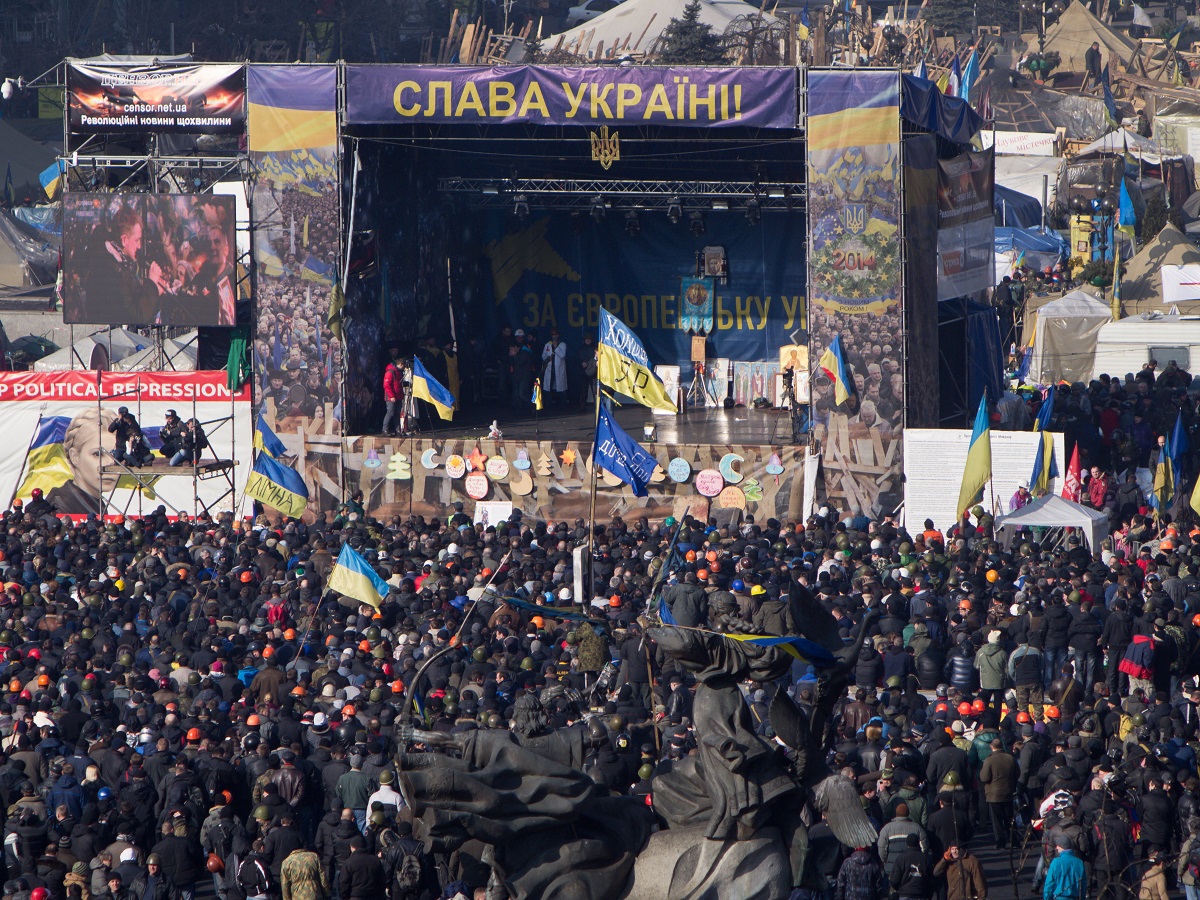
The Maidan changed the style and rhythm of the intellectual’s thinking and writing. We were used to long reflections. Now, we suddenly found ourselves in very different circumstances. Photo: Amakuha (CC) commons.wikimedia.org
When the protests began, we, a group of Kyiv-based scholars of the humanities, gathered around a table at the Institute of Philosophy, near the Maidan to discuss our role in these events. I said it was time to be with our people, not to waste time trying to understand what was happening but to participate in the events. I declared I would prepare firewood to warm the protesters. For others around the table, however, it caused some indignation. One of them got up and exclaimed: “I thought this would be about the science here!” He slammed the door as he walked out. It does not mean he was against the Maidan, and it is not about who was right, but we were only able to do what we could. Therefore, the Maidan became a moment of truth for each of us; it revealed some important features and outlined the trajectory of further thought and action.
Paralysing events
When I recall my declaration to chop firewood, I cannot recognise myself. I have not had any intention to actively participate in any political event, especially in demonstrations, revolts and revolutions. It was always a kind of messy business for me and most people in my field. We were born and raised in the Soviet Union. The authorities of this totalitarian state legitimised their crimes against their own people and peoples around the world using the emancipatory rhetoric of revolution. On the one hand, that authority usurped the right to emancipate, marginalising any resistance against itself as slavery. The Soviet man was a slave with no chance to be released, since his aspiration to liberation was stigmatised as a revolt against freedom as such. On the other hand, for many of us who grew up under the constant pressure of Soviet propaganda, any political activity was seen as disgusting, forcing an escape from political reality into internal emigration. We lived in a society with a continuous lie, we understood that we were being lied to, but the limits of the lie were unknown to us and therefore we spontaneously lied to ourselves – not to mention the fear and a sense of total helplessness in front of the terrible Soviet punitive system. Only some single heroes were able to overcome this fear – namely the dissidents – whose lives during the Soviet times passed from one imprisonment to another, often ending in death.
Yet my inability to participate in political processes had another reason. It was connected with the specifics of academic thinking, because before making our thoughts public, we have to carefully consider them. Such action also affected our daily life. Normally, I cannot make quick decisions to act. I need time for reflection, to understand what really has to be done. And sometimes you later realise that the best thing to do is nothing. And it is exactly the time of reflection that leads to the creation of new texts. Wait and soon you become pregnant with thoughts. But this intellectual pregnancy represses the will; it inhibits response and slows down action. Thinking is a long process. Decisive action interferes with that process, tearing down the quiet flow of thoughts. Those who can think are often unable to act. But is it really true?
From the first days of the confrontation on the Maidan, I got into a strange situation. My usual slow reflections left me. I was immersed into the maelstrom of events. I could not stop for a minute, and even when I sat down to write something about what was happening, I was unable to complete one sentence. I was filled with thoughts and emotions, but I was unable to transform them into text. Subsequently, I felt I could not read anything except my news feed that I saw under the images of the events on the Maidan. A strange kind of dyslexia took me over – for someone whom the process of reading and writing was the main component of life. At first it aroused anxiety, but soon I made peace with it. It was only afterwards, when my brain thawed and my hands routinely pulled up the keyboard, that I went back to writing about what happened to us in those terrible – and, at the same time, beautiful – months of fear and courage, despair and hope. I even wrote “Silence and quietness”, a kind of essay about this inability to write. Therefore, the Maidan not only just gave me new subjects to think about, but it also put new existential and intellectual tasks before me. For the intellectual, the Maidan changed the style and rhythm of our lives and thus the style and the rhythm of our thinking and writing.
The condition of silence, in which I was caught up in, was uncommon to most Ukrainian intellectuals. The first publications about the Maidan began to appear at the very onset of the events. Some Ukrainian intellectuals at the time were very active online. Internet and social media was used not only as information platforms but as a means of rapid mobilisation of a large number of people to solve specific problems. Social media was used by the protesters to organise urgent medical care for those who were injured and sick. It also helped mobilise a quick gathering of people on the Maidan during the attacks by pro-government units – or the so-called titushki (criminals paid and armed by the government); or to organise the protection of the injured at hospitals who were threatened by Ukrainian and Russian secret services. At that time, Facebook posts became a kind of auto-psychotherapy for some. But short comments and poems by Ukrainian scholars and artists on Facebook not only helped them to cope with these terrible times but also played an important role in their lives. These works helped convince the protesters that the Maidan had broad support in Ukrainian society. They gave people hope for victory.
Intellectual duty
As I mentioned earlier, Maidan changed the style and rhythm of our thinking and writing. We were used to long reflections. Now, we suddenly found ourselves in very different circumstances. The stormy course of events required a radically different pace of response. Some of us remained silent, but others changed the speed and rhythm of their writing and speeches – and not only in austere academic journals or magazines, but also in quickly created short pieces – as instant responses to the events. We no longer could write lengthy academic papers or attend conferences or seminars, we now had to respond straightforwardly to journalists’ questions. I think that the writers who were used to the scale of novels and stories were in a similar situation. However, it was probably easier for them to work in such formats, because artists usually feel more comfortable in the public domain than academics. In any case, public speaking became a duty of responsibility for us, and not as a means to fame or money.
It soon became clear that an important part of our work was to share our interpretation of events to international audiences, first of all because of the disinformation of Russian media and the influence of paid Kremlin surrogates in other countries. But even our interpretations began to transform. After the Maidan, and from the beginning of the Russian-Ukrainian war, a new type of discourse, the kernels of which had existed previously, began to develop in our society. In this context Ukrainian intellectuals had come to realise the new tasks facing them in relation to these challenges. The most important, undoubtedly, was the Russian aggression against our country – the Russian occupation of Crimea and the war in Donbas unleashed by Vladimir Putin’s regime.
For many of us, the war resulted in deep changes in dealing with the past, as well as our evaluation of the present and our expectations for the future. For the overwhelming majority of Ukrainian liberal intellectuals, the Soviet Union and the rudiments of this terrible socio-political system, which still halt the development of our country, has always remained the main enemy. With that in mind, former Russian dissidents and contemporary Russian liberal intellectuals had been – and should remain – our allies. However, the Maidan and the post-Maidan events clearly illustrated what some of us were saying earlier: the Soviet Union was one of the reincarnations of the Russian Empire, and Putin is not an evil demon sent to Russia from space, but a holistic creature of the Russian socio-political reality. His frank nostalgia for the totalitarian Soviet past is a manifestation of these kinds of sentiments that are widespread in contemporary Russia. Despite the internal resistance, many of us had admitted that the enemy of Ukraine is not only the Soviet Union, but the Russian empire as presented today by Putin’s criminal regime.
Decolonisation of consciousness
Russia is neither a particular civilisation nor a part of the western civilisation. In fact, Russia is a shadow of a civilisation; illicitly and perversely reproducing shapes of western civilisation, giving them entirely different and ugly meanings. The book The decolonisation of the USSR as the only guarantor of peace around the world, which contains excerpts from Vasyl Stus’ Gulag diary, was recently published in Ukraine (Stus himself was murdered in a Soviet prison camp in Siberia). If we replace the USSR with Russia in the title, we obtain a formula for saving both Ukraine and the entire free civilised world: “the decolonisation of Russia”. What is needed is not only the decolonisation of territory, but the decolonisation of consciousness (of both the colonised and the colonisers).
Understanding this phenomenon leads to a rethinking of some fundamental guidelines and the deconstruction of established prejudices. One of them concerns our attitude to culture: politics and business, it is sometimes said, should be dirty work, but never literature and arts. Politics can both unite and divide people, and lead to wars; but culture creates mutual understanding and harmonious relations between different peoples, nations and states. However our present situation forces us to recall Edward Said’s formula that “culture is a field of struggle”. What he wrote about the great literature of western empires is even more relevant to Russian literature. It creates an imperial narrative which legitimises Russia’s aggression against other states and people. This does not mean we must refuse to accept Russian culture. On the contrary, it must be carefully studied; we must trace the sources of imperialism and critically separate them from those elements that give us hope for the possibility to understand each other in the future.
This is a difficult task for Ukrainian intellectuals because we have to find a balance between the obscurantist denials of the value of culture itself and the dangerous enthusiasm of an empire which physically kills and partly occupies the territories of citizens of another country. Hence I would advise a little Socratic irony on culture in general and, above all, on the so-called Russian culture. In general, intellectuals inherently take culture too seriously because this is the sphere of our work. Culture is important, but not enough to destroy one’s life because there will be no culture without life.
Maybe we should not take Russian literature too seriously. Ukrainian intellectuals are slowly beginning to understand that Russian literature must turn from the factor of the formation of our subjectivity into an object of our research, along with other literature. Our ambivalent attitude towards the Russian language follows the abovementioned interpretation of its literature. On the one hand, there are many Russian-speaking citizens of Ukraine who are deeply moved by the idea of sacrificing their lives for the independence of our country and in the fight against Russian imperialism. On the other hand, the type of language coming from Kremlin politicians and propagandists, unfortunately, is increasingly turning into “hate speech”. Therefore, for many intellectuals the Ukrainian language has become not only a form of cultural identification but an instrument of political emancipation.
Church and state
Much about what has been said about Russian literature can be related to another component of the “Russian world” – Russian Orthodoxy. It has always been integrated within the Russian state and the legitimacy of Russian imperial policy has always been an important function of the Russian Orthodox Church. In the Soviet Union the church seemed to have been separated from the state, and even oppressed by the communist regime. Yet this was only an external aspect of the relations between them. In fact, the criminal power of the Russian Bolsheviks quickly learnt how to use the Russian church to legitimise and implement their crimes and the Russian “priests”, under slogans of preservation of the church, co-operated with the communist criminals.
This does not mean that there were no real heroes among the priests who tried to resist the communist regime, sometimes even at the cost of their own lives. I am not talking about isolated cases, but about common trends. The Russian-speaking Kyiv philosopher Nikolai Berdyaev, in his work The Origin of Russian Communism, pointed to a deep connection between Russian Orthodoxy and Bolshevism at the beginning of the 20th century. This work shows that the concept of “Orthodox Communism” is not so strange. After all, the Russian occupation of Crimea and the part of Donbas took place under the banner of this idea.
The hysterically negative response of the Russian Orthodoxy representatives to the provision of the autocephaly of the Ukrainian Orthodox Church is another striking evidence of the corrupt links between the Russian political elite and Russian Orthodoxy. In this way, Ukrainian intellectuals face the difficult task of critically identifying the true motives and intentions of Russian Orthodox representatives in Ukraine without offending believers and without discrediting Christianity as part of our European identity.
The criminal nature of the links between Russian Orthodoxy and the communist regime is not entirely clear in Western Europe because of one single circumstance. The historical experience of post-Soviet countries, including Ukraine, distinguishes itself from Western European countries by the fact that Western European anti-human regimes were created by right-wing forces – fascists and Nazis. Yet the Soviet Union was a terrible totalitarian system created by leftists, namely the Russian Bolsheviks. So for Ukrainian liberal-minded intellectuals, the left-wing threat is as obvious as the right-wing one. Both left-wing and right-wing forces can build a totalitarian society. And in a democracy both right-wing and left-wing populism is dangerous.
Careful balance
As we have seen, the war with Russia creates a difficult task for Ukrainian intellectuals. We must take care of decommunisation and de-Sovietisation not only by renaming our streets and cities but in the consciousness of our citizens. Ultimately, decommunisation is a part of the decolonisation process in Ukraine, because Russian bolshevism was also an imperial project, like Russian tsarism and modern Putinism.
In fighting the remnants of the past, we must remember the present challenges: Russian intervention, the Ukrainian citizens killed by Russian troops and secret services, as well as our fellow Ukrainians imprisoned for dubious charges in Russia, Crimea and the occupied territories of Donbas. They are tortured in Russian prisons and places of detention by pro-Russian terrorists. Oleg Sentsov, due to his own courage and intransigence, became a symbol of the Kremlin’s prisoners, but he is not alone – there are many. We must also not forget that Russian aggression has led to the tragedy of all ethnic groups and national communities for which Ukraine is homeland. One of the most pressing issues is the fate of the Crimean Tatars who are now, once again, forced to leave their homeland by Russian authorities because of Putin’s occupation of Crimea.
In the end, the most difficult problem is to maintain a critical position towards the Ukrainian authorities. On the one hand, criticism of the authorities is one of the main functions of intellectuals in a healthy democratic society. On the other hand, in circumstances of external aggression, such criticism could easily transform into useful idiots or paid agents serving the interests of the enemy. Thus, Ukrainian intellectuals must carefully balance between critical attitudes towards the Ukrainian authorities, right-wing and left-wing populism, and the threat of becoming unconscious or cynical servants of the Putin regime.
Translated by Katarina Novikova
Vakhtang Kebuladze is a Kyiv-based philosopher, columnist and writer.