
How Russia eliminated electoral competition
Russia still holds elections, registers political parties and maintains the institutions of parliamentary democracy. Yet the September 2026 parliamentary vote illustrated how far meaningful competition has been restricted. After more than two decades of increasingly managed elections, the question is no longer simply how the Kremlin guarantees victory, but why elections remain so important to the system it has built.
October 26, 2026 -
Mathieu Lemoine
-  Articles and Commentary
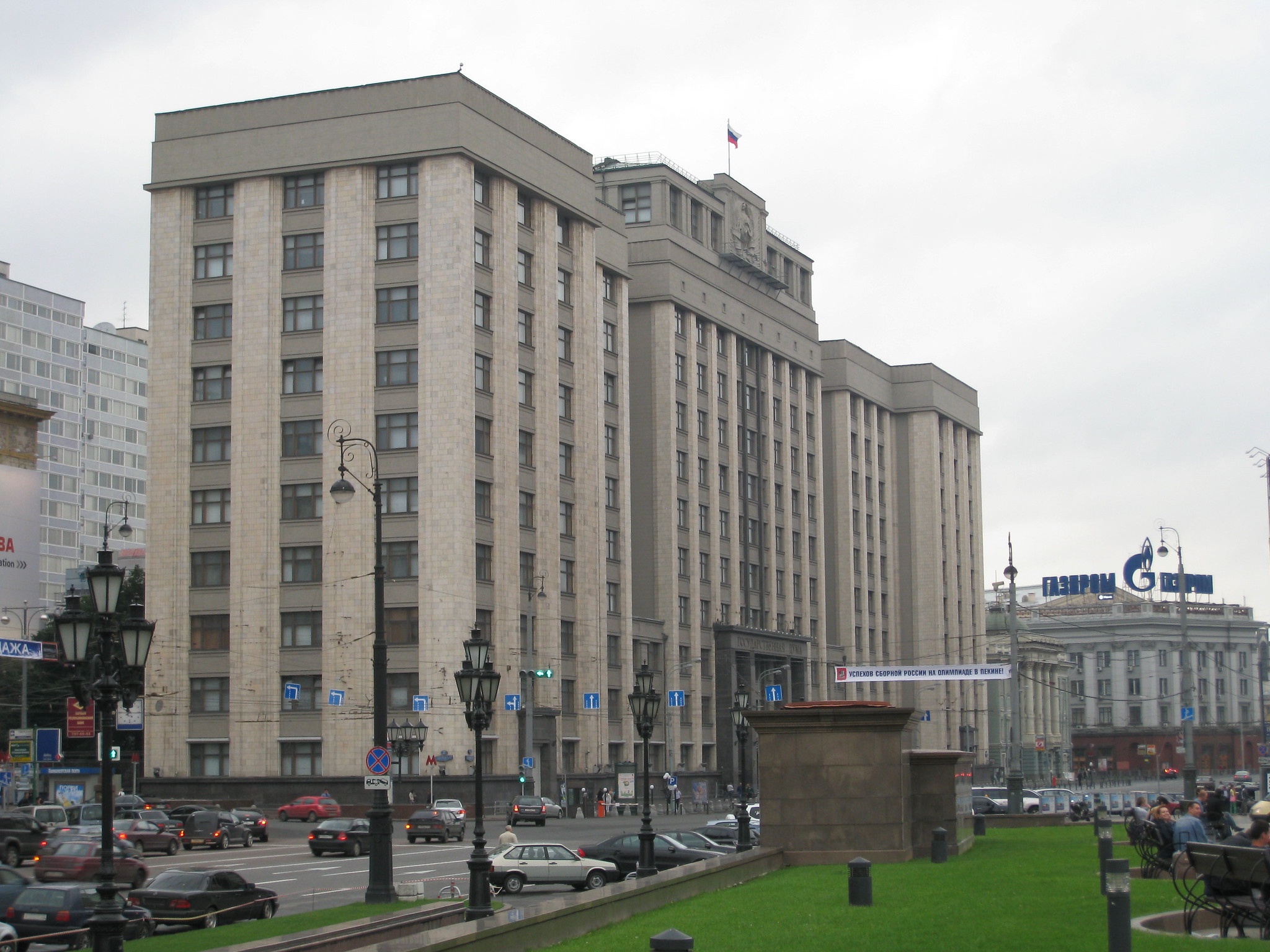
Main building of the State Duma of Russia in Moscow. Photo: Bernt Rostad / flickr.com
Inside this article
- Russia's ruling United Russia party secured 349 out of 450 seats in the State Duma following the September parliamentary elections, achieving its largest majority to date amidst official claims of high turnout and political stability.
- The Kremlin's systematic elimination of political competition, including the exclusion of opposition parties like Yabloko and the suppression of independent monitors, has transformed elections into an instrument of political management rather than a mechanism for power alternation.
- The central paradox of Russia's contemporary electoral system is that the authorities continue to rely on elections to demonstrate public support, even though the extensive controls and manipulations required to guarantee victory undermine the credibility of those results.
Russia’s ruling United Russia party emerged from September’s parliamentary elections with 349 of the State Duma’s 450 seats, its largest majority to date. Official turnout reached nearly 60 per cent, while the party secured around 58 per cent of the proportional vote. For the Kremlin, the result provided another demonstration of political stability and public support, more than four years after Russia launched its full-scale invasion of Ukraine.
Yet independent electoral analyses suggest a different picture. Researchers have estimated that genuine turnout was below 40 per cent and United Russia’s actual support was considerably lower than the official figure. The liberal Yabloko party, which campaigned for peace with Ukraine, was excluded from the federal party-list ballot. Independent monitoring had been severely weakened, while voting also took place in Russian-occupied Ukrainian territories under conditions that offered little possibility of meaningful scrutiny.
This contradiction captures the transformation of Russian elections under Vladimir Putin. The country retains the procedures of electoral democracy, yet the possibility that elections might produce a change of power has been progressively removed. Citizens still vote, parties still compete for seats, and the authorities still celebrate their victories. What has changed is the extent to which those procedures can produce genuine political uncertainty.
The September vote offered a revealing picture of a system that has spent a quarter of a century learning how to hold elections without risking political alternation.
From competition to control
Russia’s electoral system did not begin in its present form. During the 1990s, parliamentary politics was fragmented, often chaotic, and frequently shaped by powerful economic interests. Communists, nationalists, liberal reformers and parties built around influential political figures competed for representation. Parliamentary majorities were uncertain, and the Kremlin could not always rely on a compliant legislature.
These were hardly exemplary democratic conditions. The 1996 presidential election exposed the influence of oligarchs, the misuse of state resources, and imbalances in media coverage. Nevertheless, electoral competition remained consequential. Opposition parties could win substantial representation, and election results could complicate the government’s political agenda.
Putin’s arrival in power gradually changed this relationship. United Russia, established in 2001 through the consolidation of pro-Kremlin organizations, became the principal vehicle for securing parliamentary control. Electoral legislation, party registration requirements, and the management of regional politics increasingly favoured the executive.
The abolition of direct gubernatorial elections in 2004, followed by their later restoration under restrictive conditions, illustrated the consolidation of presidential authority. Parliamentary elections underwent similar changes. In 2007, Russia introduced an exclusively proportional electoral system with a seven per cent threshold, making it harder for smaller parties to enter parliament. Although a mixed system returned in 2016, the broader conditions for competition had already deteriorated.
The decisive transformation was not a single reform, but the accumulation of restrictions. Over time, it became progressively harder for independent political actors to register parties, nominate candidates, reach voters and challenge official results.
Clémentine Fauconnier, a French political scientist specializing in Russian party politics, describes contemporary Russia as an emblematic case of electoral authoritarianism: a system in which political alternation is prevented, but elections continue under carefully controlled conditions.
“Elections are therefore a constraint that must be accommodated while being kept under control,” she explains.
Formally pluralist elections have become such an established political norm since the end of the Cold War that abandoning them entirely would carry political costs. Instead, the Kremlin has transformed their function.
United Russia illustrates this transformation. The party has dominated parliamentary politics for more than twenty years, yet it has never become an autonomous centre of political authority. For Fauconnier, its principal functions are to produce parliamentary majorities and supplement the administrative hierarchy with a parallel party structure.
During its early years, senior officials discussed whether United Russia might eventually form governments and provide continuity beyond Putin’s presidential terms. The party also developed youth organizations, internal discussion clubs, and primaries intended to strengthen its presence in society. None fundamentally changed the party’s subordinate position.
Unlike the Communist Party of the Soviet Union, United Russia is not itself the leading institution of the political system. Putin remains formally unaffiliated with any party, as does Prime Minister Mikhail Mishustin. The centre of authority remains the presidency and the executive structures surrounding it.
The other parliamentary parties operate within the same framework. The Communist Party of the Russian Federation, once the Kremlin’s principal electoral challenger, has gradually aligned itself with the authorities on major political questions. The nationalist Liberal Democratic Party has traditionally maintained close relations with the executive, while A Just Russia emerged with support from within the political establishment.
These parties retain distinct histories, organizations and elements of electoral support. But none opposed the full-scale invasion of Ukraine, and the scope for challenging the Kremlin’s central policies has narrowed considerably.
The result is a form of managed pluralism. Voters are offered several parties, but the boundaries of acceptable competition are largely established before the campaign begins.
This arrangement serves purposes beyond distributing parliamentary seats. According to Fauconnier, elections allow the authorities to mobilize administrative structures, test the loyalty and effectiveness of regional officials, distribute positions, and manage relationships among political elites.
Parliamentary mandates provide status, privileges and immunity, making them valuable resources within networks of political patronage. Regular elections create opportunities to promote loyal figures, remove inconvenient ones, and reorganize the governing elite.
Elections have thus become an instrument of political management rather than a mechanism through which voters determine who governs.
The lessons of 2011
Yet the Kremlin’s control over elections has not always prevented unexpected political consequences.
The parliamentary elections of December 2011 marked a turning point. Allegations of widespread fraud triggered large demonstrations in Moscow and other Russian cities, bringing together different strands of the opposition and helping establish Alexei Navalny as a prominent national political figure.
The OSCE’s election observation mission documented serious shortcomings, including the convergence of state institutions and the ruling party, restrictions on competition, biased media coverage, and indications of ballot stuffing.
For Fauconnier, the protests demonstrated that even an already restricted electoral system could produce moments of genuine political mobilization. The authorities subsequently drew lessons that shaped parliamentary contests in 2016, 2021 and 2026.
The response combined tighter electoral management with increasing pressure on opposition organizations, independent media and civil society. Navalny’s political organizations were banned as extremist, and he died in prison in February 2024. Legislation concerning foreign agents, undesirable organizations and wartime censorship further reduced the space for political activity.
Independent election monitoring also came under sustained pressure. Golos, the movement that had documented electoral irregularities for many years, was forced to dissolve in 2025. Its co-chair, Grigory Melkonyants, was sentenced to five years in prison.
By September 2026, Russia was holding another parliamentary election without observers from the OSCE’s Office for Democratic Institutions and Human Rights.
The exclusion of Yabloko illustrated how far the process had advanced. The party, which had not secured proportional representation in the federal parliament since 1999, remained one of the few registered political organizations openly calling for an end to the war. Its campaign, centred on peace and freedom, offered an alternative for the defining political question of contemporary Russia.
Yet its federal party list was removed before voters had the opportunity to make that choice.
The significance of the exclusion was not that Yabloko was certain to enter parliament. It was that an identifiable political alternative had been removed before the election even began.
The limits of electoral management
For Roman Udot, a veteran election observer and former Golos activist, the September vote also revealed something about the limits of electoral control.
Udot describes the election as a collapse of the electoral machinery’s ability to operate smoothly. He does not suggest that the Kremlin lost control of the outcome. United Russia obtained the majority it sought. Rather, he argues that the scale of the manipulation required to deliver the official figures produced unusually visible irregularities and contradictions.
His own estimates place genuine turnout at approximately 40 per cent, compared with the official figure of nearly 60 per cent. He believes United Russia’s actual support was closer to 35 to 37 per cent of participating voters rather than the official result.
These are analytical estimates, not verified alternative election results. Nevertheless, independent statistical assessments have also identified substantial discrepancies between official figures and probable voting patterns.
Udot points to reports of ballot stuffing, irregularities in electoral protocols, and allegations of manipulation in regions where such practices had previously been less prominent.
He also highlights an unusual tension between the effort to maximize United Russia’s result and the need to preserve representation for other loyal parliamentary parties. In his interpretation, the authorities initially pushed the ruling party’s figures so high that subsequent adjustments became necessary to ensure that A Just Russia remained above the electoral threshold.
This specific allegation has not been independently established. But it points to a structural dilemma of managed elections: the authorities must guarantee the ruling party’s victory while preserving enough parliamentary diversity to maintain the appearance of pluralism.
The Russian Election Monitor documented reports of voter coercion, ballot stuffing, restrictions on observers and manipulated results. Yet the weakening of established monitoring organizations did not eliminate independent scrutiny.
Udot was particularly struck by the emergence of decentralized initiatives documenting irregularities, collecting evidence and analysing electoral statistics. Where Golos had once coordinated a national system for recording violations, smaller initiatives had begun developing their own tools and databases.
“Instead of one map of violations, I found two,” he recalls, describing the unexpected proliferation of monitoring initiatives.
For him, the significance of this activity lies not necessarily in its ability to alter the official outcome, but in its capacity to expose discrepancies between the authorities’ claims and the available evidence.
Yet documenting manipulation and mobilizing political opposition are different matters. In 2011, allegations of fraud contributed to mass demonstrations. In 2026, the political environment is far more repressive, and those documenting irregularities face considerably greater personal risks.
Evidence of manipulation could still circulate, but the organizations capable of transforming public dissatisfaction into sustained political action have been systematically weakened.
The war enters the electoral system
The war against Ukraine has added another dimension to this transformation.
For much of Putin’s presidency, parliamentary campaigns were deliberately depoliticized. The authorities generally emphasized stability, administrative competence and social benefits while avoiding divisive political questions.
According to Fauconnier, the September 2026 campaign departed from that pattern.
Putin, who has generally kept some distance from parliamentary campaigning, became personally involved. The war occupied a prominent place in electoral messaging, while special arrangements facilitated the inclusion of veterans of the conflict on party lists.
Ultimately, 46 participants in Russia’s war against Ukraine were elected to the State Duma, most representing United Russia.
Their election was presented by the Kremlin as recognition of military service and an opportunity to bring wartime experience into national decision-making. It also reflected Putin’s broader ambition to promote a new elite drawn from those who have served in Ukraine.
Yet the process raises questions about how far the existing political establishment is prepared to accommodate newcomers.
The promotion of veterans creates opportunities to reward service and incorporate wartime constituencies into the governing system. But parliamentary positions remain controlled by established political institutions, and the presence of veterans does not necessarily translate into independent political influence.
Udot highlights the tensions this creates. He notes the discrepancy between the expectations generated by official rhetoric about promoting war veterans and the limited number of positions ultimately made available to them.
Fauconnier is cautious about interpreting the development as a definitive turning point. In her view, the main mechanisms of the Russian political system remain continuous with the pre-war period: control over parties, candidates, media, administrative structures and voters, accompanied by the progressive alignment of the parliamentary opposition.
“What predominates, essentially, is an optimized version of continuity,” she argues.
What has changed is the visibility of the war within electoral politics. Whether this reflects a temporary response to political and social pressures in 2026 or a more lasting transformation of the role assigned to elections remains uncertain.
The official results themselves cannot resolve that question. Nor can they provide a reliable measure of the distribution of political opinion in Russian society.
The exclusion of candidates, restrictions on information, administrative pressure, and documented irregularities make it difficult to separate genuine electoral preferences from the effects of political management.
Nevertheless, elections do not become entirely meaningless simply because their results are manipulated. Fauconnier notes that geographical differences remain visible. Large urban centres have historically shown lower levels of support for the authorities, while some regions report exceptionally high results reflecting both their political environments and the capacity of local administrations to direct voting.
Udot similarly argues that comparisons between polling stations with different levels of observation can reveal discrepancies otherwise concealed by official statistics. But individual examples cannot establish the preferences of an entire electorate. Opposition to the war, fatigue with the conflict, and dissatisfaction with the government are not necessarily the same thing.
This uncertainty matters. The Kremlin presents elections as evidence of national unity. Yet the restrictions placed on competition and the documented irregularities make such claims difficult to substantiate from electoral results alone.
Russia has not abolished elections. It has progressively separated them from the possibility of political alternation.
The September 2026 vote showed how far that process has not only advanced but also exposed its contradictions. Elections remain useful for allocating positions, rewarding loyalty, mobilizing regional officials, and presenting an image of public support. Yet producing that image requires increasingly extensive controls, while the exclusion of political alternatives makes the resulting figures less informative about society.
The central paradox of contemporary Russian elections is therefore not simply that the Kremlin continues to win. It is that the authorities still need elections to demonstrate political strength, even as the mechanisms used to guarantee victory undermine the credibility of that demonstration.
Russia’s electoral system has become highly effective at producing parliamentary majorities. Whether it remains capable of measuring the society it claims to represent is an entirely different question.
Mathieu Lemoine is a governance, rule of law and elections specialist who has worked across Eastern Europe, the Balkans, the South Caucasus and Central Asia with international organizations including the OSCE, USAID and UNDP.
New Eastern Europe is reader-supported. If you value independent coverage of Central and Eastern Europe, please consider supporting our work.
👉 Click here to donate.