When history becomes policy
The Belarusian case illustrates a broader transformation of the role of history within today’s political systems. The past is no longer only a source of identity or a field of symbolic contestation. Instead, it has become an instrument through which the present is organized and governed.
September 11, 2026 -
Hanna Vasilevich
-  AnalysisIssue 5 2026Magazine
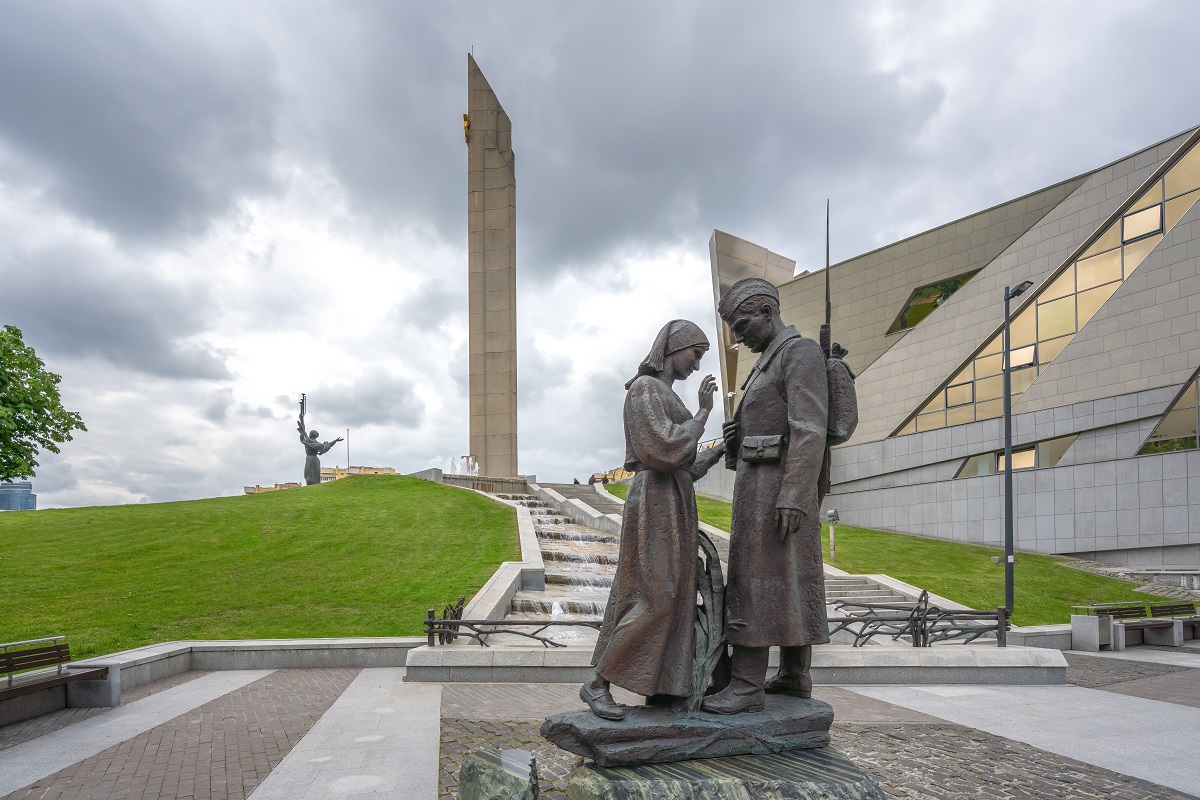
A statue in Minsk’s Victory Park, outside the museum of the Great Patriotic War (the name for the Second World War), depicting a mother sending off a Belarusian soldier. Since 2021, the authorities in Minsk have changed the narrative calling the war a “genocide of the Belarusian people”.
Photo: Diego Grandi / Shutterstock
In April 2021, the Belarusian authorities opened a criminal investigation into what they described as the “genocide of the Belarusian people” during the Second World War. At first glance, the move appeared to follow a long-established pattern. The war has always occupied a central place in Belarusian state narratives, serving as a source of political legitimacy, national identity and moral authority. This is hardly surprising given the extraordinary scale of destruction and human loss suffered by Belarus. Some historians estimate that as many as three million inhabitants of Belarus died during the war. The memory of these losses has been repeatedly invoked in official narratives, while sites of wartime violence have become part of a dense and highly visible commemorative landscape. Against this backdrop, the authorities’ renewed focus on wartime atrocities might initially have seemed unsurprising, even predictable.
Yet the developments that followed point to a more fundamental shift in how the past is being used. What is taking place is not simply a reaffirmation of an established historical narrative, but a change in the way that narrative is produced and enforced. The issue is no longer only how Belarus remembers the past, but what happens when history ceases to be treated as a matter of interpretation and debate. Instead, it becomes an object of investigation, classification and legal consolidation. In this sense, history has ceased to be merely debated and has become something to be prosecuted.

This article is for members only
Join the New Eastern Europe community to unlock this article — plus enjoy full access to premium content, our digital archive, newsletter insights, and podcast updates.
BECOME A MEMBER!
Already a member? Sign in to read the full article.
 belarus, genocide, Germany, memory, Second World War, World War II