
The historical advisors of Vladimir Putin
The decision to invade Ukraine was made by a tiny circle of people within the Kremlin. However, as it turns out, Vladimir Putin’s “advisors” have something unique in common with one another: they have been dead for hundreds of years. What does it mean for Putin, the war in Ukraine and the Russian standoff against the West, when the Russian president lets his actions be inspired and driven by historical precedent?
How many individuals does it take to decide upon invading a neighbouring country? After February 2022, the world learnt that you apparently do not necessarily need to consult a whole lot of people if you are intent on taking what is not yours. For sure, one could suggest that the fear of any leaks concerning your invasion plan could very well mess up your plans in the first place. Therefore, secrecy is a prime matter of recourse.
April 28, 2023 -
Benjamin Looijen
-
AnalysisIssue 2 2023Magazine
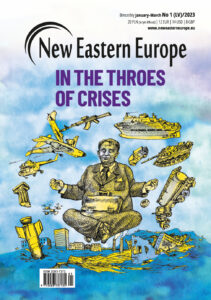
Illustration by Andrzej Zaręba
As many found out in the early hours of February 24th last year – even within the Kremlin – the decision to invade Ukraine was taken by a very small circle of individuals, consisting of Vladimir Putin and his closest entourage of confidants.
This is surprising, for sure, certainly for those who consider themselves part of the crème de la Kremlin, and therefore entitled to any discussions related to decision-making of such magnitude. But it becomes even more surreal when, according to eyewitnesses described in a recent article by the Financial Times, these same members of the Kremlin elite confronted the Russian Foreign Minister Sergei Lavrov and asked how Putin could have planned such an enormous invasion among such a tiny circle of confidants. Lavrov replied that Putin “only has three advisers: Ivan the Terrible, Peter the Great and Catherine the Great.’’
Regardless of the fact that it is difficult to verify if this story is true, and the fact that Lavrov is most likely using a figure of speech to convey a certain message to his stunned audience, he refrained from offering further explanation on this matter. Nevertheless, we can still ask ourselves the question of what it all actually means to a leader like Putin, the war in Ukraine and the Russian standoff against the West, if he takes heed of these historical individuals, as opposed to listening to the advice of other persons around him who might be a bit more grounded in reality and, not wholly unimportant, not dead? To do this, we would do well to consider these three characters from the pages of history and assess why Putin would be so particularly interested in exactly these three. For as it turns out: history is casting its shadow over Russian actions, and the outcome of the current conflict will have tremendous implications for the future.
Ivan IV, the “not-so Terrible”
History has accorded to Ivan IV (1530-84) the dubious moniker of “the Terrible”. Although somewhat lost in translation in English, the Russian original was meant to mean something akin to awe-inspiring or formidable. Apart from a chaotic fire which consumed parts of Moscow early in his reign, he started off by modernising and reforming several aspects of Muscovite society. Among other things, he established a standing army of Streltsy, ordered the introduction of the first printing press in Muscovy, improved ecclesiastical regulations within the Orthodox Church and initiated the first gathering of the Muscovite feudal estates in the so-called Zemsky Sobor. He also made attempts to affirm local self-government in rural regions away from Moscow and established trade relations with western countries such as England. Ivan was aware of Muscovy’s relative weakness compared to the more developed countries to the West and as such set out on a path to strengthen Muscovy.
However, this is not what Ivan is remembered for. Indeed, Ivan’s conquests of Kazan and Astrakhan in the 16th century – the first cities which did not bear any relation to ancient Rus’ lands – are often seen as one of the first crucial steps in the development of Russian empire-building. In addition, as Ivan was raised in an environment of deadly court intrigue and noble boyar quarrels, and as tragedy and illness befell him and his wife, his paranoid, repressive and authoritarian tendencies were strengthened. In addition, years of war pursued by Ivan strained the economy, through which famine and epidemics ensued. Furthermore, he implemented a unique form of repression in the shape of the infamous Oprichnina, a systematic policy of repression made effective by thousands of Oprichniki – loyal strongmen of Ivan who implemented mass repression of the boyars, confiscating their land and executing them. In hindsight, Ivan left his people and his land in the most unfavourable conditions for what was still to come – the “Time of Troubles”, which would cast a dark shadow over the country well into the 17th century.
Taking into account all of the above, it is difficult to see how exactly Putin could take any lessons from this idiosyncratic character of history. But perhaps Putin takes a whole different perspective on the matter. In general, Putin attaches a high value to the subject of history, so much so that it features in his public speeches on a regular basis. However, Putin does seem to take a revisionist view from which most historians shy away. For instance, on the subject of Ivan IV, Putin has in the past disputed facts surrounding Ivan’s life and actions. In this regard, he is supported by people such as Vladimir Medinsky, the previous minister of culture and current chairman of the Russian Military-Historical Society, who argues that the West was fighting an information war against Russia already in the 16th century. According to Medinsky, that which has made Ivan “terrible” in a negative sense, was concocted or fabricated by Europeans, who wrote slanders about Russia to please their masters. This view is further supported by some members of the Russian Orthodox Church, such as Metropolitan Tikhon (rumoured to be Putin’s confessor) and the late Ivan Snychov, who see in Ivan a bastion against the depraved norms and values of the West.
By turning Ivan IV into a victim of western disinformation and downplaying his own repressive actions, Ivan turns out not to be the man who left Russia weakened and impotent, but a wise and devout albeit troubled leader, who had to do what had to be done in order to save Russia from foreign influence and treacherous boyars. He is a man who stands at the beginning of Russian imperial conquest, thereby laying the foundation of Russian empire-building. The lesson to Putin then, is to continue down the imperial path, regardless of the human cost that might entail. For only in this way can he protect and strengthen Russia.
In pursuit of Tsar Peter
Peter I (1672-1725), known in Russian historiography as “the Great”, left behind a different legacy in Russia which, in many ways, continues to resonate today. It is with Peter that the cultural divide originated between those oriented toward the West and the “Slavophiles”. As the founder of Russia’s cultural and erstwhile capital of St. Petersburg, he transformed Russian society on many levels, with his reforms having a lasting impact on the land. He was a moderniser, to be sure, but was based on autocratic rule, as his modernisation efforts were built on the lives of thousands. Yet, his legacy is controversial in contemporary Russia to the extent that his rule inaugurated the cultural identity confusion which to this day still captivates Russia – the question of whether it is part of Europe or Eurasia, West or East.
It is with Peter that the empire truly began to take form. Just as Ivan IV did prior, Peter too endeavoured to strengthen Russia through the acquisition of territory and land, and thereby enter the European political arena as a great power. He, too, was keenly aware of the fact that western states were more developed than Russia. To rectify this, he set forth to engage the Swedish, who at the time were the predominant power in and around the Baltic area. Thus, the Great Northern War (1700-21) between Russia and Sweden shaped a large part of his reign, the result of which ensured that Russia became the predominant power in the east of Europe and secured for itself a place within Baltic trade.
The lesson which Peter might offer to Putin is of all three historical figures described here the most obvious and straight forward. We need not to look far to see how Putin assesses the importance of Peter. Quite recently, Putin has spoken favourably about Peter and his contribution to Russia’s development. Rumour has it that Putin most clearly associates himself with Peter as his prime historical reference, even comparing himself to the historical ruler to the extent that he embodies him in a modern-day setting. What advice, then, does Putin receive from Peter? As Putin argued during the celebration of the former tsar’s birth in 2022: “Peter the Great waged the Great Northern War for 21 years. It would seem that he was at war with Sweden, he took something from them. [However] he did not take anything from them, he returned [what was Russia’s].”
Besides arguing that Peter took what is rightfully Russia’s to begin with, Putin even makes a direct comparison to the current conflict with Ukraine: “Apparently, it is also our lot to return [what is Russia’s] and strengthen [the country]. And if we proceed from the fact that these basic values form the basis of our existence, we will certainly succeed in solving the tasks that we face.” This is a blatant acknowledgement that the purpose of the war in Ukraine is to return that which has been lost, in order to strengthen Russia. The advice Peter gives to Putin, then, is that he should engage in the further “gathering of the Russian lands”, thereby fortifying Russia in the process.
The wisdom of Catherine
The last advisor of the three is Catherine II (1729-96), also known as “the Great” in Russian historiography. As Peter I spent a large part of his life fighting and acquiring territory in the north and west, Catherine focused on the south. It is during her reign that Russia conquered modern-day Ukrainian lands, such as Crimea, through wars with neighbours such as the Ottoman Empire, and oversaw the partitioning of Poland in addition to suppressing rebellions. An admirer of western philosophy and Enlightenment ideals, she positioned herself as an enlightened monarch, equal to the monarchs of Europe. She too felt that Russia needed to develop itself further to catch up to the western powers. However, various displays of autocratic power ensured that western philosophers distanced themselves from her actions. In her time too, the building of empire through conquest continued unabated.
Putin himself has spoken most admirably about Catherine and her deeds. Already in 2012 he argued that Catherine was one of the most effective rulers Russia has ever had. She was, in the words of Putin: “more effective than Peter I – less bloodshed, but more business”. He further emphasised that “under Catherine, Russia acquired the most land” when compared to other Russian rulers. In 2022, on International Women’s Day and after the start of the invasion of Ukraine, Putin took a moment to congratulate women in Russia by putting forward an example of a woman he admires above all: Catherine. “Her sculpture is placed here, in the Kremlin. She was not Russian by birth, but she was proud that she became Russian.”
Furthermore, Putin cites the wisdom of Catherine which for him still rings true today: “These lines: ‘I will defend my homeland with tongue, pen and sword, as long as I have enough life’ … and in our time, the words homeland, mother and beloved, for us, are in the same row. It will be this way forever.” As Putin considers Ukrainian lands as historically part of Russia, once lost but now to be returned to the fold, he follows in the footsteps of Catherine. Russia’s rulers have always felt a sincere insecurity vis-à-vis their western neighbours and Putin is no different. Perhaps, in this regard, the lesson which this particular advisor gives to Putin is the oft-cited quote of Catherine that “I have no way to defend my borders but to extend them.”
Continuing history
The lessons that Putin takes from his historical “advisors” made sense in their times and ages. Overall, the conquest and expansion of territory at the cost of others was a favoured tool of attaining power for monarchs and leaders worldwide hundreds of years ago. In this case, Russia certainly did not differ from other European powers. Furthermore, one could argue that these three aforementioned historical rulers all have one thing in common: the feeling of insecurity with regards to the West, and the building and strengthening of Russian empire as a countermeasure. However, this is an extremely costly and outdated endeavour in the 21st century, especially after 1945. In this regard, Russia has become an oddity, and seeks to return to a time when “might makes right” by ruthless geopolitical hard power play, inspired by historical rulers of the past which exemplify martial qualities.
The glorification of these martial rulers makes sense for those in the Kremlin, who are obsessed with history, and who try to justify to their own people the idea that Russia’s greatness lies in its historical past. However, for every single one of these historical leaders, one could just as easily describe their faults and folly, as Russia’s expansion externally did not necessarily strengthen it internally. Indeed, sometimes it even weakened it, through the economic, social, political and human ruin and fallout it brought about. All three of these rulers left behind complex legacies, the results of which in some ways continue to influence the thinking within the Kremlin today.
Putin’s conspiratorial view on history and world politics ensures that he and his entourage hold fast to a vision in which Russia has always been surrounded by enemies, which in turn has a substantial effect on the mental paradigm of those within the Kremlin. Although the West might see the invasion of Ukraine as a war of aggression initiated by Russia, Moscow operates from a historical sense of insecurity vis-à-vis the West. The war then, for Putin, suddenly becomes a defensive one, aimed at preventing further western encroachment on Russian “historical” lands and the possibility that western influences might penetrate the motherland itself.
As his historical predecessors would advise, he only sees one way of countering that supposed threat: through the application of hard power. This is partly why the war is portrayed as such an existential and even religious struggle within Russia, as Putin sees it as the continuation of a long historical rivalry. As history casts its shadow over Russia today, the war in Ukraine is absolutely historic in scale, and so too will be its result. For depending on the outcome, it could mean the return and legitimisation of hard power rule in Europe, and a vindication of Putin’s historically inspired vision of the past, and with it, the future.
Benjamin Looijen has a BA in History and MA in Russian and Eurasian Studies. He mostly writes on the history of Central and Eastern Europe. His research is particularly focused on how the past influences the present and vice versa, in addition to memory politics, and the history of international relations.