
When crises become political tools
In a crisis situation nothing is certain. We all share the unpleasant feeling that we are slowly losing the firm ground beneath our feet. And this crisis mood colours also our view of the future. Yet, there are actors who consciously and willingly cause crisis situations with the intention to profit from the ensuing chaos.
Today the word “crisis” is on everyone’s lips. And this is not without reason. In the last few years we have been confronted with an accumulation of crisis situations. It started with the Donald Trump presidency and continued with the COVID-19 pandemic, which not only caused a huge death toll, but also destabilised the world economy. The crisis further deepened with Russia’s war of aggression against Ukraine, undermining the international rules-based order that was built after the Second World War. The war led not only to bloodshed and hardship, but also further deterioration in an already dire economic situation, boosting inflation. So, here we are today!
February 16, 2023 -
Marcel H. Van Herpen
-
Hot TopicsIssue 1-2 2023Magazine
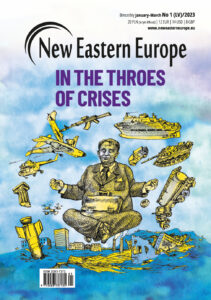
illustration by Andrzej Zaręba
Deep change
Let us first have a closer look at the phenomenon of crisis. What is it? And when we speak about a “crisis” what do we mean? Reinhart Koselleck, who wrote a classic study on the subject, defined a crisis as follows: “It is part of the essence of a crisis that a decision has to be taken, but that [this decision] has not yet been taken. And it is also part of the crisis that it remains open what kind of decision will be taken. The general feeling of insecurity in a critical situation is therefore mixed with the certainty that … an end to the critical situation is imminent. What the solution could be remains uncertain, the end itself, however, a change to the existing situation – threatening and feared, or hopefully welcomed – is certain for the people.”
In Koselleck’s definition a crisis situation boils down to the following elements: 1) there is a feeling of insecurity; 2) a decision has to be taken; and 3) the individual has no idea about the outcome of this decision, but it is certain that it will bring a deep change – positive or negative. I have some problems with the word “decision” used by Koselleck in this context, because often the outcome of a crisis situation depends not on the (rational) decision of one actor, but on the power play of different actors that leads to a result that no one has foreseen or expected. Feelings of helplessness, therefore, are not restricted to the average citizen. Political leaders also do not know how the dice will roll. In a crisis situation nothing is certain: we all share the unpleasant feeling that we are slowly losing the firm ground beneath our feet. And this crisis mood colours also our view of the future.
An example of the present crisis mood can be seen in a report on global trends, published in 2021 by the American National Intelligence Council (i.e., before the full-scale invasion of Ukraine). Most scenarios for the next 20 years in this report are far from reassuring. According to the authors the world will be “more contested, uncertain, and conflict prone”, while “the risk of interstate conflict is likely to rise due to advances in technology and an expanding range of targets, new frontiers for conflict and a greater variety of actors, more difficult deterrence and a weakening or a lack of treaties and norms on acceptable use.”
One of the scenarios – “a world adrift” – describes the emerging international system as “directionless, chaotic and volatile as international rules and institutions are largely ignored”. According to the New York Times, “experts in Washington who have read these reports said they do not recall a gloomier one.” It is, therefore, no surprise that today in the media comparisons are often made with the 1930s and that these comparisons increased after the brutal Russian invasion of Ukraine. Already before the war French President Emmanuel Macron said in an interview that “I don’t want simply to observe history. I want … to try to understand the lessons from history. I am struck by the similarities between the period in which we are living and [the period] between the two world wars …”
Losers and winners
It is clear that the world is in bad shape and that everybody is suffering from this situation. Everybody? Is this so? Are there only losers and no winners? This is an interesting question. When the COVID-19 pandemic broke out vaccine deniers claimed that the pandemic was the work of the pharmaceutical industry wanting to boost its profits. Attacks on “Big Pharma” went viral on social media. The same phenomenon could be observed when Russia invaded Ukraine. Activists from the extreme left and extreme right claimed that the war, rather than being caused by Russian aggression, was the result of an American conspiracy to strengthen its grip on Europe and help the American arms industry, which would urgently need new orders.
Nobody can deny that COVID-19 boosted the profits of the pharmaceutical industry and that the war in Ukraine will boost the profits of the arms industry. However, to conclude that the pandemic and the war were both the result of dark deep state conspiracies makes little sense. Of course, there are actors who win in a crisis situation without causing the crisis. Turkey, Saudi Arabia and Qatar are clear examples. Due to the war, Turkey could improve its international status, while US President Joe Biden felt obliged to visit Saudi Crown Prince Mohammed Bin Salman al Saud despite his role in the murder of journalist Jamal Khashoggi. Meanwhile Qatar became the world’s major gas supplier after a sanctions regime was imposed on Russia.
But there are also actors who consciously and willingly cause crisis situations with the intention to profit from the ensuing chaos. This is a policy conducted by rogue states. North Korea, which launched a ballistic missile over Japan in October 2022, is a clear example. The global champion for creating crisis situations, however, is the Russian Federation, which is in this respect a worthy successor to the defunct Soviet Union. Russia is continuously creating crises and causing turmoil and chaos by attacking foreign countries, undermining the international rules-based order, conducting cyberattacks, spreading fake news, intervening in elections, supporting rebel groups and putschists abroad (Wagner in Africa), and organising rallies in foreign countries, such as pro-Moscow demonstrations by Russians in Berlin or paid protests against the pro-EU government of Moldova. Concerning this final example, the New York Times commented: “Russia stokes a crisis and then, directly or through local proxies, offers a solution that requires acceptance of Russian hegemony.”
Collision of wills
What can be done to counter these destabilising threats? The first imperative is to uphold international law and the rules-based international order because this is essential for liberal democracies. This means that the governments of rogue states have to be held accountable for the war crimes and the crimes against humanity they have committed. This implies that already now, while the war in Ukraine is still raging, preparations must be made for a trial before the International Criminal Court in The Hague. It means further that the principle of “aggression must not pay” must be upheld and that Ukraine must be helped to win the war without the loss of any territory – including Crimea and the territories of Donbas occupied since 2014. Sanctions should be upheld and, where possible, strengthened. And, last but not least, the West should supply all the armaments which are necessary for a Ukrainian victory.
Is this possible? We have to be conscious of the fact that wars are not only collisions of armies, they are – above all – collisions of wills. Has the West enough stomach to confront an imperialist, fascist Russia? I think we have, but much will depend on the maintenance of transatlantic unity and keeping divisive forces – populist parties and illiberal governments – under control. Like the generation of the 1940s we stand before our historical responsibility. We may like it or not, but we have to accept it. The future of Europe and the world depends on our actions today.
Marcel H. Van Herpen is the author of Putin’s Wars – The Rise of Russia’s New Imperialism. In his forthcoming book History and Human Responsibility – The Unbearable Weight of Freedom in a Dystopian World (St Augustine’s Press, 2023), the author analyses the present crisis and argues that our generation has an increased, threefold historical responsibility – not only for everyone alive today, but also for the (mis)deeds of past generations and the well-being of future generations.