
Georgia’s strong economic performance comes at a heavy price
Since February 24th 2022, Georgia’s economic ties and dependence regarding Russia have markedly increased, leading to heavy criticism of the Georgian Dream-led government about its lack of transparency around ties to Russian business interests. Most obvious among these concerns are those centred on the party’s founder, Bidzina Ivanishvili, the billionaire and former prime minister who made his fortune in Russia before entering Georgian politics.
Nearly one year on from Russia’s invasion of Ukraine, a stroll through the streets of Tbilisi provides a visual reminder of both the ongoing conflict and the Georgian population’s prodigious support for the Ukrainian people. With billboards flashing blue and yellow and Ukrainian flags nearly matching their Georgian counterparts in representation, it is unsurprising that a March 2022 poll commissioned by the National Democratic Institute (NDI) showed that 98 per cent of Georgians support the Ukrainian people.
February 15, 2023 -
Mackenzie Baldinger
-
AnalysisIssue 1-2 2023Magazine
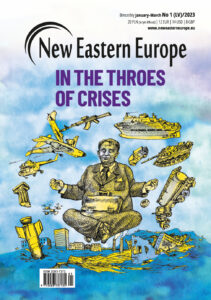
Illustration by Andrzej Zaręba
To the dismay of much of the population, however, support from the Georgian government has proven less robust. While the official stance of the government has been one of solidarity with Ukraine, offering support for UN resolutions condemning Russia’s actions in the country, for example, many in Georgia see their government’s response as too little, and often, too late. The latest example of this came in early December, when news emerged that five Georgian soldiers had died fighting in Bakhmut in Eastern Ukraine. The ruling Georgian Dream party took two days to issue a statement, using the opportunity to blame the opposition for “arranging provocations” and deceiving “our fellow citizens to take them to Ukraine [to fight]” – a move that has received widespread condemnation for what many view as disrespect against fallen heroes.
Yet, as the war has dragged on, questions about the Georgian government’s support for the Ukrainian cause has also expanded beyond the political arena. A look at Georgia’s economic performance indicates that 2022 was a banner year – which many have been quick to point out is largely due to the country’s growing economic ties with Russia.
Georgia’s economic boom
Touting the country’s estimated growth at 10.5 per cent for the year, Levan Davitashvili, the minister of economy, told reporters in late November that increased trade, tourism and transport were to thank for Georgia’s strong performance in 2022. Later that week, Prime Minister Irakli Garibashvili attributed this success to the work of his government, noting that double-digit economic growth and unemployment at a “historic minimum” were thanks to “sound economic policy”. But while the ruling Georgian Dream party has been quick to accept accolades for the country’s strong economic performance, it has been less forthcoming about exactly how that growth has been achieved. In a September visit to the country, President of the European Bank for Reconstruction and Development (EBRD) Odile Renaud Basso characterised Georgia’s exceptional growth in 2022 as “due to unexpected short-term factors including higher net inflow of money transfers from Russia and higher than expected income generated from tourism”.
In fact, a look at the sectors exhibiting the strongest growth this year indicates that the country has benefited largely from a growing economic relationship with Russia. In part, this is due to the large wave of Russians that migrated to Georgia first at the onset of the war and then again in September when Russia announced a partial military mobilisation. With its land border offering a viable alternative to the increasingly limited and exorbitant flight options from Russia, a relatively low cost of living, and a lack of visa restrictions, Georgia has become a haven for an estimated 50,000-100,000 Russians who have left their homeland since the war began.
This growing population of Russian migrants has had a marked impact on Georgia’s local economy, pushing real estate demand and prices to an all-time high. A November report by the investment arm of one of Georgia’s largest banks, TBC Capital, found that average rental prices in Tbilisi were up 140 per cent year-on-year in October, meaning rental prices in the capital have more than doubled since the war began.
Remittances, which have long represented a vital lifeline to Georgia’s economy, have also been dramatically impacted since the invasion of Ukraine. These money transfers into the country, which were equivalent in value to 13.3 per cent of the country’s GDP in 2020, have continued to grow in recent years, as more Georgians have moved abroad to seek out better employment opportunities. Before the COVID-19 pandemic, the share of remittances coming from Russia had been steadily declining as more Georgians sought employment in new markets – predominantly in the European Union. Since the onset of full-scale war in Ukraine, however, this trend has been turned on its head as capital from Russia has flooded into Georgia, with the value of money transfers from Russia up a staggering 726 per cent year-on-year in October.
This sharp increase in Russian capital has raised questions around why it is in Georgia and what it is being used for. Beso Namchavadze, the chief economist for Transparency International Georgia, says that this inflow of capital is sizable for Georgia and indicates that these funds are being used for more than just living expenses. “The National Bank of Georgia currently estimates that an additional one billion US dollars of deposits coming from Russia have been infused into Georgia’s banking system since the war began. That is substantial for a country of this size, and it indicates that people are moving significant amounts of money out of Russia.” This, he notes, could potentially be for real estate purchases or moving business operations, given that the number of Russian businesses registered in Georgia since March is also up tenfold.
“What’s a bit concerning”, Namchavadze adds, “is that these are only the official numbers of money moving into or through Georgia. We do not have any way to measure how much more money is coming across the border physically or how much is being transferred via crypto assets”.
In addition to an infusion of money into Georgia’s economy, 2022 also witnessed significant growth in the country’s trade sector, due in part to its increased trade relations with its northern neighbour. Data from the first nine months of the year indicates that Georgian exports to Russia were valued at 473 million US dollars, up 11 per cent year-on-year, and that imports from Russia were valued at 1.2 billion, up a whopping 73 per cent compared to the previous year.
This growth in imports was predominantly fuelled by Georgia’s increased purchases of Russian petrol, which Namchavadze says were the result of lower prices as Russia struggled to sell its supply in the global market. “There seemed to be little moral concern from Georgian companies that substituted cheaper Russian petroleum products this year,” he says, noting that petrol imports from Russia were five times higher in the first nine months of 2022 compared to the year prior.
Opaque at best
Beyond the well-documented growth of Georgia’s economic ties with Russia since it invaded Ukraine, the Georgian Dream-led government has also suffered heavy criticism about its lack of transparency around its party members’ ties to Russian business interests. Most obvious among these concerns are those centred on the party’s founder, Bidzina Ivanishvili, the billionaire and former prime minister who made his fortune in Russia before entering Georgian politics.
The leak of an audio tape in March 2022, only weeks after the invasion began, reportedly revealed Ivanishvili speaking with sanctioned Russian oligarch Vladimir Yevtushenkov to set up a meeting between his associates and Georgian Prime Minister Irakli Garibashvili. This was ultimately meant to facilitate a business deal. This, along with a report released by Transparency International Georgia in April 2022, unmasked a large web of offshore companies and associates controlled by Ivanishvili that hold major stakes in Russian companies. All of this has caused greater suspicion that Ivanishvili is still heavily linked to Moscow and has played a major role in dictating Georgia’s soft response to Russia’s invasion of Ukraine. Misgivings around Ivanishvili’s deep ties to Moscow have been so overwhelming that the European Parliament passed a resolution in June calling for sanctions to be levied against him for his “personal and business links to the Kremlin”, which “determine the position of the current government of Georgia towards sanctions on Russia”. This was followed by a resolution of the European People’s Party in late November urging that he personally be sanctioned in light of “his role in sabotaging Georgia’s European integration and posing a threat to Georgia’s and regional security”.
Beyond concerns around the ruling party’s de facto leader, further criticism was brought against Georgian Dream after it emerged in the spring of 2022 that the government had auctioned off more than 100,000 hectares of land in Georgia’s western Racha-Lechkhumi forest. The winning company, HG Capra Caucasus, is owned by David Khidasheli, the business partner of the sanctioned Russian oligarch Vladimir Yevtushenkov. Critics were quick to point out that the single-bidder auction was held in a non-transparent manner, with the government refusing to release administrative documents related to the proceedings around the auction.
Meanwhile, no example of growing Russian influence in Georgian business is more poignant than that of Borjomi – Georgia’s iconic mineral water brand that temporarily shuttered its doors in the spring due to sanctions. The company’s majority holder, Alfa Group, owned by sanctioned oligarch Mikhail Fridman, announced at the end of April that it was unable to continue production due to limited access to its bank accounts. In June, Alfa Group transferred 7.7 per cent of its share in the company and two board seats to the Georgian government, decreasing its stake to just shy of a majority. For many, this solution represents the government’s less-than-stringent approach to doing business with Russia. It has taken care not to defy international sanctions, yet it has also not endeavoured to take additional steps to further limit Alfa Group’s stake in the company. This has facilitated an agreement in which a large share of the company’s profits will continue to be paid out to a Russian company owned by a sanctioned oligarch.
Cannot afford not to decrease dependency
Whether or not the Georgian government has violated the international sanctions levied against Russia remains a topic of debate. The government has maintained that it has complied with all international sanctions, a claim supported by the US embassy in Georgia. However, this has been highly disputed by Ukraine, which has accused Tbilisi of assisting Russia in evading sanctions as relations between the countries have grown increasingly sour.
One thing Prime Minister Garibashvili has been clear on is his government’s policy against any kind of bilateral sanctions, telling reporters only one day after the invasion of Ukraine that “I want to state clearly and unambiguously, considering our national interests and interests of the people, Georgia does not plan to participate in the financial and economic sanctions, as this would only damage our country and populace more.”
And while the government has maintained that it cannot afford to cut economic ties with Russia, many in Georgia argue it cannot afford the alternative. Namchavadze, the chief economist of Transparency International Georgia, says that the country’s economic dependence on Russia has long been the subject of manipulation by Moscow. “We have numerous examples of times when Russia used Georgia’s economic dependence as a political weapon. In 2006 Russia embargoed our wine and mineral water, which was a huge hit to the market. In 2019 they cancelled commercial flights to the country, majorly disrupting our tourism industry,” he says. “Being that dependent on one market is not sustainable for Georgia’s economy.”
In lieu of a complete cessation of economic ties with Russia, Namchavadze says Georgia needs to focus on diversifying its trade relations. “I don’t think we need to stop selling wine in the Russian market,” he notes. “In this case, diversification is key. Better utilising our free trade deal with the European Union, focusing our wine exports to new markets in Asia, and pursuing renewable energy projects in the country to decrease our dependency on Russian energy – these are all policies that could better protect our economy from being held hostage in the future.”
Otherwise, he says, the implications of growing economic ties will spill into the domestic political sphere. “We have already seen far right and pro-Russian parties seize on this narrative that the only way for Georgia to have economic prosperity is through Russia,” Namchavadze notes. “We have also seen the ruling party become far more brazen in their rhetorical attacks against the US and certain actors in the EU. Some of these statements would have been unimaginable only a year ago.”
As domestic debate rages around the topic of Georgia’s Euro-Atlantic aspirations on the tail of missing EU candidacy status in June, the question of Georgia’s economic dependency on Russia represents far more than just the country’s long-term economic security. Double-digit economic growth certainly seems commendable, but for many, this accolade is tarnished by what it may cost Georgia in the future.
Mackenzie Baldinger is a contributing editor with New Eastern Europe and a political analyst focusing on political extremism and populism in Central and Eastern Europe. She holds a master’s degree in International Relations from Central European University and a Master of Arts in European Politics from Leiden University.