
Russia-Ukraine: Only one will remain
The Russo-Ukrainian War, which on February 24th 2022 transitioned from a hybrid phase to full-scale conventional war, is not only attracting the attention of the whole world. It also gives us reason to think about what the configuration of relations between the two states will be after the end of the war – a war in which only one of the states may have a chance to survive intact.
The ideological underpinnings of the Russo-Ukrainian War are contradictory. On the one hand, Russian President Vladimir Putin published his article “On the Historical Unity of Russians and Ukrainians” last summer, which was filled with amateur arguments about the Ukrainians’ lack of right to their own statehood. On the other hand, on February 24th 2022, Putin, among other things, declared the need for the “denazification of Ukraine”, though he failed to find an adequate explanation for this thesis. Official Russian ideology allows for combining the rhetoric of a “fraternal people” with the “Nazi regime that prevails in Ukraine”.
December 8, 2022 -
Yevhen Magda
-
Hot TopicsIssue 6 2022Magazine
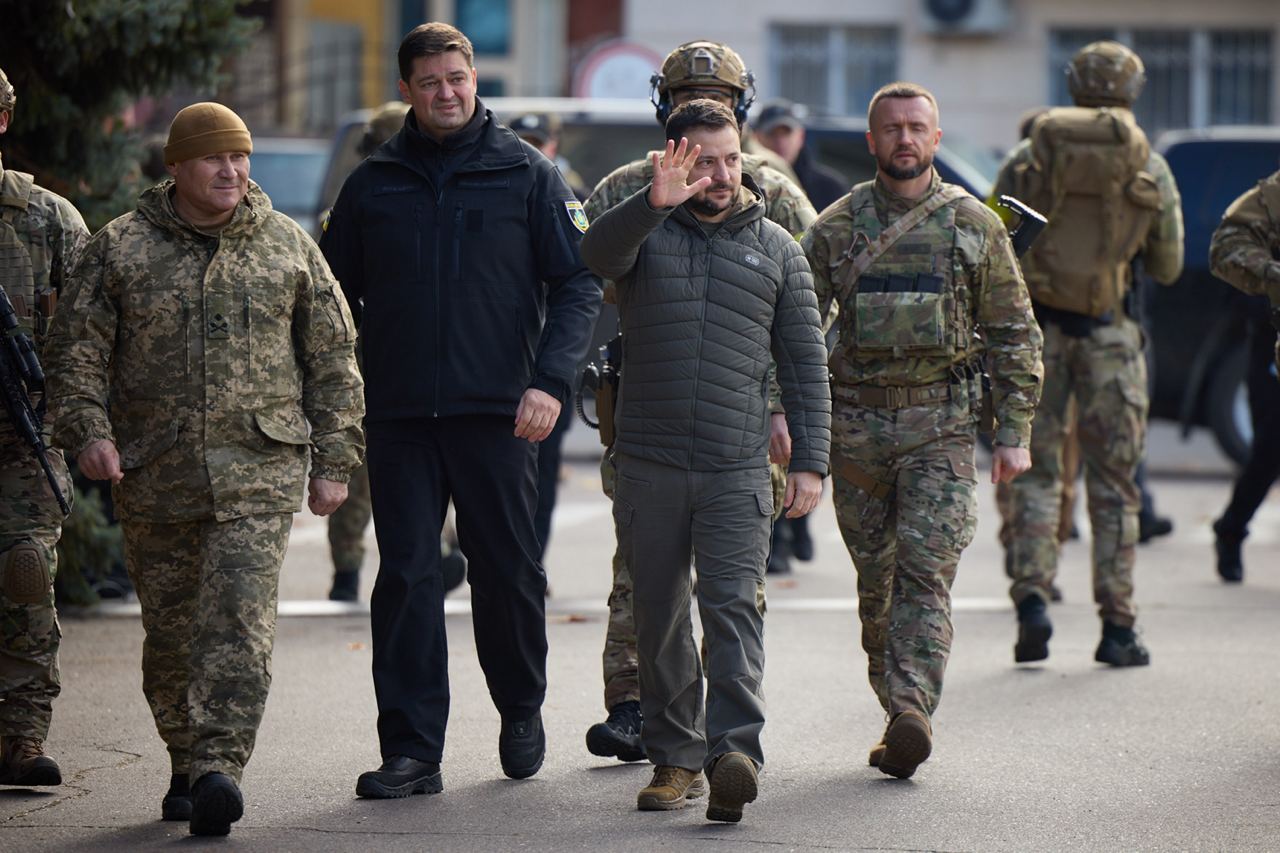
President Volodymyr Zelesnkyy tours Kherson after its liberation on November 11th 2022. The official position of the Ukrainian authorities has crystallised in their desire to fully restore the territorial integrity of the country. Photo: Volodymyr Zelenskyy official Telegram channel
This shows a catastrophic lack of understanding in Moscow regarding the foundations and depth of Ukrainian statehood, and the inevitability of its independent development after 1991.
It is worth noting that the Russo-Ukrainian War in its current form has become the largest in Europe since 1945, and the largest in the world in the 21st century. Although the war is still ongoing, we can already state that Ukraine has preserved its status as an autonomous member of the international community, whose state independence will not be questioned. Thus, it can be argued that the main goal of the Russian “special military operation” has not been and will not be achieved, despite the increased intensity of shelling and limited mobilisation into the ranks of the Russian army.
Ukraine’s war of independence
Today we are witnessing (and millions of people as direct participants) the war for the independence of Ukraine. Its participants are the two largest republics of the former Soviet Union, and in the recent past a metropole and a colony. The paradox is that this war for independence is unfolding more than 30 years after its formal declaration. Even if we choose the beginning of the hybrid confrontation between Russia and Ukraine (2014) as a starting point, the situation will not change fundamentally. The war for Ukraine’s independence involves the destruction of a number of principles that seemed unwavering after the collapse of the Soviet Union. And – what seems quite likely – the destruction of Russia in its current form. This is evidenced by the scale and irreconcilable nature of the confrontation between Russia and Ukraine, the course of hostilities, the invasion and the information policy of the aggressor.
Ukraine, despite the power of the Russian strike on February 24th and the following days, managed to withstand and demonstrate to the international community its own resilience. If before the large-scale invasion, the West was captive to the assessments of military experts who predicted the imminent collapse of Ukraine’s military and statehood, then developments in February through April proved the existence of a solid foundation for independence. At the same time, the process of demythologising Russia, its rapid loss of potential as a prospective partner, as a civilised state capable of acting by established norms, began and continues to this day.
Therefore, Russia, after the pseudo-referendums in the occupied territories of Ukraine, which were the result of the military defeat of its army in the Kharkiv region, has effectively deprived its own borders of sacred inviolability. Vladimir Putin’s declaration that “Russia’s borders do not end anywhere” now sounds highly ambiguous in its meaning. The United Nations General Assembly resolution on the non-recognition of the results of the pseudo-referendums demonstrated that the international community is on the side of Ukraine. And this already shows the inability of Russia to win the war against Ukraine and to convince the international community of its victory.
The provisions of the Ukrainian constitution that are filled with real meaning (acquiring EU candidate status and applying for accelerated accession to NATO) are not only propaganda. Their implementation will allow us to talk about the final withdrawal of Ukraine from the sphere of Russian influence. This scenario remains unacceptable for the Kremlin, which will do its best to prevent it. At the same time, it should be understood that until the end of hostilities and the formal end of the war, Ukraine’s accession to the EU and NATO should not be seriously counted on.
Kremlin delusions
For a long time, the Kremlin has been exploiting in its state propaganda the idea of the existence of a “triune Slavic people – Russians, Belarusians, Ukrainians”. This idea was widespread during the Russian Empire, yet only Russians can count on a privileged status in this trio. Ukrainians and Belarusians – each in their own way – are exploited and discriminated against. And this alignment of forces not only determines the logic of the Kremlin’s policy, but also significantly narrows its room for manoeuvre. The situation in Belarus during the rule of Alyaksandr Lukashenka has illustrated the methodology behind the hybrid dismantling of a post-Soviet republic’s statehood. For its part, Ukraine proved to be a tough nut to crack, able to resist Russia despite pre-existing problems and contradictions within both society and the state.
During the war, as recent experience shows, it is important not only to recognise success on the battlefield, but also within society. According to research conducted by the Kyiv-based Rating Group, more than 90 per cent of respondents from among Ukrainian citizens believe in the country’s ability to withstand the Russian attack. If this figure was 100 per cent, one could assume problems in the methodology of the survey, or assume that it was conducted somewhere like North Korea. Instead, this figure correlates with the results of the All-Ukrainian referendum held on December 1st 1991. More than 90 per cent of Ukrainian citizens supported the proclamation of Ukraine’s independence, and in each region of the country this decision was supported by more than 50 per cent of citizens who voted.
It is worth recalling that the practical application of the slogan “Away from Moscow!” for independent Ukraine became possible only after the occupation of Crimea and the outbreak of the war in Donbas. The Kremlin was once able to impose an agreement on Ukraine regarding the transformation of the Sea of Azov into an inland water body of Ukraine and Russia. While this agreement clearly privileged Moscow’s position, by the autumn of 2018 things were changing. In September 2018, then President Petro Poroshenko announced the termination of the Treaty of Friendship and Cooperation between Russia and Ukraine through its non-renewal. And for obvious reasons, diplomatic relations between Russia and Ukraine were terminated in February 2022.
Russia’s large-scale invasion made a number of previously habitual processes in Ukrainian politics impossible. The main leaders of pro-Russian political parties ended up in Russia (the exchange of Viktor Medvedchuk for the defenders of Azovstal completed this process). After the end of the war, Ukrainian political actors will not be able to rely on Russian finances, engage with Russian political technologists or use models of Russian election campaigns. The political process in this case looks like a reflection of the fractures that are taking place in Ukrainian society.
The Russian language will gradually lose its position in Ukraine, as well as Russian culture, which will significantly reduce the influence of the “Russian world” on the citizens of Ukraine. It is appropriate in this context to give the example of Kharkiv – a city of 1.4 million inhabitants 40 kilometres from the Russian-Ukrainian border, which has been subjected to barbaric shelling by Russian troops. Given the fact that the Russo-Ukrainian War has become a military confrontation between the states with the largest number of Orthodox believers, we can predict post-war changes not only in the position of the Russian Orthodox Church in Ukraine, but also in its influence.
Russian hatred
It is worth highlighting an interesting detail: Russia failed to properly make use of the Ukrainian political emigrants who settled on its territory after the Revolution of Dignity. This indicates both a preservation of imperial thinking among those who prepared the large-scale invasion of Ukraine, and the real scale of Ukrainian political emigration to Russia. At the same time, there are relatively few Russian citizens who are trying to prove their loyalty to Ukraine by word and deed. A significant number of them are instead fighting in the country with arms in their hands.
I would like to note that the Russo-Ukrainian War has already intensified decentralisation movements in Russia, whose participants are increasingly talking about the need to disintegrate the Russian Federation and create dozens of new states in its place. In assessing this process, it is important not to overestimate the real capabilities of representatives of national movements, but also not to ignore them. The Russo-Ukrainian War is clearly a trigger for internal upheavals within the Russian Federation, and its disintegration today does not look like an absolutely unrealistic scenario.
The scale of war crimes committed by Russian troops in Ukraine since the beginning of the full-scale invasion suggests that hatred towards Ukrainian citizens is an element of Russian state policy. The Kremlin thus acknowledges that a democratic and uncontrolled Ukraine is a threat to its existence, but uses the methods of the 19th and 20th centuries in the largest armed interstate confrontation of the 21st century. The myth of Russian-Ukrainian friendship was buried on the streets of Bucha, Mariupol and other cities that became places of mass murder of Ukrainian citizens. It is significant that the “argumentation” behind the destruction of the inhabitants of Ukraine’s occupied territories is often related to the area’s higher standard of living.
The development of events also changed the tone of statements made by the political leadership of Ukraine. If in the first month of the war Ukrainian leadership was ready to negotiate with representatives of Russia and even agree on the Istanbul Communiqué with them, in the spring of 2022, an understanding that such a dialogue may be impossible began to grow. This was documented in the National Security and Defence Council of Ukraine decision on the impossibility of negotiating with Vladimir Putin. This step has become the subject of particular irritation in Russian propaganda, as it encroaches on the positions of the Russian president.
Since autumn 2022, the official position of the Ukrainian authorities has crystallised in their desire to fully restore the territorial integrity of the country, including the territories of Crimea and the Donetsk and Luhansk regions occupied in 2014. This suggests that Ukraine’s military victory by way of restoring its territorial integrity will place the values of the international community before the need to facilitate the peaceful dismantling of the current Russian Federation. Otherwise, the threat of revanchism and new aggression against one of its neighbours will be too realistic. Therefore, Ukraine should not only stress its desire to restore sovereignty over its territories, but also emphasise its rejection of territorial gains at the expense of the current territories of Russia.
Yevhen Magda is a Ukrainian political analyst and the executive director of the Institute of World Policy, a think-tank based in Kyiv.