
Ukraine’s defiance goes beyond the battlefield
Poetry may not have the power to stop Russian missile strikes but Ukraine’s literary festival season, which carried on in spite of the horrors of war, became a testament to the importance of defending culture during the invasion. After all, the Russians have been very clear that they do not recognise the Ukrainian identity.
In Chernivtsi, a small Western Ukrainian city located on the border with Romania, September begins with poetry. Artists from throughout Ukraine and all over the world have been gathering there for the past 13 years during the annual Meridian Czernowitz Festival. Due to the Russian invasion of Ukraine, this year’s festival was different, and, in the words of Meridian’s chief editor Evgenia Lopata, “a small miracle”.
December 7, 2022 -
Kate Tsurkan
-
Issue 6 2022MagazineStories and ideas
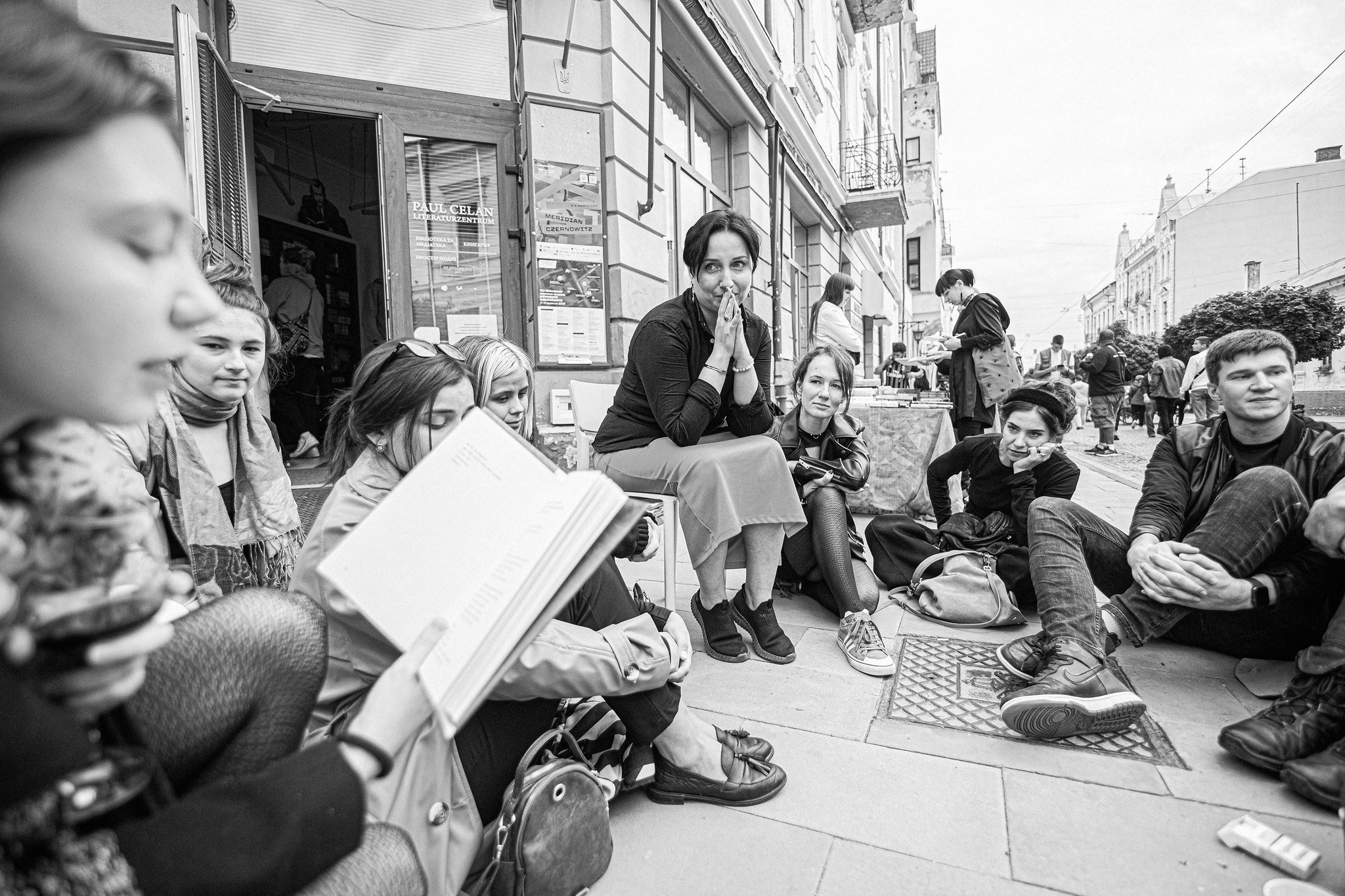
An outdoor poetry reading and discussion during the 2022 Meridian Czernowitz Festival in September 2022. Despite the war and martial law, this key cultural event still took place in Chernivtsi, Ukraine. Photo: Julia Weber
Shortly after the start of the invasion on February 24th, cultural projects in Ukraine were either put on hold or suspended altogether. Some of Ukraine’s most famous writers – including a few published by Meridian Czernowitz – have enlisted in the armed forces or prioritised much-needed volunteer efforts over writing.
Six months into the invasion, Chernivtsi remained the only region in Ukraine that had not been hit by Russian missile strikes. However, this was no guarantee that the city would remain untouched by the horrors of war. The question remained: should the Meridian Czernowitz festival take place during wartime or not? According to Lopata, it was always a matter of how, not if.
Finding refuge in poetry
While choosing locations for the events, the organisers of the festival could not go with many of their preferred locations, such as the city’s magnificent drama theatre, a testament to the wonders of 19th century Austro-Hungarian architecture. This is because they were not close enough to bomb shelters that could fit all of the guests and participants. Security guards were hired to watch over each event, and although the sight of stern, cross-armed men standing by the entrances of poetry readings added to the cognitive dissonance of those three days, it was nonetheless a relief that safety was the number one priority.

There was also the question of getting permission from the local government. Chernivtsi had a new governor, as the former left in disgrace following a corruption scandal. Unfortunately, the new one did not seem very interested or familiar with literature. As the fiery young Lopata told me, when the governor’s office said that she did not have permission to stage the festival and police would show up to arrest her and end the event if she proceeded, she defiantly replied: “I have journalists coming from all over the country. Go ahead, arrest me in front of them and see what happens.” Thankfully, the festival’s opening ceremony carried on without a hitch.
Absent from this year’s Meridian was Serhiy Zhadan, Ukraine’s heartthrob rock star poet. He is not only Meridian’s biggest star, but the most well-known and beloved contemporary writer in the country. His events always command large audiences of adoring fans. This year, his presence would have posed a huge security risk, especially if the air raid sirens were to sound during a music performance or poetry reading. However, Zhadan and his punk rock band had planned a tour across Europe in the months of August and September to raise funds for volunteer efforts in his native Kharkiv. Yuri Andrukhovych – Meridian’s other big star and a staple of the Ukrainian literature scene since the country’s independence in 1991 – had also embarked on a literary tour across Europe to promote Ukrainian culture during wartime and thus did not make it to Chernivtsi for the festival.
Nevertheless, some of Meridian’s other stars were around for the three-day event, such as poet Kateryna Kalytko and prose writer Andriy Lyubka, who both presented their latest books. Lyubka’s collection of essays titled Something’s wrong with me had been scheduled for release back in April; the room was packed with eager fans who had been patiently waiting to hear his witty and notorious exchanges with the literary critic Oleksandr Boichenko. I found myself sitting next to Lyubka’s wife Yulia (a good friend of mine and fellow translator) who blushed as he read a fantastical essay about when she had forced him to throw out a pair of grungy old shorts at the beginning of their relationship – “my first capitulation”, he teasingly called it.
Likewise, the consecutive poetry readings by Yuri Izdryk and Iryna Tsilyk were packed, as was Irena Karpa’s presentation of her new novel Just don’t tell anyone about it. Meridian’s events have always been well attended, but I had never seen so many people gathered together to listen to poetry readings. The main venue – beyond the Paul Celan Centre on Kobylianska Street – was a meeting room in the Magnat Hotel across the street. The walls were stripped bare and were dimly lit, which indicated renovations were underway. Nonetheless it gave the aesthetic of us sitting together in a bomb shelter, with poetry shielding us from the threat of Russian missile strikes.
The power of words in the face of evil
Meridian Czernowitz is ultimately the brainchild of the writer and radio broadcaster Igor Pomerantsev. According to Svyatoslav Pomerantsev, Igor’s nephew and founder and president of Meridian, it was his uncle who ushered him into the world of contemporary Ukrainian literature and unwrapped the mythos of Chernivtsi back when he was just starting the publishing house. The 74-year-old former Soviet dissident speaks in a tranquil and unhurried manner that enchants everyone within earshot of him. Back in the Soviet Union, Igor Pomerantsev gained the attention of the KGB for his possession and circulation of so-called forbidden literature, so he has a deeper understanding than most of how powerful words can be in the face of evil. He eventually went into exile with his wife and son, becoming a staple of the BBC Russian-language service and Radio Svoboda. As Igor Pomerantsev addressed the audience during the opening ceremony of this year’s Meridian Czernowitz festival, he reminded them that “Poetry is against death, and war is death. I believe in the victory of poetry. True, poetry does not have guns, cruise missiles or cluster bombs, but it has high-precision words against which guns are powerless.”
This certainly remained the rallying cry throughout the entirety of the three-day festival. On multiple occasions attendees burst into tears of joy telling me how grateful they were to have attended such an event. Perhaps we were all emboldened by the wine, but our feelings were sincere. The past few months had imposed a heavy psychological burden on us all, whether we had friends and family on the frontlines or not.
There are varying levels of suffering during wartime, none of them enviable. The war was also constantly on our minds. For example, Lyubka has spent much of his time since March raising funds to purchase cars for soldiers on the frontlines. A donation box was set up in the Paul Celan Centre specifically for this cause, but nonetheless, people approached him to give money at every chance, including during our interview. During my interview with Irena Karpa, some women approached our table outside the cafe to thank her for coming to Chernivtsi, saying how important it was to see her here.
As Igor Pomerantsev explained to me in the days following the Meridian festival, “Emotions overwhelmed all of us and literature took a step back. In the context of war, tears mean more than poems; human touch is more necessary than brilliant metaphors. It is difficult for me to admit.” At the same time, it was poetry that led us to experience this collective catharsis. Cognitive dissonance reigned supreme during those three days, but I believe that none of us were ever more thankful for poetry than we were in that moment.
Defending culture during wartime
Meridian was the first but certainly not the only literary festival to take place following the Russian invasion. This year, the Lviv Book Forum took place in early October. However, it was by invite only due to security concerns. On the second day of the festival, Ukrainians woke up and rejoiced in the news that Putin’s precious Crimean bridge had been bombed. I, too, rejoiced, but worried that something bad would happen (actually, it did on the following Monday – when massive strikes against the country’s energy infrastructure began) but not a single air raid siren sounded during the festival, nor did it during Meridian.
Peter Pomerantsev, Jon Lee Anderson, Misha Glenny, Emma Graham Harrison and other big names in western journalism joined Ukraine’s literary elite at the impressive Ukrainian Catholic University. The discussions were broadcast live online for those who could not attend. Over the course of four days, there were discussions centred on the role of women in wartime, propaganda, cultural identity in the face of imperialism, and more. However, it must be said that the most compelling conversations were those where Ukrainian literary figures engaged in dialogue with western literary greats, including the prodigious translator and public intellectual Yurko Prokhasko with Margaret Atwood (attending remotely); and Crimean Tatar activist Alim Aliev with the 2021 Nobel Prize winner Abdulrazak Gurnah (also attending remotely). After all, the main goal of Ukrainian literature in translation has always been to convey that the country’s writers are just as talented and worthy of attention as other writers who contribute to the canon of world literature. Ukrainians fight for their freedom, but one should not forget that Ukrainian literature is worth more than just the world’s tears.
Perhaps no one articulated what is at stake for Ukrainian culture better than the writer Oleksandr Mykhed in his speech during the opening ceremony at the Book Forum. Shortly after the start of the invasion, his home in Hostomel was destroyed by a Russian missile strike. Mykhed and his wife fled to his mother’s native city of Chernivtsi, and he enlisted in the Ukrainian armed forces.
“What is the state of the Ukrainian book industry during the full-scale Russian invasion?” declared Mykhed. “Writers, translators, and publishers are dying. The shells of the occupiers destroy publishers’ warehouses. Libraries are burning. The Russians are burning Ukrainian books and clearing libraries of ‘enemy’ literature. Many publishing houses stopped working altogether. Some of the niche publishing houses founded by veterans closed down because all the staff have gone to the front. Book sales have sunk into the abyss. Bookstores have only recently reopened. Paper and printing materials became more expensive. Hundreds of books that were due to be published this year will never see the light of day. Generations of authors will not have their rightful entry into the literary sphere. Thousands of forced migrants will never seek relief in literature, translation, and art because they need first and foremost to survive. Others try to rediscover the value in creative work in the blood-soaked fog of war.”
Poetry, sadly, does not have the power to stop Russian missile strikes. But Ukraine’s literary festival season carrying on in spite of the horrors of war is testament to the importance of defending culture during wartime. After all, the Russians have been very clear about how they do not recognise the Ukrainian state as legitimate and have, throughout history, either murdered Ukrainian artists or tried to claim them as their own.
The opening lines of a poem by Kateryna Kalytko, in this context, seem like an appropriate rebuke to Russia’s genocidal campaign:
What’s going on?
They came to kill us.
We are being killed right now. We
Will continue to be killed.
We will never be killed.
Why do they want to kill us?
We are the antithesis
Of stolen history…
Kate Tsurkan is the editor-in-chief of Apofenie Magazine and a PhD candidate at New York University. Her written work and translations have appeared in The New Yorker, The Guardian, Vanity Fair, The Los Angeles Review of Books and elsewhere. Along with Daisy Gibbons she is currently translating Oleh Sentsov’s Chronicle of a Hunger Striker, forthcoming from Deep Vellum.