
Gudijos istorija for the 21st century
With regards to Belarus, it is difficult to ask Lithuanians, or actually any other neighbouring society, about how they perceive Belarusians. The truth is that in this country we are dealing with two entities: the official Belarus and the Belarus of the opposition.
At first glance, in the autumn of 2022, Vilnius has enjoyed a normal life. The capital of Lithuania has finally almost returned to its pre-pandemic pace of life. The majority of institutions are now working like they were before. The same can be said about small shops, coffee shops and restaurants. Even though the prices that you pay there are much higher. It is also not difficult to notice that some new places have been set up. For example, on Gediminas Avenue there is a bar called Pahonia, while Vilnius Street is now home to the Belarusian House, which is located near the main government building.
December 7, 2022 -
Andrzej Pukszto
-
AnalysisIssue 6 2022Magazine
Photo: Ausra Barysiene / Shutterstock
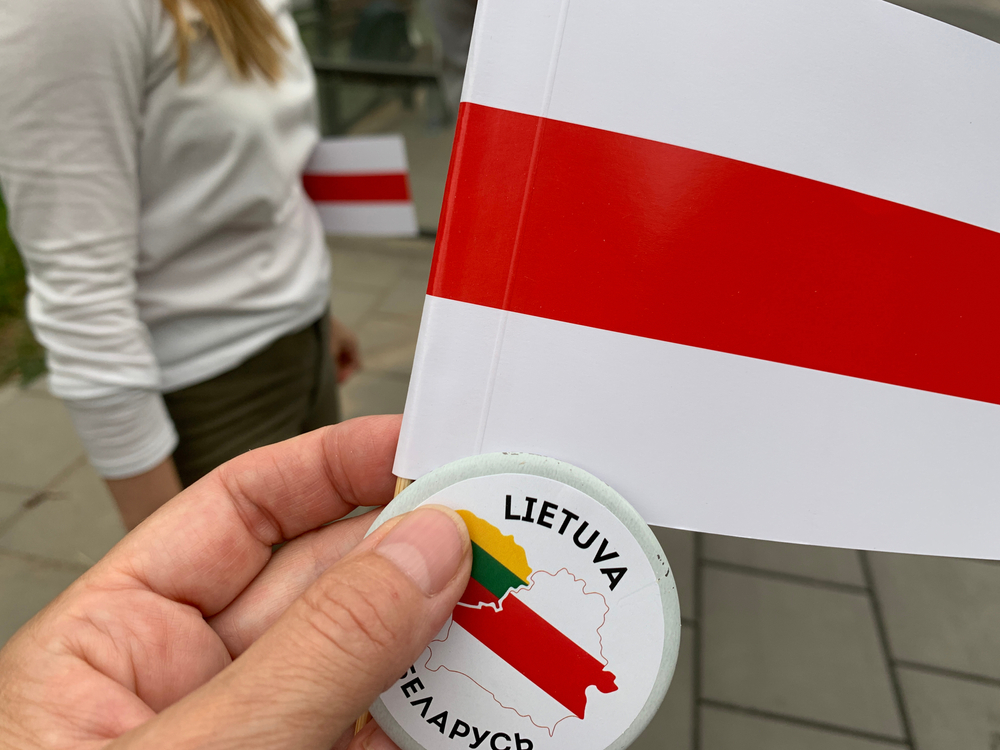
There are many flags and Ukrainian symbols around the city as well. But a careful eye will also spot the white-red-white Belarusian flags. Compared to the situation from two years ago, when words such as COVID-19 or SARS were completely unknown here, we can say that the Russian language is much more often heard in the streets and public spaces. Its users are usually Ukrainians, for example the refugees who have fled from Kharkiv, or Belarusians, who – in large numbers – arrived here from Minsk. But there are also representatives of the Russian minority in Lithuania.
Thinking about this new ethnic mosaic, I cannot help but think of an online post that was made by a well-known Lithuanian professor, the women’s rights researcher Dalia Leinartė. In it she complained about the new reality, which in her view, has been pushing the Lithuanian language out of the public space. As a remedy, she proposed that the language of communication with Ukrainian and Belarusian migrants in Lithuania should be English.
Ukraine in focus but not instead of Belarus
To say that Ukrainian refugees and support for Ukraine have pushed the Belarusian issue out of the media agenda in Lithuania would not be true. For sure, there is less space for Belarus now, especially when we look at the situation from before February 24th 2022. First and foremost, the Vilnius office of Sviatlana Tsikhanouskaya does not allow us to forget about our neighbouring state. Also importantly, the threats that Lukashenka poses towards our country do not leave us indifferent. In the summer he even encouraged all of Belarus’s democratic neighbours (Poles, Lithuanians, Latvians and Ukrainians) to come to his state if they want to buy kasha grains and salt. By uttering these words, he was trying to say that the situation in these countries, which are either current or aspiring members of the EU, is now very dire and that they subsequently require help from neighbours. Also, the difference in prices between these countries and Belarus is significant and that is why people living in Poland and Lithuania are apparently flocking to the border to do their shopping in Belarus.
Lukashenka’s anger with Lithuania is actually not ungrounded. Not only did our country take in Tsikhanouskaya in August 2020, after she had fled from Belarus in fear for her safety and life, but we also cut the majority of our economic ties with Belarus. The most painful for the Belarusian ruling elite was the halting of the transit of mineral fertilisers produced by Belaruskali, which is one of the biggest state-owned chemical producers in Belarus. Before, exported fertilisers from this plant were transported by Lithuanian Railways to the harbour in Klaipėda, thereby significantly enriching the Belarusian state coffers for many years.
To complete the picture, let me add that in early October of this year an individual named Mantas Danielius, who introduced himself as a lawyer and business consultant, was detained in Lithuania on charges of espionage. He was suspected of passing information he had been collecting among Belarusian refugees to the Belarusian KGB. Danielius’s case is an illustration of the fact that Lukashenka’s regime has not forgotten about Lithuania and despite reduced diplomatic relations it remains active with regards to our state.
Two Belarusian anniversaries
In autumn 2020, Lithuania became a destination for many Belarusian refugees, especially those who work in the IT and new technologies sectors. In a way, we can say that our country saw an opportunity in hosting world-famous firms from Minsk. However, we do not know to what extent these techies are supporting the Belarusian opposition. If they are, they are doing it quietly and secretly.
Understandably, the activity of Belarusian firms in Vilnius and other Lithuanian cities is less known to the public eye than the political activities of the representatives of the Belarusian opposition. For example, in early August of this year a conference called “New Belarus” was hosted in Vilnius. Its aim was to unite different opposition groups that are now active in Vilnius, Warsaw and other European cities.
Most importantly, by creating the government in exile, Tsikhanouskaya wanted to prove that her intention was not to waste time and that she has plans for Belarus’s future. At a banquet organised at Vilnius’s City Hall on the occasion of the second anniversary of the protests in Minsk, Tsikhanouskaya thanked the diplomatic services from the main European states and the US – but above all Lithuanian politicians and diplomats – for their support of democratic Belarus. On the other hand, the 30th anniversary of the establishment of the European Humanities University, which is often called a Belarusian university in exile, was poorly reported on by the media and stayed, in a way, in the background. This academic centre, which Lukashenka closed down back in 2004, found its place on Belarus’s opposition map. However, it does not have a good reputation among the Belarusians, even though the number of students attending it has increased in the last two years.
Belarusian studies
The rapid changes in international affairs have made it fashionable to survey the residents of one country on their perceptions of those who live abroad and especially in their neighbouring states. With regards to Belarus, it is difficult to ask Lithuanians, or actually any other neighbouring society, about how they perceive Belarusians. The truth is that in this country we are dealing with two entities: the official Belarus and the Belarus of the opposition.
In regards to the opposition, it is worth mentioning the Congress of Belarusian Researchers, which has been active for ten years now. This international gathering of scholars specialising in Belarus is held every year in Kaunas, which was Lithuania’s interwar capital. It was only organised in Warsaw for one year. In 2022, like before, the event gathered a few thousand specialists from different academic areas, including linguistics, sociology, economics and others. They arrived in Kaunas from all over the world. The conference is organised by a small team of academics who work at the Vytautas Magnus University and researchers with a Belarusian organisation called Political Sphere. Initially criticised by the Lithuanian ministry of foreign affairs and Lithuanian media, in recent years this event has gathered the support of all of Lithuania’s most important institutions.
One of the congress’s organisers is historian Rūstis Kamuntavičius, who in 2021 published a now very popular book. It is the first concise history of Belarus in Lithuanian. Before him, nobody dared to prepare such a publication. In fact, many Lithuanian researchers were simply of the opinion that the history of Belarus overlaps with Lithuania’s history, while others simply claimed that this was a topic that was not worthy of much attention.
Kamuntavičius provocatively called his book the History of Gudia, not Belarus, referring to the Old Lithuanian geographic term. There have already been two editions of the publication and new ones can be expected in the future. This shows that today Lithuanians are more and more interested in Belarus and are united in the conviction that without a democratic and pro-western Belarus, there can be no safe Lithuania.
Andrzej Pukszto graduated from history at the Vilnius University (1996) and defended his PhD at the Cardinal Stefan Wyszynski University in Warsaw (2004). He has been working at Vytautas Magnus University in Kaunas since 2005, and as an associate professor of the department of political science since 2008. His research and lectures focus on East and Central European politics, and specifically national movements in East-Central Europe in the 19th and 20th centuries.