
In the footsteps of Viktor Orbán’s invincibility
Viktor Orbán’s thoughts about the Hungarian people almost always appear in his speeches. If you search for the term “Hungarian people” on Orbán’s personal site, a peculiar universe unfolds in front of your eyes. Certainly, his target is not the liberal Budapest intelligentsia, but rather ordinary Hungarians, a group that Orbán knows best – and grants him victory.
Whatever the expression means, Hungary has degraded into a “partly-free” democracy in recent years according to Freedom House. We are now both geographically and politically halfway between Germany and Belarus. Our democratic institutions still stand but they are like houses whose only renovation has been the façade – they look nice from the street but if one enters, destruction is obvious. This is because the caretaker was not appointed as the result of the residents’ trust but that of the local real estate tycoon. According to the 2022 World Press Freedom Index, Hungary’s media ranks 85th, behind Guinea and ahead of Israel. It was 23rd in 2010. No other country has slid down about five places on an annual basis.
July 14, 2022 -
Szabolcs Vörös
-
Hot TopicsIssue 4 2022Magazine
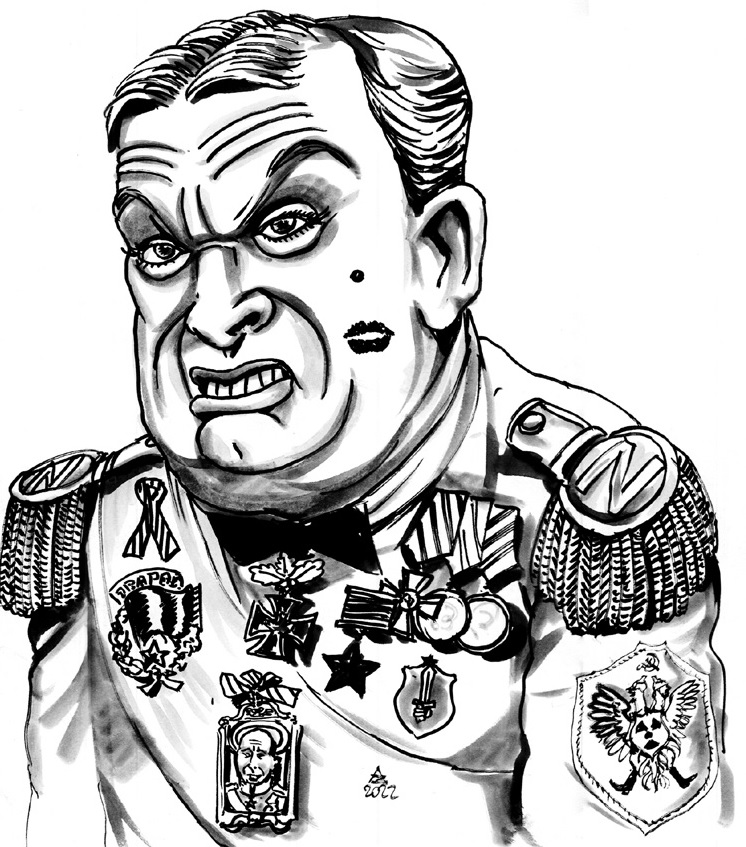
Illustration by Andrzej Zaręba
It is best not to talk about the handling of the pandemic. More than 46,000 people have already died in a country of 9.8 million, resulting in the fourth worst outcome worldwide. Our prime minister stated in September 2020 that “we can measure the success of our containment effort in the number of deaths – or lives saved.” Our welfare system is indeed growing. However, countries like Slovakia, Poland or Romania, all looked down upon by the Budapest intelligentsia around 1990, now have more robust development.
All the ingredients were there for the political opposition to score a landslide election victory this year. What happened instead? Viktor Orbán was elected Hungary’s prime minister for the fifth time by a massive margin. His Fidesz party – with their invisible junior partner, the Christian Democratic Party – now has 135 seats in the 199-member National Assembly. Essentially, the prime minister can carry on doing whatever he wishes. It should be noted that Orbán is now the most senior leader in the European Council. This means that there is no other politician in the club who has seen more Brussels bargaining. He is never shy to exploit this experience – just look at his most recent game of chicken with the EU over the Russian oil embargo.
The Viktor Orbán show
Every Friday at 7:30 in the morning, the studio of Hungarian radio’s legendary first station Kossuth becomes a venue for excessive flattery. The guest is always Viktor Orbán. While Kossuth’s leaders say that the radio is edited in line with BBC standards, these interviews are rather the prime minister’s own 22-minute one-man-shows. He is allowed to say whatever he wants without interruption. Sometimes even he is surprised that the host – a worrying but dulcet-voiced mother of two – voices harsher views about Brussels or migration, let alone the opposition. By nine o’clock, the essence of these conversations overwhelms the Hungarian public space.
Orbán’s thoughts about the Hungarian people appear in almost every one of his speeches. If one takes the trouble to search for “Hungarian people” on Orbán’s personal site, a peculiar universe unfolds. It is as if the writer Paolo Coelho had written a booklet about us: “For centuries the Hungarian people have defended Europe in its battles” … “The Hungarian economy has three treasures: the Hungarian people, land and water” … “Hungary’s greatest advantage is the knowledge and professional expertise of the Hungarian people” … “The Hungarian people stood up in support of Hungarian sovereignty” … “The Hungarian people deserved the Lord’s patronage.”
Of course, the most recent statement declares that “We do not want the Hungarian people to be made to pay the price of war.” Although no one has ever examined these statements, one thing is certain – it is not the liberal Budapest intelligentsia they intend to flatter. Their target is rather ordinary Hungarians, a group that Viktor Orbán knows best. The reason for the growing discrepancy between western wishful thinking about Hungary and reality is that the foreign media picks up the comments of those who are politically irrelevant to the prime minister.
So, how come Orbán knows what the Hungarian people like? This is partly because he is the only person who uses this expression. Words carry weight and the prime minister has been using terms like this for decades. He also misuses them. In his vocabulary, for instance, national equals Fidesz voter. He even labels his base as the national side. As a result, anyone who does not vote for Fidesz is not national – even a traitor, according to the logic of Hungarian grammar. There are some who do not even intend to conceal this connotation. Orbán’s eternal brother-in-arms, the Speaker of the National Assembly László Kövér, said in April 2020 that “The left-liberal opposition in Hungary is part of the globalist, anti-national network. Their intentionally fake information and slanders are the basis of the propaganda campaign of western opinion-makers. This opposition is not part of the nation but a comprador unit of this world elite.”
For Kövér, this is probably a personal belief but make no mistake – these statements are the result of a constant and systematic monitoring of Hungarian society. If something does not serve the party’s interests, it is simply thrown away. In early 2015, for instance, Fidesz tried to score sympathy points by praising hard-working citizens (literally calling them “hard-working little men”), the low-income countryside cluster of Hungarians – typically Fidesz voters. Internal polls showed that such talk was viewed as rather humiliating for this group. Fidesz stopped using it in a heartbeat.
Island of normality
Why does the self-image of Hungarians matter to Orbán? The answer can be found in Hungarian history: a thousand year struggle with external enemies. These include Batu Khan’s Mongols in the 13th century, the Ottoman Turks from the 15th, the Habsburgs, Russians, Nazis and Soviets. The country’s Trianon trauma in 1920 should also be mentioned. One does not need to be an outright patriot to draw the conclusion that “we have always been doing everything right, we protected Europe but never got anything in return, moreover the West let us down – like in 1956.”
I have been studying history for eight years but am unable to recall a single footnote about the possible faults of our historic figures. Defiance is in our bones and waits to be exploited by politicians. This is the very Hungarian reflex Orbán appeals to with cold professionalism. He is fully aware of the reality-conquering power of grievance politics. Are you underpaid? It is the fault of Brussels! Worrying about your family? Rightfully so, as George Soros and his friends certainly want to change the gender of your kids! Was Fidesz expelled from the European People’s Party? Good for them, as there is no more line between Christian democrats and socialists in Europe! Has the unification of Europe’s far-right parties been a huge failure so far? Orbán did his utmost to make it happen! Is there a war in Europe? Americans should have never provoked Moscow!
According to the narrative of Fidesz, Hungary is an island of normality surrounded by an ocean of strange ideas. It is as if we are not EU and NATO members – confirmed by referenda – but rather some external actors. As if it was some sinister external power and not Orbán’s votes in the European Council that influence European grand strategy. It is not a coincidence that Orbán differentiates between Brussels and the EU. Brussels is the complicated universe of unelected bureaucrats, with a deliberate anti-Hungarian mindset, whereas the EU is something 80 per cent of Hungarians consider beneficial. Perhaps this sounds familiar in Poland?
Another blessing of the prime minister is his mother tongue. The Hungarian language is a unique encrypted code system. We might have some relatives, like the Finns or Estonians, but we do not understand each other at all. As Hungarians say, “we are an island in a Slavic and Germanic sea.” This outlook also hints at the country’s insufficient knowledge of foreign languages. According to a 2019 Eurostat figure, the Hungarians’ language skills are among the worst in the EU, as only 42 per cent of the 25-64 age group speak another language. Apart from being isolating, our mother tongue also provides us with the feeling of being special. Anyone criticising us is suspected of cancelling our language and culture. Why do we have this reflex? Precisely because of the nation’s aforementioned historical experiences. The thoughts of critics also cannot often be verified due to our poor language skills. What is the result? Our leaders are free to feed us with the most absurd narratives.
New state religion
Shortly after Orbán’s 2018 election victory, I tried to explain on these pages that it was a grave mistake to judge his media empire by journalistic standards. This is an unnecessary mission, as the Hungarian leader’s media holdings are anything but watchdogs. They have the same goal as their masters – keeping power. If they have to make a U-turn, even from one day to another, they just do it. If they are ordered to destroy an opponent, they do it too. The media has become Fidesz’s revolver in its fight with political opponents. This spring, this gun shot a whole round with such efficiency that even the most pessimistic opposition policymaker could not have imagined its impact. In the run up to the April election, a misinterpreted quote from the opposition’s leader was repeated day after day. By March, even the residents of the smallest villages were talking about how “Péter Márki-Zay was about to take our kids to be human shields in Ukraine.”
Having suffered a fatal wound, the opposition’s excuses were useless. No question remained about the election’s outcome. Vladimir Putin’s best friend in Europe was once again allowed to comfort a nation that bases its self-worth on the legacy of the anti-Soviet revolution in 1956.
Even if it sounds absurd, the majority of Hungarians could not care less. Indeed, “Orbánism” has effectively become the state religion of their homeland. But this religion has no dogmas, except for the idea that the leader is always right. Fidesz does not have voters, but rather believers who, much like good Christians, are seeking answers to big questions. They receive them as soon as they internalise Orbánism, alongside massive financial reimbursements throughout early 2022. The state religion has an answer for every problem in life, be it family, educational, geopolitical, art or media issues. Over its 12 years in power, Fidesz has seized every asset with which it can fulfill these needs. Answers are also produced around the clock by its hand-fed “think tanks”. Their unquestionable effectiveness is one of the reasons why believers are supposed to forgive the “church” for its own mistakes. This is especially apparent when life standards have been growing significantly. Who cares that this was the result of EU money and an international economic boom? Who cares that other countries in the region outperformed us?
The point is that, thanks to Viktor Orbán, everything is good for us. Just as the Catholic Church will not collapse because of its paedophile priests, Orbán will not lose popularity either because of some corrupt subordinates. Orbán’s supporters typically overlook issues such as oligarchs continuously winning public tenders. Instead, they say, “At least they do not wheelbarrow the money out of Hungary.” The longer this state religion prevails, the lazier people become. They increasingly accept the idea that all of their problems can be traced back to either the grey corridors of Berlaymont or the glass tower desk of George Soros.
It is instructive to see what happens when someone backs away from the Orbán Bible. Just ask Hungary’s new president, Katalin Novák. Whilst Hungary’s most senior politician often remained closely aligned with the prime minister’s will, she finally condemned Putin for his war in Ukraine in her May inauguration speech, something her former senior colleagues in Fidesz were reluctant to do since February. Minutes after, hundreds of social media commentators – former fans – attacked her. One of them criticised her for donating state money to Ukrainian refugee children during her first foreign visit to Poland. No one really cared that Novák was the face of Fidesz’s rather successful family policies. The fact that she was the chief negotiator for Fidesz in its effort to create a far-right group in the European Parliament was also forgotten. After all, she committed a deadly sin by offering a war narrative different to that of her former boss. Apostates have to confront the public wrath of the believers, as it is still the sect leader’s exclusive right to decide on new dogmas in Hungary.
Szabolcs Vörös is a Budapest-based Hungarian journalist. He is the co-founder and editor of Válasz Online, a collective of journalists founded by five former staffers of Hungarian weekly Heti Válasz, which ceased publication in 2018. Over the past two years, its articles have been quoted in publications like the New York Times, Gazeta Wyborcza, Ukrainska Pravda and Le Monde.