
A referendum in the shadow of war
The Russian invasion of Ukraine has shifted international attention away from yet another referendum in Belarus. Like all the previous ones, these reforms significantly change the Belarusian political landscape, while giving Alyaksandr Lukashenka even more influence and power.
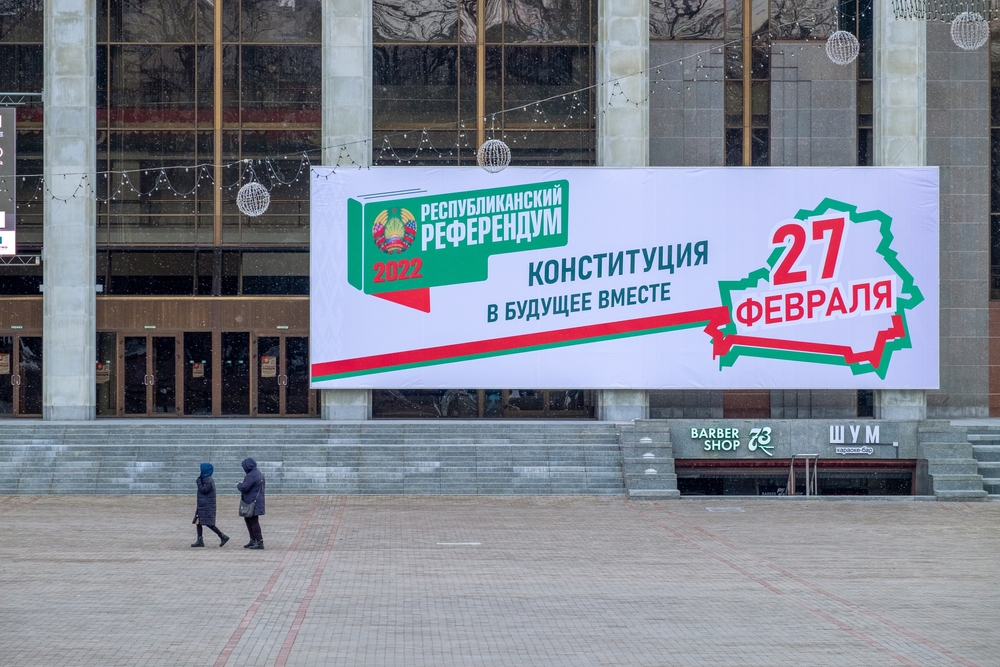
A long-debated constitutional referendum was held in Belarus on February 27th. It had only one question: do you accept the new constitutional amendments? An alternative version of the constitution was put forward by the country’s democratic forces outside of Belarus called “The People’s Constitution”. However, this was not even considered by the state working group. Despite an official invitation to all citizens to participate in public debate and suggest proposals, it became obvious that only those changes proposed in line with the regime’s vision would be considered and adopted by Minsk.
July 14, 2022 -
Hanna Vasilevich
-
AnalysisIssue 4 2022Magazine
Photo: Denis Shitikoff / Shutterstock
Those who questioned or even criticised the regime’s proposals faced various negative consequences, such as detainment. This is what happened to Mіkalai Vicikau, a pensioner who now faces criminal charges for his public criticism of the proposed constitutional changes.
Voting as a form of protest
The mainstream anti-Lukashenka groups joined forces in an attempt to use the referendum as a tool for political protest. To this end, they asked the electorate not to boycott the referendum but to use ballots to express their negative feelings regarding the referendum in particular and the regime in general. Considering the invasion of Ukraine had been launched just a few days before the referendum, many Belarusians used their ballots to express their disapproval of the war – shifting the focus from the referendum to condemning the war and Russia’s military presence in the country.
Only Belarusians residing in Belarus were allowed to participate in the referendum. For those residing abroad, no polling stations were organised. According to the official results, 65.16 per cent voted for the constitutional changes, while only 10.07 per cent voted against them. Nearly 43 per cent voted early. In the Minsk region, which returned the fewest votes in favour of the changes, 55.13 per cent voted for and 13.23 per cent voted against. Meanwhile in the Mahilioŭ region, the area most supportive of the changes, 71.69 per cent voted for and 10.4 per cent voted against.
Of course, the procedures surrounding the referendum were not democratic and the results could hardly be trusted. The official results revealed an unprecedented percentage of voters who spoiled their ballots by writing anti-war slogans. As suggested by the opposition leader in exile Sviatlana Tsikhanouskaya’s team, some also crossed out both answers in order to express their rejection of the referendum.
The Viasna Human Rights Centre published a list of 908 people who were detained on the day of the referendum for publicly protesting against the war. Most of them were detained near polling stations and the building of the general staff of the Belarusian armed forces in Minsk. Tsikhanouskaya called for citizens to gather in these places.
New governing body
The Belarusian constitution has been changed three times since Alyaksandr Lukashenka became president: in 1995, 1996 and 2004. In 1996, the presidential term was extended and presidential powers significantly broadened. This new fourth change to the constitution does not bring any checks and balances to the state’s existing separation of powers. However, it does introduce some significant changes that could weaken the position of the president. At the same time, it has created a new supreme representative body made up of about 1,200 people called the “All-Belarusian People’s Assembly”. This new body will control key government appointments and reforms.
According to the new constitution: “the president could be dismissed from his/her position by the All-Belarusian People’s Assembly in the case of systematic or brutal violation of the constitution or in conducting state treason or any other severe crime … An investigation of the accusations is to be organised by the assembly. A decision for dismissal of a president from his/her position is taken by the assembly after the conclusion of the constitutional court on the facts of systematic or brutal violation of the constitution by a president.”
In general, the new regulation provides the assembly with the widest possible range of rights and responsibilities, affecting both domestic and foreign affairs. This includes approving the main concepts of domestic and foreign policy, military doctrine and national security. It will also preside over proposals regarding the constitution and referenda. Finally, this body will have the right to examine the legitimacy of elections and possibly even remove the president from office.
Upon the recommendation of the president, the All-Belarusian People’s Assembly should be able to elect and dismiss the constitutional and supreme courts’ chairpersons and judges. It will also decide on the possibility of sending servicemen and members of paramilitary organisations outside of the country to participate in activities ensuring state security.
Considering that the new constitution allows the assembly to overrule the decisions of state bodies and officials that threaten national security (except for acts of judicial bodies), its role essentially allows it to take on the responsibilities of parliament.
More power for Lukashenka
Lukashenka is expected to be appointed chairperson of this new assembly, suggesting that he could remain one of the country’s main political figures well after his presidential term. In this capacity, he could easily influence presidential decisions and even question them, given the weak and dependent position of the Belarusian constitutional court. He could also become involved in most domestic and foreign policies.
Even before the next presidential elections in 2025, Lukashenka might simultaneously serve as president and chair of the new assembly. There are no limitations in the new constitution that say he cannot do this. However, such a move would contradict various official statements. According to the president’s office, “the All-Belarusian People’s Assembly should have the function of public control over the decisions of the new President when he is elected.” As a result, the new assembly will carry out two functions: to control whoever becomes the next president; and to allow Lukashenka to keep as much power as possible. What is more, the new constitution opens up the possibility that Lukashenka could become a lifelong member of the Council of the Republic – the upper chamber of Belarus’s parliament.
These constitutional changes were actively promoted soon after the 2020 presidential election and associated mass protests that lasted for nearly nine months. The promoted changes are aimed at limiting presidential power. Considering the insecurity of Lukashenka’s position for several months, the proposed amendments provided him with several options to stay in power and limit the powers of a new president. These have challenged some norms set in the 1990s that ultimately allowed him to become president in the first place. Thus, the “new old” age threshold of 40 instead of 35 has been brought back for the president.
The new constitution has also doubled the amount of time a permanent resident must live in Belarus in order to become president from ten to 20 years. Candidates must now also have no previous and/or current foreign citizenship/s, or a residence permit of a foreign state entitling them to privileges and other benefits. These limitations mean that a significant number of Lukashenka’s opponents will not even have the chance to become president. After all, many of them had to flee the country during and after the 2020 protests.
The new constitution also limits the president to two terms. However, it remains unclear how this rule will be applied to Lukashenka. All previous constitutional changes were effectively used by him to “annul” his term, meaning that the new regulations applied only after they came into force.
Lukashenka’s personal security
The 2020 protests naturally affected domestic security policy. They revealed Lukashenka’s feelings of insecurity regarding his future position as president. As a result, another new constitutional change concerns the legal grounds for a state of emergency. This now includes “attempts at violent change of the constitutional order, seizure or appropriation of state power, armed insurrection, mass, and other riots”.
A whole new article is focused on providing security for Lukashenka even if he should lose his position as president. It also ensures that he will not be persecuted for any deeds or crimes committed while in office. Specifically, it declares that “the president shall have immunity, his honour and dignity shall be protected by law … The President who has terminated the exercise of his powers shall not be called to account for the actions he committed in connection with the exercise of his presidential powers.”
One more significant change to the constitution concerns Belarus’s status as a nuclear-free state. Article 18 of the new constitution states that “The Republic of Belarus excludes military aggression from its territory against other states.” However, this provision has been broken from the very beginning, considering the Russian military’s presence on the territory of Belarus. Moscow’s forces have simply stayed after their “military training” and have been used ever since in attacks against Ukraine. Another issue of concern is that Russia potentially could use the territory of Belarus as a base for nuclear weapons.
The new constitution has also introduced a new regulation regarding the potential termination of citizenship. Even though there have already been cases when Lukashenka has stripped critics of their Belarusian citizenship (e.g., the case of Pavel Sheremet), this amendment will likely be used to further target Lukashenka’s opponents.
Back in 2021, the head of the department of the main directorate of the state security service of Belarus, Viachaslau Arlouski, suggested that the authorities deprive those Belarusians who left the country of their citizenship. Arlouski claimed that they “work in the interests of western countries” and “do everything possible to harm the state”. He stated that those deprived of citizenship will not be able to return to Belarus, take part in elections or referenda, or participate in the social and political life of the country.
Finally, the new constitution is further regulating social life as it defines marriage exclusively as a union between a man and a woman, who “have equal rights in marriage and family”. It also clearly limits interpretations of the Second World War, as it should be referred to as the Great Patriotic War like in Russia. This state approved version of history is described by the new constitution as “the historical truth and the memory of the heroic feat of the Belarusian people”. As a result, it has become a duty for Belarusians to follow such history as a show of patriotism.
Transition
Overall, the Council of Europe’s Venice Commission has stated that the constitutional changes proposed by the regime “fail to correct the strong unbalance of powers which already exists under the current Constitution and indeed may even aggravate it”.
The next two years will offer a transition for Minsk to adopt legislation on the All-Belarusian People’s Assembly, which will become a central body with rather vague functions. It is clear that the assembly will secure Lukashenka’s powers and provide him with chances to influence key legislation and appointments on a lifelong basis.
However, the proposed changes will only become fully effective in 2024. Before the end of February that year, when the elections to the House of Representatives are due to take place, there will be no significant changes to the country’s existing political system.
Hanna Vasilevich holds a Doctoral Degree in International Relations and European Studies. Her research interests include state ideology and propaganda, identity issues, inter-ethnic relations, linguistic diversity as well as diaspora and kin-state relations.