
The more things change… Britain, Russia and the war in Ukraine
The Kremlin’s invasion of Ukraine has upended its bilateral links with countries around the world. This is no clearer than in the United Kingdom, which has forged a rather contradictory relationship with Russia over the past few decades. British politicians are now faced with pursuing a clean break with this peculiar status quo in response to today’s exceptional circumstances.
It has not been an easy winter for UK Prime Minister Boris Johnson. Whether it is overlooking a friend’s paid lobbying or lockdown parties at Downing Street, the British leader has often found himself in the media spotlight for all the wrong reasons. This uncertain domestic situation has had a drastic effect on the fortunes of his own Conservative Party, with recent by-election results often turning in favour of opposition parties. Polls now show steady support for the Labour Party for the first time since Johnson’s landslide election victory in late 2019. Nevertheless, the famously resilient Boris continues to hold on to his job.
April 25, 2022 -
Niall Gray
-
AnalysisIssue 3 2022Magazine
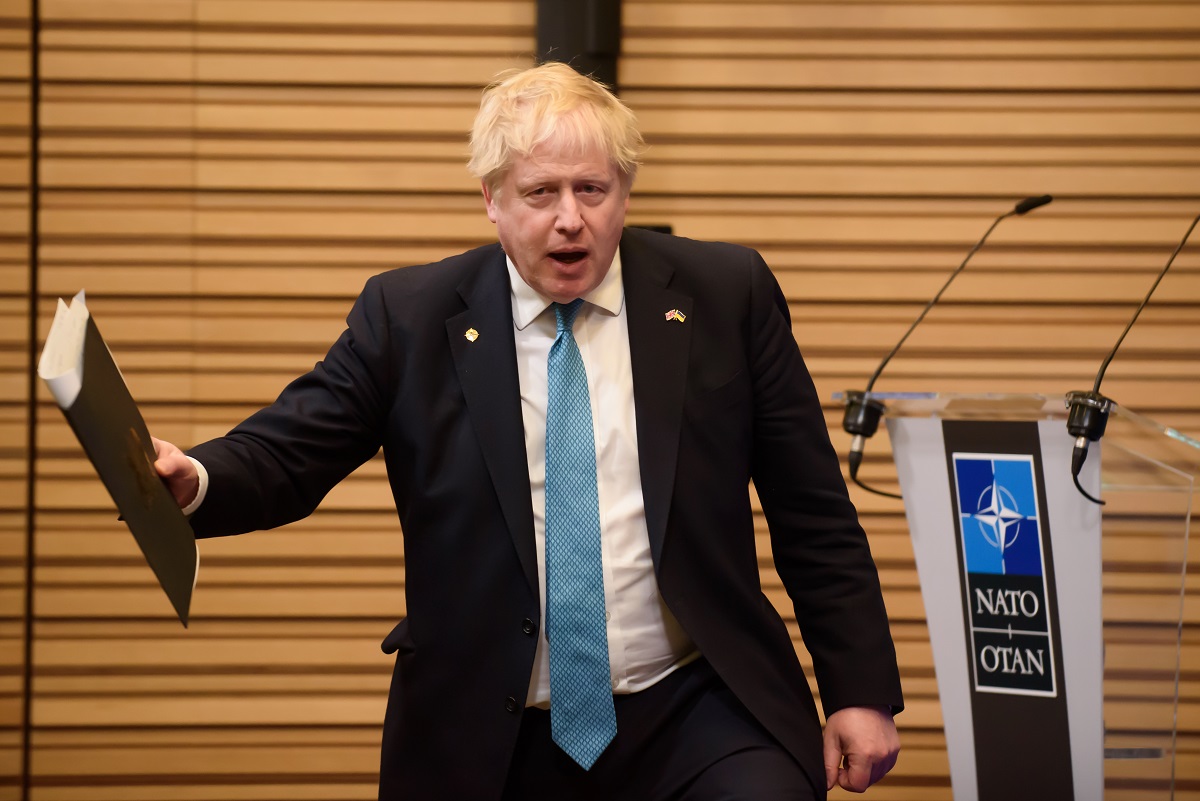
The past month has seen the UK largely attempt to push its allies towards what NATO Secretary General Jens Stoltenberg described as a “new normal” for European security. Photo courtesy of NATO.
A journalist by trade, the prime minister has shown a keen ability to deflect from a growing barrage of media and political criticism.
Political theatrics on the world stage
Whilst Johnson continues to fight off enemies at home, an increasingly chaotic international stage has ironically offered him and his government some breathing space. This is particularly true in relation to Central and Eastern Europe, a region that has experienced somewhat of a renaissance in ties with the Conservative Party top brass. For example, Foreign Minister Liz Truss and Defence Minister Ben Wallace were warmly welcomed in many regional capitals throughout the past year. Whilst both figures broke new ground in relations with the countries of the Western Balkans, the pair also reinforced Britain’s traditional diplomatic and security links with Central Europe and the Baltic states. Such regional diplomacy has often been conducted in dramatic fashion, with a visit from the Royal Navy’s Carrier Strike Group in June complemented by the almost overnight deployment of 140 soldiers to shore up Poland’s troubled border with Belarus six months later. November even saw Johnson demand that the European Union decide between Ukraine and Nord Stream 2, showcasing to audiences at home and abroad the UK’s renewed commitment to the area. These actions appeared to reflect a concerted effort in London to reimagine its role in the region post-Brexit. In light of recent events, however, it is clear that these decisions over the past year were by no means taken in isolation. Indeed, it now seems that the resurgent regional actor was responding to an increasingly personal rivalry with the Kremlin that even resulted in a naval standoff in the Black Sea last summer.
Britain’s initial response to the build-up of Russian troops on the Ukrainian border appeared to follow a familiar pattern when it comes to debate on Moscow. Whilst defence specialists and the government lined up to discuss further military aid to Kyiv, the opposition either criticised such moves as too little or too much. Traditional NATO sceptics affiliated with former Labour leader Jeremy Corbyn even periodically took the media spotlight with talk of western aggression. For many politicians, therefore, the war at first simply presented yet another opportunity to draw battle lines and court support from their electoral bases.
This back and forth was seized on by the country’s typically sarcastic media, with publications such as The Spectator and Private Eye linking these domestic squabbles to what could then be viewed as the “theatre” and hysteria of a potential “doomsday crisis” in Eastern Europe. Despite this, Johnson and Truss made the unusual decision to visit Kyiv and Moscow respectively in early February. Traditionally the preserve of London’s continental allies, such diplomacy appeared to reflect a change of thinking in light of increased uncertainty. These exceptional moves, however, quickly gave way to the established cycle following Russian President Vladimir Putin’s recognition of the breakaway Donbas republics. Whilst a new round of sanctions was announced in line with international partners, the opposition maintained its scepticism. Labour leader Keir Starmer led criticism of London’s lack of action regarding various Russian oligarchs and their ambiguous links to the government. The UK had once again gone full circle regarding another flashpoint in relations with Moscow.
A new normal?
Putin’s fateful announcement of a “special military operation” in the early hours of February 24th confirmed the worst fears of British intelligence. One week before the invasion, the UK’s Secret Intelligence Service (MI6) made a rare exception and allowed the release of a map of planned Russian operations across Ukraine. Officials subsequently responded with some measure of calm as these sweeping geopolitical visions became reality. Johnson immediately held a phone call with Ukrainian President Volodymyr Zelenskyy and organised an extraordinary session of parliament. This pivotal session would mark the beginning of the country’s shift away from its troubled yet largely predictable status quo with Russia. Certainly, the prime minister’s declaration that “this hideous and barbaric venture of Vladimir Putin must end in failure” was roundly supported across the House of Commons. Even the usually cutting criticism of backbenchers was replaced by firm support, with former Prime Minister Theresa May urging her successor to make the Russian president feel the “cold wind of isolation”.
In general, the list of sanctions drawn up by the government largely lived up to May’s demands. Asset freezes on over 100 prominent groups and individuals were announced alongside the complete exclusion of Russian banks from the British financial system (the largest in Europe). Outside parliament, former Scottish National Party head Alex Salmond quietly suspended his long-running talk show on RT. At least on paper, the invasion had forced the British political establishment to pursue a clean break with various Russian interests connected to the country.
The past month has seen the UK largely attempt to push its allies towards what NATO Secretary General Jens Stoltenberg described as a “new normal” for European security. For example, London was the first government to ban Russian aircraft, such as those of the national flag carrier Aeroflot, from its skies. This move saw the country react more quickly than many of its regional allies in this regard, with Bulgaria, the Czech Republic and Poland quickly following suit. Russian aircraft are now almost completely shut off from airspace to their west following the EU’s ban on February 27th.
At the same time, Britain was also a pioneer with regards to the West’s adoption of SWIFT restrictions on the Russian financial system. Johnson immediately declared his intention to pursue such action following the invasion and raised this issue in forums such as NATO and the G7. Whilst only able to enforce restrictions on some banks in light of German and Italian uncertainty, these moves display the UK’s growing commitment to a long-term break with the Russian status quo. Johnson also appears to be a regular personal contact for Zelenskyy, with the Ukrainian president often praising the country’s military aid on Twitter. Surreal scenes in British media of Ukraine’s former President Petro Poroshenko praising the effectiveness of the Anglo-Swedish NLAW anti-tank system from the besieged streets of Kyiv exemplify a close bilateral relationship that looks set to persist well into the future.
London undoubtedly remains an enthusiastic partner of Ukraine. However, it seems that its assistance may ultimately be constrained by bureaucratic realities. This is perhaps made most clear by issues surrounding the millions of Ukrainian refugees that are now scattered across Europe. Of course, it should be noted that the UK specifically placed 1,000 soldiers on standby to deal with such a possibility in early February. The prime minister even later held a dedicated meeting with Central European leaders in London to pledge further support. However, it appears that the resettlement of a part of this group in Britain will likely face a more complicated process compared to the EU and its long-standing visa-free regime with Kyiv. This is exemplified by a now deleted tweet made by Immigration Minister Kevin Foster, who urged Ukrainian refugees to apply for seasonal work visas in the initial chaos of the invasion. Even though the minister undoubtedly meant well in the circumstances, the statement reflected the realities of a bureaucratic system still lagging behind its regional partners. London has often claimed that its decision to maintain a visa regime for Ukrainian refugees is the result of past Kremlin abuse connected to events such as the 2018 Salisbury poisonings. Despite this, Labour’s Baroness Kennedy has suggested that such claims have often been used to conceal a level of inefficiency last seen during London’s evacuation of Afghan nationals from Kabul in 2021. The British government’s strong backing of Ukraine may subsequently focus more on the peculiarities of its own traditional relationship with Russia.
Crackdown on oligarchs
The coming months will prove crucial as to the exact nature and strength of Britain’s long-term support for Kyiv. Of course, any talk of diplomatic and military de-escalation with Moscow now appears a distant prospect. This is especially true in the case of the UK, which is viewed as an especially malevolent force by Moscow’s top decision-makers. As aforementioned, such realities reflect an extraordinary bilateral rivalry characterised by everything from military confrontation to poisonings on the streets of Britain. It came as no surprise, therefore, when Kremlin Spokesman Dmitry Peskov claimed that Foreign Minister Truss was personally responsible for Russia’s nuclear forces going on high alert. Changes at home are more likely to indicate Downing Street’s real level of support for Ukraine in the long run.
This domestic reform is especially true in relation to the country’s Russian oligarchs. At home in the most exclusive boroughs of London, many of these figures have often used the city’s notoriously unregulated financial system to conceal their wealth in shell companies. This practice has been made all the more controversial by their often-cosy ties with both the Kremlin and members of the Conservative political elite. The war in Ukraine has finally forged a consensus on such murky matters, with the government no longer able to ignore the security risks of its unrestrained zeal for deregulation. A long-awaited Economic Crime Bill will subsequently prove decisive as to Downing Street’s willingness to root out these illicit financial practices. Universal political support for more “unexplained wealth orders” and a register of overseas property ownership already appears to be causing great worry among oligarchs in the UK. For example, Roman Abramovich’s frantic fire sale of his British assets following the invasion has now been halted by the government. The future of Chelsea Football Club now hangs in the balance alongside a 125 million pound mansion on London’s “Billionaires’ Row”. This move exemplifies London’s desire to keep up with the rapid superyacht seizures made by France and Germany. Despite this, the bill’s small print suggests that it could take months to fully implement such restrictions in relation to other controversial figures. It is now up to government to decide whether or not the summer resembles something other than a last window of opportunity for the questionable assets of Britain’s oligarchs.
At the same time, Britain’s avidly pro-Ukraine stance will also be tested in the energy sector. Whilst the government has now pledged to phase out Russian oil imports by the end of the year, continued uncertainties surrounding gas imports (three to four per cent of the country’s total) represent a crucial blind spot in strategic planning. Like many European capitals, London now effectively funds Moscow’s war effort through such inaction. In spite of spirited talk surrounding disengagement, this holdover of past realist realities has led the government to talk up the creation of a wholly new energy strategy over the next few months. Figures such as Conservative member of parliament Mark Harper have subsequently urged Downing Street for clarity regarding the potential impact of these moves on the cost of living.
In the meantime, the Johnson administration appears to be leading the way in pushing energy companies to break off co-operation with the Kremlin. For instance, February 25th saw Business Secretary Kwasi Kwarteng speak to BP boss Bernard Looney. What followed amounted to an effective U-turn on the group’s 30-year relationship with Russia. BP soon announced that it would not only immediately withdraw from the board of state-owned Rosneft but also offload its 20 per cent share of the company. Such moves appear to reflect the seriousness of London’s sanctions strategy. After all, BP could lose billions in any sale of these assets. The question must be asked, however, as to who will buy such toxic shares? Putin has temporarily banned the sale of foreign-owned assets and abandonment would only mean lining the Kremlin’s pockets further. Continued uncertainty surrounding the war could see any such pivotal moves frozen for the foreseeable future.
No going back
These realities suggest that the UK’s new Ukraine and wider regional strategies are very much works in progress. The contradictory foundations of modern Anglo-Russian relations have indeed been shaken to their core. Despite this, it remains unclear as to the exact details of London’s long-term plans. The months following the invasion have been a time of great rhetoric on both sides and the UK appears to be currently busying itself with continued military and aid shipments to Ukraine. These deliveries show London’s eagerness to live up to its position as one of the first states to answer Kyiv’s growing calls for military help in mid-January.
As the situation in Ukraine becomes an uncomfortable “normal”, however, London will be forced to look for ways to make its wider rhetoric a political reality. Boris Johnson even wrote a piece regarding this issue in The New York Times on March 6th. Stressing the need to maintain a diplomatic option only if Ukraine has “full agency”, the prime minister noted that there must be no “creeping normalisation” in relation to Moscow’s latest military venture. As the halls of power look set to debate the minutiae of such plans, this should not distract from the monumental shift in attitudes that has recently occurred in the UK. Zelenskyy’s Churchillian speech to parliament on March 8th made history as the first direct address by a foreign leader to the Commons chamber. In a rare display of unity, government and opposition alike joined each other in a round of applause for the president, challenging a tradition that has stood in parliament for centuries. If most British politicians now agree on anything, it is that there is no going back.
Niall Gray is the copy editor and proofreader of New Eastern Europe. He holds a master’s degree in Central and East European, Russian and Eurasian Studies from the University of Glasgow.