
Text resize: A A
Change contrast

Poland as a new frontline state

Russia’s full-scale invasion of Ukraine not only wreaked havoc on Ukrainian society but also damaged the regional security architecture of Central and Eastern Europe. For Poland and other states on the Eastern Flank of NATO, it instantly meant that they had all become de facto frontline states.

February 24th marked the end of the world order as we know it when Russian tanks rolled into Ukrainian territory and Russian missiles started to target Ukrainian civilian and military infrastructure. It is by no means an exaggeration to claim that the international security architecture that was shaped after the Second World War is now gone. From the regional perspective, the first day of the Russian aggression changed everything for both Ukraine and its neighbours. Many of these states have been pondering whether they would be next on Putin’s list.

April 25, 2022 - Wojciech Michnik - Hot TopicsIssue 3 2022Magazine

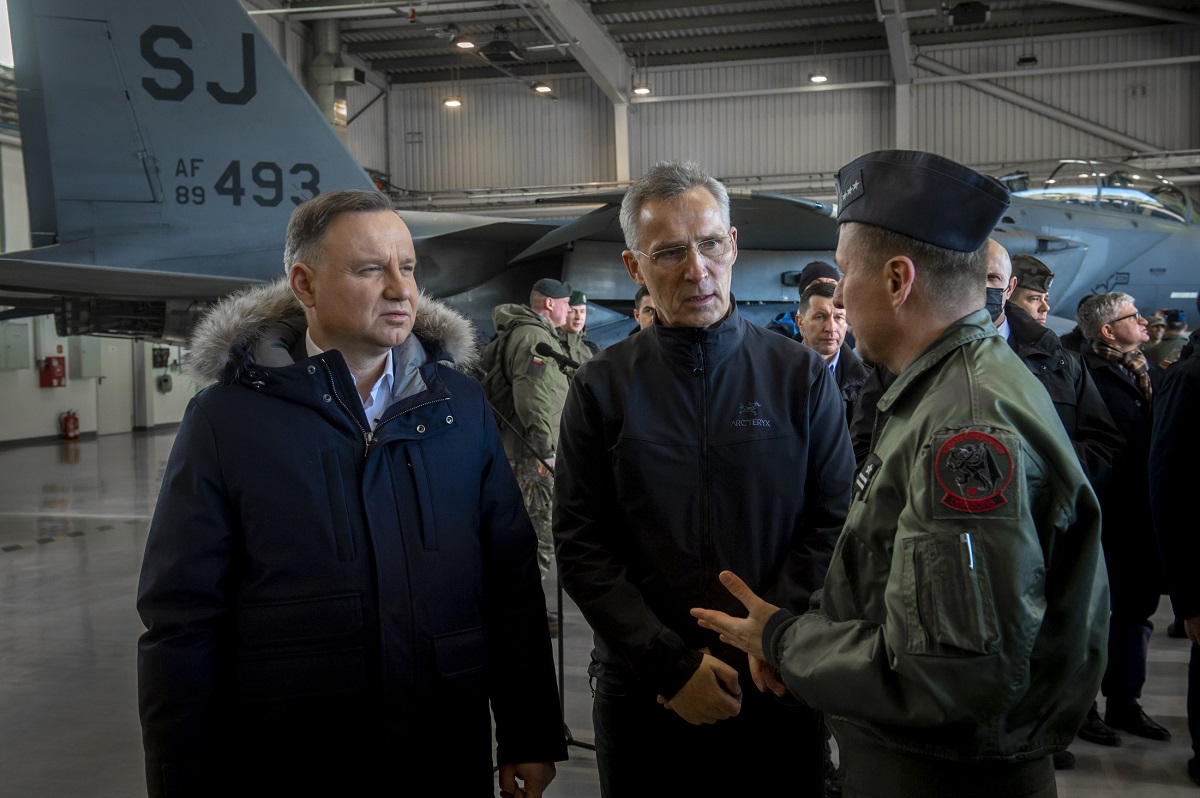
Polish President Andrzej Duda (left) with NATO Secretary General Jens Stoltenberg meeting with troops at the Łask Military Airbase in Poland in March 2022. Photo courtesy of NATO


In an instant, Poland found itself in a situation that thus far few were warning against. Poland became a frontline state, bordering both a Russian aggressor and a Ukrainian state that had become the victim of Putin’s latest attempt at ruthless territorial conquest.

For Warsaw, a member of both NATO and the European Union, it quickly became apparent that it needed to perform two key tasks at the same time. Poland would assist Ukrainians in their heroic struggle against the Russian occupiers while also attempting to do everything in its power to prepare contingency planning in case Russia chooses to escalate the war directly on NATO territory. Even though the war should have not come as a total surprise, becoming a frontline state has challenged Poland in various dimensions.

Adaptation and assistance

For Poland, becoming a frontline state in these circumstances means facing the reality of bordering an increasingly aggressive Russia and its military extension in the form of Alyaksandr Lukashenka’s regime in Belarus. Since February 24th, Warsaw now faces a deteriorating security situation in relation to Russia’s war in Ukraine, a subsequent refugee crisis and a potential conflict between Russia and NATO. As a result, Poland should be ready for every scenario that would require the defence of Poland and other NATO states.

It is noteworthy that Poland, the Baltic states, Romania and other allies in the region have been warning the West about Russia for years. Russia’s invasion and full-scale war against Ukraine validated these concerns and signalled a fundamental change in western attitudes towards Moscow. A predominantly united response from NATO and the EU to Russia’s invasion included harsh economic sanctions aimed at Moscow and financial and military support for Ukraine. Before February 24th, these united moves would have been hard to imagine. German Chancellor Olaf Scholz called this moment a zeitenwende (a turning point), while Liz Truss, the United Kingdom’s foreign secretary, said it was a “paradigm shift”, pointing out that “the age of complacency was over.” Even though for Ukrainians it has all been viewed as (understandably) too little and too late of a response, the West implemented most of its toolset against Russia, short of direct military confrontation. Poland, with its political, geographical and cultural proximity to Ukraine, has stood at the forefront of this strategic transformation.

The direct effect of Russia’s attack on Ukraine was most clearly seen regarding a refugee crisis on an unprecedented scale. As people from Ukraine fled for their lives, they escaped mostly through borders with Poland, Romania, Moldova, Slovakia, Russia and Hungary. As of March 22nd, the United Nations reported that more than 3.5 million people have fled Ukraine, describing the exodus as “the fastest growing refugee crisis in Europe since the Second World War.” Poland took in most of the refugees (2.6 million by latest estimates) and continues to help and accommodate this group. Integrating the refugees into Polish society will most likely remain the central challenge for both the government and society. In this regard, Poland and its enormous grassroots societal engagement has made a remarkable effort to accommodate as many people fleeing war-torn Ukraine as it possibly could. In the first four weeks of the war, Polish society has shown kindness and openness, welcoming refugees and supporting them in various ways. That should not go unnoticed, as Poland has not always been known for such generous gestures towards refugees (i.e., the refugee crisis in 2015).

Diplomacy and fighter jets

On the diplomatic front, Poland’s record since the beginning of the Russian war in Ukraine seems mostly positive, yet mixed. With so many crucial decisions to be made and high stakes involved, not everything could have gone smoothly. The diplomatic hiccup over the Polish MiG fighter jets may serve as a case in point. From the military perspective, even before the Russian aggression, Poland had become a hub for the West’s co-operation with Ukraine. This has largely involved the coordination of weaponry shipments to the country. After February 24th, these efforts have been intensified even further, as more and more western countries decided to send arms, military equipment and humanitarian aid to Ukraine. Most of this has gone through Poland. As a result, Warsaw has become both the logistical and diplomatic regional centre of joint efforts to assist Ukraine with its resistance against the unprovoked Russian aggression.

However, as the war progressed and Russia’s onslaught on Ukraine continued, Kyiv’s leadership started to call upon the western powers to supply even more weapons, including fighter jets. In this situation, the idea of providing Poland’s MiG-29 fighters to Ukraine and receiving in their place F-16s from the United States seemed like not only a good idea but also a decent deal for the country’s air force. Yet, given the fact that such an exchange would take months to implement and that Poland would lose one-third of its war planes without “Russian-made jet fighters”, this move brought more questions than answers. In the end, Warsaw decided to take an unusual diplomatic move. The government proposed and publicly announced that Poland was ready to hand over its 28 MiG-29 fighter planes “immediately and free of charge” to the American air base in Ramstein, Germany, with the understanding that they would be transferred to Ukrainian pilots fighting against the Russian invasion. This proposal stunned US officials, not only because of its potential consequences but also because of its public nature (discussed in the spotlight of public opinion). Hence, it was little or no surprise that Defence Department spokesperson John Kirby rejected the Polish offer, stating that “we do not believe Poland’s proposal is a tenable one” and that it is “simply not clear to us that there is a substantive rationale for it”. The deal was clearly off, amounting to a sort of diplomatic “glitch” between Polish and American counterparts.

Yet it would be unjustified to point to Poland as a primary scapegoat for this misunderstanding. In retrospect, should the fighter jets have been offered publicly? Probably not, but the Polish government was being pressured by both the US and Ukraine and had little room for manoeuvre in this difficult situation. Why? Even before the war, western allies had way too many times been concerned that Poland and other regional allies were “escalating” relations with Russia. Handing over fighter jets to Ukraine in a direct and unilateral manner during a war that Russia started could have caused even more controversy in western capitals. Even more importantly, Poland would risk provoking Russia and then face fierce criticism from other NATO allies. This could negatively affect Alliance cohesion and even challenge its commitment to common defence. Indeed, Russia could have treated supplying Ukraine with war planes as a reason to attack Poland. By offering planes and discussing the details in the public domain, Warsaw signalled openly that it was willing to support Ukraine. However, Poland wanted the Americans to take care of the details so that they would bear the potential risks.

In this regard, it is worth discussing the view of Elliot A. Cohen, who pointed out in The Atlantic that the United States and its NATO allies are already “engaged in a proxy war with Russia”. He also stated that they are “supplying thousands of munitions and hopefully doing much else – sharing intelligence, for example – with the intent of killing Russian soldiers”. According to Cohen, the problem mostly lies on the American side rather than on the Polish side because “when you are at war, you need to be disciplined in your decision making, and once again, the United States was not.” Overall, being a frontline state might seem simple but it is never easy.

Miscalculating responses

War is always prone to full or partial miscalculations. With his invasion of Ukraine, Vladimir Putin has redrawn the world map but not the way he intended. He not only underestimated the Ukrainians’ willingness to defend their independence but also unintentionally helped to cement the unity of the Ukrainian nation. Additionally, he provided the West with an exceptional opportunity to come together by rolling out sanctions against Russia and supplying weapons to Ukraine. He also gave NATO a proper reason to face up to a “new-old” adversary in order to defend peace and security in its transatlantic realm. For Poland, Russia’s bloody war against Ukraine should also serve as a reminder that the country chose the correct course in the early 1990s when it decided to align itself with both NATO and the EU. This move marked its symbolic return to the West and the start of its path to becoming an integral part of its security structure.

Moreover, Warsaw should take this costly lesson as a reminder that it is not its geopolitical position but resilience that constitutes its best defence against external threats. The state should also better appreciate its ability to build long-lasting partnerships and alliances. Populist tendencies and party politics should not trump Poland’s premium security capital built over the last 30 years of its democratic transformation.

It is way too early to make a realistic prediction on the outcome of the war. Yet, for Poland’s decision makers, some things should already have become quite clear by now. First and foremost, Russia is the largest security threat to Poland and Europe’s well-being and will remain so for years to come. Consequently, Warsaw would be wise to exercise strategic patience by (smartly) boosting its military spending and readiness while doing everything in its power to keep the West united and rallied against Russia. Secondly, Ukraine’s security is inseparable to that of Poland. If anyone ever doubted that before, the war has made it crystal clear. As a result, relations between these two nations could be the single most important factor in the shaping of Central and Eastern Europe’s future security architecture. Thirdly, there is no substitute for NATO, the EU and the United States as European powers, as all three should maintain co-operation in their attempts to bring peace and stability back to the continent. Poland should remember that this united multilateral response is where its strength truly lies and not necessarily in its public emphasis on its bilateral partnership with the US.

Lastly, whilst being a frontline state certainly means more concerns for Warsaw, it also allows Poland to be in the vanguard of NATO’s response. For that, Poland’s foreign policy would need to strike a delicate balance between hawkish temptations and the ability to maintain western unity in response to Russia’s aggressive behaviour in the region. Equally critical in this regard, would be Warsaw’s constant effort to keep reminding some of its allies in the West that the war is not just Russia’s war against Ukraine but Russian war against the whole West. In other words, being a frontline state requires strategic readiness and patience for the likely very dangerous long haul.

Wojciech Michnik is an assistant professor at the Institute of Political Science and International Relations at the Jagiellonian University and the Transatlantic Project Coordinator of the Central and South-East Europe Programme at LSE IDEAS. He is also a contributing editor with New Eastern Europe.

, , , , ,

Partners

Terms of Use | Cookie policy | Copyryight 2025 Kolegium Europy Wschodniej im. Jana Nowaka-Jeziorańskiego 31-153 Kraków
Agencja digital: hauerpower studio krakow.
We use cookies to personalise content and ads, to provide social media features and to analyse our traffic. We also share information about your use of our site with our social media, advertising and analytics partners. View more
Cookies settings
Accept
Decline
Privacy & Cookie policy
Privacy & Cookies policy
Cookie name Active
Poniższa Polityka Prywatności – klauzule informacyjne dotyczące przetwarzania danych osobowych w związku z korzystaniem z serwisu internetowego https://neweasterneurope.eu/ lub usług dostępnych za jego pośrednictwem Polityka Prywatności zawiera informacje wymagane przez przepisy Rozporządzenia Parlamentu Europejskiego i Rady 2016/679 w sprawie ochrony osób fizycznych w związku z przetwarzaniem danych osobowych i w sprawie swobodnego przepływu takich danych oraz uchylenia dyrektywy 95/46/WE (RODO). Całość do przeczytania pod tym linkiem
Save settings
Cookies settings