
Mission impossible? EU membership for Ukraine, Georgia and Moldova during wartime
Whilst Ukraine, Georgia and Moldova’s applications for EU membership were submitted before they were really ready, the Russian military assault on Ukraine has put the EU in a very delicate situation. Nevertheless, the EU has given the green light to start evaluating the eligibility of the three associated states for candidate status.
Never before have Ukraine, Georgia and Moldova’s European prospects been as bright as they are now. All three partner countries in the Eastern Partnership region have already submitted applications to join the European Union. However, the trigger for this move was not the success of internal reforms or the fulfilment of other political and economic milestones (also known as the Copenhagen Criteria).
April 25, 2022 -
Denis Cenusa
-
AnalysisIssue 3 2022Magazine
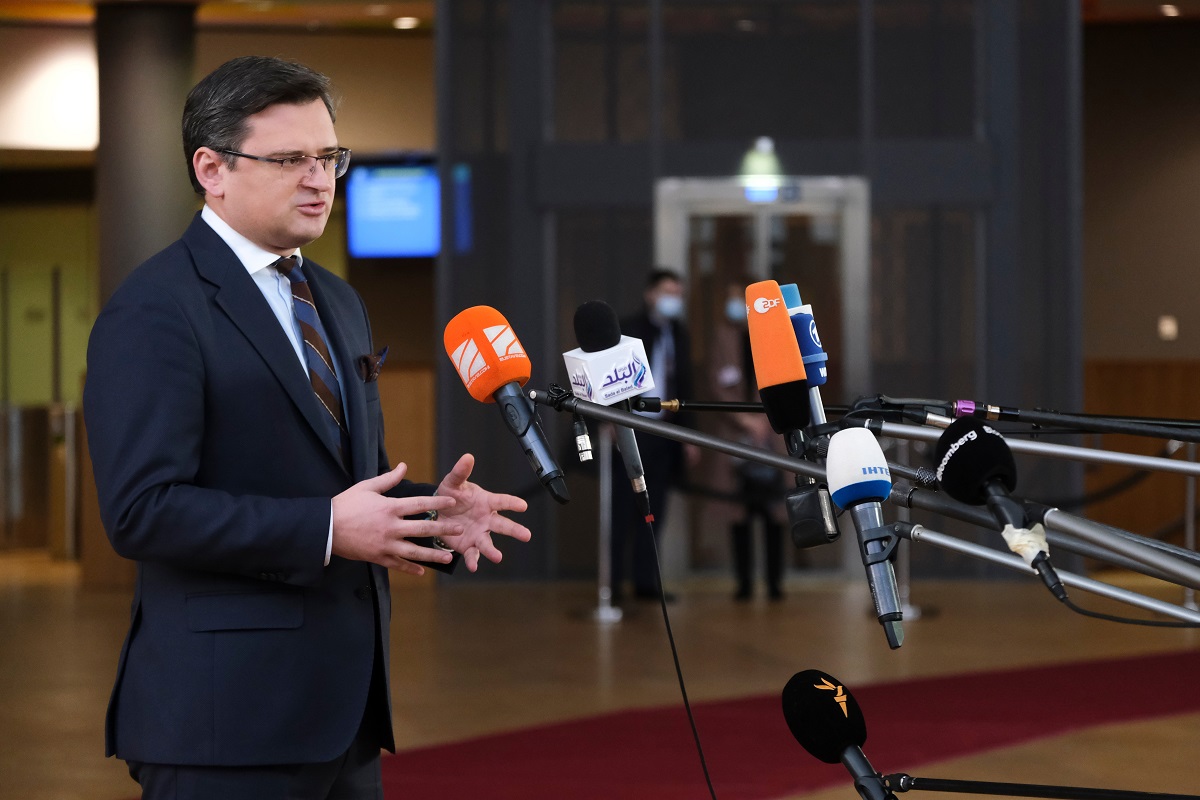
Ukrainian Foreign Minister Dmytro Kuleba talks to the press as he arrives for a Foreign Affairs Council meeting at the EU headquarters. Photo: Alexandros Michailidis / Shutterstock
Unlike the previous cases in Eastern Europe or the Western Balkans, the factor that accelerated the application process was the ongoing Russian invasion of Ukraine that began in February. Georgia and Moldova decided to follow Ukraine’s example, understanding the magnitude of the historical precedent that is emerging and fearing being detached from Ukraine on their way to the EU.
Geopolitical calculations
Less than a decade ago, the EU set ambitious agendas for the Europeanisation and modernisation of its Eastern neighbours. In particular, it recognised the European aspirations of Ukraine, Georgia and Moldova, which agreed to implement Association Agreements. After this, any active demand for more European integration was perceived as a potentially risky diplomatic move that could cause political damage. With five countries already queuing up to join the EU (Albania, North Macedonia, Montenegro, Serbia and Turkey), fully opening the door to new candidates from the East was incomprehensible.
Ukraine, Georgia and Moldova also did not have adequate political conditions to carry out successful reforms. It was hard for these countries to continuously outperform in order to gain candidate status and obtain a well-deserved spot on the enlargement agenda. Both the “Brussels bubble” and the pro-EU political forces in the three associated countries were consciously delaying a serious discussion about the prospect of EU accession. It appears that they were waiting for sufficient and indisputable evidence of progress regarding sectoral reforms and the rule of law. These old patterns based mainly on the evaluation of progress lost relevance when Vladimir Putin unleashed his military fury against Ukraine. The Russian military assault has turned regional security upside down, forcing the EU and associated countries to reconsider their geopolitical reluctance and timidity respectively.
The main argument invoked by proponents of EU accession for the three associated countries stems from the perception that granting geopolitical guarantees must be swift due to the Russian threat. In the case of Ukraine, the EU perspective is believed to provide a sense of direction for those fighting a war in defence of their homeland against Russia. However, the wider benefits of EU membership for the country require more nuanced analysis. First, if Ukraine is admitted as a candidate, this could have a positive effect with regards to information warfare. In addition to destroying the enemy’s psychological confidence, it would also serve to raise the morale of Ukrainian society. Second, the role of a concrete EU perspective is significant during the current war and is equally valuable in the post-war reconstruction process. It ensures a positive geopolitical fate for the Ukrainian state, regardless of how enormous the damage caused by the Russian invasion. Third, EU candidate status can play a substitute role for Kyiv’s fading NATO prospects.
As a result of the war, the likelihood of Alliance membership is even more problematic and uncertain. This is especially true as Russia pushes for Ukraine’s neutrality in exchange for a cessation of military aggression. The EU perspective carries deep civilisational symbolism. It has a guiding function for the Ukrainian ruling elites and population alike in choosing the model of development embedded in liberal democracy and rule-based national and international affairs. Furthermore, candidate status would also send a powerful message to the Kremlin that the EU is serious about the European future of Ukraine and the other two associated countries.
Different motivations
Ukrainian diplomacy worked incessantly to achieve progress in various matters, including increasing military assistance, pursuing peace negotiations, mobilising humanitarian support and advocating for robust sanctions against Russia. On top of these enormous efforts, Ukraine sought to convince the EU to grant it accelerated membership. Integration with the EU remains the only viable path to the West. There has been a conceptual shift in Kyiv’s current motivations towards the EU. Further democratisation, economic development and international prestige are no longer the main objectives. Joining the EU is now seen as a means of survival and protection for the Ukrainian identity and state against Russian neo-imperialism pushed by Putin.
Georgia and Moldova’s motivations to apply now for EU membership differed from those of Ukraine. The Georgian government was facing many protests fuelled by its non-alignment with the sanctions against Russia and ambiguous discourse in relation to the invasion of Ukraine. The protests also pushed for the ousting of the government and the country’s official application for EU membership. To level down the public pressure and reiterate its own European outlook, the Georgian government had no other choice but to revise its previous plans of applying for EU candidate status in 2022. The fact that Georgia filed an application too was what changed minds among decision makers in Chișinău. Initially, they put forward a moral argument that they would not exploit the Ukrainian situation in order to apply for EU membership, which is a long-term goal anyway. Suddenly after Tbilisi announced its plans to send an application, however, Moldova decided to do so as well on March 3rd.
The three associated countries did not coordinate their membership application decisions among themselves, proving that the “Associated Trio” launched last year is not yet a fully functional platform. They also did not consult with Brussels in advance. The decisions of Georgia and Moldova came as an unpleasant surprise for Ukraine. Foreign Minister Dmytro Kuleba criticised the two attempts to move closer to Europe as “attaching two of their carriages to a high-speed Ukrainian train heading to Brussels”. After all three applications were submitted, Ukraine demanded that its application be prioritised over the others. This revealed a sort of rivalry for EU attention among the three countries. EU institutions have refused to separate Ukraine from Georgia and Moldova. The European Commission has been tasked with evaluating the applications from the three associated countries, indicating that it is using a “one package” approach for their possible accession procedures in the future. In any case, the first in line is Ukraine, which chronologically submitted its request before the other two.
Hopes higher than real chances?
Although these applications for EU membership came before the countries were really prepared, Russia’s military assault on Ukraine and aggressive policies concerning Moldova and Georgia put the EU in a very delicate situation. According to the Versailles Statement on March 10th, the heads of the EU states gave the green light to the start of evaluations regarding the three associated states’ eligibility for candidate status. The same goal was set in the European Council’s Conclusions of March 24th and 25th.
This constituted a qualitative change in the EU’s perception of these countries. Not only are their electoral and European aspirations recognised, but they are also considered to have a more advanced status than the Western Balkan states. These countries had to wait several months for the European Commission to deliver its verdict on their EU applications, compared with less than two weeks for the three partners. It is also worth remembering that most of the eight newly created Western Balkan states suffered from wars during the implosion of Yugoslavia in the 1990s. In the post-war era, these countries have waited 20 years or more for clear prospects to become candidates for EU membership. Today, only Slovenia and Croatia have been in the EU since 2004 and 2013 respectively.
The game changer for partner countries in the Eastern Neighbourhood is obviously the Russian aggression against Ukraine. The strategic thinking of the Ukrainian leadership to combine wartime diplomacy with a dynamic pro-EU outlook has also played a key role. At this point, hopes for a positive response remain very high in all three associated countries. The European Commission is already working on a sort of fast-track regime regarding Ukraine’s candidate status. Once this is done, the evaluation of Georgia and Moldova will require much less time and effort, since they have implemented Association Agreements similar to Ukraine and are considerably smaller with no ongoing war on the ground.

Having candidate status is not the same as opening the full accession process and facilitating rapid accession, something that was rejected during the last EU summit in Versailles. Much like the EU, Ukraine is a pragmatic actor and understands the complexity of the process. However, it still wants to get the minimum (EU candidate status) by asking for the maximum (fast access). Never in history has the Russian factor been so conducive to promoting the idea of EU enlargement to the East. It must be remembered though that the price for such progress is high and is being paid by the Ukrainian state and people.

Denis Cenusa is an Associate Expert at Eastern Europe Studies Centre in Lithuania and PhD candidate at Giessen University in Germany. He is also an associate expert at the Expert-Grup think tank in Moldova and a contributor at the IPN News Agency in Moldova since 2015.