
Lithuania fumbles with 4,200 migrants, pushing human rights aside
As of September 28th 2021, 4,163 migrants have illegaly crossed Lithuania’s border with Belarus. To deter migrants – now and for good – Lithuania has pinned its hopes on a fence along the frontier.
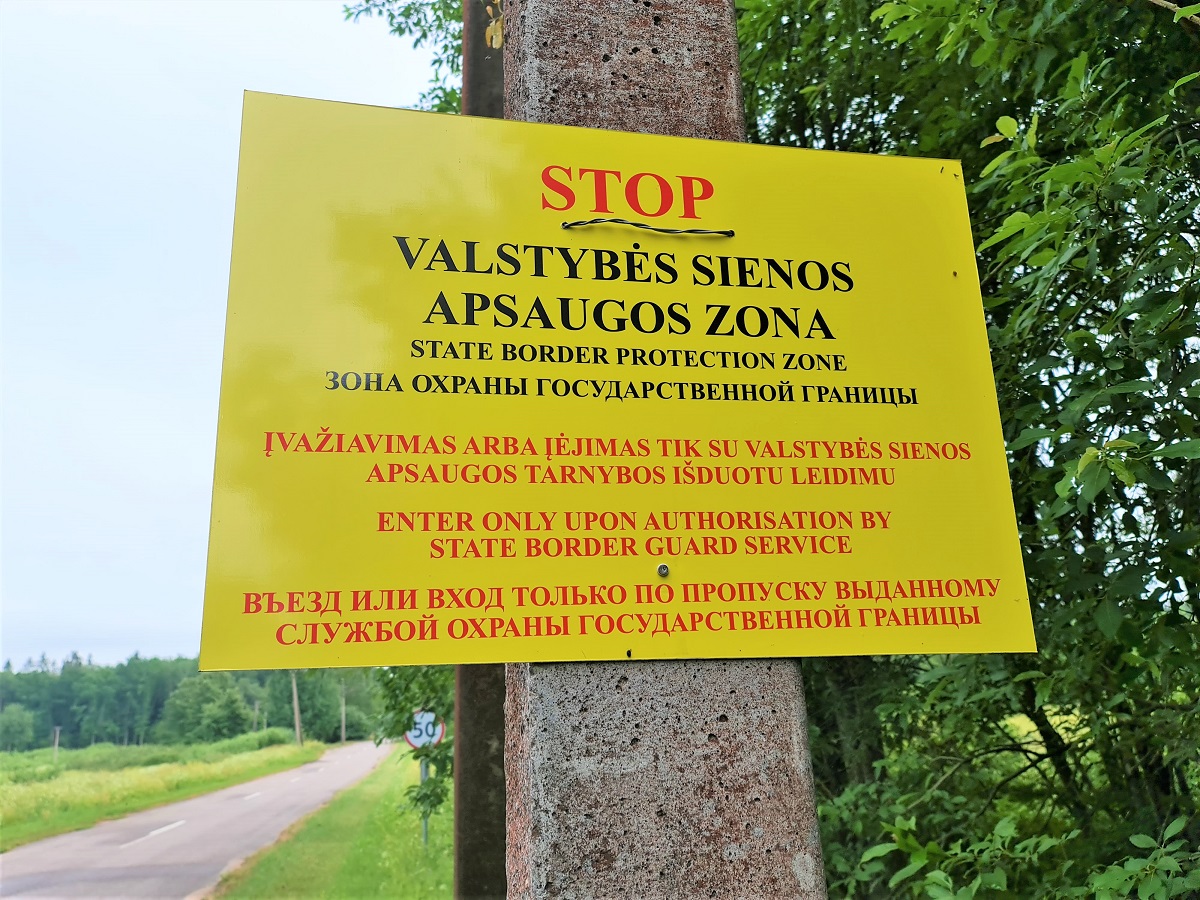
Rudninkai, a sleepy Lithuanian settlement of 500 inhabitants in the Salcininkai district along Lithuania and the EU’s border with Belarus, has been in both the local and international media spotlight this summer. Over 700 illegal male migrants had been placed for nearly three months in a makeshift tent camp, which is now eerily empty. All the migrants, mostly Iraqis, Kurds, Afghans and Sri Lankans, have been moved from the settlement to a former correctional facility in Kybartai, in the south-western district of Vilkaviskis near the Russian border. At the same time, around 400 vulnerable migrants have been moved to a refugee reception centre in Rukla, which is located in the central Jonava district. Some others are still living in municipal shelters, mostly crumbling dormitories in municipalities located along the 680 kilometre border with Belarus.
December 1, 2021 -
Linas Jegelevicius
-
issue 6 2021MagazineStories and ideas
Photo: Linas Jegelevicius
“Lithuania is clearly unprepared for a situation like this. Yes, Belarus is waging hybrid warfare against us, but do not get me wrong – the number of illegal migrants we have in the country is relatively insignificant and not a challenge for a state with resources like ours. But we’re acting – and overacting – as if we had been flooded by thousands and thousands of migrants”, says Dainius Zalimas, a former judge and former president of Lithuania’s Constitutional Court.
State of emergency
A couple of years ago, when Lithuanian border guards and the military held an exercise aimed at handling an imaginative deluge of 40,000 migrants, they claimed the drill was successful, Zalimas recalls. “From today’s perspective, the drills look inadequate to me”, he concludes.
Faced with the unprecedented emergency, Lithuania has largely managed to stem the migrant flows. The country has forcibly pushed many migrants back, a practice questioned both by national and international human rights watchdogs. The liberal-conservative Lithuanian government has defended its chosen tactics, maintaining that only harsh measures will work. Vilnius has also hinted that just a battle – not the whole war – had been won against the malicious Belarusian president, Alyaksandr Lukashenka.
“This is a hybrid weapon being used against Lithuania and the European Union… Most likely, Belarus will reroute the migrant flows towards Lithuania and work to find new means of provocation”, says Agne Bilotaite, the country’s interior minister. Bilotaite had been appointed commander of the national emergency operation during the summer. To cope with the migrant crisis, she has proposed building a fence on the border and her ministry has also introduced a state of emergency that has been in effect since early July.
Yet Zalimas, who is a law professor at Vytautas Magnus University in Kaunas, the country’s second largest city, cautions that the legal status of the emergency does not legitimise the Lithuanian government’s current actions. “Many omit one important thing: Lithuania has declared a state of emergency along the border municipalities. Not a countrywide emergency or a state of war, which, legally, would exempt the authorities from adhering to the country’s constitution and European human rights legislation. Although migrant pushbacks may work efficiently, it is plausible that Lithuania’s support for collective migrant detention and expulsion can backfire in the form of lawsuits (by the detainees) being filed against the country and losses through litigation”, the former constitutional court judge underscored. He added that “I am sure we will have cases of the kind”.
The interior ministry has informed New Eastern Europe that as of September 28th, 4,163 migrants have crossed Lithuania’s border with Belarus illegally. Around 2,800 of these migrants have applied for asylum. The number of registered migrants does not include those who have tested positive for COVID-19, who are subject to quarantine. Another 512 migrants remained unregistered because they refused to submit asylum applications. As of writing, a total of 164 migrants have been returned from Lithuania to their countries of origin.
Meanwhile, the Lithuanian state border guard service has noted that the flow of illegal migration into Lithuania this year is nearly 50 times higher compared to 2020. Last year, only 81 migrants were detained on the Lithuanian border. For comparison, in 2019, just 46 illegal migrants were caught by border guards. This figure was 104 in 2018 and 72 in 2017.
Iraqi or allegedly Iraqi citizens represent the majority of detainees on the border with Belarus this year. The rest of the detainees include citizens of Belarus, Guinea, Iran, Russia, Sri Lanka, Syria, Turkey and others. With the recent sharp rise in the number of such cases, the border guard has tightened security along the border with Belarus. Apart from a number of organisational measures, officers from other border guard units have been mobilised to this area and extra technical resources have been sent there. The public security service, the national riflemen’s union and the military have also come to the aid of the border guards. The European Border and Coast Guard teams (FRONTEX) are also working together on the border with Belarus.
Border fence
To deter migrants – now and for good – Lithuania has pinned its hopes on a fence to be built along the border. However, this endeavour has faced problems from the outset. It appeared that barbed razor wire was not readily available in the country. Reluctant to spend its own money, Lithuania appealed to Brussels but was told that funding cannot be earmarked for such purposes. However, in early August, EU Commissioner for Home Affairs Ylva Johansson visited the border and said that Lithuania can expect 20 to 30 million euros by 2022 to bolster border security. In the end, it was Estonia, Slovenia and Ukraine that offered Lithuania a helping hand, sending supplies of barbed wire. Meanwhile, the Czech Republic has pledged 530,000 euros to Lithuania to help secure its border with Belarus.
Lithuania also did its share of work, issuing an international tender to purchase 3,000 kilometres of barbed wire and all other necessary parts for installation. The interior ministry has said that the plan is to spend up to 16.15 million euros on 3,000 kilometres of barbed razor wire, which will be put up in several layers, and up to 12.5 million euros on installation works. The government says that, in all, 34 companies from Estonia, India, Israel, Lithuania, Luxembourg, Ukraine and the United States have expressed interest in the upcoming tender. Suppliers involved in the construction of the US-Mexico and India-Pakistan border barriers have also reportedly taken interest in the project. On September 14th, Epso-G signed a contract with Tetas, a Lithuanian firm, for the construction of the first 100 kilometre section of the border fence, with work expected to start at the end of the month. The fence will measure around 500 kilometres in total. It will not be put up in wetlands and other naturally impassable areas. Lithuania and Belarus share a border of 680 kilometres, including more than 100 kilometres of frontier along rivers and lakes.
Polls show that a third of Lithuanians support the border fence to stop irregular migration. But the fence has been a bone of contention among Lithuanian politicians since its inception. Dainius Kepenis, a member of Parliamentfrom the opposition Farmers and Greens Union (LFGU), is doubtful whether the fence will be enough to stop migrants from trying to get into the country. “Unless we erect a fence like the Great Wall of China, the fence [will] not be impenetrable… I hear some very weird things being said by the Lithuanian government. First, the ruling conservatives scold Hungary fiercely for building its own wall and now, look, what a U-turn – we are consulting with them on how to build our own wall”, he told New Eastern Europe.
Referring to Lithuania’s earnest support for the opposition in Belarus, he says that the country has ended up “paying a heavy price” for what he calls Vilnius’s role as a “pushy exporter” of democracy. He says that the hawkish foreign policy of the conservative-liberal government will cost Lithuania nearly one billion euros. This includes millions for temporary housing and roughly 150 million euros for the fence project.
“Very sadly, the crisis arose after the presidential election in Belarus in August 2020, when the Lithuanian government allowed Sviatlana Tsikhanouskaya (the symbol of the Belarusian opposition) to flee to Vilnius. It did so without consulting even our closest allies. It could not have made a bigger mistake than this. Secondly, we not only supported sanctions against Belarus, but also encouraged others to apply new ones, which, again, was against our core interests”.
Remigijus Zemaitaitis, a Lithuanian MP, said that “it would be naïve to believe that the fence will do the job the government expects [it to do]. With the chaos in Afghanistan, which followed the US troops’ chaotic withdrawal from the country, it is just a matter of time before we will see hordes of Afghan migrants stomping on our border”.
Plight at the border
Speaking to New Eastern Europe, Saulius Skvernelis, prime minister of the previous LFGU government, says that Lithuania missed a “good chance” in the summer to speak directly to Minsk about the migrants. “The new government was too hesitant and did not introduce a state of emergency at the border, which would have allowed the mobilisation of all state resources in tackling the issue”, Skvernelis added.
He is also convinced that the fence will not root out the problem stemming from increased illegal migration. Yet Laurynas Kasciunas, a Conservative MP and head of the influential parliamentary committee on national security and defence, believes that the fence is necessary to protect Lithuania from migrants now and in the future. “The two-layer fence with various engineering solutions is what we need to protect our border against an unpredictable regime like that of the tyrannical ruler over the border. We intend to finance the whole fence project from the state coffers, but we will ask Brussels to help us with it too”, Kasciunas said. According to him, the completion of the fence will cost around 150 million euros. So far, however, Lithuania has made a slow start to the project.
As of September 27th, a mere 40 kilometres of the barbed wire has been installed. The Lithuanian government says that the first 110-kilometre-section of fencing along the Belarusian border, topped with razor wire, should be finished by April next year. When Lithuanian border guards recently observed migrants crossing the already laid barbed wire barrier by simply cutting it, Agne Bilotaite quickly responded without providing any details that it would be improved with “various engineering solutions”.
Whilst many ponder what concrete measures the border guards are using to deter migrants from the border, the interior ministry has vehemently denied rumours that specially trained hounds, whips, beatings with rifles and any other form of physical and verbal coercion are being employed at the frontier. Despite this, five Afghan migrants maintain that they were helped by a local family after being wounded during an altercation with border guards. The European Court of Human Rights (ECHR) has issued an interim measure preventing Lithuania from removing this group from the country whilst their legal case is heard.
Zalimas says that Lithuania has “clearly” favoured state security issues over human rights throughout the emergency and that this will ultimately backfire on them at the end of the day. “Who knows – Lithuania could find itself in an unfavorable situation someday. The Belarusian regime can afford to do anything it deems necessary, but we cannot allow those people to die at the border. We seem now to be sometimes forgetting that there is a minimum level of compassion that has to be shown”, Zalimas added.
Caring for migrants’ safety
Until very recently, the Lithuanian authorities, citing security concerns, banned journalists from covering the situation at the border. However, the authorities have been carefully watching how local and international media have been reporting on the country’s handling of the crisis. In September, many major Lithuanian news rooms appealed to the country’s President Gitanas Nauseda, the Seimas (parliament) and the government in the hope that they would abide by the constitution and allow journalists into the country’s hotspots.
“The constraints for journalists cannot be implemented under the regional state of emergency we are still in. These measures could only be put in place during a general state of emergency or a state of war. Both can be declared only by the Seimas”, Zalimas emphasised. Only after widespread backlash did Lithuanian politicians reverse their decision to authorise mass detention of migrants and limit their right to appeal.
The interior ministry has reported that all the migrants from the infamous Rudninkai camp have been relocated to facilities with more amenities as of September 24th. Prior to the move, Lithuanian media had reported that male prostitution, sexual exploitation and extortion were taking place in the tent camp. Lithuania’s Red Cross has partly confirmed these findings to New Eastern Europe, stating that the situation in the tent camp was much worse than in the country’s other temporary migrant shelters. “There is a shortage of both tents and sanitary facilities to ensure the minimal conditions needed for dignified living in the Rudninkai camp”, the Red Cross said. The most vulnerable refugees, in all, 400 people, mostly families with children, were recently placed in the refugee reception center in Rukla in central Lithuania, where new modular housing units were quickly built.

The refugee centre in Rukla. Photo by: Linas Jegelevicius

Yet on September 25th, riot police rushed to the facility to quash unrest, which, reportedly, appeared out of the blue and was unrelated to the death of a child in the centre that night. When speaking to me during the summer, Beatrice Bernotiene, director of the Rukla refugee reception centre, confessed that she “sometimes” is more worried about the safety of migrants than of local inhabitants. Zalimas agrees with this feeling and says that Lithuanian social media is “ripe” with incendiary anti-migrant rhetoric. “I cannot fight my gut feeling that this (allowing it) is being done purposely – keep all migrants at bay at any cost”, he ponders.

Photo by Linas Jegelevicius

Notably, Lithuania’s foreign minister, Gabrielius Landsbergis, made a trip to Iraq in the summer in an attempt to get the Iraqi authorities more actively engaged in solving the migrant crisis. He specifically hoped to stop Minsk-bound flights with Iraqis on board and has said that highlighting the “unbearable” conditions of migrants in Lithuania on social media is very important. Since Iraq suspended all flights to Minsk in early August, Lithuania has recorded a significant drop in attempts by Iraqi nationals to enter from Belarus. The foreign minister also hopes that the EU will review its migration policies. The EU should not make the redistribution of migrants among member states a priority in discussing the bloc’s common migration policy, Landsbergis said in early September. The European Commission proposed a New Pact on Migration and Asylum back in 2020. Concerns about a possible new migration influx from Afghanistan has now brought a new impetus to the discussion about new migration rules in the EU. The growing burden of migrants weighs heavily on the government, as it could well face economic and reputational consequences should it not handle the crisis in a responsible manner.
Lithuanian analysts now argue that political fallout from the emergency is perhaps imminent. “Contrary to what the authorities say, the [migrant] crisis has not been handled fully. Many of the decisions, like passing a resolution on hybrid warfare [against Lithuania], constructing the trope of Lithuania as of an unattractive country [for migration] and some other decisions were rather successful, but they, as many more others, came belatedly and this has only increased the severity of the problem”, argued Jurate Novagrockiene, a professor of political science at the Military Academy of Lithuania. She says that it is difficult to say what impact the crisis will have on the ruling party. But with over three years until a new parliamentary election, the internet is already teeming with the posts of nationalist political wannabes and their supporters.
At the end of September, Evelina Gudzinskaite, director of Lithuania’s migration department, stated that asylum requests made by illegal migrants who have crossed the border should be fully processed by November. Of the 2,800 migrants who have already lodged asylum requests, only 600 have seen their cases processed. Despite this, not a single migrant has been granted asylum so far. In all, 320 requests have been rejected and asylum procedures have been discontinued in the cases of another 325, the Lithuanian official emphasised.
Linas Jegelevicius is a Lithuanian journalist and editor-in-chief of The Baltic Times.