
The essence of Belarusian solidarity
Thousands of Belarusians have fled to Poland. They include students, pensioners, mothers, and the children of parents who were arrested. Yet, these Belarusians continue the fight, despite the risks. They have formed structures and organisations which provide aid, political analysis and cultural promotion. And they have managed to turn the world’s eyes on Belarus.
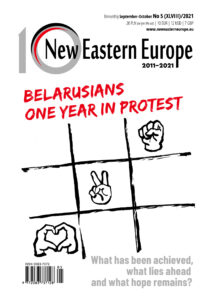
Since the rigged presidential elections in Belarus last year, thousands of Belarusians have come to Poland seeking refuge from the repressions of the Alyaksandr Lukashenka regime. Almost a thousand of them have already received political asylum and protection. However, their struggle for democracy in Belarus did not end with their departures. In exile, they grouped, got involved and created initiatives that allowed them to not only maintain a spirit of solidarity, but to continue the fight for a free Belarus.
September 12, 2021 -
Magdalena Chodownik
Omar Marques
-
Hot TopicsIssue 5 2021Magazine
Photo: Omar Marques
From victim to guilty
During one of the first protests in Minsk, Vitali[1] was hit by a grenade. The blast ripped a piece of his skin and muscle away. He lost a lot of blood while lying on the street. He waited a long time before receiving help, because no one could get through the blocked streets. He spent weeks in hospital healing. When he was due to be discharged, his friends advised him not to return home. People already knew that victims of Lukashenka’s brutality were searched by the authorities and then accused of participating in illegal protests (the infamous article 23.34, part 1 of the Administrative Violations Code, punishes those who “conduct” illegal demonstrations or other mass public events), or, in the case those who have actively opposed the regime, they could be accused of terrorism or an attempted coup. Victims were immediately labelled as guilty of crimes against the regime. Punishments include fines, imprisonment and torture.
Vitali did as he was told – he did not go back home. He was advised to inform his immediate family and to try to leave the country as soon as possible. “I was told that it would be possible to travel to Poland, that the Polish Embassy would help us to leave,” Vitali explains. “So my wife packed the most necessary things, we took the children and we left Belarus with the first possible transport.”
Two employees of the Ministry of Light Industry peek into the cardboard boxes placed in the rooms – one with clothing, the other with bed sheets. There are dozens of other boxes here as well. Women take out each item, unfold it, check it and, if good enough, put it back into the box. Items include women’s blouses, men’s trousers and children’s sweaters; there are toys in other rooms of the ministry, towels and shoes.
“Once we sort everything, we will take it to the Belarusians in need. Those who had to flee immediately usually have nothing except what they were wearing on them at the very moment”, they explain to us. The Ministry of Light Industry, as they call themselves, is part of an initiative called “Partisan”, carried out in Poland jointly by Belarusians and Poles. Their activity focuses on many aspects of assistance to respond to the basic needs of Belarusians fleeing to Poland, like Vitali’s family. The Ministry of Light Industry is responsible for material aid, the Ministry of Language for help in learning Polish, and the Ministry of Housing helps newcomers find a place to live. The alternative Belarusian government is based on solidarity and kindness.
One of the activists of “Partisans” is Jana Shostak, a Polish-Belarusian activist known for “The Minute of Scream for Belarus” (a performance during which, wearing a white and red dress, Jana Shostak screams in order to draw attention to the Belarusian issue). She brings clothes to the ministry, drives to refugee centres and other places where Belarusians are to distribute help, knocks on the doors of Polish politicians, fights for a faster process of issuing visas for those in need, creates an info-line for newcomers and strives for better migration policy in general.
“I have this strength from people who share with me their stories of torture through which they went. I take my strength from political prisoners who still write, in their letters, asking not to give up. I take strength from every family I see here in Warsaw, and despite the terrible situation, the separation of their families, the death of individual family members, they still want to fight for a new Belarus. New and free,” she concludes.
“Victory” Plan
Not only do the victims of the regime and their families flee to Poland, so do former employees of the regime – employees from the lower and higher levels of Lukashenka’s apparatus, including member of the police force of the “siloviki”, security forces. In Warsaw, they created an organisation called ByPol, which – thanks to its contacts, knowledge and information obtained “from within” – carries out investigations into the activities of the regime, as well as mobilising Belarusians inside the country.
“With the help of our specialists, we started the so-called ‘Victory’ plan – a plan for the mobilisation of the mass public, which is taking place inside our country. Specifically, we have created an anonymous bot, so that people can join or sign up with us via Telegram. They answer a small questionnaire, a few questions, and after we receive these answers, we already know how and where to group them. It is important for us to be able to form groups out of them in order to be able to give them specific tasks later,” explains Alexandr Azarov, one of ByPol’s employees and a former Lieutenant Colonel with the Belarusian police. He quit his job and came to Poland to work for the organisation.
The street protests in Belarus are over for now. Even the slightest display of disagreement with the authorities is enough to end up being beaten or imprisoned. As Azarov explains, during the big wave of demonstrations, the special forces and police were ordered to beat demonstrators so that they would not be able to physically return to the streets to demonstrate. “Now people don’t want to go out anymore, but they still want change,” he continues. “It ends with arrests and fines. And if you count all those fines together, it would be millions of dollars. And why should we finance the regime with these fines?”
That is why ByPol has developed a different strategy, although its goal is the same as that of the majority – to remove Lukashenka from power and bring democratic change to Belarus. “There must be enough people, and then we will only wait for the right moment, when we can put these mobilised groups into action,” Azarov explains. “When that moment comes, it will be a bloodless revolution in the country.”
The fight
“Today’s emigration is different than earlier ones, the one that has been fleeing Belarus since last year. Before, mainly political activists, civil activists and journalists have fled the country. Today, even ordinary people who have never dealt with politics are forced to escape in search of safety. Today, one can be repressed for really anything,” says Aleś Zarembiuk, head of the Belarusian House in Warsaw.
The scale of repression is also unprecedented as is the number of people seeking refuge. Thousands like Vitali fled to Poland. They include students, pensioners, mothers, the children of parents who were arrested and people whose only crime was to take to the streets and voice their opinion. Among them are Belarusian politicians, Olga Kovalkova, who was forcibly driven out of the country, and politician Pavel Latushko. The group of asylum seekers was recently joined by the Olympic athlete, Krystsina Tsimanouskaya, who received threats for criticising the Belarus Olympic Committee. As a result, she had to hide in the Polish Embassy from Belarusian officials and did not return to her country from Tokyo. After being granted a humanitarian visa, she flew to Poland, where her husband and child are about to join her.
Despite the risks, even abroad, Belarusians continue the fight. They have formed structures and organisations that operate in many sectors – aid, political, cultural and information. They managed to turn the world’s eyes on Belarus. For the past year, the Belarusian community in exile, has been a loud voice of their country, a voice of constructive opposition to Lukashenka’s rule.
When Vitali and his family were leaving Belarus, it was still possible to cross the Polish-Belarusian border. Over time, however, the government of Belarus has closed its land borders, and after diverting the flight with Roman Protasevich on board earlier this year, Poland stopped all direct flights to Belarus (as well as flights over Belarusian air space). Today, it is more difficult for Belarusians to escape – they have to organise flights through other countries, such as Russia, Ukraine or Turkey, or cross borders illegally. But Belarusian migrants in neighbouring countries do what they can to help to make such trips possible and to help others to reach a safe place.
Magdelena Chodownik is a Polish freelance journalist, photographer and producer.
Omar Marques is a freelance photojournalist from northwest Portugal based in Kraków, Poland. He works as a stringer for Getty Images, Anadolu Agency and collaborates with magazines on editorial and commercial assignments between Central/Eastern Europe and the Balkans.
[1] For security reasons, the names of some activists have been changed.