
Repressions reveal the ruthlessness of the Lukashenka regime
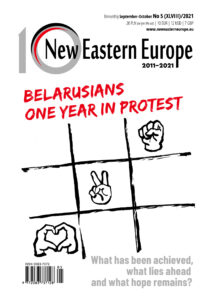
Since August last year, the Belarusian regime under Alyaksandr Lukashenka has instituted a system of repressions which is unprecedented for Europe in the second decade of the 21st century. By the end of July this year there were 604 political prisoners in Belarus, the total number of those imprisoned after August 9th 2020 is estimated at more than 35,000. Thirty-two Belarusian journalists are currently in custody, either awaiting trial or serving their sentences.
For more than 25 out of its 30 years of independence, Belarus has been a country governed by a sophisticated state-run system of repressions. Yet since last year’s presidential elections, these repressions lost their sophistication and reached a different level in terms of quantity and “quality”. There are at least three perspectives to consider when examining what is happening in Belarus since August 9th 2020.
September 12, 2021 -
Stephan Malerius
-
Hot TopicsIssue 5 2021Magazine
Poster of opposition activist and journalist Roman Protasevich on display outside of Lithuanian embassy in Brussels, Belgium. Photo: Alexandros Michailidis / Shutterstock
The first is the global perspective that both US president Joe Biden and Sviatlana Tsikhanouskaya referred to during their meeting at the White House in July when describing Belarus as being on the frontline of a battle between democracy and autocracy. A second more country-specific perspective is looking at the repressive actions of the Belarusian regime that had led to the democratic community – the US, Canada, the European Union, the United Kingdom and numerous other states – to introduce sanctions against Alyaksandr Lukashenka and its entourage as a result of human rights violations, electoral fraud and the violent repression of civil society, democratic opposition and journalists, most significantly symbolised by the forced landing of the Ryanair flight in Minsk and the related detention of Raman Pratasevich and Sofia Sapega.
The third perspective is zooming in on what is happening on the ground level, namely, differentiating between police violence on the streets, the forced entry into private homes or businesses, the random fines imposed on citizens, the punishment of family members for alleged offenses committed by their relatives, the removing of children from the custody of their parents, the risk of losing one’s job or being expelled from university, arbitrary detentions, torture and killings. All of this is covered by a complete dysfunctional legal system and total lawlessness. All three perspectives are interrelated and equally important with the third one building the basis for, and substantiating, the other two.
New scale of repressions
When writing about repressions in Belarus – it is a good idea to start with numbers. As of the end of July this year there are 604 political prisoners in Belarus, the total number of those imprisoned after August 9th 2020 is estimated at more than 35,000. Thirty-two Belarusian journalists are currently in custody, either awaiting trial or serving their sentences. There have been 4,691 criminal cases related to peaceful protests launched, mostly concerning political graffiti or “insulting government officials”. Within a year Belarusians are estimated to have paid more than 850,000 euros in fines for participating in protests. It is difficult to establish an accurate number of ill-treatment but during the post-election unrest between August 9th and 11th, the human rights NGO, Viasna, documented 500 cases of torture. More than 200 raids of offices and apartments of activists and journalists have been reported in July this year alone. Fifty-six NGOs have been forced to close during a nationwide crackdown on civil society in July, including the Belarusian Association of Journalists, the Belarusian PEN Centre, the European Youth Parliament, the BelSetka Anti-AIDS group, an organisation that assists disabled people and an animal rights group.
This does not take into account all those who have been sacked from work, expelled from university, or forced to leave the country. It does not account for the torture that has happened during arrests, the use of electric shock devices and tear gas, psychological humiliation, rape and sexual abuse, and the deprivation of food, water, hygiene, sleep and medical assistance. The aim of the abuse is to punish and humiliate – they are intentional, widespread and systematic. They are targeted at protesters, though sometimes bystanders have been assaulted or attacked.

Individual cases further illustrate and underline the magnitude of brutality and inhumanity that is occurring in the middle of present day Europe. For example, a woman on her way to a driving lesson was grabbed by four men in black balaclavas in Minsk. They told her she was dressed improperly. The reason? She was wearing white socks with red stripes. A judge ordered her to pay 2,320 Belarus roubles (780 euros), according to a law banning unauthorised protests. Alexander Gazimov, 35, a construction worker, was detained in the aftermath of a protest last August in northern Minsk. Trying to evade arrest, he broke his leg. When the officers caught him, they threw him into a van and beat him for about 10 minutes. The police repeatedly stepped on and kicked his broken leg, inquiring “Is your leg really broken?” They also threatened him with rape.
In Homiel, Dmitry Lukowski, arrested on the street by police, described a corridor full of OMON officers waiting to beat him and other detainees, recounting: “At first, I kept silent, but then I started screaming. I fainted, but they splashed water into my face and continued to beat me. There was blood everywhere and I saw a few teeth on the floor [not my own].” At some point a policeman grabbed him by the hair and said, “So, Lukowski, you want a lawyer?” When he answered, “Yes,” the officer beat him again and asked, “So, Lukowski, you still want a lawyer?” Despite many proven cases of torture, abuse and arbitrary arrests, not a single member of the security forces has been put on trial.
International reaction
One reason for the ruthlessness of the Lukashenka regime is that there seemed to be a momentum for the protest movement after the election day in August 2020. Tens of thousands attended rallies that were creative, almost cheerful, attracting international attention. Protesters would organise decentralised meetings in courtyards after it had become impossible to peacefully gather in central places, making it harder for the police to control them. But with time, the brutality of the security forces against the protesters resulted in this momentum fading away.
The EU, its member states and (transatlantic) partners began to support the peaceful protesters in Belarus: Lukashenka was not recognised as president, instead that went to Sviatlana Tsikhanouskaya, the likely actual winner of the elections. Lithuania and Poland provided support for activists fleeing the country. Moreover, 206 European politicians have taken on the role of god-parent for political prisoners. In June this year the EU imposed the fourth package of sanctions against the Lukashenka regime. In Lithuania, Poland, the Czech Republic and Germany legal inquiries into the regime’s conduct are being prepared. And, perhaps most importantly, an international accountability platform for Belarus was established, collecting and preserving evidence of torture and other serious human rights violations in a secure manner.
What can be done?
In light of the above, what else can and should be done? Three points seem to stand out. First, the EU has already provided significant support to civil society in Belarus. However, bureaucracy in Brussels is often making its support less effective – poor management of funding, lengthy decision-making processes and administrative requirements. In this exceptional situation, procedures for support programmes need to be simplified as much as possible, including the provision of humanitarian funds that directly help people and families of those who are imprisoned or need to flee abroad.
Second, some (geographically) relevant EU member states like Germany are still not flexible enough when it comes to issuing visas for Belarusians in need. EU member states need to be as flexible as possible in granting visas for repressed Belarusians.
Lastly, the international community has so far stopped short of naming Russia as the sponsor, agitator and instigator for the actions of the Belarusian regime. The key to ending violence is in Moscow, and international anger to what is going on in Belarus should be directed at Lukashenka the same way as at Putin. In the joint communication of the EU on EU-Russia relations from June 16th this year there is no mention of Russia’s backing of Belarus. The EU, the US and their partners need to be much more outspoken, making it clear to Putin that he too will be made responsible for the violence in Belarus.
Stephan Malerius is a member of the board of the German-based NGO Human Rights in Belarus and former head of the Belarus office of the Konrad Adenauer Foundation.