
Text resize: A A
Change contrast

Turkey’s original sin

A conversation with Candan Badem, a Turkish historian and participant of the Scholars at Risk (SAR) programme. Interviewer: Krzysztof Popek

KRZYSZTOF POPEK: You are the first participant of the Scholars at Risk (SAR) programme in Poland and your host is the Villa Decius Institute for Culture and the Jagiellonian University in Kraków. SAR protects scholars suffering from threats to their lives, liberty and well-being by arranging temporary research and teaching positions. Why were you forced to leave Turkey?

CANDAN BADEM: Since September 2016, I have not been allowed to teach or even participate in symposia at Turkish universities due to a state of emergency decree of the Recep Erdoğan regime. After the attempted coup d’état in July 2016, linked to Fethullah Gülen, an Islamist preacher who was Erdoğan’s former ally, Erdoğan announced a state of emergency and purged the opposition (along with Gülen’s supporters) from their jobs in state institutions, including universities. We still do not have key information on this attempted coup since the Erdoğan regime does not want to disclose the details and prevents a parliamentary investigation.

June 23, 2021 - Candan Badem Krzysztof Popek - InterviewsIssue 4 2021Magazine

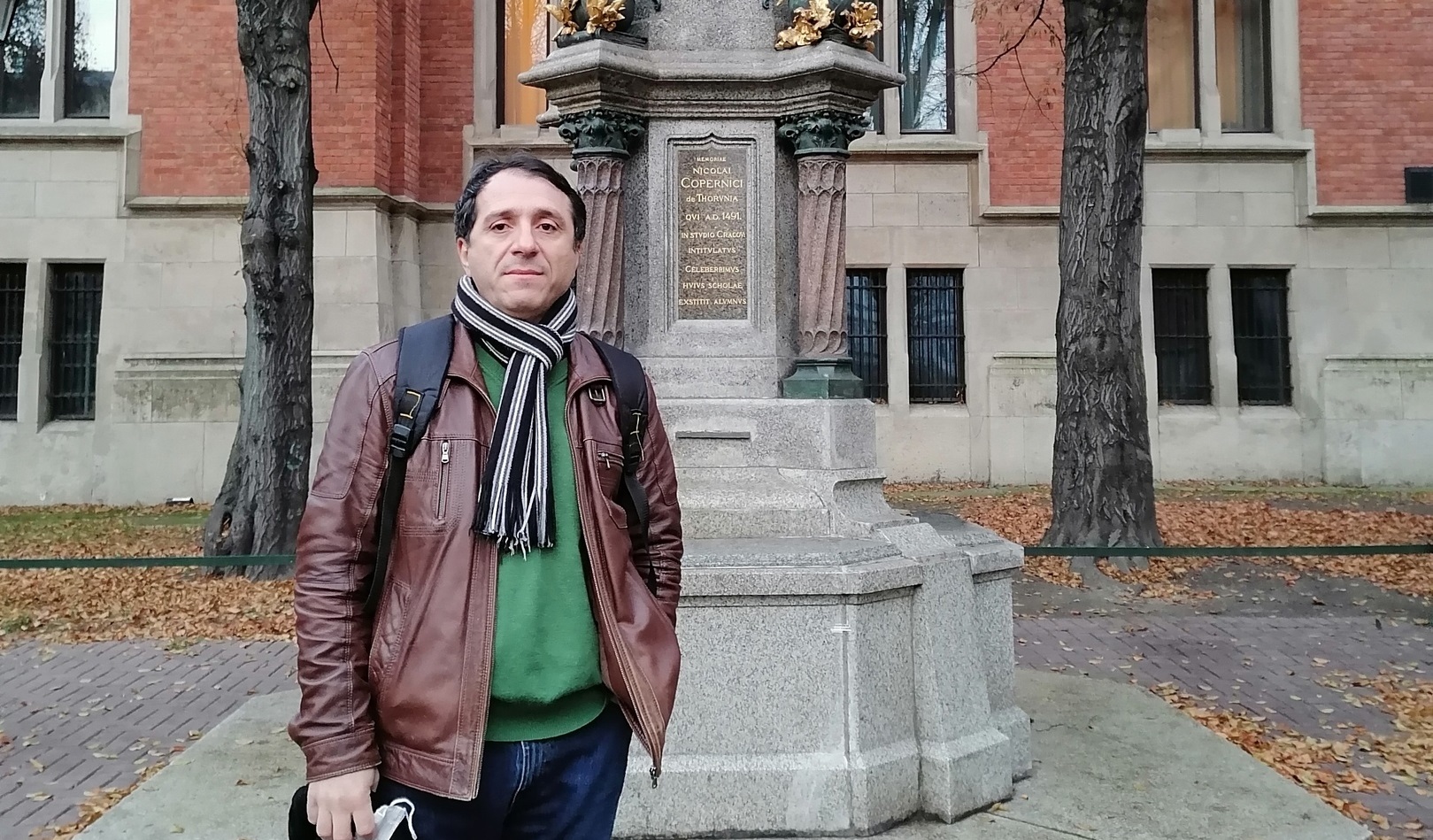
Photo courtesy of Candan Badem

I was among the first who suffered repression, I was expelled from the position of head of the History Department in the Munzur University in Tunceli (a small city in eastern Turkey). I faced absurd charges, including belonging to Fethullah Gülen’s religious sect even though I have always identified as an atheist and I strongly criticize Islam. The rector of my university claimed that they had evidence against me, but he and others never showed proof of these claims. The commission appointed by the government has not decided on my case since 2017 despite the fact that I was acquitted by the court of the charges of being a member of the Gülen terror organisation. I am still not allowed to work in public or private universities in Turkey because private universities are also under pressure and do nothing to defend academic freedom. In most cases, the owners of these universities are dependent on the regime. In 2016 the authorities also cancelled my passport and banned me from going abroad. Thus, I could not take jobs and scholarships offered to me in Europe. Only in August 2020, the regime gave me my passport back and I travelled here to Kraków in November. Kraków is a beautiful historical city and that is why I am here.

The accusations against you belonging to the Gülen movement were false, so why did the Turkish government take all these actions against you?

Of course, the regime knew that I am not a Gülenist. It was just an excuse. They simply do not want any free voices in academia. You must be either a loyalist, Islamist, Islamofascist or a conformist at most. I was one of the more than 2,000 academics who signed the Academics for Peace Declaration in January 2016 in which we protested the violence on Kurdish civilians, calling on the government to stop these actions, and announced that we would not be silent on these crimes. I was also one of the four academics who filed a lawsuit against Erdoğan’s insults to the Academics for Peace. At the time the Erdoğan regime started widespread repressions against the Kurds. Since 2016 the leader of the Peoples’ Democratic Party, Selahattin Demirtaş, and many journalists, academics, lawyers, and students remain imprisoned as “terrorists”.

How big is the problem of censorship in the humanities in Turkey? How does it affect academic life?

Everyone in Turkey practices self-censorship because any criticism may lead to imprisonment or dismissal. The Erdoğan regime has turned Turkey into a semi-sharia state where the rule of law is not applied and the constitution is de facto suspended. The problem with the humanities started when the Islamists came to power, they wanted to control all universities and professors. In the past, the Gülenists strongly influenced higher education – for example, they were stealing the questions of the state exams to enter universities and military schools so their followers could pass exams and infiltrate these institutions. Now the government calls them terrorists, but other political Islamist, jihadist sects are replacing the Gülenists in all institutions. Many former Gülenists are also still in parliament, hold places within the ruling party and almost everywhere. The universities lost the last part of their autonomy.

One of the most obvious signs of this is how rectors are appointed. Rectors are directly appointed by Erdoğan. In the past, faculty arranged elections for choosing new rectors. Now appointed rectors usually do not have the necessary qualifications. For example, there is still a protest at the Boğaziçi University in Istanbul, my alma mater; the authorities appointed Melih Bulu who has been accused of plagiarism. Protesting students were arrested at night in their homes and the interior minister accused them of being members of terrorist organisations. Academics of the university, despite a few exceptions, are against Bulu. They protest his appointment every day at campus, but he still holds office. Only a few professors support him, and they have been appointed as vice rectors. The rectors copy the methods of Erdoğan and act like dictators; faculties and departments cannot make any decisions in their affairs. The quality of academic work is negatively affected. No Turkish university is now on the top international ranking university lists. The number of academics and universities is increasing but the quality of education has declined. As a result, academics are afraid of speaking on social and political matters. Even if they wanted to speak, mainstream media is controlled by the government, and these media outlets exist in a post-truth parallel reality. They prefer to listen to uninformed imams than professors. Like Erdoğan, they believe that interest rates are the cause of inflation. One of the most important people is the head imam of the Hagia Sophia (it has become a mosque again in 2020) who makes comments on everything, including economic matters. Yet economics professors and specialists remain silent and do not comment on the situation in Turkey – they are too afraid.

The situation at universities affects the public sphere. For example, Professor Erişah Arıcan was the thesis adviser of Berat Albayrak, the son-in-law of Erdoğan and former minister of finance. There are serious allegations that this professor wrote Albayrak’s thesis (some emails leaked with information about it). He repaid Arıcan by making her chair or vice chair of key institutions, such as the Istanbul Stock Exchange, the Turkey Wealth Fund and Marmara University. Meanwhile, the EU Commission and EU Council continue to co-operate with the regime in Turkey, paying only lip service to human rights violations by stating they are “deeply concerned”. Commercial interests are obviously more important for them. The European Court of Human Rights is also reluctant to pass verdicts regarding the victims of the regime in Turkey, stating that domestic legal remedies have not yet been exhausted when in fact the regime simply keeps us waiting endlessly.

You were the first historian from a Turkish university who did research in the National Archives of Armenia in Yerevan in 2009. Why was this so extraordinary?

Technically, it was not extraordinary – the Armenian archives do not require any special permission. It is likely that other historians did not know the existence of these archives, did not know Russian or Armenian, or thought they were not open to Turkish researchers. Nationalist historians in Turkey have claimed that the Armenian archives were not accessible to Turkish researchers, but they never tried applying to those archives. For them, it was convenient because they could claim that the Ottoman archives are open and everybody can research there, while the Armenian archives are allegedly closed. As far as I know, the only Armenian archives that are closed are the ones of the Armenian Revolutionary Federation in the United States and they do not belong to the Armenian state. Turkish nationalists accuse Armenians of hiding something. I think I did a good job showing that the Armenian archives were there and open to all. If you go to Yerevan, you can work there normally. In 2009, I went to Armenia for my research on the Kars area in the Caucasus and I did not work directly on the Armenian genocide. However, if you are a historian in Turkey, you will have to eventually confront this problem one day or another. It is unavoidable.

Why is it like that?

 For Armenians, the Armenian genocide is a national tragedy, for Turkey it is the original sin of the modern nation. In the late Ottoman Empire, about ten per cent of inhabitants of Anatolia were Armenians, now they are practically gone, only a very small community has remained in Istanbul. During the First World War, the Ottoman government decided to relocate Armenians to the desert of Syria using security and the war as an excuse. However, the Ottoman government banished all Armenians regardless of their proximity to the war zone or their actual ties to any anti-government activity. In this mass relocation of around one and a half million Ottoman Armenians, hundreds of thousands were killed, captured, raped, or left to starve. Some children and young women were forcibly converted to Islam. This is a big issue that cannot be left to historians alone. Our nation needs to face it. I believe recognising the truth will liberate us.

The Turkish authorities have silenced or denied the Armenian Genocide for more than one century. Is dialogue between Turkish and Armenian historians possible?

 Yes, it is possible. There are many Turkish historians open to dialogue but usually they live outside of Turkey. Some historians in Turkey also do not accept the state ideology, but they are now afraid to speak up. The Islamist regime in Turkey initially seemed to be open to dialogue. Ten years ago, they were presenting themselves as supporters of the so-called “moderate Islam”, as democratic conservatives and economically liberals. But it was just a simulation and tactic to mislead. They now openly declare their Islamist agenda and the idea of a sharia state. In 2005, there was an important symposium organised by three universities in Istanbul, to be held at Boğaziçi University, a state university. For the first time, the Armenian question was the subject of a scholarly discussion, free from state propaganda. However, the symposium was suppressed by the government before it even began and the event was only held months later under different conditions in a private university.

Why do Turkish authorities deny the Armenian genocide? You called it the original sin of the Turkish Republic, but it was so long ago. There were several generations after these events…

It is because they have dug a defence trench for themselves so deep that they cannot get out. The Armenian genocide did not become an international issue after the First World War. Unlike the Holocaust, there was no international tribunal that would bring justice to the Armenian people and punish its perpetrators. During the occupation of Istanbul by the French and English in 1919, the Ottoman Military Tribunal sentenced many perpetrators, but its decisions were not implemented because of the resistance of the bureaucracy, the ensuing national struggle, and the war against Greece and Armenia. When the Turkish Republic was founded in 1923, the issue was already forgotten. Fortunately, the founder of the Turkish Republic, Mustafa Kemal Atatürk, was not involved in the genocide. Until the 1970s there was not much pressure on Turkey. Afterwards, Armenian terrorists started to assassinate Turkish diplomats and the Armenian genocide became an international issue. At that time new publications appeared, and western researchers began to be interested in the subject. The Turkish foreign ministry began to formulate the official viewpoint, denying the genocide. The authorities decided to modernise the Ottoman archives and open them to researchers – however, these archives were purged and many documents about the fate of Armenians during the First World War have been lost or unclassified. However, there is still a huge body of documentation that indirectly demonstrates that the state directed massacres against Armenians. My position is that it was genocide and not just a relocation of the population necessitated by war. Yet the Turkish government thinks that if it accepts that historical fact, the Armenians will demand territory and reparations.

Candan Badem is a Turkish historian, a writer and editor of publications on the Ottoman Empire and the Caucasus. He has researched the history of Turkey in the state archives of the United Kingdom, Armenia, Georgia and Russia. In 2009, he was the first Turkish historian who researched in the National Archives of Armenia in Yerevan.
Krzysztof Popek is a Polish historian, an assistant at the Institute of History of the Jagiellonian University, and member of the Balkan History Association in Bucharest. He specialises in the political and social history of the Balkan Peninsula in the 19th century.

, ,

Partners

Terms of Use | Cookie policy | Copyryight 2026 Kolegium Europy Wschodniej im. Jana Nowaka-Jeziorańskiego 31-153 Kraków
Agencja digital: hauerpower studio krakow.
We use cookies to personalise content and ads, to provide social media features and to analyse our traffic. We also share information about your use of our site with our social media, advertising and analytics partners. View more
Cookies settings
Accept
Decline
Privacy & Cookie policy
Privacy & Cookies policy
Cookie name Active
Poniższa Polityka Prywatności – klauzule informacyjne dotyczące przetwarzania danych osobowych w związku z korzystaniem z serwisu internetowego https://neweasterneurope.eu/ lub usług dostępnych za jego pośrednictwem Polityka Prywatności zawiera informacje wymagane przez przepisy Rozporządzenia Parlamentu Europejskiego i Rady 2016/679 w sprawie ochrony osób fizycznych w związku z przetwarzaniem danych osobowych i w sprawie swobodnego przepływu takich danych oraz uchylenia dyrektywy 95/46/WE (RODO). Całość do przeczytania pod tym linkiem
Save settings
Cookies settings