
Odesa’s growing mismanagement
Odesa has faced many challenges in recent years. However, the ongoing pandemic and the reduction of land available for construction have brought the issue of ineffective management back. It is linked to the lack of an adequate response from the authorities as well as corruption.
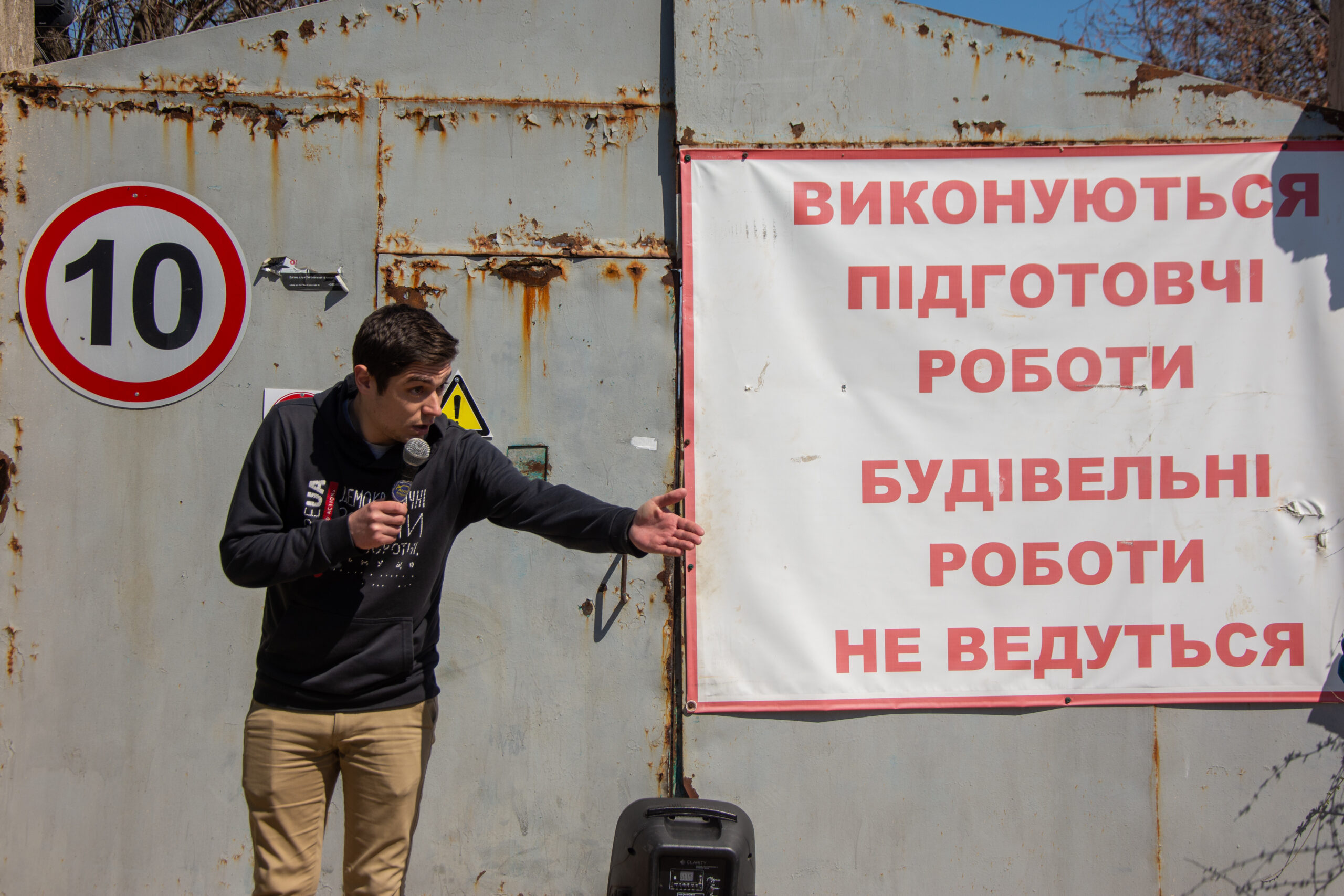
On Saturday morning, several dozen people picketed the construction of an alleged yacht club and residential complex being built on the sea coast in Odesa. The protests were led by Vitaliy Ustimenko, an activist from Odesa who is the leader of a grassroots organisation called the AutoMaidan. “We will not allow dumb and insolent oxen capture the sea coast of Odesa,” Ustimenko said as he was speaking into a microphone.
June 23, 2021 -
Maxym Przybyszewski
-
Issue 4 2021MagazineStories and ideas
Several dozen people have picketed the construction of an alleged yacht club and residential complex being built on the sea coast. Photo: Maxym Przybyszewski
People gathered at the gates of the construction site. The company in charge of the construction is called Varda Plius. Its representatives have claimed the construction is not going forward, but refused to let people on the premises. Journalists, police officers or the city councillor, Olga Kvasnichkaya, cannot enter the site. Previously, the environmental inspection was denied. The plan is to build apartment buildings about 20 metres from the sea. Environmentalists worry about the impact this could have on the sea and coastal soil. According to Ukrainian law, a building this close to the sea is allowed only in exceptional cases. For this very reason, one of the five-star hotels on the beach of Odesa was initially built as a “rehabilitation and a health resort with dolphin-assisted therapy”, the other one allegedly was a reconstruction of a sea rescue station.
The Varda Plius construction company received permission for the reconstruction of a yacht club which includes three buildings up to 25 metres tall. Activists believe this will be a normal residential complex. Trials are still ongoing, but the property developers are winning so far – restrictions on the construction were lifted at the end of March.
Corruption and lost opportunities
This was one of many recent lawsuits and street protests against the construction in Odesa’s historic city centre. Although the architectural ensemble of Odesa’s old town contributes to tourism, it is hard to remember the last time something was done to preserve or expand the city’s cultural heritage. For instance, the owner of one of the most famous buildings in Odesa, Russov’s House, was sued by city authorities several years ago. The four-storey mansion situated in the city centre was built at the end of the 19th century at the request of a merchant, philanthropist and art collector named Alexander Russov. The mansion was a perfect representation of neo-baroque, with its richly decorated stucco, sculptures, a tower with a spire and rows of spacious windows. In the early 21st century, every apartment in the Russov building was purchased by Ruslan Tarpan, an entrepreneur who publicly announced his initiative to dismantle and rebuild the mansion. The house was never restored during the Soviet era and around 2000 its restoration was declared a dire need. Between 2009 and 2017 around ten fires occurred in the building. As a result, the roof was partly destroyed.
Tarpan did not have enough time to restore the house. In 2013 he went abroad to escape criminal charges issued against him. He is still a wanted man in Ukraine. He is accused of forging documents and embezzlement of huge sums of money. None of the accusations, however, has anything to do with Odesa’s architecture.
The authorities in Odesa, since 2017, have tried to win the right to restore Russov’s house in court. They even managed to demonstrate their right to spend money on the restoration. A company from Kyiv, called Ukrspetsproekt, won a tender to carry out the reconstruction. After the work was finished, police opened a criminal case based on budget embezzlement and criminal association. Details of the newly restored house quickly started to crack. In December 2020, the prosecutor’s office brought charges against the director of the company. As it turned out, she hired the company of the business partner of the house owner as a subcontractor. In April this year one of the restored statues crumbled because those who were restoring it used a plastic bottle as the frame.
Throughout the last year, around ten old buildings have either partially or completely collapsed – some of them did not have historic value but most were architectural monuments. Some were privately owned and had been collapsing overtime. Such was the fate of Odesa’s former ice cream factory, Polyarnaya Zvezda (Polar Star). Others were residential buildings which had the status of architectural monument. Therefore, theoretically they should have been maintained in appropriate conditions. One way or another, the city began losing buildings that could have been valuable for locals and tourists. Activists have declared a readiness to defend what is left of Odesa’s historic heritage, fighting for it almost with guns in their hands. The number of these activists, however, remains very small.
Fighting to preserve heritage
One successful example of the activists’ collective effort was the fight to preserve the Marazli Summerhouse – a complex of three historical buildings constructed at the end of the 19th century. The land on which those buildings are located had been part of a Soviet sanatorium and was handed over for new construction work in 2019. Before that, in 2017-2018, the city authorities and future complex owners were dealing with formal procedures of handing over land from one owner to another, including privatising households and historic buildings. The buildings have a direct view of the sea and are surrounded by one of the largest parks in Odesa – truly an upmarket neighbourhood for a residential complex.
The new owner’s initial plan was to build several residential buildings and preserve at least one of the three historic buildings. In December of 2020 and January 2021, hundreds of local residents took part in the protest – a drop in the ocean for a city with a million inhabitants. Several weeks afterwards, the National Anti-Corruption Bureau of Ukraine prohibited the construction on the territory until the investigation was over. Currently, the construction is halted; however, the old buildings are not being restored either.
Alexandr Babich is among those who are fighting to preserve the heritage of Odesa. It is not only limited to old buildings but to burial grounds. Babich was among those who recently achieved the ban of building new garages on the burial ground of the victims of communist repressions of 1937-1939 and 1941. One hundred years ago, this land was located at the outskirts of the city and, according to preliminary data, the remains of around 8,000 Ukrainians, Poles, Germans and Romanians are buried there.
“You are fighting for something that has value for you. Some of the activists are fighting for green spaces which are becoming fewer and fewer. Others are fighting against construction on the sea coast. And there are some who are in this to preserve the local heritage. Another type of fight is for the pro-Ukrainian idea and a pro-Ukrainian context,” Babich says. He owns a tourist company, called Tudoy-Sudoy, and has been fighting against Russian influence in Odesa since 2014. He defends the right of the people of Odesa to have a new Ukrainian history, a normal historiography without Soviet influence.
“This is about the history of vandalising monuments, the history of renaming streets of Marshal Zhukov or Nebesnaya Sotnya street (Heavenly Hundred street), about the language issue, the choice between [using the phrase] the Second World War and the Great Patriotic War, about whether the monument of Catherine the Great should be in Odesa or not. The question is very complex and only a careful incorporation of historic documents into the context can solve it”, Babich says.
Babich is honest when he says that he and other activists are exhausted. The number of motivated activists is still small. Despite that, Babich keeps working and says that people on the other side, (i.e. those working for the city administration) are also tired. “Before, the city authorities communicated with the activists, but now they do not even bother to gather coordinating councils. Previously they at least tried to demonstrate a readiness to talk, but now they don’t need that,” he says.
All politics is local
Many residents of Odesa hoped things would change for the better after local elections took place in autumn 2020. Turnout was around one-third of the voters and even fewer cast their vote during the second round of the mayoral elections. As a result, new members made up nearly half of the new city council. However, Mayor Gennady Trukhanov managed to maintain control over the city administration. Officially, he has held the position since 2014, but in fact he has been running the city for some time longer – through his business and political associates.
Trukhanov controls the largest fraction in the Odesa city council and has easily succeeded to bypass his opponent, Nikolay Skorik. Skorik is a member of the pro-Russian Opposition Platform-for Life party. Both politicians are former members of Viktor Yanukovych’s Party of Regions. The difference between them is that Trukhanov managed to partly win Odesa’s patriotic-minded electorate. Prominent artist and former comedian Oleh Filimonov, who was running in the election as a candidate for the Volodymyr Zelenskyy’s Servant of the People party ended up with less than 10 per cent of the popular vote.
Zelenskyy’s party has the largest number of new members in the city council, with 9 out 10 members never involved in local politics or affiliated with local politicians. They are still facing challenges competing with older fractions. Both the Opposition Platform-for Life and Trukhanov’s party have twice as many deputies in the city council as Zelenskyy’s party. However, according to the head of a local department of the Committee of Voters of Ukraine, Anatoly Boiko, the city mayor, still has to negotiate with the fractions in order to operate.
“These changes have potential, but they are not revolutionary. The residents treat the city authorities in the same manner as they used to, but there are some changes taking place, although their consequences are not clear. Trukhanov has no majority, so he must negotiate with the Servant of the People party” or European Solidarity [the party of the former president Petro Poroshenko]. It is too early to speak about any changes in the structure of local authorities, but these circumstances have weakened his influence”, Boiko says.
Last year was a test for Odesa. The COVID-19 pandemic revealed serious flaws in the city management and healthcare system. In spring 2020 the first lockdown was introduced. Cafés and restaurants were shut down and public transport was operating in a limited capacity. However some people found ways to avoid the restrictions. For instance, Privoz, which is Odesa’s largest supermarket, was operating almost as usual and police attempts to penalise the company were unsuccessful. Privoz is half-owned by Vladymyr Galanternik, a businessman whom the Ukrainian media call the “mastermind” and “grey cardinal” of Odesa. He is considered to be a major partner of the city’s mayor, Gennady Trukhanov.
Along with Privoz, many fancy restaurants and guesthouses were operating despite the pandemic. Hotels were accepting clients after they found a loophole in the law that allowed them to operate. City transport companies were violating safety regulations, allowing more passengers to commute than permitted and not forcing people to wear masks. Medical staff in the city’s hospitals faced equipment shortages necessary to deal with COVID-19. Hospitals across Ukraine had the same issues as government procurement was slow and did not keep up with the needs of medical staff. Several doctors in Odesa called on the president to increase supplies to health services and address the shortage of medical workers.
The operational headquarters monitoring the pandemic in Ukraine was created upon Zelenskyy’s initiative. However, big business and the oligarchs took the responsibility to support the health services in the regions of their interest. Such headquarters appeared in Odesa as well, and the co-owner of the port company Transinvestservice, Andrey Stavnitser, was appointed its chairman. Together with other businesses and local charities in the region, they managed to gather around four million US dollars. This was spent on medical equipment and personal protection gear.
Reliance on volunteers
When the second wave of coronavirus hit Odesa, hospital capacities had to be increased as hospitals were not able to cope with the large number of infected patients. They had to purchase artificial lung ventilation machines, oxygen, and ask volunteers for help. The end of autumn, winter and beginning of spring were tough times for Odesa’s medical workers who were faced with a lack of hospital beds and a shortage of medical workers. Some infected patients were denied hospitalisation as there were not enough beds.
The rollout of COVID-19 vaccines in Ukraine began at the end of February. As of mid-April, the Odesa region has received 38,000 vaccine doses and around 16,000 people have received their first shot. While the Ukrainian health minister, Maxim Stepanov, promised that Ukraine would receive four million vaccines by the end of March, there were fewer than one million delivered by mid-April. The vaccination process, at present, is going rather slowly in Odesa. It is one of the first regions in the country where Stepanov would allow public opinion leaders first to promote the vaccine among the general public. Due to this decision, journalists, politicians and other public figures received their jabs. They were then asked to share their experiences on social media, inviting people to follow their lead. Kyiv and other Ukrainian cities followed this example, but by mid-April the campaign was shut down due to “political reasons”. Many were disappointed that social media celebrities received their jabs before to those in high risk groups. Thus, it is impossible to measure success of this campaign.
By the end of March, the number of infections increased so rapidly that hospitals had to turn people away. Lockdown restrictions were introduced but guidelines were again not properly followed. Public transport, stores and markets were still operating. Volunteers continue to provide hospitals with oxygen concentrators as authorities have failed to supply what is required.
“Between October 2020 and April 2021 as many as 2,000 people received oxygen. We donated 169 oxygen concentrators to major medical facilities of the Odesa region. We did it without cameras, without showing off, unlike others. 545 oxygen concentrators already help people in our region to breathe”, the head of the Monster Incorporated charity Katerina Nozhevnikova wrote on Facebook on April 19th. According to official information, 420 tonnes of oxygen were employed by hospitals in March 2021. Fortunately, the Odesa region has not experienced shortages of oxygen. Two large local businesses have received permission to produce oxygen tanks (the Odesa port factory and Krioprom-Gaz). Together they can produce 480 tonnes of oxygen per month. By mid-April, the number of COVID-19 cases in the Odesa region has started to decrease. Distance learning and restrictions of public life turned out to be effective. Odesa is eagerly waiting for Ukrainian tourists to travel to the Back Sea shore this summer as international travel will probably still be limited.
Odesa has faced many challenges in recent years. However the ongoing pandemic and the reduction of land available for construction have brought the issue of ineffective management back. It is linked to the lack of an adequate response from the authorities as well as corruption. Competition for available pieces of land is harsh, and it seems that no one cares about the interests of ordinary citizens when it comes to land redistribution. Locals can only hope that these challenges will make the city stronger and that someday they will have leaders who will be ready to unite Odesa residents.
Translated by Anna Efimova
Maxym Przybyszewski is a Ukrainian journalist based in Odesa since 2017. He works as a field correspondent, local analyst and VJ-reporter in Odesa, Kyiv and Donbas region. His main fields are regional politics, the COVID-19 pandemic and the war in Donbas.