
Latvia prepares for big step in LGBTQ+ rights
The issue of granting parental rights to same-sex partners has become the most important fight for equality in modern day Latvia. As parliament prepares to decide on key amendments to the country’s constitution, Latvians are struggling to understand that their freedom should not infringe on the freedom of others.
No one embodies the individual and collective fight for one’s liberties and freedom in modern-day Latvia as much as Evita Goša. When her fiancée found out she was not entitled to a ten-day paid leave usually granted to fathers of new-borns, she petitioned the Constitutional Court of Latvia which agreed to hear the case.
April 11, 2021 -
Ričards Umbraško
-
Issue 3 2021MagazineStories and ideas
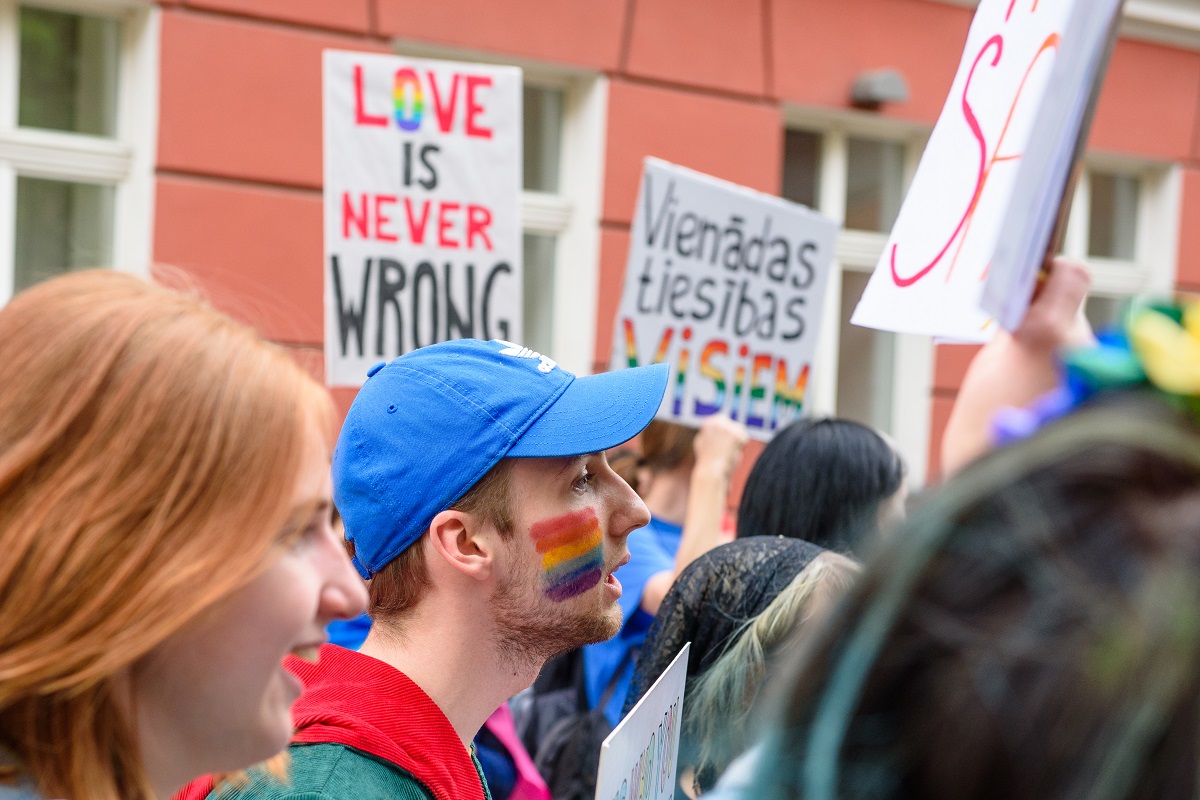
A protest in front of Parliament of Latvia. Photo: Gints Ivuskans
Goša and her lawyers argued that Article 110 of the Latvian Constitution, which declares that the state protects families, should also be applied to families with same-sex parents, and thus her partner’s inability to receive the paid leave as per the national Civil Law should be declared unconstitutional.
In mid-November 2020, the constitutional court ruled that Goša’s partner was indeed eligible for the ten-day paid leave after the birth of the couple’s child. But what is more, the court also decided, in a landmark case, that same-sex couples are entitled to the same legal protections as heterosexual couples, thus giving the national legislature, the Saeima, 18 months to establish a legal framework for the protection of same-sex families.
The court reasoned that the definition of what constitutes a family should not be perceived so narrowly – a family is, by all means, a social construct that is based on close ties and mutual dignity and respect. These same close ties, the court argued, can also be established not only through marriage but also by simply living together in the form of a civil union. More importantly, however, the court ruled that the state cannot simply deny same-sex couples the right to establish a legal family. It applied the principle of the inviolability of human dignity which, if denied the right to form a family, is a direct violation of the constitution.
Standstill
The delight caused by the court’s ruling was immense. It signalled the long journey that Latvians have made since joining the European Union in 2004, and holding their first gay pride parade a year later when human faeces and eggs were thrown at participants. The court’s ruling was also a painful reminder of the 2005 constitutional amendments, pushed by the Christian nationalist Latvia’s First Party, which took away the right for same-sex couples to establish a family in the first place and cemented homophobia in the constitution.

But the joy was short-lived. For substantial change to be implemented, the Saeima now needs to work on establishing the legal framework for the recognition of same-sex couples. This, however, has come to a standstill. On January 7th, two months after the historic ruling, the far-right National Alliance party introduced a bill to the Saeima that would target same-sex couples by specifying that a family, at its core, is a union between a father, who is a man, and a mother, who is a woman. The constitutional amendments were widely criticised by civil society, lawyers and activists. It directly violates the right of all Latvians – irrespective of their sexual orientation – to be entitled to basic human dignity and provisions that do not restrict their fundamental rights in a democracy. Lawyer Matīss Šķiņkis even indicated that if the amendments pass the supermajority vote in the Saeima, “we should then reconsider changing Article 1 of the constitution which describes Latvia as a democratic country”.
Throughout history, Latvia has never been an entirely safe place for the LGBTQ+ community. Consensual sexual acts between men were illegal during the interwar period, but researcher Juris Ludvigs Lavrikovs argues that the law was rarely enforced and Latvia’s non-heterosexual community felt largely safe in the country’s largest cities. However, following the Soviet occupation in 1940, Soviet law, which also prohibited consensual sexual acts between men, was implemented with real-life consequences. Starting in 1961, men could find themselves in prison for five years for engaging in homosexual activities, and conversion therapy was often sought as a solution to cure homosexuality. Following the restoration of independence, Soviet-era provisions were finally struck down in 1992.
In recent years, however, the rights of the Latvian LGBTQ+ community have still been neglected, and institutionalised homophobia is still a daily occurrence for many. According to the ILGA-Europe Index 2020, which reflects the legal and policy situation of LGBTQ+ people in Europe, Latvia ranks as the second-worst country in the EU in terms of equality, hate speech and civil society space for members of the community. Unsurprisingly, homophobic attitudes are reflected in real-life applications of the law – inheritance, property arrangement, tenancy, pensions, tax and social security are just a few of the areas in which the LGBTQ+ community has to deal with due to the government’s inability to establish an effective framework for granting equal rights in the country.
In addition, the country’s education system still retains Soviet-era attitudes when it comes to weeding out faculty’s prejudices against the LGBTQ+ community. As the director of “Papardes zieds” – Latvia’s largest reproductive rights campaign – Iveta Ķelle says: “there are still schools that are afraid of even mentioning homosexuality in the curriculum. When we go to schools to teach students about reproductive health, oftentimes teachers will ask us if we will be talking about homosexuality. When we say that we will, if someone asks about it, they no longer welcome us there.”
Deep polarisation exposed
Homophobic attitudes have recently been overshadowed by the far-right’s own disbelief in institutions and the rule of law they proclaim to be the basis for a traditional and moral society. The court’s ruling as well as the court as a body has been criticised by leading members of the National Alliance, who question the jurisdiction of the ruling, arguing that the court heavily overstepped its provisions that fall within the rule of law. There are similar parallels here, albeit less radical, to the 2015 Polish constitutional tribunal crisis where the vilification of judges who interpret the law accordingly and apply it to situations that bear significant consequences on a large fraction of the population should not be a tool prone to political manipulation. Instead, it should be something that we value and cherish, especially in a young democracy like Latvia.
Following the ruling, the court was relentlessly mystified by all fractions of society. The chief justice, Sanita Osipova, who authored the court’s majority opinion in Goša’s case, was selected as the European of the Year in Latvia for 2020 for “moving the country in the direction of tolerance and the rule of law”. At the same time, conservative news outlets have described Osipova and supporters of the ruling as “die-hard leftists” that will bring about the destruction of the traditionalist state. In 2019 the Guardian wrote about the dangers of such rhetoric in accelerating anti-LGBTQ+ sentiments in the context of Poland and the ruling PiS party. These recent statements also rub salt into the wounds of Latvia’s already-galvanised political environment.
The court’s ruling has only highlighted pre-existing political divisions that have largely gone unnoticed for years. More than 40 conservative citizen groups have sided with the National Alliance and drafted a plan for initiating a referendum to let Latvians decide for themselves if they are ready to accept the proposed amendments. But this very action raises the question: why should tax-payers’ money be spent on organising a national referendum to decide whether the rights of a particular minority group should be violated?
On top of that, deep religious divisions have also contributed to the general discourse. Although the constitution establishes a separation between church and state, it is not uncommon for religious leaders to have subliminal and implicit influence on political decisions in Latvia. Catholic and Lutheran congregations have historically maintained a conservative position when it comes to LGBTQ+ and women’s rights. The day following the court’s ruling, the archbishop of Riga not only heavily condemned the “mutilation of what we know as ‘family’” but, in a similar manner to several American Evangelical groups, invoked conspiracy theories about the climate emergency and the ongoing COVID-19 health crisis.
Despite divisions, however, Latvians, especially younger generations, have become more supportive of the LGBTQ+ community. When one of the most popular Latvian fashion influencers, Elīna Didrihsone, spoke about how her religious beliefs prohibit her from accepting LGBTQ+ as equals, public backlash quickly consumed the media and several well-established companies rapidly cut their sponsorship ties with her. On the very frontlines are young people, the majority of who were born after Latvia gained its independence in 1991. Raised around the time when Latvia joined the EU, the struggles of Latvia’s youth are very different from those decades ago. The new generation has become more open, more liberal, and more accepting of minority groups.
Even though the main impetus for change has come from younger generations, more than 57 per cent of Latvians are opposed to the National Alliance’s constitutional amendments. The same poll also shown that out of the 72 MPs surveyed, 65 per cent are in favour of the amendments – laying dangerously close to the 66 per cent required for the amendments to pass in parliament. By all means, it will be a close call.
Ray of hope
What the National Alliance and other conservative parties fail to consider, however, is the wide scope of the court’s ruling that would have an impact on real-life situations, including non-homosexual partners. There has recently been a myriad of stories emerging in Latvian media about unmarried heterosexual couples who have found themselves in legal dismay after the death of their partner. As the state only grants certain privileges and rights (e.g. the application of inheritance laws) to married couples, unmarried partners are not entitled to the same benefits as married ones. Therefore, a new citizen movement, titled “Dzīvesbiedri”, has emerged in recent years to task the Saeima with coming up with a solution to recognise civil unions and partnerships for both same-sex and heterosexual couples.
Neighbouring Estonia is a prime example of such legislation – in 2016 it legalised civil partnerships, the first among the Baltic and ex-Soviet states to do so. “Dzīvesbiedri” has already collected over 20,000 signatures (out of the 10,000 required) for parliament to consider the legislative proposal, and in light of the recent ruling there is still a ray of hope that the legislature will heavily factor in public opinion on LGBTQ+ rights, as well as the wide range of benefits such a legal framework could bring upon every Latvian, regardless of their sexual orientation.
The fight for equality has never been so important in modern day Latvia. With increasing polarisation and a growing political gap between the generations, it is likely that a backlash will be inevitable if the Saeima votes against the amendments. The beacon of hope lies in Latvians’ own ability to understand that their freedom should never go beyond the freedom of others. In an interview with the Latvian National television, Osipova vividly illustrates the court’s ruling: “None of the basic rights guaranteed by the constitution can be applied without tolerance. If we want to have more rights but we are not yet ready to give the same rights to others; if we want to be free to restrict the rights of others… Guaranteeing our basic rights is impossible without tolerance and respecting each other’s dignity.”
Ričards Umbraško is a writer based in Riga, Latvia. His work has been published in several Latvian publications, including Diena and Žurnāls IR.