
Russia in the starting blocks for the 2021 parliamentary election
The 2021 State Duma election will be the most important stress-test for the Russian regime in the run-up to a possible transition of power in the coming years. The Kremlin has responded to real or imagined threats linked to this election with a new wave of highly repressive laws. However, this authoritarian overreaction may backfire, thus confirming the Kremlin’s fears of a self-fulfilling prophecy.
Parliamentary elections in Russia are about much more than just window-dressing. They serve to legitimise the authoritarian regime in the eyes of the public as well as verify the efficacy of the state administration machinery. The tangible unease among the Kremlin’s decision-makers, provoked by an unfavourable economic future and a worrisome evolution in the social mood, has accelerated efforts to consolidate authoritarian rule.
February 3, 2021 -
Maria Domańska
-
Hot TopicsIssue 1-2 2021Magazine
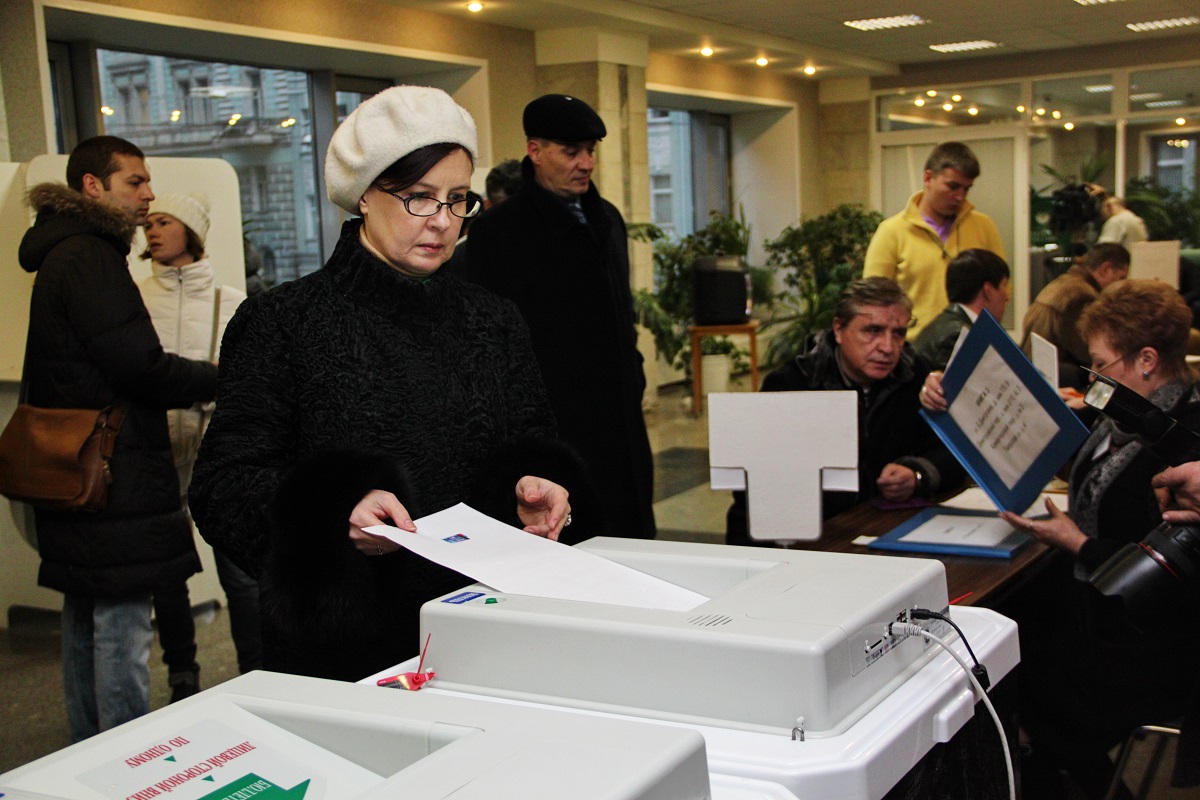
The Kremlin plans for the 2021 Duma elections to end in a landslide victory for the “party of power” – United Russia. Photo: Giuseppe Fucile/Shutterstock
New repressive laws, passed in 2020, are intended to ultimately suppress civic rights and freedoms and nip any forms of grassroots mobilisation in the bud.
Mirage of stability
Putin’s plan for 2020 seemed perfect. The rotting authoritarian regime, which has lost some public support since the 2018 presidential election, badly needed to revive a “rally around the flag” spirit among Russian citizens. The Kremlin had planned to mark 2020 as a kind of coronation of Vladimir Putin’s 20-year rule, and its strategy was based on two pillars. First, the constitutional reform and the government reshuffle, announced in January, served to create the impression of a complex renewal of the system leading to its greater effectiveness and legitimacy in the eyes of the public. However, in fact, the essence of the constitutional amendments boiled down to the final consolidation of authoritarian power in Putin’s hands and enabled him to potentially hold the office of president until 2036.
Second, the 75th anniversary of the victory over Nazism, solemnly celebrated in a traditional imperial setting, was intended to demonstrate the unity of the Russian nation against external threats, as well as offset the effects of growing socio-economic problems. The hope was that both manoeuvres would guarantee stability on the domestic front over the coming years, which is deemed indispensable for planning a seamless transition of power (possibly between 2024 and 2030).
However, a series of unwelcome surprises almost nullified the propaganda effects of this strategy and ruined the mirage of Putin’s perfect stability. Among them the COVID-19 pandemic, which laid bare the defective state management, is merely one of the cracks in the façade. From the Kremlin’s point of view, there are even more reasons for anxiety. The unprecedented rebellion against Alyaksandr Lukashenka’s rule in Belarus revived the Kremlin’s fear of another “colour revolution” in Russia’s backyard and revealed the potential fragility of Russian authoritarian regime. The victory of Joe Biden in the American presidential election will probably make Russia more vulnerable in the international arena. And, last but not least, the Kremlin was taken by surprise by the mass, months-long protests in Khabarovsk (Russian Far East), with a strong anti-Kremlin tone, provoked by the scandalous arrest of the local governor in July 2020. All these challenges feed the Kremlin’s obsessive fears of a West-orchestrated coup d’etat and exacerbate the “besieged fortress” syndrome in Russian domestic policy. Against this backdrop, the Russian political system will undergo a stress-test this year, namely the parliamentary election planned for September.
Looming challenges
Although the tripartite division of powers in Russia, significantly mutilated under Putin’s rule, has further eroded under the amended constitution, parliamentary elections continue to play a role that goes beyond a merely decorative one. The parliament, an appendage to the executive, is used as one of the key tools for maintaining stability in the political system and one of the lobbying platforms for interest groups inside the ruling elite. This is why the Kremlin strives to keep a firm grip on both the formation and work of this body.
Parliamentary elections (which determine the makeup of the State Duma – the lower house of the Federal Assembly) have several major functions, encompassing both purely image-building functions and practical ones. The regular holding of elections is intended to legitimise the authorities in the eyes of the public by creating the appearance of citizen empowerment, and by offering a substitute for real dialogue between the government and citizens. Elections are also intended to mobilise the state administration machinery, verify its effectiveness (as well as reveal weak points in the system) and select the “staff reserve” for top positions in the central and regional apparatus. The 2021 election, in particular, will be a crucial test for the system ahead of the next presidential vote (so far planned for 2024), and to prepare the ground for a major reshuffle and generational change within the ruling elite. However, there are quite a few reasons why this year’s election may prove problematic for Putin’s regime.
The looming challenges that may influence the course and results of the next parliamentary election refer mainly to the social consequences of the current economic crisis and the prospect of long-term stagnation. Since 2013 the Russian economy has been swinging between stagnation and recession. Average annual GDP growth in 2015-2019 did not exceed 0.6 per cent. Russia is lagging behind developed countries in socio-economic and technological terms and this gap has been widening for years. The present crisis, provoked by the pandemic, has merely exacerbated the intrinsic long-term barriers to growth, including an over-dependence on raw materials and the deeply kleptocratic nature of the regime. The real incomes of citizens have been falling since 2014, and according to forecasts this trend will continue over the next four to five years. The very structure of the Russian economy will impede compensatory growth after the present recession.
In these circumstances the ruling elite cannot use economic development and growing living standards as the basis for their legitimisation, as was the case of 2000-2008. Moreover, after the revival of the imperial spirit among the public in 2014, the regime now displays a conspicuous ideological void and has failed to formulate any attractive vision for the future. The years 2018–2020 have been marked by “deep trends” revealed by independent sociologists: growing social dissatisfaction with the present model of state management; mounting awareness of civic rights; demand for systemic change; and increased readiness to engage in public protests. Public trust in Putin fell to around 30 per cent, and although the approval of his policy is approximately twice as high, it significantly lags behind its previous “Crimean” peak of over 80 per cent and does not meet ideal authoritarian standards. Moreover, both indicators are mainly the consequence of the total lack of a political alternative, thus they do not reflect citizens’ real preferences.
Authoritarian reflex
The number of small-scale, localised protests taking place has significantly grown in 2020, and their causes vary from purely socio-economic through ecological to purely political (the latter remaining a minority, however). There is a growing number of protest hot spots across Russia, although the overwhelming majority of the public remains passive. Nevertheless, as the election to the State Duma will be most probably combined with annual elections in the regions, the many local problems festering there on a limited scale can be added to the general public frustration and disrupt the Kremlin’s desired scenario for parliamentary voting. Additionally, the government is gradually losing its dominance in the information sphere as a growing proportion of Russians access online information and social media, thus bypassing traditional channels of Kremlin-sponsored TV propaganda. All these tendencies have made the decision-makers doubt the efficacy of the existing tools of political control.
However, the unconditioned authoritarian reflex to these challenges, which is deeply rooted in the Kremlin’s political culture, is itself generating further problems and tensions. It envelops at least three mechanisms of reaction: first, it is an obsessively over-centralised regional policy; second, the hollowing out of the institution of popular vote; and third, the overzealous pursuit of total control over citizens.
The state called the Russian Federation is, in fact, a highly centralised entity. Not only are the regional budgets fully dependent on political priorities and whims of the federal government, but the governors are appointed without much regard to the needs and expectations of the local populace. Over recent years a growing number of newly-appointed governors are outsiders in their regions and draw their legitimacy primarily or uniquely from the federal centre of power. They are also expected to realise the vested interests of federal business circles at the cost of regional political-business clans and the social-economic development of the regions. As in the case of the Khabarovsk protests mentioned above, such practice often leads to accusations of “colonial policy of exploitation” addressed to Moscow.
The pursuit to rein in any undesirable social activity (often labelled as “anti-state” or “anti-constitutional”), including during the time of elections, has led to an array of repressive laws adopted in May-July and December 2020. The May-July novelties not only further restricted passive electoral rights, but significantly limited independent election monitoring through the introduction of a multi-day vote and an unprecedented expansion of voting outside polling stations. Both mechanisms allow for the flexible shaping of desired results on a scale much larger than before. Faulty and fraudulent as elections normally were in the past, they sometimes allowed surprises, as in 2018 and 2019 when some Kremlin-backed candidates lost regional elections. Now, independent candidates will be more effectively prevented from running and monitors will not stand much chance of collecting and publicising proof of fraud. In fact, the electoral technologies in Russia have evolved into a full-fledged neo-Soviet mockery.
A mere hint of how the parliamentary election may look like are the independent estimates made by analyst Sergei Shpilkin after the constitutional vote in July, where the new voting provisions were tried and tested. Based on a statistical analysis of the anomalies, he found that 22.4 million votes were suspicious – more than twice as many as in the March 2018 presidential election (i.e., almost a third of the total votes officially cast).
The December laws will allow for further suppression of horizontal self-organisation, as well as freedom of speech, of assembly and the right to access information. The authorities do not conceal that these pre-emptive legal initiatives are specially tailored to the Duma election. They are primarily targeted against non-governmental organisations, peaceful protesters, election monitors, independent candidates and journalists. First, the activities of independent NGOs and politically active individuals are likely to be paralysed as new provisions expand the existing restrictions referring to “foreign agent” status. Second, any form of anti-government protest (either collective or individual) could be treated as illegal. Third, in addition to the existing gate-keeping laws, independent candidates could, in fact, be ousted from electoral competition based merely on false accusations of “representing foreign interests”.
The overarching goal of this legal campaign is thus to prevent all forms of anti-Kremlin mobilisation (especially the “smart vote” initiative developed by Alexei Navalny’s network) in the run-up to the vote, as well as to intimidate frustrated citizens and scare them away from protesting. Apart from this tactical goal, the strategic goal of state repression is to obliterate the civil society that has emerged over recent decades against the tradition of social atomisation inherited from the Soviet Union. Moreover, the new laws are most likely intended to pre-emptively set the stage for future relations with the new American administration headed by Joe Biden, renowned for his strong attachment to democratic values.
In fact, Putin’s inner circle has embraced a dangerous strategy of openly breaking with the Kremlin’s previous policy of maintaining the appearance of legality, and are now shutting down all the remaining safety valves. In this neo-Soviet sham, the public has been offered a mere role of “extras” without will and voice, while the ruling elite is anxiously seeking guarantees of their future positions in the system under possible transition.
Self-fulfilling prophecy?
The 2021 vote is designed to end in a landslide victory for the “party of power” – United Russia. The outlines of this strategy are quite clear: the Kremlin wants the party to officially gain at least a two-thirds constitutional majority. However, in accordance to its authoritarian logic, the actual ambition may be to retain the current majority of three-fourths. This would be unattainable without mass and ostensible fraud, as the present electoral rating of United Russia has long been stuck at around 30 per cent. The authorities hope that an overwhelming electoral victory would not only demobilise the Russian public by demonstrating a total lack of suitable alternatives, but also demonstrate to the Russian political-economic elite and the world that Vladimir Putin remains strong enough to fully control the domestic political processes even during a time of serious economic turmoil.
The authorities have thus created all the tools needed to rig the election, officially announce fake results and suppress possible social protests. Apart from repressions, they will engage the entire administrative apparatus to mobilise the loyal electorate while discouraging regime opponents from voting (according to the Levada Centre surveys, three-fourths of those who do not vote are against the regime). Employees of the state sector will be forced to vote for Kremlin-backed candidates and other necessary votes will be bought through the additional distribution of social assistance, badly needed during the present economic crisis.
Furthermore, the image of United Russia can be partially rebranded by co-opting fresh blood, including pro-Kremlin social activists, to run in the election, thus creating an artificial impression of change. While these methods are nothing new in Russia, it remains an open question whether they will be effective against the background of mounting public disillusionment in the work of state institutions during the pandemic. The latter is adding to the usual frustration with the conspicuous arrogance and large-scale corruption of the “servants of the people”.
The Kremlin’s reaction to real or potential threats and the resulting authoritarian overstretch are proof of the mounting unease among decision-makers. Most probably the presidential administration is fearing an outburst of popular anger once the peak of the pandemic is over. At the same time, this over-tightening of the screws may easily backfire, leading to a wider electoral mobilisation of regime opponents or an eruption of mass protests in the wake of the parliamentary election, thus confirming the Kremlin’s fears of a self-fulfilling prophecy.
Even if the public’s passivity and attachment to stability, which has been a trademark of the entire Putin regime, prevails over growing social discontent, gradual changes in the collective social mentality will continue to pose a risk for the regime. The mounting awareness of the state’s dysfunctionality, together with the government’s over-repressive strategy, will further weaken the regime’s legitimacy. The widening gap between citizens and the state will most probably generate political micro-crises and possibly accumulate a critical mass that can disrupt Kremlin-designed political scenarios in the coming years.
Maria Domańska is a senior fellow at the Warsaw-based Centre for Eastern Studies (OSW). She has a PhD from the Warsaw University in political science. Her publications on Russian topics are available on the centre’s website: www.osw.waw.pl.