
Text resize: A A
Change contrast

Belarus. Fighting for the future or the past?

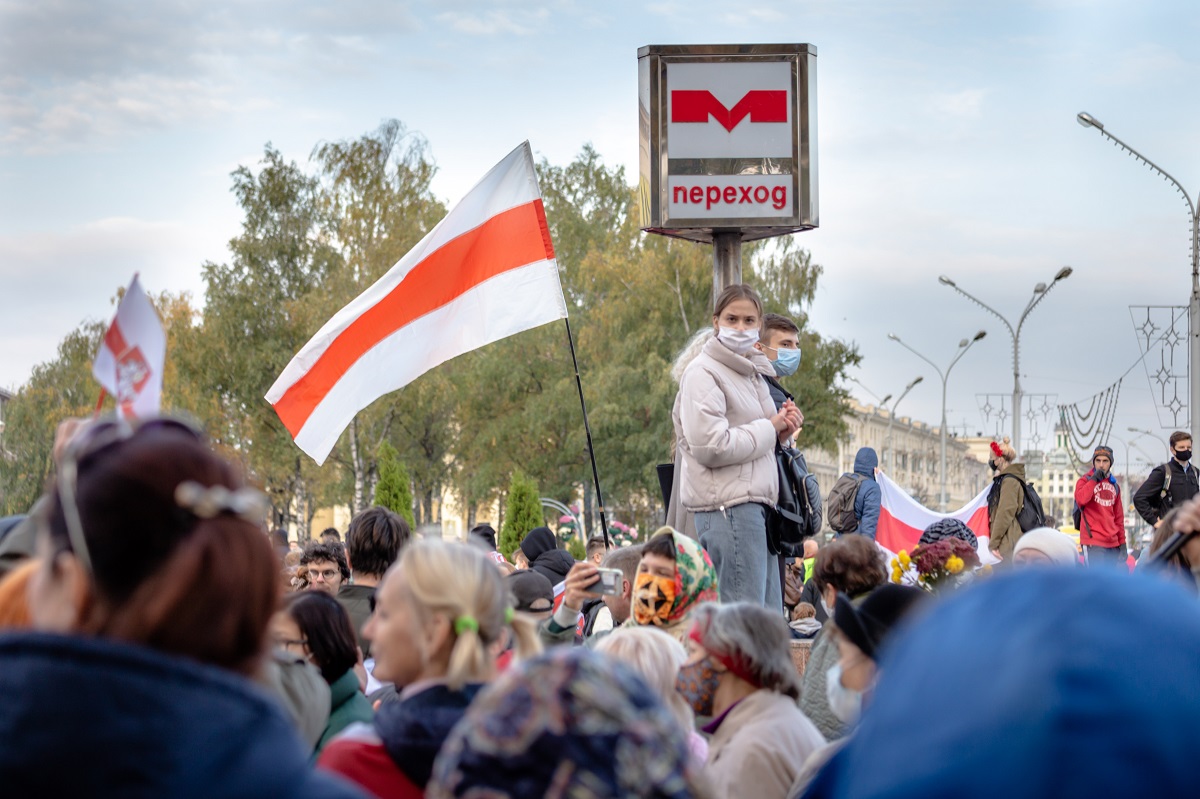
Despite the historical parallels, the differences in memory politics and more recent national developments explain why Belarus never turned to Ukraine for guidance, symbols or role models. The marches in the streets of Minsk and other major cities typically brandish the white-red-white flag which is about the only historical reference. The flag clearly has become the symbol of protest, similar to the colour orange in Ukraine almost two decades ago.

In the 2004 Orange Revolution as well as during the EuroMaidan uprising a decade later, Ukraine’s future orientation was at stake. In both cases, pro-European citizens confronted pro-Russian state authorities on Kyiv’s main square, the Maidan Nezalezhnosti or Independence Square. Not only did the views of Ukraine’s future and the principles of democracy clash, but events and heroes from the nation’s past were fielded as arguments.

February 3, 2021 - Olga Morozova Wim van Meurs - Hot TopicsIssue 1-2 2021Magazine

Photo: Max Katz (CC) commons.wikimedia.org

Over the past 30 years, in most post-Soviet nations’ struggle for independent statehood and regime change, the past has been used by all contenders as a powerful argument and weapon. Inevitably, some events and heroes (or villains) from one contender’s historical repertoire are also featured in the narrative of others. Early-modern state builders, the post-1917 independent republics and those emerging after the Second World War, are all recurring cases in point. Belatedly, Belarus is, for once, no exception.

Belated revolution

Ever since the August 2020 presidential elections, Belarus has been in turmoil. According to the official result, Alyaksandr Lukashenka secured his sixth term in office with a landslide victory. The opposition in the “last dictatorship in Europe”, however, begged to differ and accused the regime of election rigging and the harassment of opposition leaders. The opposition’s female leadership has successfully mobilised tens of thousands of Belarusians on a regular basis since, despite arrests and the brutal police violence. In an unprecedented reaction, Washington and Brussels have refused to accept the outcome because of electoral fraud.

It is noteworthy, however, that the authoritarian incumbent, on the one hand, and opposition leaders such as Sviatlana Tsikhanouskaya, on the other, agree with the need for good relations with Russia, unlike the Ukrainian standoff. The opposition’s Coordination Council demands fair elections, civil freedoms, the release of political prisoners and democratic government, but not a radical geopolitical reorientation towards Europe.

The Coordination Council was created by Tsikhanouskaya following the presidential elections as a means of setting a general direction for the protesters. However, according to the opinion poll held by Chatham House, it remains largely obscure to the general population. Likewise, there is no clarity about the opposition’s political programme. The progamme of Tsikhanouskaya has been deleted shortly after its publication. She is known to take no fixed standpoint on foreign policy as the focus is now primarily on the current domestic crisis of democracy. According to her: “Belarus wants to be friends with everyone, but solely in the own interests of the country”; and thus will try to avoid financial and energy dependence. This moderate view is widely shared by the majority of Belarusians.

At first glance, historical symbols and references have been nearly absent from the Belarusian protests and its leaders’ rhetoric. Moreover, since acquiring independent statehood in 1991 almost unwillingly, the Belarusian state authorities have not capitalised too much on history, national or other. Arguably, in this case such a reluctance or near-absence of historical claims is as telling as any historical falsehoods, incendiary grandstanding or banner waving in the street. The marginalisation of the Belarusian language has continued unabated after the end of communism and the third East Slavic republic lacks the Baltic states’ or Ukraine’s ethnopolitically charged regional divides and urban-rural polarisation.

Lukashenka’s historical recipe over the past quarter of a century has been a continuation of Soviet traditions, with a quantum of Belarus national pride and identity. Victory Day on May 9th, for example, still holds pride of place in the Belarusian national calendar. Unlike his Moscow rival Vladimir Putin, Lukashenka refused to let COVID-19 interfere with parades and festivities on the 75th anniversary.

According to Belarusian journalist Ihar Tyshkevich, Lukashenka used the Victory Day parade as a means to fight Russian propaganda by its own means. As Lukashenka stated to the Belarusian Telegraph Agency: “We cannot cancel the parade. We simply cannot. I have thought about this for a long time. Of course, it is an emotional, deeply ideological thing. We need to remember that these people were dying, maybe also from viruses or other illnesses. But they did not care about that. They died for us … Think what people will say. Maybe not immediately, but in a day or two after this, they will say we were afraid.”

His historical narrative is a carbon copy of the old Soviet textbook, focusing on the relentless advances of communism since the October Revolution in general, and the heroism of the Red Army and the Soviet citizens during the Great Patriotic War in particular. Lukashenka, like Putin, fails to mention the purges of the 1930s and the atrocities of the Stalinist era. The thousands of Belarusian victims of Stalinism do not prevent him, in hindsight, from making decades of Soviet progress and the wartime victory more and more a Belarusian achievement. Instead, the intense Soviet tradition of propaganda around veterans and military triumph had faltered since the 1970s, but has been reinvigorated under Lukashenka with new monuments and publications.

By default, Independence Day in the former Soviet republics highlights national events following the demise of the Soviet Union, usually the new democratic constitution: July 27, 1990, and the declaration of state sovereignty in the Belarusian case. Lukashenka, however, abolished this tradition in 1995 and returned to July 3rd. Thus, Independence Day as a national holiday in Belarus again refers to the liberation of Minsk by the Red Army on July 3rd 1944, like in the old communist days. In the Baltic states, independence commemorates the first republic of 1918. In Belarus that would have been the founding of the Belarusian National Republic on March 25th 1918. This national holiday was chosen by the first moderately national post-communist regime in Minsk until Lukashenka came to power.

Foundational myth

Belarus’s erstwhile national opposition, the Belarusian Popular Front led by Zianon Pazniak, made an alternative historical repertoire an important prop of its political agenda. Its leaders as well as the country’s first post-communist head of state, Stanislau Shushkevich (1991-1994), have been mostly members of the pre-war generation of the Soviet nomenclature. Their foundational myth concerns the Polish-Lithuanian (and Belarusian) Commonwealth, established by the Union of Lublin in 1569. This early-modern state to them signifies the historical importance and Western orientation of Belarus and sets its national identity apart from its East Slavic neighbours.

Its key symbol is the “Pahonia” – the Medieval icon of a charging knight on horseback. The iconic figure was part of the coat of arms of the Grand Duchy of Lithuania, apart from serving as an emblem for many other local and regional rulers and states since the Middle Ages. Today, it appears in the coat of arms of Lithuania, but its use by the 1918 republic and again in the first post-communist years has established its status as the national identifier of Belarusians. It is a cherished symbol for the exile community and, as ultimate proof of its emotional appeal, even Lukashenka’s state authorities declared the Pahonia a part of national cultural heritage. Arguably this act as late as 2007, indicates the demise of Belarusian nationalist opposition – the Pahonia had become a harmless cultural logo, referring to a time long gone.

To the national democratic movement of the late 1980s and early 1990s, the fateful years under communist dictatorship from 1917 until 1991 constitute a deviation from the true destiny of the Belarusian nation. They mobilised the general public by revealing the truth about the mass graves in Kuropaty Forest, (sometimes called the Belarusian Katyń). Having weathered Stalinist repressions, the onslaught of two totalitarian regimes since the Second World War and another half-century of communist denationalisation and exploitation, which included the Chernobyl disaster, independence and unity were eventually restored in 1991. Belarusian became the sole state language by law in 1990. Over the next few years, quite drastic or desperate measures were undertaken, as only a minority of the population still spoke Belarusian at home. Yet, contrary to the Baltic states, popular support for a course of Belarusification and defiant national independence remained lukewarm. Before long, many of those championing restorative nation-building ended up as disillusioned exiles in neighbouring Lithuania, much like their predecessors in 1919.

The three female leaders of today’s opposition belong to a quite different generation from these octogenarians. Tsikhanouskaya, Maria Kalesnikava and Veronika Tsepkalo were in their teens when the USSR ceased to exist. The protest marches by their followers in the streets of Minsk and other major cities typically brandish white-red-white flags, about their only historical reference. This flag harkens back to the Belarusian National Republic that existed from 1918 until the communist takeover of 1919. The Pahonia is occasionally seen as well, but the historical flag clearly has become the symbol of the protest, similar to the colour orange in Ukraine almost two decades ago.

The Popular Front of the late 1980s has argued that the white-red-white flag resembles not so much (or not only) the flag from 1918, but rather the (red-white-red) flag of the 16th century Commonwealth, as the heyday of Belarusian state building. Once in power, however, Lukashenka, who was at the time actively exploiting nostalgia for the USSR and saw nationalism as the main threat to his regime, reintroduced the red-green flag of Soviet Belarus (minus the hammer and sickle) and banned the red-and-white one. Even though the red-and-white flag is tainted as it was also used by the Nazi occupational regime and their local collaborationist minions during the war, after 1995 it has primarily become the symbol of Belarusian political opposition to Lukashenka.

As a result, four different memory repertoires compete for the approval of the citizens. First, a traditional communist narrative centred on the Great Patriotic War and second a slightly modified version championed by Lukashenka, highlighting the Belarusians’ contribution to the Soviet victory. Third, a national and anti-communist canon based on the long tradition of Belarusian statehood, before and after foreign communist rule. And last, but not least, the 2020 protest leaders have their own take on history and its symbols, while steering clear of all the established repertoires.

Revolutions of colours and squares

Making sense of the historical symbols and references used by an authoritarian post-communist regime and its adversaries from civil society and political challengers, however, requires more than only intimate knowledge of Belarusian history. Both for the political actors in Minsk and for their audiences and for foreign observers, national history provides more than just telling symbols and references. There are, for instance, many parallels between Belarus and Ukraine – in the past and the present. They both experienced a brief, convoluted and violent bout of independence after the First World War. Thereafter, the eastern half of each state became part of the Soviet Union, whereas the western half was incorporated in the newly created Polish state. In 1940, the Soviet occupation resulted in national reunification for both of them as well as Stalinist terror and, in the second half of the 20th century, Russification became a serious threat to the survival of both the Ukrainian and Belarusian national cultures and identities.

Historically, both nations were among the prime victims of Stalinism. Yet, both Belarusians and Ukrainians also held their fair share of nomenklatura positions throughout the Soviet Union. In Ukraine, however, mining and heavy industry created a divide between the eastern and the western halves of the republic. The manufacturing industries in Belarus were better able to cope with the transition to a market economy and continued to provide relative prosperity by the end of the century. Belarus was saved from the ordeals of an east-west divide and post-Soviet separatism. Since the abortive Belarusification boost of the early 1990s, the cause of Belarusian as a national identity and language in its own right seems to have subsided. In Ukraine, nationalism is a major mobiliser for the opposition, next to democracy and political rights. In the current protests in Belarus, this mobilising factor is far less prominent.

Even today the Second World War holds pride of place in the memory politics of both states. In the Belarusian case, the heroic partisan movement is a unifying myth like no other, whereas the memory is contested in Ukraine: The Red Army and partisans versus the pro-fascist “traitors” from the western provinces – now adorned by some Ukrainian nationalists.

Despite the historical parallels, the differences in memory politics and more recent national developments explain why Belarus never turned to Ukraine for guidance, symbols and role models. The two successful Ukrainian popular revolts (of 2004 and 2014) against electoral fraud and authoritarian pro-Russian rulers must have unnerved Lukashenka. A lesson not learnt: in 2004 Viktor Yanukovych thought he could claim victory in the presidential elections, but popular outcry forced him to resign. Against similar odds, in 2020, Lukashenka claimed an 80 per cent landslide, probably simply not to be outdone by his rival Vladimir Putin who won his constitutional referendum this summer with a 77 per cent victory.

The Ukrainian democratic opposition opted for a pro-western course and embraced the historical examples of the short-lived 1918 republic and the controversial war-time militant, Stepan Bandera. Sensibly, the Belarusian opposition in 2020 only uses the 1918 flag and steers clear of tainted figures from the Second World War that allowed pro-Russian forces in Ukraine to brand the entire new Kyiv regime as fascists. Similarly, they have avoided any reference to the symbols and rituals of their contemporary Ukrainian counterparts: the colour orange and the “square revolution”. Ultimately, the alternative flag is probably more of a rallying symbol of collective identity rather than a purposive historical reference revealing a political programme.

The partisans, again

When the protesters took to the streets for the eleventh time on Sunday October 17th, the Coordination Council made a surprising announcement. It declared the day’s demonstration as the “Partisan March”. Marching along Partisan Prospect in Minsk they thereby claimed to be the successors to the tens of thousands of brave fighters of the Belarus underground during the war. Paradoxically, the dictator himself has prepared the ground for this move. Over the years, he has purposely rebranded Stalin’s partisans into Belarusian patriots. Ever since the liberation, and again under Lukashenka, the memory of these partisans had been celebrated excessively in monuments, festivities, history books and propaganda. They had been used to give the generic memory of the glorious Soviet victory in the Second World War as a founding myth in its Belarusian manifestation. And now the opposition has decided to steal this trusted propaganda weapon from the regime, to compete with the dictator for the approval of these legendary diehards.

The hard-pressed dictator habitually associates any opposition and critical assessment of his regime with war-time collaborationism, fascism and treason. At the beginning of his reign, he successfully accused his adversaries of corruption and ideological ties to wartime traitors and fascists. In 2020, at the end of his reign, his strategy remains unchanged. The new opposition and its white-red-white flag, according to the president, are stooges of foreign powers and the flag proves their affiliation with Nazi collaborators.

Despite their 21st-century political agenda and outlook, the current Belarusian opposition leaders feel compelled to target Lukashenka’s Achilles’ heel, his total reliance on the Great Patriotic War and, most of all, the Belarusian partisan movement for legitimacy. With his regime more and more out of sync with the civil and economic expectations of the people, the partisans’ potent amalgam of Belarusian patriotism and Soviet tradition is his last resort. And yet, the Belarusian partisans in 2020 return from their native forests and marshes with vengeance.

Wim van Meurs is a professor of European Political History at Radboud University Nijmegen.

Olga Morozova is a research assistant at Radboud University Nijmegen.

, ,

Partners

Terms of Use | Cookie policy | Copyryight 2026 Kolegium Europy Wschodniej im. Jana Nowaka-Jeziorańskiego 31-153 Kraków
Agencja digital: hauerpower studio krakow.
We use cookies to personalise content and ads, to provide social media features and to analyse our traffic. We also share information about your use of our site with our social media, advertising and analytics partners. View more
Cookies settings
Accept
Decline
Privacy & Cookie policy
Privacy & Cookies policy
Cookie name Active
Poniższa Polityka Prywatności – klauzule informacyjne dotyczące przetwarzania danych osobowych w związku z korzystaniem z serwisu internetowego https://neweasterneurope.eu/ lub usług dostępnych za jego pośrednictwem Polityka Prywatności zawiera informacje wymagane przez przepisy Rozporządzenia Parlamentu Europejskiego i Rady 2016/679 w sprawie ochrony osób fizycznych w związku z przetwarzaniem danych osobowych i w sprawie swobodnego przepływu takich danych oraz uchylenia dyrektywy 95/46/WE (RODO). Całość do przeczytania pod tym linkiem
Save settings
Cookies settings