
Text resize: A A
Change contrast

Moldova’s oligarch mayors go global

The experience of Moldova reveals that in Central and Eastern Europe’s highly politicised and oligarchised environment, city diplomacy can be an easy tool for wealthy politicians suspected of corruption to gain more popularity and shield themselves from the judicial system. Ilan Șor and Renato Usatîi have been particularly adept in this realm.

Orhei, a medium-sized city about an hour north of Chișinău, is an unlikely rival to Monaco. Yet mayor Ilan Șor – one of the country’s oligarchs – promised in 2018 that Orhei’s residents would “live as they do” in the European principality. Farther north, in Bălți, mayor Renato Usatîi – yet another oligarch – claimed to have started a revolution in the city’s contacts with the world.

November 16, 2020 - Cristian Cantir - AnalysisIssue 6 2020Magazine

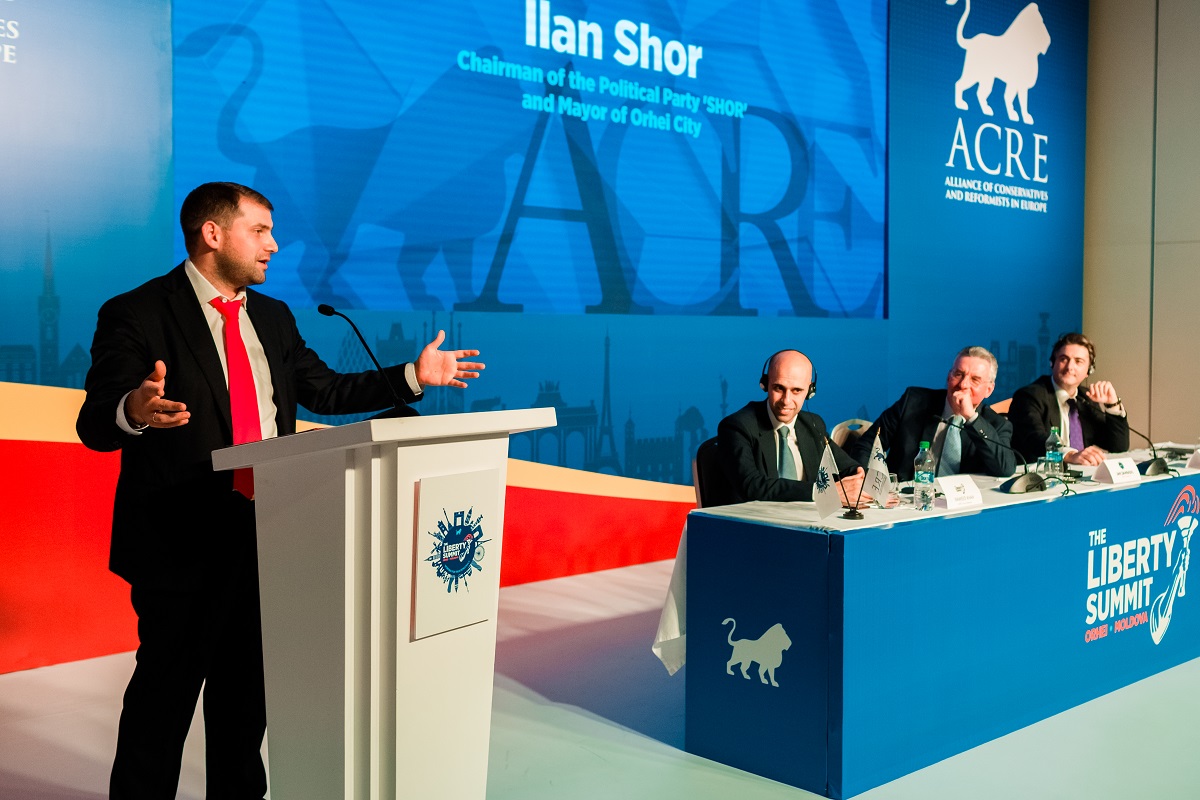
Ilan Șor hosting the 2018 Liberty Summit in Orhei Moldova/ Photo: Flick profile (CC) of the Alliance of Conservatives and Reformists in Europe (now European Conservatives and Reformists)


Such bombast is common from the two wealthy businessmen and political leaders, who have carved out independent centres of power in Orhei and Bălți and have remained popular there, frequently digging into their own pockets to entertain residents with a deluge of concerts and festivities. Both run political parties – the Șor Party and Our Party – and both have used charitable public events to enhance their profile. But in the pursuit of their ultimate goal of taking control over central institutions, bread and circuses have been merely one front.

The mayors have availed themselves of command over the mayoral seat in order to manipulate their cities’ existing international networks and fashion new ones in the European Union and Russia. These diplomatic actions cement and broaden domestic political support, amplify narratives of political persecution in international forums, and advertise alternative foreign policy relationships as purportedly preferable to that of the central government, all to serve their ultimate goals of securing more political power at the centre and of avoiding criminal punishment.

Alternative sites of power

Normally, city diplomacy is a rather benign phenomenon. Mayors and city councils sign sister-city agreements that focus on economic and cultural exchanges and pursue investors. Central authorities often encourage or are tolerant of such initiatives, which rarely run afoul of major foreign policy choices or national security. Șor and Usatîi have themselves engaged in these pedestrian foreign associations; for instance, an Orhei delegation went to China in 2015 to sign a co-operation arrangement with the Shuangliu region and Usatîi met with an OSCE delegation in the city to present his perspective on issues like the Transnistrian conflict.

However, Moldova’s experience reveals that in Central and Eastern Europe’s highly politicised and oligarchised environment, city diplomacy may be an easy tool for wealthy politicians suspected of corruption to institutionalise international channels to gain more popularity and shield themselves from the judicial system. Șor and Usatîi have been particularly adept in this realm. Their main foreign policy endeavours have involved independent diaspora networks, city identity-building and branding events to claim an international position that rivals Chișinău’s and therefore creates alternative sites of power, and, most importantly, visibility and access to foreign entities, including the Russian State Duma and the European Parliament.

Moldova’s substantial diaspora has always been a source of political contention and competition in the country in light of the availability of hundreds of thousands of Moldovan votes abroad that could alter the balance of power in parliament and the presidency. Both Șor and Usatîi saw an opportunity in these untapped votes and used their cities as springboards to establish and fortify ties with diaspora Moldovans. In 2017 Ilan Șor announced the opening of Orhei’s “first office abroad” in Bologna, which encouraged Moldovans living in Italy to return to the city by circulating information about jobs and living conditions in Orhei and, at one point in 2018, by extending a 500 euro bonus to those returning home. Its opening ceremony was also attended by Bologna city hall representatives, which lent further legitimacy to the venture. Attendance by these European officials was later used by the party and the mayoralty to advance a narrative of support for and popularity of Ilan Șor in the EU. Bologna soon became a centre for concerts and celebrations affiliated with the Orhei mayoralty and with the Șor Party; during one event, party activists organised a lottery of roundtrip plane tickets to Moldova. Șor later claimed that, by April 2019, he had brought back about 100 families to Orhei, most of them from Italy, Israel and Russia.

Șor’s explicit use of Orhei as a base for diaspora networks has been the more sophisticated approach of the two. Usatîi’s networks have relied less on systematising Bălți’s ties with Moldovans abroad. The Bălți mayor used similar tactics in 2020 when he announced that he had paid for a flight from Paris for members of the Moldovan diaspora stranded in the city because of the COVID-19 pandemic. Nonetheless, he has primarily congregated in person or online with the Moldovan diaspora in Russia, where he has sought to portray himself as a viable pro-Russian rival to the more powerful Party of Socialists.

New global identity

It is difficult to assess how successful these efforts have been, but the strategies seem to have been one of the many pillars used to improve the standing of these political leaders and their parties, both in the diaspora and inside the country. Moldovan authorities have been unable to interfere with the emerging diaspora networks established abroad because both Șor and Usatîi are not doing anything explicitly illegal, including the use of the city (in Șor’s case) as a base for diaspora policies that are not coordinated at the level of the central government.

At home, the mayors have struggled to build a new global identity for their cities, branding both Orhei and Bălți as potential international hubs whose increasing attractiveness and modernisation is tethered to the names of their mayors. Rivalry with Chișinău – the dominant economic and political power in the country where Șor and Usatîi are rather marginal figures – looms large in these undertakings. Representations of invigorating ties with Russia have been the cornerstone of Renato Usatîi’s city branding. In meetings with Russian officials, the mayor has pointed routinely to Bălți as a bridge for Russian businesses into the European Union. Speaking to officials from St Petersburg, Usatîi has voiced parallels between the status as “northern capitals” that both cities enjoy in their countries. Usatîi has also promised to turn Bălți into the country’s first “smart city”, competing with Chișinău over innovation and the adoption of international good practices. In 2016 Usatîi said Bălți would be a good venue for international sports events and, in 2017, organised an international investment forum meant, in his interpretation, to copy the feats Bălți had already recorded with Moscow, St Petersburg and Nizhny Novgorod. The city’s increasing international presence would, as Usatîi has argued, bring more prosperity and attention to the city and away from Chișinău. And this presence would, inevitably, be tied with Usatîi’s name.

Șor’s characterisations have been adamant about the city’s “infrastructure revolution” and modernisation, which has been connected to Orhei’s international appeal. City hall claimed at one point to have turned Orhei into Moldova’s “summer capital” because of its bustling entertainment infrastructure and the party’s and the mayor’s websites have been plastered with pictures of brand-new roads and venues for socialisation. In light of this celebrated modernisation, in 2018 the small city hosted a “Liberty Summit” – touting its affiliation with the Alliance of Conservatives and Reformists in Europe (ACRE), with which the Șor Party announced a partnership. The mayor used the event to announce Orhei’s transformation into a “city of international relations” and city hall hinted at the slow recovery of an erstwhile medieval grandeur. The mayor has taken credit for any form of development or modernisation, framing the city’s identity as an antithesis to both the chaotic urban development of Chișinău and the inability of central authorities to provide reasonable quality of life. The Central Moldovan authorities have rarely reacted to these international liaisons since the incipient projects are not inherently antagonistic. Cities build identities and branding all the time. In the hands of oligarchs, however, these networks contribute to the amassing of power mayors seek locally and nationally and solidify regional urban identities in a way that could have long-term political effects and establish local fiefdoms that will be difficult to dismantle.

Autonomous platform with Moscow

By far, the most visible city diplomatic activities have involved Șor and Usatîi forging direct relationships with foreign representatives of cities, countries and international fora. These relationships have promoted the desired portrayal of recurring legal investigations as unfounded and politically motivated since the ambitious politicians have both had a variety of legal headaches. Ilan Șor is appealing a 7.5-year prison sentence related to his involvement in the infamous plundering of the Moldovan banking system in 2014. Renato Usatîi spent a sizable portion of his first mayoral term in Russia to avoid detention by Moldovan authorities, who have accused him of crimes like the alleged assassination of a businessman. Furthermore, city diplomacy has strengthened the oligarchs’ claims of furnishing national-level foreign policy superior to the central government’s.

Usatîi has been especially skilled at using the Bălți mayoralty to set up networks with major Russian cities. While in power, the mayor signed co-operation and sister-city agreements with Nizhny Novgorod, the Pushkin raion of St Petersburg and Moscow’s western okrug, and met repeatedly with officials from the cities, including Moscow mayor Sergey Sobyanin. The deals sought to enable Bălți to open trade offices in the Russian cities and offered scholarships in Russian colleges to students from Bălți. Throughout, Usatîi’s extensive Russian dealings – hyped on Bălți’s website and press and social media associated with the mayor – stood in stark contrast with the sparse interchanges that the ostensibly pro-western central authorities had with the Kremlin during the same period. The country’s ruling coalition during Usatîi’s first mayoral term (2015-2018) was itself dominated by another oligarch – Vlad Plahotniuc – but maintained somewhat close ties with Romania and the European Union and experienced a falling-out with the Kremlin. The mayor could therefore claim to have a better relationship with Russian authorities than Chișinău. Usatîi could also portray himself as the solver of long-standing problems that Chișinău could not untangle: in 2015, Usatîi visited the deputy director of Russia’s Federal Service for Veterinary and Phytosanitary Surveillance (Rosselhoznadzor) and criticised Moldova’s Agricultural Ministry for failing to secure access to Russian markets, later announcing that fruit producers whose interests he pushed had been allowed in.

Usatîi’s networks have expanded into broader political links: the mayor’s Our Party signed an agreement with Vladimir Zhirinovsky’s Liberal Democratic Party (LDPR) in 2017. Although the bond was along party lines, Usatîi took advantage of his double role as party leader and mayor to frame his accomplishments in Bălți as being part of a grander project to rejuvenate kinship with Russia, and to criticise the state authorities for fabricating criminal investigations to undermine that project. During a meeting with Zhirinovsky, Usatîi bemoaned the collapse of the Soviet Union and explained that his actions as mayor, including Bălți’s agreements with Russian cities, revived some of the connections after independence. Furthermore, the alliance with the Russian party amplified Usatîi’s claims of persecution: in the State Duma, LDPR verbalised Our Party assertions about the incompetence and anti-Kremlin bias of authorities in Chișinău and the hounding of Our Party activists, including mayor Usatîi. Despite LDPR’s secondary role in Russian politics, Usatîi’s networks in the country grant him an autonomous platform with Moscow, which continues to have significant influence at the top levels of Moldovan politics. Usatîi himself has claimed that any legal trouble that he has experienced recently in Russia itself have been at the behest of pro-Russian President Igor Dodon, who has his own connections in Russia.  

Breaking the monopoly on relations with Europe

Șor’s use of his mayoral position has echoed Usatîi’s ventures, but the Orhei mayor has looked more towards the EU. In 2017, while Ilan Șor was under investigation, Șor Party representatives and, eventually, the mayor himself, visited the European Parliament to criticise Moldovan authorities for what they defined as political persecution. Șor’s meetings often veered into discussions about his reforms as mayor, coupling alleged harassment by Moldovan law enforcement against him to his achievements as mayor. In 2018, for example, Șor organised a roundtable on the enactment of European practices at the local level and about reforms in Orhei, which was attended by five Members of the European Parliament from the European People’s Party. Another MEP, Alberto Cirio, was a guest in Orhei in 2017, in a story publicised widely by the Șor Party, which emphasised the high praise the official had for reforms in the city.

The Șor Party also promoted its partnership with the European Conservatives and Reformists Party (ECR Party). Several MEPs, including Richard Milsom and Barbara Kappel, openly supported the Șor Party’s run in the 2019 legislative elections. In 2018, the Șor Party’s website trumpeted the fact that MEP Fulvio Martusciello doubted the findings of a report implicating the mayor in the aforementioned plundering of the banking system, which fit party narratives that the mayor’s legal quandaries were rooted in political persecution. As a rule, the broadcasting of these complaints was accompanied by arguments that reforms in Orhei were at the forefront of the country’s modernisation and that Șor’s popularity was getting too uncomfortable for central authorities.

While Usatîi’s use of co-operation agreements with Russian cities sought to build his image as a leader who could revive ties with Russia, Șor’s strategy was to establish – and tout – networks with European officials to challenge what he said was the monopoly claimed by some parties in Chișinău over relations with Brussels. A press release about the “Liberty Summit” emphasised that the Șor Party was affiliated with the third-largest European political family and quoted ACRE head Jan Zahradil’s praise for “constructions, jobs, and fixed-up streets and roads” in Orhei. The paramount goal, therefore, was to break the impression that only a few parties in Chișinău could draw the support of – and impress – Europeans. Șor insisted that, contrary to accusations by pro-European forces that Brussels was suspicious of the Orhei mayor, he was garnering support for his reforms in the city.

Ultimately, these strategies have contributed to the transformation of the mayors into national figures. Ilan Șor won the Orhei single-member district during the 2019 legislative election and is now a deputy in the parliament. He fled the country in 2019, but continues to run the party from abroad, which remains very popular in Orhei and is growing nationally. Renato Usatîi won another term as mayor in 2019 after he returned to Moldova and has announced a run for president this November; he has systematically placed third or fourth in recent polls and is seen as the major pro-Russian rival to incumbent Igor Dodon. Neither of them has been subject to thorough legal proceedings regarding accusations lodged against them. It is difficult to imagine these feats without taking into account the international activities of these mayors.

The economic power and political influence of oligarchs has complicated the consolidation of democracy in Central and Eastern Europe. Nationally, wealthy businesspeople have joined legislatures and executives, and have occasionally taken the reins of power themselves. The cases of Șor and Usatîi reveal another dimension of the oligarch’s political war chest in the pursuit of national-level power: city diplomacy.

In some ways, near-complete control over local institutions, especially mayoral offices, has given the leaders more freedom to forge global links and generate narratives about their global influence and popularity. Under normal circumstances, most of these diplomatic activities are legal and are in fact encouraged or supported by the national government as they can usher in investments and better governance practices. In a region tattered by weak institutions, where city diplomacy is hijacked by individuals who seek, above all else, self-serving political power and impunity, it can become a means to a more nefarious end.

Cristian Cantir is an associate professor with the department of political science at Oakland University (Michigan, USA).

, , , ,

Partners

Terms of Use | Cookie policy | Copyryight 2025 Kolegium Europy Wschodniej im. Jana Nowaka-Jeziorańskiego 31-153 Kraków
Agencja digital: hauerpower studio krakow.
We use cookies to personalise content and ads, to provide social media features and to analyse our traffic. We also share information about your use of our site with our social media, advertising and analytics partners. View more
Cookies settings
Accept
Decline
Privacy & Cookie policy
Privacy & Cookies policy
Cookie name Active
Poniższa Polityka Prywatności – klauzule informacyjne dotyczące przetwarzania danych osobowych w związku z korzystaniem z serwisu internetowego https://neweasterneurope.eu/ lub usług dostępnych za jego pośrednictwem Polityka Prywatności zawiera informacje wymagane przez przepisy Rozporządzenia Parlamentu Europejskiego i Rady 2016/679 w sprawie ochrony osób fizycznych w związku z przetwarzaniem danych osobowych i w sprawie swobodnego przepływu takich danych oraz uchylenia dyrektywy 95/46/WE (RODO). Całość do przeczytania pod tym linkiem
Save settings
Cookies settings