
Zelenskyy’s Ukraine and the Eastern Partnership
In recent years Ukraine has become an informal leader of the Eastern Partnership. Along with Georgia and Moldova, Ukraine seeks more active co-operation with the European Union and advocates expanding its activities. Nevertheless, the further success of the Eastern Partnership will depend on whether the EU succeeds in developing an effective approach that meets the needs, expectations and interests of all partner countries.
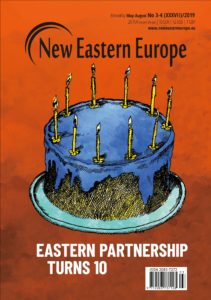
This year the Eastern Partnership celebrated its 11th anniversary. For Ukraine, this time is clearly divided into two periods: 1) the pre-EuroMaidan period and 2) the post-EuroMaidan period with the signing of the Association Agreement with the European Union. The political part of the agreement was signed on March 21st 2014 (entering into force on November 1st 2014); while the economic part was signed on June 27th 2014. The aim of the Eastern Partnership (EaP) is to integrate Ukraine and other participating countries with the EU. The EU’s co-operation with its eastern partners is focused on stimulating political and socio-economic reforms. And it contributes to the deepening of political and economic relations, ensuring compliance of domestic legislation with EU norms and standards, as well as maintaining mutual respect for common values.
September 4, 2020 -
Hanna Bazhenova
Tomasz Stępniewski
-
AnalysisIssue 5 2020Magazine
Photo: European Commission
Undeniably, the greatest issue the EaP is faced with is the perception of the project in geopolitical terms: the states have to make a choice – either be with the EU or be with Russia (when listening to some EU decision-makers, it seems that these are the only available options). This may be the greatest drawback of the project. When Poland and Sweden initiated the EaP, they did not foresee the signatory countries would face such a plight. This issue is extremely challenging and entails several difficulties (in the case of Ukraine, these are existential in character). Unsurprisingly, a policy which would lead to EU membership would be the most effective. Yet the lack of such a prospect (as currently found in the EaP) deprives the EU of serious leverage as far as these countries are concerned.
Ukraine’s achievements
The extension of trade relations was an important result of the co-operation between Ukraine and the EU within the framework of the Eastern Partnership. The EU largely liberalised access to its market in April 2014 by providing Ukraine with Autonomous Trade Measures and eliminating 95 per cent of its tariffs on Ukrainian industrial goods and 83 per cent on agricultural and food products. The Deep and Comprehensive Free Trade Area (DCFTA) fully entered into force on September 1st 2017. Currently, the EU is Ukraine’s main trading partner. Ukraine’s trade in goods with the EU totalled 45.7 billion US dollars in 2019 and amounted to 40.1 per cent of the country’s total trade turnover. The country’s key trading partners in the EU are Germany, with goods turnover of 2.4 billion dollars in exports and six billion in imports; Poland with 3.3 billion dollars in exports and 4.1 billion in imports; and Italy with 2.4 billion dollars in exports and 2.1 billion in imports. As an important consequence of this process, dozens of export “newcomers” from Ukraine access the EU market every year.
Ukraine was the first of the Eastern Partnership countries to receive a visa liberalisation action plan for short-term trips of its citizens to the EU. This occurred during the Ukraine-EU Summit on November 22nd 2010 in Brussels. However, the visa-free regime came into force only on June 11th 2017. According to the Ukrainian Border Service, between that date and April 11th 2020, Ukrainians made 49 million border crossings to the EU – using both biometric and non-biometric passports.
Owing to the Eastern Partnership, Ukraine was able to participate in programmes that are part of this initiative, as well as within the framework of the European Neighbourhood Policy. These programmes seek to develop small and medium-sized enterprises, education, culture, science and innovation, academic mobility, urban infrastructure and other areas. Ukraine received the largest amount allocated for the implementation of the EU4Business projects, which is aimed at financing small and medium-sized enterprises and providing access to European markets and knowledge. The country is also one of the largest beneficiaries of the Erasmus+ programme in the Eastern Partnership region. As many as 4,695 Ukrainian students and 4,361 university professors, as well as 2,872 professors and 1,123 students from Europe, took advantage of academic exchange opportunities during 2014-2019.
In 2017 the EU issued the “20 Deliverables for 2020” – a roadmap of 20 key actions to be implemented by partner countries for closer co-operation with the EU. This document is an addition to the Association Agreement. According to the Monitoring Report of the Ukrainian National Platform of the Eastern Partnership Civil Society Forum, Ukraine made progress in 19 out of 20 areas in carrying out reforms and achieving goals by the end of 2019. The progress was registered in the areas of rule of law and anti-corruption, infrastructure development, judiciary, public administration, security, development of small and medium-sized enterprises, implementation of the DCFTA, environmental protection, and visa liberalisation. The energy industry remains the only problematic area.
The signing of the Association Agreement, including the DCFTA and the introduction of the visa-free regime with the European Union, induced Ukrainian authorities to diversify the Eastern Partnership. In 2017 Ukraine proposed the launch of a new format of co-operation with partner countries called the “Eastern Partnership Plus” (EaP+). This initiative provided for the intensification of EU relations with those countries that have signed association agreements. It aimed to include Ukraine, Moldova and Georgia in the customs, energy and digital unions and in the Schengen area, as well as to stimulate closer co-operation in security and defence with the EU. However the idea of introducing a new Eastern Partnership format did not find support at the level of heads of states or governments during the fifth Eastern Partnership Summit in Brussels on November 24th 2017. At the same time, Ukraine’s proposal does not contradict the concept of a multi-speed Europe, which is somewhat popular within the European Union.
For President Volodymyr Zelenskyy and his administration, which came to power in May 2019, the Eastern Partnership is part of the general road to European integration and a bridge to EU accession. At the same time, the Ukrainian government continues to take an active part in the initiative beyond 2020. It supports the idea of the “EaP+”, or “EU+3” format, which provides Ukraine, Moldova and Georgia with more opportunities to co-operate with the EU.
Areas for growing co-operation
During the ministerial video conference of the Eastern Partnership on June 11th 2020, Dmytro Kuleba, Ukraine’s foreign minister, named the main priorities of his country within the Eastern Partnership. These include the expansion of free trade opportunities and the introduction of an “industrial visa-free regime” (signing of the Agreement on Conformity Assessment and Acceptance of Industrial Goods – ACAA); access to the EU Digital Single Market; the integration of energy markets; and the joint implementation of the European Green Deal. Kuleba also proposed to expand the EU economic recovery programmes to encompass the Eastern Partnership region (regarding EaP members); to consider the possibility of moving supply chains closer to EU borders, in particular to Ukraine; and to involve partner countries, especially Ukraine, in projects within the Euro-Asian connectivity strategy.
The foreign minister further proposed setting up a discussion panel on countering disinformation to work out appropriate solutions and involve partner countries in the activities of the European Centre of Excellence for Countering Hybrid Threats. He also suggested expanding the work of the EU Network and Information Security Agency and the EU Rapid Alert System to include other interested parties. Lastly, Ukraine has called for the intensification of co-operation in the sphere of security and for the EU to become more involved in resolving conflicts in the Eastern Partnership region.
Zelenskyy, speaking at a video conference of EU leaders and Eastern Partnership leaders on June 18th 2020, stated that Ukraine aspires to be a full member of the European Union. At the same time, he stressed that Ukraine can help improve security in the region by participating in peacekeeping missions, EU military and security projects, initiatives aimed at countering information and hybrid threats. Zelenskyy noted that, in the future, the EU and partner countries should focus on areas that have been neglected before the coronavirus quarantine, including digitalisation, further integration of transport links, access to the European payment system, loans for small businesses and other practical instruments. This will help the region’s economies to emerge from the economic crisis caused by the COVID-19 pandemic. Zelensky expressed gratitude to the EU for the new macro-financial assistance programme, worth 1.2 billion euro, and for its humanitarian assistance.
Russia-Ukraine war and implications for the eastern neighbourhood
The countries of the Eastern Partnership do not function in a vacuum but are influenced by internal and external factors. Among the external ones, actions of both the EU and Russia seem critical. The EaP states find themselves forced to consider Russian political and geopolitical objectives in their own decision-making. This is done in order to identify Russia’s tactical, but also strategic, objectives towards the post-Soviet states. It can be said that since the very beginning of the Russian-Ukrainian conflict in 2014, Russia had intended to destabilise the situation in southern and eastern Ukraine in order to disconnect the areas from the country or to turn them into “occupied territories” or establish a quasi-state in the area (as in the case of Transdniestria).
Importantly, Russia widely uses propaganda in the conflict with Ukraine. The West should take measures to curb Russian propaganda. Ukraine is experiencing not only a news blackout but a disinformation campaign which is intended to destabilise the internal situation in the country. Russian propaganda is spread by Russian mass media – television being an important instrument. The EU therefore needs to find ways to support independent (or, at least, not pro-Russian) media channels – maybe even consider setting up its own. An example is already in operation with the Belsat TV channel, operating from Poland, addressing Belarus.


According to Russian politicians, swift democratic reforms in Ukraine pose a serious threat to Russia’s interests and its political decision-makers. Clearly, Ukraine’s democratisation will only be possible with the assistance and close co-operation with western structures. Russia is well aware of this fact and it is the reason for its strong opposition to the prospect of Ukraine becoming an EU and NATO member. One may go as far as to claim that Russia’s strategic objective is to prevent Ukraine’s democratisation and integration with the West.
Sergey Karaganov, a recognised researcher who frequently comments on Russia’s international policies in western media, has stated that Russia will never become a global superpower unless it succeeds in being a regional one. As a consequence, Ukraine is critical for Russia’s supremacy. Undeniably, Russia is capable of becoming a regional superpower and of playing a key role in international politics in the future. However the war with Ukraine questions its ability to achieve this objective.
Despite the above, the fact that Russia, in the past couple of decades, was determined to reintegrate the post-Soviet space ought to be noted. From Russia’s perspective, ensuring its hegemony in the space and forcing the West out will enforce its imperial character in the regional and global dimension and will enable a series of lesser socio-economic interests to be achieved. Moreover, in order to protect its zone of influence, Russia has not hesitated to adopt a confrontational approach towards the West. The fact that the dependence of Ukraine and other EaP member states on Russia’s influence is considerable ought to be noted. In other words, Russia has numerous instruments to influence the situation in these countries. EU policy-makers are often unaware of this fact.
New approach
In recent years Ukraine has become an informal leader of the three countries that have signed the association agreements and are in favour of implementing the “EU+3” enhanced dialogue format within the Eastern Partnership. Along with Georgia and Moldova, Ukraine seeks more active co-operation with the EU and advocates expanding the themes and areas of activity for the Eastern Partnership. The further success of the Eastern Partnership initiative will depend on whether the EU succeeds in developing an effective differentiated approach that meets the needs, expectations and interests of all partner countries.
Eleven years since the introduction of the Eastern Partnership, its achievements, objectives and opportunities need to be revisited. A change of both the approach and narration, as far as the EaP and the countries it encompasses are concerned, is necessary. Symbolism is also a vital element of politics, and the EaP summit in 2021, along with a new approach towards the project, would constitute such a symbol. Moreover, the predicament of the EaP countries has been pushed to the background. As a consequence, the Russian-Ukrainian conflict in Donbas has become a challenge not only for Ukraine’s security but also for the wider European and international security and order.
The EU needs to highlight that it was Russia who annexed Crimea, Russia who is waging war against Ukraine and Russia who violated international law. EU sanctions imposed on Russia are a proper response with regards to the fait accompli policy applied by the Russian Federation. As a consequence, the EU should seek to enforce the Minsk II Agreements and its implementation by Russia. The EU also needs to work out a mechanism to respond efficiently enough to emerging crises in its immediate vicinity (especially during the ongoing COVID-19 pandemic).
The situation in the eastern neighbourhood confirms that far-reaching changes are required. It will be difficult to reach a compromise on this issue due to the fact that even the states under the EaP project failed to reach a consensus on whether or not the annexation of Crimea by Russia should be condemned.
Hanna Bazhenova is a senior analyst at the Institute of Central Europe (Instytut Europy Środkowej, IEŚ) in Lublin.
Tomasz Stępniewski is an associate professor at the John Paul II Catholic University of Lublin and deputy director of the Institute of Central Europe (Instytut Europy Środkowej, IEŚ) in Lublin.