
The Eastern Partnership: Between fundamentals and integration
By signing Association Agreements with some countries of the Eastern Partnership, the EU has embarked on a foreign policy experiment. In essence, it is an offer of integration without accession to promote transformative reforms in neighbouring countries. This necessitates a change in the nature of the support that the EU typically offered in the past.
The European Union has offered the six Eastern neighbourhood countries – Armenia, Azerbaijan, Belarus, Georgia, Moldova and Ukraine – a privileged relationship with the eventual aim of economic integration into the EU’s single market. To some, this offer has proven attractive as evidenced by the conclusion of the Association Agreements and the Deep and Comprehensive Free Trade Areas with Georgia, Moldova and Ukraine. Armenia, Azerbaijan and Belarus, however, have opted for a looser relationship within the framework of the multilateral Eastern Partnership.
September 4, 2020 -
Katarina Mathernova
Kataryna Wolczuk
-
AnalysisIssue 5 2020Magazine
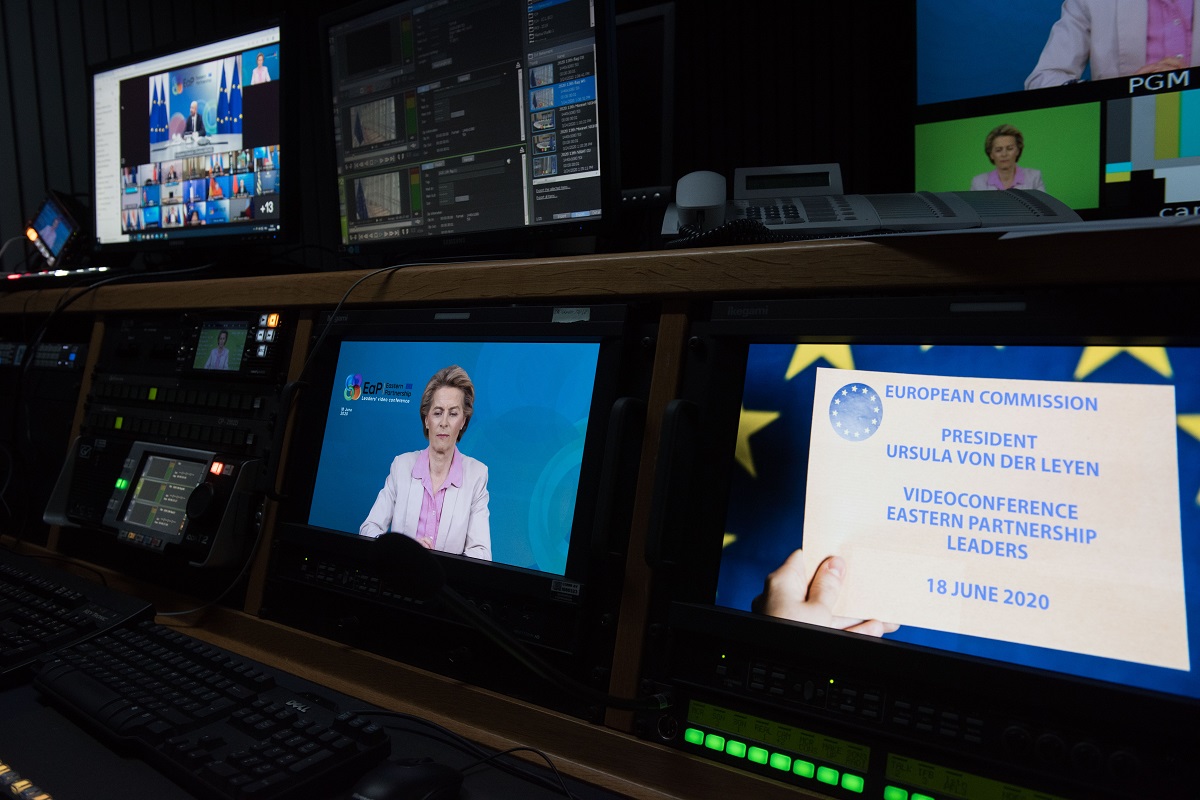
Ursula von der Leyen, President of the European Commission, participated in the Eastern Partnership Leaders' videoconference on June 18th 2020. The political diversity of the Eastern Partnership countries has called for a calibrated and nuanced strategy for each country. Photo: European Commission
The scale of the AA’s “transformative” ambitions initially exposed a gap in the EU’s own capacity to drive domestic reforms in the countries of the Eastern neighbourhood. The most significant steps to address this weakness have been taken in relation to Ukraine, where the EU has engaged more strategically in the reform process. The EU has shifted attention from simply exporting its rulebook (the acquis communataire), backed with development aid, to supporting more fundamental reforms of state institutions and economic structures. Increasingly, this has become a blueprint for supporting reforms in all Eastern Partnership countries. The EU has moved from a somewhat formulaic insistence on the implementation of the acquis to a greater understanding of and responsiveness to the more granular needs of the partner countries.
Challenges
Despite the challenges Georgia, Moldova and Ukraine have encountered in the period leading up to the signing of the Association Agreements, it was widely assumed that the full and rapid implementation of the complex agreements would follow. For the governments, civil society and the EU, the Association Agreements appeared to represent a ready-made blueprint for comprehensive reform. This proved to be anything but true.
While post-Soviet states are ostensibly endowed with the requisite state institutions (e.g. a cabinet of ministers, judiciaries, anti-monopoly agencies, energy regulators and so forth), many, if not most, have proved to be dysfunctional. The eastern neighbours inherited Soviet state structures that were not only unfit-for-purpose in the post-communist era, but had increasingly fallen into the hands of predatory networks who exploited them for their own rent-seeking purposes. Over time, these networks have corroded the capacity of the institutions to function to the benefit of society while facilitating rent extraction. The outcome is that the state as a whole lacks the capacity to design, implement and enforce rules in a competent and neutral way, which is necessary to deliver public goods and to maintain public trust. The long-standing nature of these phenomena means that there is no quick fix. Public protests and revolutions can bring corrupt regimes down and thus give a tremendous boost to democratic changes; however, these institutions remain remarkably resilient to reform. Yet to sustain any revolutionary change, they needed to be embedded in institutions. Jean Monet, one of the founding fathers of what later became the EU, famously said: “Nothing is possible without men, but nothing is lasting without institutions.”
Ukraine has long been in need of fundamental reform. By 2014, this need had become desperate – though the way forward was far from obvious. While civic activism had, in effect, secured a pro-European orientation, public officials in positions of influence lacked the experience and expertise to carry out a reform agenda. The EU-Ukraine Association Agreement proved to be a transformative step – albeit in a counter-intuitive way – as after its adoption it became clear that nothing less than a complete overhaul of state institutions was required. In other words, the conclusion of the Association Agreement had not resolved Ukraine’s predicament – it had more starkly exposed it. In doing so, however, it triggered a series of actions that could bring about fundamental change in Ukraine, albeit only in the long term.
An association agreement lays out a complex and sophisticated contractual relationship with the European Union. Once it is fully implemented, it results in a far-reaching political association and economic integration with the EU. In exchange for access to EU markets, the Association Agreements require associated countries to adopt significant portions of the acquis – the set of EU norms that regulate the single market and the EU’s common activities. The level of economic integration offered to the eastern neighbours entails progressive convergence with internal market rules and the adaptation of institutional practices to EU standards.
Yet the intense focus on the acquis leaves the EU somewhat rigid in its interactions with third countries. This was evident in the negotiations of the Association Agreements with the eastern partners. Eager to sign the Association Agreements, including its significance as a political symbol, the negotiating countries rarely examined the fine print and rarely challenged the requirements. At that stage, neither the EU nor the national officials negotiating the Association Agreements fully grasped the nature of this challenge. Indeed, it could be argued that there was a major difference in perceptions. EU officials simply assumed that the countries pursuing European integration had the capacity to take on and administer a highly complex corpus of common rules. Ukrainian officials, however, were confident in the transformative potential of the acquis. It would soon be clear that both were overly optimistic.
At the heart of the issue was the fact that the acquis was never designed to guide a country undergoing transition from communism through the fundamental reforms. In other words, the acquis in itself offered nothing in terms of what Ukraine needed most: the rule of law, democratic institutions, effective and impartial judiciaries, a functioning market economy and an effective public administration, all bolstered by high standards of integrity and public-mindedness of the political class. The reason for this absence is simple: EU member states are expected to have mastered these fundamentals before joining.
Prior to the adoption of the Association Agreements, support for fundamental reform was provided by various international donors in the Eastern Partnership countries. In other words, it was piecemeal, ad hoc, unsystematic, and rarely tackled the specific needs of the country. All too often the view that training alone could improve dysfunctional institutions prevailed. Once the implementation of the Association Agreements started, however, the inadequacy of this type of support became evident.
The EU’s support for the Eastern Partnership countries in “ensuring a stable, prosperous and democratic future for all its citizens” could only be achieved by effective state institutions. As noted by international development experts: “for donors to simply attend to social and economic needs without sufficient attention to the basic functioning of core political institutions makes no sense”. The European Commission recognised the challenge and responded strategically in the wake of the tumultuous events of 2013-14.

Innovative approach to Ukraine
The European Commission responded in three distinct ways. First, in April 2014, it created a dedicated Support Group for Ukraine (SGUA). Second, it re-orientated its assistance from pure technical assistance to institution and capacity building through support for comprehensive reforms. Third, it became more strategic in its coordination of assistance.

The SGUA was set up as a task force by the then President of the European Commission, José Manuel Barosso, with the remit to provide assistance and support for reform development and implementation. It is noteworthy that Ukraine is the only third country, (i.e., one that is not a member of the EU) that has been allocated a special task force. The SGUA is staffed by a combination of seconded officials from the commission’s sectoral Directorates General and temporary expert staff.
The importance of this innovation cannot be overstated: the internal capacity of the SGUA has allowed it to test and experiment with new approaches in supporting reforms, a model that the European Commission is trying to emulate in other parts of the Eastern Partnership. Originally the SGUA was viewed with some suspicion by other institutional players, even within the EU itself. However its impact has been such that it has come to be widely respected by EU institutions, member states and their agencies, and, last but not least, the Ukrainian administration. One of the SGUA’s key achievements has been the creation of effective communication channels between national officials, civil society, the media and western donors in Ukraine. For example, when anti-reform forces sought to undermine certain reform bills, their efforts were almost immediately made public thanks to the SGUA.

Institution and capacity building
Institution and capacity building has become a clear priority of support to Ukraine in the Association Agreement implementation. Strategic priorities have included reform of public administration, public finance management, energy efficiency, decentralisation, judicial and prosecutorial reform, governance and anti-corruption. Original post-Maidan efforts were based on initiatives taken by various think tanks, with the SGUA/EU Delegation helping build reform alliances, raise public awareness, support for the drafting, and making the case for, any new legislation all the way through implementation. This has had a transformative impact on the country in important areas: health, education and pension reforms; decentralisation; energy sector reforms and macro-economic stabilisation; VAT reform; and overall public finance management.
This sector-focused approach allowed for a comprehensive strategy – from capacity-building to policy implementation – that was more effective than isolated and sporadic interventions. This has been aided by the key interplay between the policy dialogue across the sectors as part of the implementation of the Association Agreements and the simultaneous technical and financial support for reforms in these sectors.
In strengthening institutions in Ukraine, the EU took an even a step further. In partnership with the European Bank for Reconstruction and Development (EBRD), as part of broader public administration reforms, the EU has set up a support infrastructure which includes sets of dedicated teams of reformers embedded in the Cabinet of Ministers and across various ministries and agencies. These teams have had dual roles – to design and implement specific sector reforms as well as help reform the ministries and agencies from within, in accordance with international standards of public administration. While managing the reform architecture entails very significant investments of time, money and energy, its benefits are also very clear. Reforms are designed with the full knowledge of local conditions and their ownership is assured.
The Support Group for Ukraine – in close co-operation with the EU Delegation in Kyiv – has been able to tailor its assistance and expertise to Ukrainian needs and priorities. As a result, EU assistance has become more systemic, focusing on strengthening state capacity rather than merely funding individual projects or facilitating legal approximation. The EU has been able to deploy a mix of instruments in a comprehensive way, with clear conditions and an accompanying policy dialogue, as well as coordinating strategically with member states and other donors, such as the International Financial Institutions (IFIs). This hybrid/mixed approach is not novel in itself – it has been done elsewhere. Yet its application to stimulate reform in Ukraine represents an important innovation. Thanks to the combined staff capacity of the SGUA and EU Delegation in Ukraine, the EU is able to assist in the implementation of reform much more robustly than before.
This means that the often fragmented assistance commonly seen prior to the SGUA, and which resulted in repetition and inefficiency, was vastly reduced. With the EU as the largest partner and contributor, the SGUA took the lead in organising regular programming meetings with member states. Some of them join the EU either as implementers or as co-financing programmes with the EU. Good examples include Germany and the energy efficiency reform, or Denmark and the programme on anti-corruption which provides support to the new anti-corruption bodies. In addition to EU member states, the SGUA/EU Delegation actively coordinates reform support and joint messaging on key reforms with other bilateral actors, notably the United States and Canada. This is a marked improvement from the pre-2014 assistance.
***
The EU, in signing the Association Agreements with the members of the Eastern Partnership, has embarked on a foreign policy experiment. In essence, it is an offer of integration without accession to promote transformative reforms in neighbouring countries. The adoption and implementation have been varied. Moreover, the political diversity of the Eastern Partnership countries has called for a calibrated and nuanced strategy for each country, as foreseen in the 2015 revision of the European Neighbourhood Policy. This more tailored approach has, in turn, necessitated building more capacity and expertise on the individual countries within EU institutions in order to allow an effective engagement in the fundamental reforms. In the case of Ukraine, by combining the EU’s policy leverage with reorienting financial assistance towards reform fundamentals, the EU has managed to influence a number of positive changes. Reform, whether in Ukraine or in the broader Eastern Partnership region is, however, inevitably slow and uneven. Fundamental institutional transformations take many years to take hold. Yet the length and difficulty should not deter the EU from continuing to engage in these reforms.


The significance of European integration for the eastern neighbours thus goes beyond the implementation of the agreements. It extends to root-and-branch reform of state structures. This is a novel and underappreciated aspect of the Eastern Partnership: how intensifying bilateral relations can promote reforms in individual countries – the only way to create a stable, prosperous neighbourhood to the East of the EU.
Reforms will no doubt take time but there is already much to reflect on, learn from and build on. Crucially, as the experience of Ukraine indicates, what matters is that this support strategy has not been done in Brussels for Ukraine but, rather, with Ukraine. EU and local officials interact more closely than is typical in similar such situations. This is particularly important for fast changing political contexts. In many regards, the EU’s novel support in Ukraine is verging on transformational not only for Ukraine but for the EU’s role as an international actor. This brings invaluable lessons and experience for the EU’s role in the Eastern neighbourhood and beyond.
Katarina Mathernova is the Deputy Director-General for European Neighbourhood and Enlargement Negotiations with the European Commission.
Kataryna Wolczuk is a professor with the School of Government at the University of Birmingham.