
Failed Expectations? Belarus and the Eastern Partnership
When compared with other members of the Eastern Partnership, Belarus appears to be at the back of the line in terms of projects and endeavours. Belarus has not signed any partnership or co-operation agreements and the last attempt to restart bilateral relations disappeared in October 2019 when Frederica Mogherini’s visit was postponed indefinitely. Perhaps the current political situation in Belarus will provide the EU with an opportunity to reassess its policy towards Belarus and Belarus’s place in the Eastern Partnership.
When the first Eastern Partnership (EaP) Summit took place in Prague in 2009, Belarus seemed to be demonstrating more hope than despair in terms of its internal and external political development. Another wave of western sanctions had just been mitigated and bilateral relations with one of the two major proponents and initiators of the Eastern Partnership – Poland – were reaching a new level of mutual trust and co-operation. Despite the fact that Belarusian president Alyaksandr Lukashenka did not come to Prague himself, unlike his colleagues from Armenia, Azerbaijan, Georgia and Ukraine (Moldova was also not represented by the head of state), Belarusian media portrayed the Eastern Partnership Initiative as a success of Belarusian diplomacy.
September 4, 2020 -
Veranika Laputska
-
AnalysisIssue 5 2020Magazine
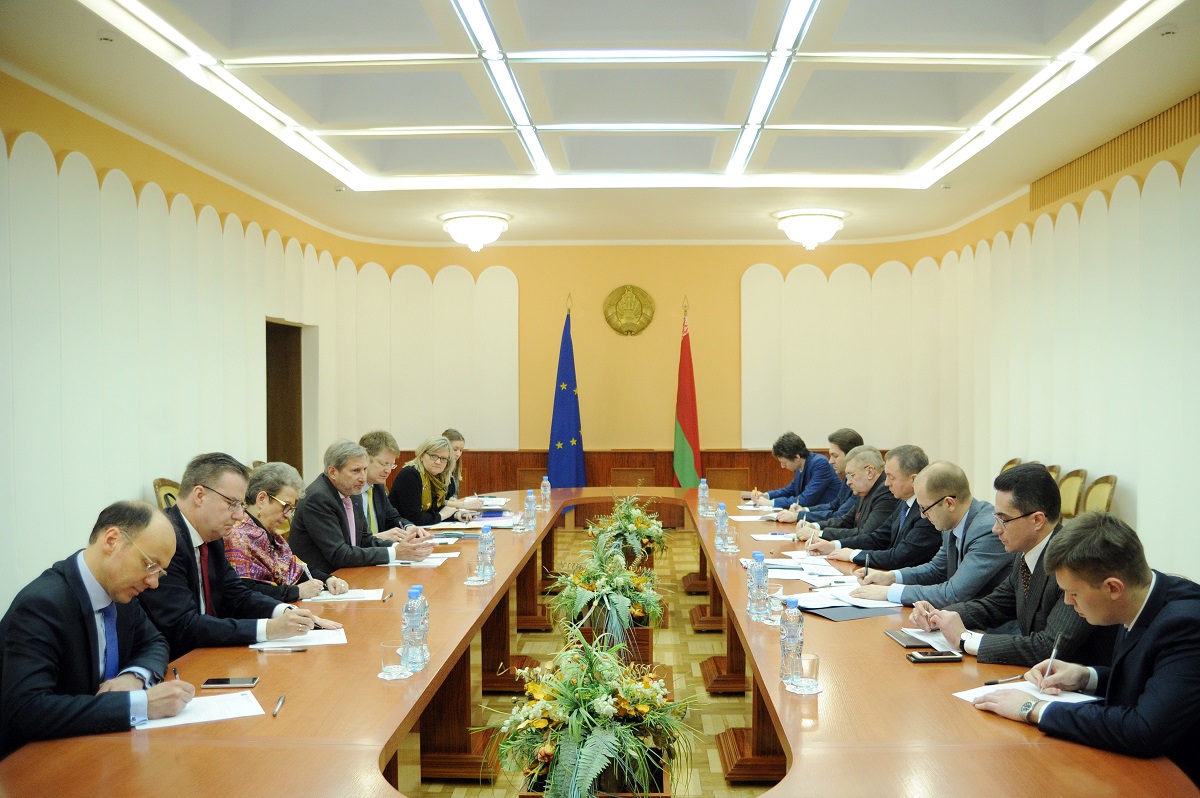
Vladimir Makei, Belarusian Minister of Foreign Affairs, 4th from the right, and meets with Johannes Hahn, EU Commissioner for Neighborhood Policy and Enlargement Negotiations, 4th from the left, in Minsk, on January 30, 2018. Photo: European Commission
However, the leadership clearly abstained from the loud statements of the Eastern Partnership being a first step for Belarus’s accession to the European Union, unlike other countries like Georgia or Ukraine.
The EU at that time perceived Belarus in a cautious, but rather supportive way. It appreciated the fact that the Belarusian leader opted against recognition of the breakaway territories of South Ossetia and Abkhazia following the Russian-Georgian war in 2008. In 2009, Belarus was also recovering from another run of “gas wars” with Russia and rapprochement with the EU at that point sent a certain signal to Russia, which the Belarusian president could use to his advantage. Everything changed after the 2010 presidential election in Belarus when seven out of nine candidates were imprisoned in the aftermath of the election. Massive repressions targeting Belarusian civil society, mass media and political activists was then launched and lasted for several years.
Sticks and carrots
Since 2010 Belarus became a complicated partner for the EU. Approaches on how to deal with Belarus divided EU members into three main groups. One group led by the Baltic states, Czech Republic, Poland and Sweden, who were simultaneously the most enthusiastic supporters of the Eastern Partnership, distanced themselves from the official communication, but strengthened their support for independent media, political activists and non-governmental organisations and became vocal in condemning political oppressions.
The second group – made up of EU leaders and the large countries such as Germany, France and the United Kingdom – preferred to follow the first group, but in a softer way. They would publicly criticise Belarusian authorities for the violations of freedoms in Belarus and provide assistance to the Belarusian third sector. However, such activities were clearly not the priority of their foreign policy compounded by a vast number of different dimensions and geographical vectors. The third group – and the vast majority of the EU – remained practically indifferent to what was happening in Belarus apart from sporadic political declarations on the national and multinational levels of the UN, OSCE and EU.
The EU introduced a number of sanctions aimed at individuals and enterprises connected to the Lukashenka regime and responsible for political repressions and election falsifications. The Eastern Partnership initiative for Belarus was practically frozen for several years, although Belarusian leaders did participate in summits, ministerial meetings and remained somewhat engaged in “politically neutral” aspects such as cross-border, ecological or socially-oriented projects dealing with vulnerable groups. In this way, the Eastern Partnership turned out to be in fact the only multinational EU platform where Belarus could engage with EU officials.
Unsurprisingly, such external circumstances led to another round of the enhancement of Belarusian-Russian relations which was interrupted only in 2014 by the Russian aggression in Ukraine and Russia’s annexation of Crimea. The Belarusian authorities found themselves in a complex situation when they continued to be extremely dependent on Russia economically and politically, but had to implement a smart position towards the conflict that involved its two important neighbours. The Belarusian leadership elaborated an idea to play a role of a mediator in the Russo-Ukrainian war and this was highly appreciated by the European leaders who also became engaged in a conflict resolution process.
This, however, did not change the very cautious vision of Belarus’s role in the Eastern Partnership. The authorities understood very well that Russia’s aggression which followed the EuroMaidan in Ukraine (the protests which erupted in the aftermath of the Ukrainian government’s decision to suspend the signing of the Association Agreement) clearly demonstrated that it would be fighting for its allies in post-Soviet territories. In order to avoid a direct clash with its eastern neighbour, Belarus decided it had to be very mindful of possible aggression or any type of economic and political pressure originating from there.
How good are the carrots?
When comparing to other members of the Eastern Partnership initiative, Belarus appears to be at the back of the line in terms of many projects and endeavours. Belarus has not signed a Partnership and Co-operation or Partnership Priorities agreements, although even Armenia and Azerbaijan – who also mainly focus on the economic co-operation with the EU – already signed one. The last attempt to touch upon the crucial issues of bilateral relations disappeared in October 2019 when the visit of High Representative of the EU for Foreign Affairs and Security Policy Frederica Mogherini was postponed indefinitely.
In the autumn of 2019 EU-Belarus relations became even more complicated due to the complaints by the Lithuanian authorities on the Astravets nuclear power station which was built at the Belarusian-Lithuanian border. Taking into account current plans to launch the operation of the power plant on July 1st this year, despite numerous protests by Lithuanian on bilateral and international level (most notably at the EU one), any intensification of affairs between the EU and Belarus in the near future is unlikely to happen as Lithuanian will continue its rhetoric.
Belarus also possesses the most unfavourable visa policy with the EU in comparison to all other members of the Eastern Partnership, despite the fact that the highest number of Schengen visas were issued to Belarusians out of all the Eastern Partnership countries for the last several years. The Belarusian authorities were also far behind the rest of the EaP to sign a visa facilitation and readmission agreement on January 8th 2020. The European Parliament approved a decision on May 14th to reduce the price for Schengen visas for Belarusians from 60 to 35 euros.
Belarus’s visa situation looks backwards when compared to Georgia, Moldova and Ukraine who have been enjoying the visa-free regime with the EU for several years already. Even Armenia and Azerbaijan signed agreements with the EU on the facilitation of the issuance of visas back in 2014. In addition to that, Belarus is the only state out of the six EaP members that does not have the subcommittee on Justice, Freedom and Security within the Eastern Partnership which enables expert discussions on home affairs. The 2018 External Investment Plan of the European Fund for Sustainable Development (EFSD) included one project targeted at Belarus. Armenia, Georgia, Moldova and Ukraine have all received aid for various projects within the EFSD. The only larger outsider in this regard was Azerbaijan which was not mentioned in the External Investment Plan at all.
During the COVID-19 pandemic, which is heavily affecting Belarus, the EU mobilised 60 million euros out of 980 million to tackle the consequences of the virus and assist health systems in the Eastern Partnership countries. This figure is smaller than the assistance provided to Moldova, Armenia and Georgia (who received 87, 92 and 183 million euros respectively), although the number of people affected in Belarus is larger in both absolute and relative terms. Only Azerbaijan received less within this track of EU assistance – 31.6 million euros.
In May the European Commission officially stated that Belarus had appealed to the EU for macroeconomic assistance to cover the economic consequences of the COVID-19 pandemic. At that point Georgia, Moldova and Ukraine were included in the assistance package within the framework of the European Neighbourhood and Enlargement Policy involving many countries and amounting to three billion euros.
Undoubtedly, the EU remains a crucial economic partner for Belarus. The EU is the second most important trade partner after Russia. Multiple EaP and EU programmes support Belarusian businesses. The European Investment Bank (EIB) and the European Bank for Reconstruction and Development (EBRD) have been playing an important role in this process providing financial aid for small and medium-sized enterprises. In addition to that, the EU4Business initiative contributed to the funding, training and export support for 4,500 Belarusian companies and the creation of 5,700 new jobs.
The EU plays a huge role in environmental and infrastructure projects in Belarus, but also in its societal development and endorses a dialogue between the Belarusian authorities and civil society. Since the inclusion of Belarus into student and professional exchange programmes, several thousand Belarusians have taken part in these initiatives. Importantly, the EU enhances the development of democratic governance and human rights in the country. An annual forum of EU-Belarus Human Rights Dialogue provides an opportunity to discuss human rights issues in Belarus. Needless to say, this area remains the most problematic in the bilateral relations and, in many cases, hampers further intensification of the Belarus-EU affairs.
More sticks to come?
Although Belarusians remain generally positive about the EU, their overall perception of it is divided into two major streams. One side is influenced by the disinformation campaigns propagated by both Belarusian and Russian state media omnipresent in Belarus, believes that the EU, together with the Eastern Partnership, can only bring chaos, crisis and devastation to traditional Christian values. The other, more liberal, side is inclined to improvements in living standards and social mobility which can be enhanced by the EU if Belarus becomes closer to it. However, very often this pro-European stream becomes disillusioned with the way the EU tackles human rights issues and democratic repressions in Belarus. Oftentimes Belarusians are disappointed with the sanctions-lifting cycle, not realising that the EU cannot directly interfere in the domestic political situation in Belarus.
In this regard the 2020 presidential election in Belarus will be another test for the EU and the Eastern Partnership on its ability to carry out a wise policy towards Belarus. The protests which took place demonstrated one of the highest levels of social frustration with the Lukashenka and the Belarusian leadership in years. A huge wave of solidarity coming from the Belarusian diaspora all over the world, including those living in EU countries, contributed to the eagerness of Belarus’s citizens to react towards the oppression of civic and political freedoms, but also to the lack of adequate measures to tackle the ongoing COVID-19 pandemic by authorities.
On June 19th, following a number of arrests of potential candidates, journalists, activists and regular civilians, often detained by officials with no insignia, the EU’s lead spokesperson for Foreign Affairs and Security Policy, Peter Stano, urged the Belarusian authorities to ensure a fair and free election campaign. For the first time a number of Belarusian bloggers and digital influencers became subjects of detention and criminal charges for sharing insider information on social media and publishing live streams from political rallies and protests.

Indeed, the current political situation in Belarus provides the EU with an opportunity to reassess its policy towards Belarus and its place in the Eastern Partnership. Thus far the EU has been unable to impact democratic changes at large despite a vast level of support for Belarusians in different fields and on various levels. The aftermath of the presidential election might lead to another wave of western sanctions and further Belarus’s integration with Russia. This would create a new dilemma for European stakeholders, especially for the neighbouring countries who are mostly interested in the European Partnership development such as the Baltic states and Poland.
The economic consequences of the COVID-19 pandemic worsen the situation even further by occupying the top of the EU’s priority list. Nevertheless, the democratic voices in the EU remain strong and lessons learnt from previous dynamics with Belarus might create an impulse for a positive relaunch of Belarus-EU relations and a change of Belarus’s role in the Eastern Partnership.
Veranika Laputska is a co-founder of the EAST Research Center and a PhD candidate at the Graduate School for Social Research, Institute of Philosophy and Sociology, Polish Academy of Sciences. Her research interests include media, visual and Jewish studies as well as the study of the nationalism and politics of memory.