
Text resize: A A
Change contrast

Volcanic vintage. The historic Hungarian wines of Lake Balaton

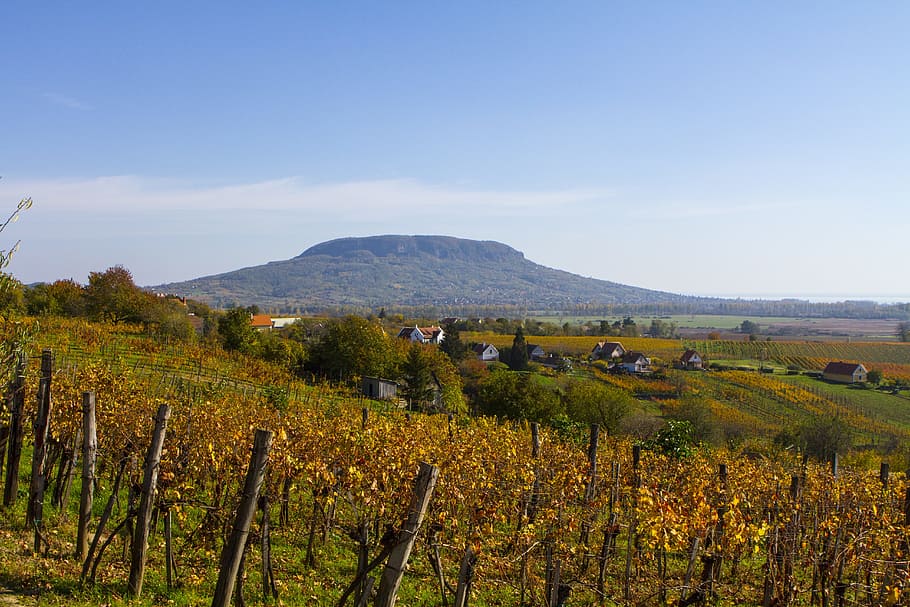
Writers and artists have long been attracted to the strange and romantic landscape of Badacsony, with its sharp volcanic hills overlooking smooth Lake Balaton. Stories about the wines from vineyards around Lake Balaton in west central Hungary go back over 2,000 years.

The fourteenth-century Hungarian King Charles Robert once travelled to Veszprém on the north shore of Lake Balaton to visit a bishop. Before dinner, the king noticed a gigantic cup in the monastery treasury. “The monks used to drink from it long ago,” the bishop told him. As they sat down to eat, the king asked that the cup be placed at their table. The bishop announced that none of the canons at the table could possibly drain the massive tankard, with the possible exception of the formidable Father Eusebius. The king challenged Eusebius to take the cup and uphold the honour of the house, but the father declined and held his ground despite the needling and beseeching of the assemblage.

July 7, 2020 - Eric Bryan - Issue 4 2020MagazineStories and ideas

Lake Balaton wine country in Hungary. Photo (CC) https://www.piqsels.com/en/public-domain-photo-fqgqt


But then, after the fifth course, Father Eusebius rose magisterially to his feet, lifted the huge cup in a toast to the king, and swallowed its contents in one superhuman slug. The monastery resonated with cheers and applause. King Charles Robert questioned the father’s initial reluctance.

“Your Majesty,” Father Eusebius replied, “I was afraid that I would fail. But I had a try under the table and found that I could, and that gave me the courage to do it for you and in front of the company.”

Heritage and legends

The wine which shimmered in Eusebius’ legendary cup would almost certainly have been one of what are known as Hungary’s “historic wines”: Badacsony Kéknyelű, Szürkebarát(“Grey Monk”), Zöldszilvánior Olaszrizling. These are the wines from vineyards around Lake Balaton in west central Hungary, the largest and shallowest lake in Central Europe. The heritage of these wines goes back over 2,000 years. What is now Hungary was then Pannonia, a province of the Roman Empire. The area’s vineyards were created when Emperor Probus waged a vine-planting campaign in the Badacsony area of Balaton, south of the Bakony Mountains.

A thousand years later the first Hungarian monarch, King Stephen, rose to power and set out to Christianise his country. He granted most of the fertile northern Balaton land to church dignitaries and religious orders. The priests and monks, being partial to a jug or two themselves, produced some of the finest wines from the vineyards.

Hospitality seems to have been part of the wine culture. Legend has it that no vintner on the slopes of Badacsony could become mayor of any of the villages if he had failed to offer a passing stranger a glass of wine from his cellar. The Badacsony area is ancient volcano country, and the grape vines thrive in the lava soil and plentiful sunshine of the lower slopes. The Avars, whose empire in the seventh century AD stretched from the Black Sea to the Adriatic, used to bury grape seeds with their dead – an effort to ensure viniculture continued into the afterlife.

Writers and artists have long been attracted to the strange and romantic landscape of Badacsony, with its sharp volcanic hills overlooking smooth Lake Balaton. In fact, a mansion in the nearby village of Szigliget is the private preserve of the Hungarian Writer’s Union. The smallest Hungarian wine region is Somló, about 34 miles north of Lake Balaton. Somló is believed to boast the highest per-capita male population in Hungary. Traditional folklore tells that drinking a glass of any Somló wine – Juhfark in particular – on the eve of one’s wedding day influences the odds in favour of the birth of a male heir.

The Habsburg royal family was alleged to have held to this belief, and from 1526 to 1918, as they ruled Hungary from Vienna, they consistently produced male heirs. Emperor Charles III was the one exception, whose daughter Maria Theresa reigned from 1740-80. But Duke Stephen, her consort, may have consumed his fair share of Somló wine: Maria Theresa had 16 children and was succeeded by her son, Joseph II, who ruled the Habsburg lands from 1780-90.

Somló Hill

The Ezerjó, Olaszrizling and Mézesfehér wines come from vineyards on Somló Hill, an extinct volcano. The mild climate and volcanic soil combine to create a golden-green wine with a pleasing twang which is reputed to ease indigestion, cleanse the kidneys and treat anaemia. Saint Stephen founded a convent in Somló, and a statute in the 1511 Urbarium details the services required of the serfs who tended the convent’s vineyards. They were demanded to pay annually one-tenth of the yield of noble Somló grapes, and twelve tubs of wine from surrounding districts.

Renaissance monarch, King Matthias Corvinus, who ruled Hungary and Croatia from 1458-90, also owned land on Somló Hill. He established the vineyards that provided wine to his renowned Black Army, an elite body of mercenaries who reputedly went into battle dressed entirely in black.

Other Somló Hill wine growers were the Benedictine and Cistercian Orders. Tamás Bakócz, a maligned humanist who rose from serf to cardinal, owned one of the largest vineyards. When the cardinal rode through Rome as a candidate in the papal election, it is said that he had his and his retinue’s horses shod with golden shoes. Bakócz hoped the impression of great wealth would secure votes, but history suggests his ploy had the reverse effect. Gift barrels brimming with Somló wine may have been more politically effective.

The Eszterházys, descended from a swashbuckling captain who founded the family fortune by marrying a wealthy widow, became the biggest landowners in Hungary. During Maria Theresa’s reign the family acquired some of the coveted Somló land. Their estate was a vast Eszterházys empire, with the Somló Hill vineyards the jewel in the crown.

The southern area of Lake Balaton also has its wines. Beyond the shoreline holiday resorts there lies a sizeable and variegated region of vineyards. These range from tiny individual holdings to large enterprises boasting their own laboratories and wine producing plants. The most famous white wines from the southern district are the Muscat Lunel, the Tramini and the Királyleányka. The popular red wines are of the lighter variety, notably Kékfrankos, Blue Oporto and Cabernet Sauvignon.

Fish is the specialty of the area and the lake beam, carp and perch are made into a number of dishes from fish soup to fish roasted on a spit. Fish is sometimes prepared by slicing in half, sprinkling with paprika and grilling until crisp. Balaton Cabernet Sauvignon, which has all the advantages of aromatic red wines made from grapes harvested when fully ripe, is the favoured wine to accompany the fish specialties.

Wine and song go hand in hand

In modern Hungary, the country’s finest wine-growing areas are divided into 20 wine regions as decreed by the Hungarian Wine Act. The act, valid as of September 1994, defines wine and carbonated categories as follows:

  • Natural Wine: Table, quality or premium quality wine produced in accordance with legal resolutions with the following stipulation: Table wines are required to be produced from must containing a minimum of 13 per cent sugar by mass.
  • Country Wines: Table wines made from the produce of certain wine growing areas and from the must of fully specified grape varieties approved of by the state with a minimum of 15 per cent sugar by mass.
  • Quality Wines: Wines made from the must of a growing area’s specific grape varieties with a minimum of 15 per cent sugar by mass, provided that they are the produce of a plantation with a maximum yield of twelve tonnes per hectare of a specific wine growing area and contain distinctive flavour and aroma substances specific to the area and grape variety, or possibly to the production technology used, or the vintage.
  • Premium Wines: Special wine made from the must of a growing area, specific grape variety grown on a plantation yielding a maximum of ten tonnes per hectare in certain wine-growing areas, the crop of which has ripened or over-ripened on its wine-stock or has shrivelled or developed noble-rot, provided that the must contains a minimum of 19 per cent sugar by mass, as well as fragrance, flavour and aroma substances characteristic of that growing area, grape variety and the method of wine-making, and that it is worthy of special distinction due to the vintage and its place of origin.
  • Museum Wines (particularly old vintage wines): Quality and exquisite wines aged for a minimum of five years and worthy of distinction due to a specific feature, the vintage and its character.

Since the reign of Saint Stephen, September has been vintage month in Hungary. Hungary’s wines are presented annually in vintage festivals held in Budapest and every wine producing region. In Pécs, a city in the southwest portion of the country near the Croatian border, the vintage celebrations reach their peak in the European Wine Song Festival. Schubert’s song in praise of wine, delivered by a 200-voice international choir, opens the festivities:

            You friends and you golden wine
            Make my life sweeter.
            Without you bestowers of joy
            I would live in fear and trembling . . .
            What is the hero without a friend?
            What are the great men of the realm?
            What is the master of the whole world?
            They are all poorly counselled,
            Without friends, without wine
            I should not even wish to be emperor.

The festival is held on the final weekend of September. Celebrations are also presented in villages dotted along the Villány-Siklós Wine Road. Inaugurated in 1993, the festival’s motto is “Wine and song go hand in hand in every culture.” The aim of the event is to not only celebrate the link between music and wine, but to reinforce the traditions associated with wine and to represent Hungarian wines to the world through the arts. The festivities offer performances of male choirs from across Europe. Chorale groups from Croatia, Finland, France, Italy, Latvia and Spain as well as celebrated Hungarian ensembles have all sung at the event. The festival’s host choir is the Bartók Béla Male Chorus. The next European Winesong Festival is scheduled to take place from September 25-27th 2020, beginning on the Villány-Siklós Wine Route.

Eric Bryan is a freelance travel writer and essayist.

, , ,

Partners

Terms of Use | Cookie policy | Copyryight 2026 Kolegium Europy Wschodniej im. Jana Nowaka-Jeziorańskiego 31-153 Kraków
Agencja digital: hauerpower studio krakow.
We use cookies to personalise content and ads, to provide social media features and to analyse our traffic. We also share information about your use of our site with our social media, advertising and analytics partners. View more
Cookies settings
Accept
Decline
Privacy & Cookie policy
Privacy & Cookies policy
Cookie name Active
Poniższa Polityka Prywatności – klauzule informacyjne dotyczące przetwarzania danych osobowych w związku z korzystaniem z serwisu internetowego https://neweasterneurope.eu/ lub usług dostępnych za jego pośrednictwem Polityka Prywatności zawiera informacje wymagane przez przepisy Rozporządzenia Parlamentu Europejskiego i Rady 2016/679 w sprawie ochrony osób fizycznych w związku z przetwarzaniem danych osobowych i w sprawie swobodnego przepływu takich danych oraz uchylenia dyrektywy 95/46/WE (RODO). Całość do przeczytania pod tym linkiem
Save settings
Cookies settings