
Text resize: A A
Change contrast

The many dimensions of hybrid warfare

Georgia is in the midst of a hybrid war with Russia. Among the various tools used by the Kremlin, economic pressure has been arguably the most effective strategy that has been directed at Georgia since the 1990s.

Georgia-Russia relations give great insight into the currently fashionable subject of hybrid warfare. Similar to the idea of “fourth generation warfare”, which focuses on blurring the fronts between opposing sides and waging war by means other than head-on military confrontation, hybrid warfare is a more sophisticated way of using all of a country’s available resources to achieve a specific set of geopolitical aims.

July 7, 2020 - Emil Avdaliani - Hot TopicsIssue 4 2020Magazine

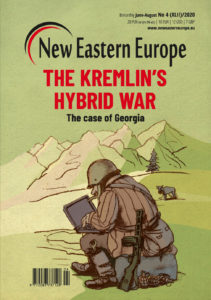
Illustration by Andrzej Zaręba

Hybrid warfare is also commonly known by terms such as “grey zone strategies”, “competition short of conflict”, “active measures” and “new generation warfare”. I will stick to the traditional term to explain what is so unique about the Russian strategy of combining various political, military and economic tools to influence Georgia. Russia’s hybrid warfare strategy is a highly innovative approach to modern conflicts. No longer pursuing the seemingly unilimited objectives of total war, it is considered an effective alternative. Innovation in Russia’s military sector since the early 2000s, as well as the shifting balance of power along the country’s borders, has encouraged its military and political leadership to develop a new concept for attaining policy goals.

Coordinated campaign

Georgia is a good example of how Russia’s hybrid strategy has developed over the years. The South Caucasus was among the first areas to experience a coordinated campaign of propaganda, military and economic actions, specifically aimed against successive governments in Tbilisi. Indeed, the West only started to pay attention to Russia’s hybrid warfare after the war in Ukraine began. NATO and the European Union documents that included the term “hybrid war” only started to appear after Russia’s annexation of Crimea in 2014. The term began to spread in 2015 after NATO Secretary General Jens Stoltenberg and the High Representative of the Union for Foreign Affairs and Security Policy Federica Mogherini first used the term.

Despite this, Georgia began to experience the effects of hybrid warfare long before 2014. These effects include Russia’s long-term support for Abkhazian and Ossetian separatists and the subsequent creation of frozen conflicts, which continue to prevent Georgia from joining Western institutions. This was the first modern case of war where military, economic and information components were purposefully intertwined.

These tactics were popular during the period preceding the Russian invasion of Georgia in 2008. Afterwards, the Kremlin demonstrated an extraordinary array of tools and tactics, which eventually blended into an overall strategic vision focused on influencing a militarily and economically vulnerable Georgia. Such tools have included disinformation campaigns targeting specific issues. Larger disinformation campaigns could potentially distort certain historical periods in Georgian history, including the highly sensitive issues of Abkhazia and South Ossetia (known as the Tskhinvali Region to Tbilisi), or perhaps even the overall history of Georgia-Russia relations.

Campaigns to polarise different parts of Georgian society, specifically the territories populated by ethnic minorities in the country’s southern regions, are also taking place. In the last decade or so cyber-attacks have also been used to target Georgia’s energy, military and economic sectors. This is in order to gather critical information on the operations of state bodies. Additionally, campaigns that target government and media websites are now also common. In 2019 up to 15,000 state and private media websites were taken down by hackers. They were replaced by an image of the former Georgia President, Mikheil Saakashvili, with the caption “I’ll be back”. An investigation confirmed that Russia was the source of this attack.

Russia’s use of the hybrid warfare in Georgia has been motivated specifically by a geopolitical dilemma it has been facing since the 1990s. This is namely Tbilisi’s burgeoning ties with the West. Russia considers such relations as an attempt by the West to undermine its geopolitical influence in the region. From a strategic perspective, the purpose of Russia’s hybrid war strategy in Georgia is to destabilise government structures as a means of permanently weakening the state.

The era of simply keeping territory after defeating an enemy in open battle has ended. Consequently, Russia has now combined various military, information, economic and diplomatic tools as a means of achieving specific goals in Georgia. As aforementioned, this strategy is preventing Georgia from joining Western structures.

Economic hybrid war in action

Prior discussion has highlighted the general premises of Russia’s hybrid playbook. Despite this, media propaganda, targeted cyber campaigns and other methods might not always be an effective way of forcing the Georgian government to make concessions regarding vital geopolitical issues. The economic aspect of hybrid warfare is by far the most important sphere and this is where Russia has the greatest influence on Georgia. If the necessity arises, this market power could be translated into real geopolitical gains.

Georgia’s difficult economic situation continuously presents Russia with opportunities to influence the country. For example, relatively low levels of approval for each major party in parliament (whether in government or in opposition), a high unemployment rate and a wider failure to improve the economy are all problems that highlight Georgia’s vulnerability to external manipulation. One of Russia’s main successes was the reopening of market links, which occurred after the Georgian Dream coalition came to power in 2013. This followed the ending of Moscow’s embargo on agricultural goods which has been in place since 2006. Russia is now among Georgia’s largest trading partners and is the largest export destination for various Georgian products, including wine and mineral water.

Renewed access to the Russian market continues to generate large economic benefits for Georgian producers. However, dependence on such benefits has also made producers vulnerable to potential Russian trade restrictions in the future. The 2006 economic embargo is a good illustration of how Moscow may use its economic power as a weapon. Alleged quality flaws found in imported Georgian goods may lead to disruptions in supply chains and ultimately economic losses for Georgian producers. Similar measures have been taken by Russia with other neighbouring countries.

Every small incident or flare-up between the countries could lead to a renewed embargo or partial disruption. For example, in August 2015 Rozpotrebnadzor, Russia’s agency for consumer protection, warned of “low quality Georgian wine” following Tbilisi’s decision to join EU sanctions against imports from Crimea. Another revealing example occurred just last year, when Tbilisi witnessed a wave of protests condemning the visit of the Russian parliamentarian Sergey Gavrilov to Tbilisi. One of the possible countermeasures discussed in the Russian State Duma was the imposition of an economic embargo on Georgian products. There is an increasing understanding among the Georgian public regarding the instablity of Russia’s economic outlook, with decisions often changing in line with geopolitics. This has subsequently allowed Moscow to become a key influence on geopolitical thinking in Tbilisi. Another influential tool at Russia’s disposal is the large number of Georgian migrants working in Russia, who send vast sums of money back to their families. For example, the 2006 crisis saw Russia deport many Georgian migrants. At the same time, Russia’s ability to buy into Georgia’s critical infrastructure is also problematic. For instance, Rosneft’s purchase of 49 per cent of the Georgian Petrocas Energy Group in late 2014 is troubling from a strategic point of view. Indeed, the group owns an important oil terminal at the port of Poti. This is Georgia’s major seaport and possesses a terminal capable of unloading oil products from tankers.

Political dimension of economic hybrid war

Georgia’s economic vulnerabilities not only reflect the country’s poor positioning in relation to Russia, but also create ideal conditions for the activity of pro-Russian groups. These organisations happen to be the most radicalised sections of Georgian politics. Despite this, the political importance of these groups is often exaggerated and their political influence is marginal at best. Nevertheless, they have a following that could complicate the situation on the ground in case of a major social or economic crisis.

As is the case generally with the anti-establishment ideas of radical parties, the rise of pro-Russian sentiment in Georgia could be strengthened by growing economic problems. This therefore links the activities of pro-Russian parties to the Kremlin’s overall hybrid warfare strategy in Georgia.

Nino Burjanadze’s Democratic Movement–United Georgia and Irma Inashvili’s Alliance of Patriots are two major pro-Russian political parties in Georgia. Both have minimal public support, though it should be noted that Inashvili’s party does have seven members in parliament. The two parties are important to watch as they both have contacts among the Russian political leadership. The two leaders share almost identical geopolitical outlooks, favouring Russia and believing that Western integration is a counterproductive idea.

Pro-Russian NGOs and their affiliated news outlets have also become increasingly active in the country. Their messages range from anti-Western reporting to appeals to Georgian nationalism. These organisations also discuss radical-conservative Orthodox values, which often do not represent the official line of the Georgian Orthodox Church. The largest pro-Russian NGOs are the Eurasian Institute and Eurasian Choice. Their activities focus on organising seminars and conferences which involve the participation of Georgian and Russian academics and analysts. They often discuss topics like the Soviet Union’s victory in the Second World War and the life of Joseph Stalin.

Countering hybrid warfare

It is clear that Russia’s hybrid warfare strategy in Georgia is a rather complex process. It includes a sophisticated combination of tools that aim to undermine Georgia’s stability and its desires for Western integration. By using this strategy, Russia has instigated conflict with the country without using explicit military might. The hybrid warfare that the Kremlin uses today is, in a sense, far greater and effective than what the communist party pursued during the Cold War. The existence of the internet, cable news, social media and the general spread of the Russian language has enabled Russia to operate extensively within Georgia. Russia’s influence has also been strengthened due to the fact that its tactics are less ideologically driven than during the Soviet era.

The Georgian state needs to develop a long-term strategy to fight hybrid warfare and not just in relation to Moscow. Measures to counter this new form of conflict should include allocating more resources to state intelligence, as well as supporting transparency and anticorruption efforts. Indeed, corruption generally allows for the inflow of dubious foreign money.

So far Georgia has shown some resilience to Russia’s hybrid warfare strategy. Nevertheless, the country’s domestic economy will remain especially vulnerable to Russian  interference in the future.

Emil Avdaliani teaches history and international relations at Tbilisi State University and Ilia State University. He has worked for various international consulting companies and currently publishes articles on military and political developments across the post-Soviet space.

, ,

Partners

Terms of Use | Cookie policy | Copyryight 2026 Kolegium Europy Wschodniej im. Jana Nowaka-Jeziorańskiego 31-153 Kraków
Agencja digital: hauerpower studio krakow.
We use cookies to personalise content and ads, to provide social media features and to analyse our traffic. We also share information about your use of our site with our social media, advertising and analytics partners. View more
Cookies settings
Accept
Decline
Privacy & Cookie policy
Privacy & Cookies policy
Cookie name Active
Poniższa Polityka Prywatności – klauzule informacyjne dotyczące przetwarzania danych osobowych w związku z korzystaniem z serwisu internetowego https://neweasterneurope.eu/ lub usług dostępnych za jego pośrednictwem Polityka Prywatności zawiera informacje wymagane przez przepisy Rozporządzenia Parlamentu Europejskiego i Rady 2016/679 w sprawie ochrony osób fizycznych w związku z przetwarzaniem danych osobowych i w sprawie swobodnego przepływu takich danych oraz uchylenia dyrektywy 95/46/WE (RODO). Całość do przeczytania pod tym linkiem
Save settings
Cookies settings