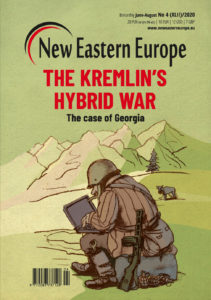

How Russian propaganda works in Georgia
Russian disinformation activities in Georgia, a front-runner in the Eastern Partnership, illustrates how Russian propaganda works on a variety of levels. Understanding the Georgian case may provide an insight into how to counter such hybrid activities in the country and elsewhere in the West.
Today, no one argues with the fact that Russian propaganda is a global challenge. Over the past few years we have witnessed how well-structured disinformation campaigns can be used as a tool for achieving certain strategic goals: to shape public opinion, increase political polarisation, influence elections, demonise opponents, undermine state security, boost nihilism and cripple democracy. As the Soviet-born British journalist, author and TV producer Peter Pomerantsev wrote: “The Kremlin weaponises information!”
July 7, 2020 -
Grigol Julukhidze
-
Hot TopicsIssue 4 2020Magazine
Russian President Vladimir Putin with Defence Minister Sergei Shoigu (right) and Chief of the General Staff of the Russian Armed Forces and Valery Gerasimov. Gerasimov is cited as author of the “Gerasimov doctrine” which states that “21st century political goals could be achieved through non-military and informative means”. Photo: Website of the President of Russia (CC) http://en.kremlin.ru/events/president/news/61584
A number of countries have become targets of the Kremlin’s propaganda operations. The list is long: Argentina, Austria, Belgium, Canada, Denmark, Estonia, France, Germany, Greece, Italy, Montenegro, the Netherlands, Romania, Spain, Ukraine, the United Kingdom and the United States. This phenomenon recognises neither a country’s borders nor any moral restrictions. It may affect state actors throughout the world from Bucharest to Buenos Aires.
Ideological basis
It is true that Russian propaganda threatens the political stability of the entire global democratic system. However, there are several regions where the Kremlin’s disinformation campaign is extremely strong. I would point to the Visegrad countries (V4: the Czech Republic, Hungary, Poland and Slovakia) and three countries of the Eastern Partnership (Georgia, Moldova and Ukraine). These states have always been viewed as significant regarding Soviet/Russian strategic spheres of interest. It should also be noted that the susceptibility of the V4 and the Eastern Partnership countries enables Russia to increase its political influence in Central and Eastern Europe whilst simultaneously undermining the stability of the European Union.
Moreover, even today there are many Russian politicians who do not want to adapt to the new world order formed after the collapse of the Soviet Union and the disappearance of these countries from the Kremlin’s direct sphere of influence. To make a long story short, Russia is trying to regain this control by creating chaos and promoting political fabrications. One of the main instruments in this campaign is propaganda. As a result, activities in Georgia may provide a case study into how Russian propaganda works, as well as how such activity may be tackled by states.
In order to understand and analyse the methodology and narratives of the Kremlin propaganda machine in Georgia, it is important to have a comprehensive understanding of the Russian information war’s ideological basis. One of the main thinkers regarding Russian propaganda is Igor Panarin – a professor at Moscow State University and author of The Information War against Russia. From time to time he makes different geopolitical predictions. For example, in 1998 he predicted that “the United States would disintegrate within the next few years”. Panarin often emphasises that the main objective of the West’s post-Cold War policy is the complete annihilation of Russia. In his written articles, Panarin often speaks of the necessity of countering this goal by means of public stereotypes, manipulation, misinformation and fabrications.
Evidently, the Kremlin’s main ideologist is Aleksandr Dugin. This Russian scholar openly criticises liberal democratic principles and promotes the idea of a “Russian World” (Русский Mир). This concept promotes Russian culture, traditions, history and the “orthodox morale.” Dugin foresees the creation of this ideological construction in the Eurasian space (i.e., the geopolitical area stretching from Cairo to Beijing). The consolidation of the Duginist post-liberal and neo-conservative Eurasian Union will be based on anti-Americanism and a rejection of “Western tendencies” such as same-sex marriage, terrorism, mass migration, etc. In his book, The Fourth Political Theory, Dugin also criticises fascism, communism and liberalism as “expired” ideologies that threaten the traditional family and religious values.
Another important ideological pillar of Russian propaganda is religious indoctrination. This started in 2004 when Russian MP Konstantin Kosachev stated, “Russia cannot justify its active policy in the post-Soviet space while the West is doing it with a ‘banner’ of democracy and our actions are viewed as ‘imperialistic’. This is patriotic but not competitive.” Since then, the Kremlin has been actively manipulating the issue of religion (“Православие”) in other Orthodox nations. The Moscow Patriarchate’s actions are fully in accordance with the Kremlin’s propaganda operations which aim to gain political power through the use of religion.
Soft power and the Gerasimov Doctrine
American political scientist Joseph Samuel Nye Jr. introduced the idea of soft power in the late 1980s. According to Nye, soft power is the ability to attract and co-opt rather than to coerce. As for the Russian version of soft power, it has little in common with Nye’s idea. We can assume that one of the initiators of this shift in understanding was Vladimir Putin. In 2012, Putin published an article titled “Russia and the Changing World”. In this document, he describes soft power as “a mechanism for achieving foreign policy goals without the use of force, intervention and aggressive campaign”. He paid special attention to the importance of co-operation with those compatriots who reside abroad as an instrument for strengthening the country’s international position.
Recent events have clearly shown that Putin’s manifesto played the key influence in decisions to mobilise Russian state funds for the purpose of propaganda operations and underhanded activities against various countries. Officially, dozens of federal foundations were established to promote Russian culture abroad. In practice, however, these bodies merely simplified the financing of pro-Kremlin think tanks, media outlets, politicians and internet trolls throughout the world.
Another important fact was a new military doctrine suggested by Valery Gerasimov, the Chief of the General Staff of the Armed Forces of Russia. It built on Putin’s political manifesto but added more detail. According to Gerasimov: “The 21st century political goals could be achieved through non-military and informative means. Modern Russia is capable of neutralising any threat coming from the West and acting the same way as the Europeans and Americans did while changing the political systems in Georgia, Ukraine and North Africa”.
The case of Georgia
It should be noted that Russian disinformation campaigns appeared in Georgia much earlier than in most other European countries. For instance, these campaigns appeared during the five-day Russian-Georgian war in August 2008. Apart from various propaganda messages, dozens of cyber-attacks by Kremlin-controlled hackers were carried out against Georgian state websites and internet servers. It could be said that this was the first large-scale and well-organised hybrid warfare operation by the Russian Federation. Since 2008 many tactics have been changed, modified and improved in the Kremlin’s hybrid methodology. Propaganda became a key element, funding has increased ten-fold and the importance of the internet and traditional mass media also experienced a dramatic increase. This global systemic transformation also created the perfect ground for Russia’s propaganda targets in Georgia.
All these integral aspects of the Russian information war – including Dugin’s ideological narratives, Panarin’s aggressive methods, Putin’s notion of soft power, and elements of the Gerasimov’s doctrine – are visible in Georgia. A closer look reveals that the main narratives of Russia’s disinformation campaign in Georgia are:
- “The West is wicked and debauched.”
- “Western ideology is incompatible with Georgian national identity and local traditions.”
- “Americans and Europeans do not care for small nations like Georgia!”
- “Same-sex marriage will be legalised due to Euro-Atlantic integration!”
- “Hundreds of thousands of immigrants will be sent to Georgia by Brussels!”
- “The Georgian Orthodox Church will be under attack!”
- “Narcotic use will be legalised!”
- “Americans and Europeans do not care about family values!”
- “Democracy does not work anymore!”
- “NATO is preparing a war against Russia!”
- “Local and international non-governmental organisations serve as an effective mechanism for chaos diffusion”.
Under these “potentially dangerous consequences”, the Kremlin offers a unique alternative – a conservative and traditional state model. This is the aforementioned “Russian World” (“Русский Mир”) that will be free from these “western tendencies”. Another important factor here is the “innocent nature” of Russia. Moscow is obliged to react to the West’s attempts to undermine the country. That is why the Kremlin sends its troops to eastern Syria, Tajikistan, Ukraine, Venezuela, and Vietnam. Self-defence is the only reason for Russia’s military operations, because the main objective of the West’s post-Cold War policy is the “full annihilation of Russia”. The same narrative is used to defend the occupied territories of Georgia: “Americans encouraged and pushed President Mikheil Saakashvili to start the five-day war against the Kremlin-backed separatists in the Tskhinvali region.” As a world power, Russia was “obliged to respond”. However, according to some pro-Russian experts, “Moscow was even generous in its military response when it did not occupy the capital city of Tbilisi.”
Actors of disinformation
Pro-Russian narratives in Georgia are mainly promoted by traditional media outlets and internet news agencies (fake news websites, Facebook pages). Despite many attempts by Georgian authorities and civil society to counter Russian propaganda operations, there has been no centralised, well-coordinated approach. It makes Georgia extremely vulnerable to disinformation. In addition, dozens of state-owned Russian television channels are widely broadcasted in Georgia. Most of these outlets directly promote propagandistic narratives. Other actors for propaganda dissemination include pro-Russian political parties and Moscow-sponsored non-governmental organisations.
The main goals of the Kremlin’s information war in Georgia include:
- Weakening pro-Western opinion among the Georgian public – “Georgia will never become an EU/NATO member”;
- Discrediting Ukraine – “The Maidan was organised by fascists supported and backed by Western intelligence services”;
- Discrediting the United States – “The 9/11 terrorist attack was organised by the CIA”, “US foreign policy is run by masons”;
- Discrediting NATO – “NATO will place a military base in Georgia and will use Eastern Europe as a ‘shield’ against Russia”;
- Discrediting the EU – “The EU is not effective anymore”; “There are only strikes and demonstrations in the European Union”; “The EU will collapse soon”;
- Promotion of conspiracy theories and nihilism – “Politicians are only focused on their own interests”;
- Positive representation of Russian foreign policy – “Russia is not an ideal state, but its policy is less aggressive than the West”.
We also have to pay attention to one other important issue. This is namely the Kremlin’s attempt to romanticise the Soviet times in Georgia, especially among the older generations. This has seen the communist era framed as a relatively positive time in comparison to contemporary troubles: “Yes, maybe the USSR was not perfect, but it was far better than the modern western capitalist order.” Such an approach aims at undermining public consensus regarding Georgia’s Euro-Atlantic aspirations.
Christopher Paul and Miriam Matthews have described various physiological features of Russia’s contemporary propaganda model. Their descriptions appear to correspond perfectly to how the Kremlin’s disinformation operates in Georgia. For example, they view this campaign as: high-volume and multichannel; rapid, continuous, and repetitive; lacking a commitment to objective reality; and lacking a commitment to consistency.
It does not matter how unbelievable certain news items appear. Russia continues to promote various anti-Western and pro-Russian narratives without any moral restrictions. The goal is to encourage chaos and undermine the sovereignty of Georgia. It is important to first grab the attention of the audience. Then, in order to maintain this interest, false information is repeated over and over. Neither the credibility of sources nor the stories’ authenticity are ever checked.
Georgia, it is fair to say, is experiencing an ongoing Russian occupation and information war. It is difficult to know truly which challenge is more difficult. As the politican Salome Samadashvili pointed out, “While Moscow remains a fortress to policymakers in the West, the Iron Curtain has been replaced by a one-way mirror through which the Kremlin can carefully observe the West, while remaining completely invisible and inscrutable.”
Grigol Julukhidze is a senior fellow at the Foreign Policy Council, a think tank in Tbilisi. He specialises in security studies and propaganda research. He is also a lecturer at Ilia State University.