
Corona in Kazakhstan: An authoritarian transparency offensive
Kazakhstan continues to defy the COVID-19 crisis. Official figures remain encouraging following the government’s harsh measures. However, these statistics do not only involve the virus, but also regime critics.
A lack of protective clothing, too few tests and no suitable treatment: Tolkinai Ordabayeva contracted COVID-19 and made some serious accusations. The 29-year old doctor is a specialist in infectious diseases and works in a regional hospital in Southern Kazakhstan. She wrote on Facebook that she had been infected by a patient because of the lack of appropriate equipment: “The hospital administration has forced the medical staff to sew their own masks because at work they do not provide masks or protective clothing.”
July 7, 2020 -
Othmara Glas
-
Issue 4 2020MagazineStories and ideas
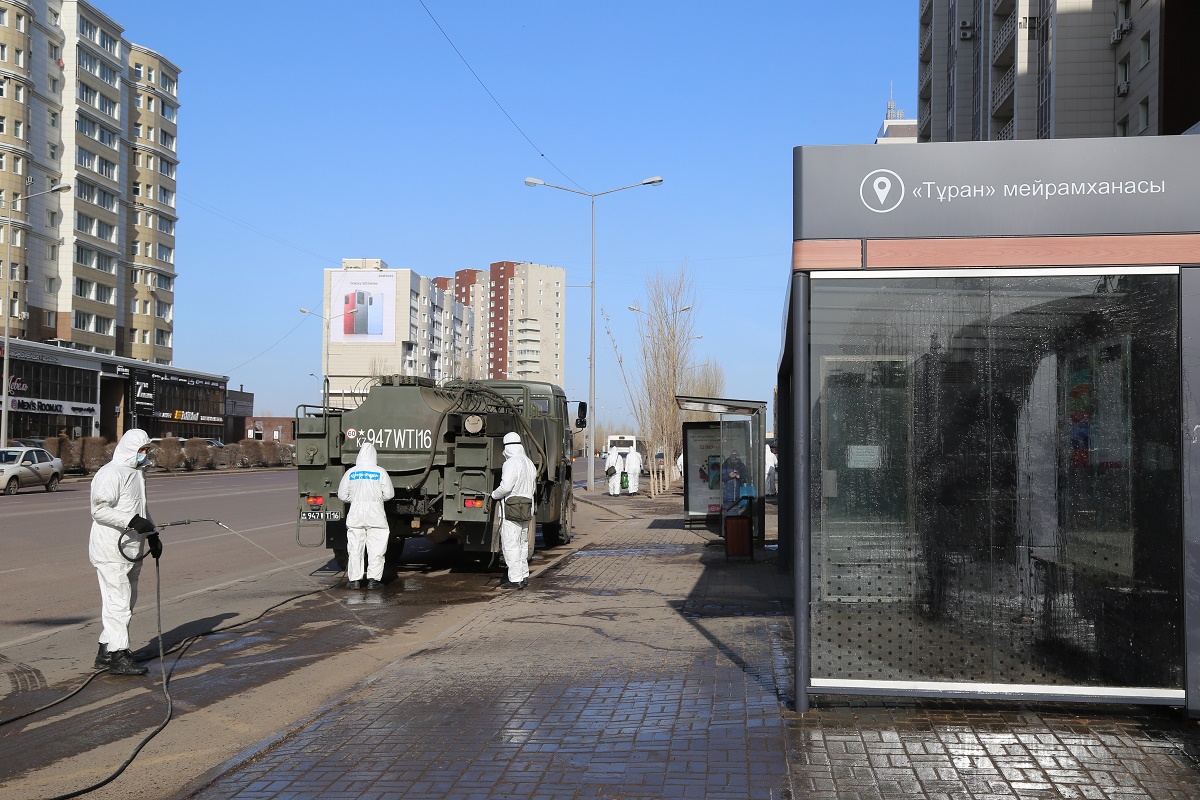
Disinfection of the streets of Nur-Sultan in Kazakhstan. Photo: Yakov Fedorov (CC) commons.wikimedia.org
By the end of May, Kazakhstan had more than 10,000 confirmed cases of coronavirus and 34 people have died. More than a quarter of those infected are medical staff. That may be why Ordabayeva’s complaints received such a large response, with state media even reporting on her case. The first reaction of the authorities was to challenge the doctor’s claims. Despite this, they announced soon after that they would open an investigation regarding the matter. During this investigation, officials surprisingly found 400 unused masks in Ordabayeva’s office. She protested, claiming that the masks had not been in the room before the inspection. Her colleagues joined the protest and supported Ordabayeva’s account. As a result, the authorities gave in and dismissed the hospital’s management. Ordabayeva’s case is a perfect example of how Kazakhstan is dealing with the COVID-19 pandemic. On the one hand, the government has reacted with harsh measures. On the other hand, however, they seem willing to discuss actual numbers and inform the public about their plans.
Controlling and tracing
Kazakhstan has managed the crisis relatively well. The government took the threat seriously from the beginning of the pandemic. After early reports of the virus at the end of January, Kazakhstan closed its borders with China. Nevertheless, there were already rumours of hospitals full of infected patients and a mysterious pulmonary disease in the country’s east weeks before the first cases were officially confirmed on March 13th. Kazakhstan was the first country in Central Asia to confirm a case of COVID-19. Since then, there have been daily updates on the number of cases, yet many experts have expressed doubts regarding the official figures published by the government. After all, the virus, according to official reports, did not come from China, but from Kazakhstanis who returned from Germany. By time, even the most critical experts on Central Asia started to believe the numbers. As social media is widely used in Kazakhstan, high infection numbers or “mysterious” deaths would cause suspicion and it would not be possible for the authorities to silence these reports.
In order to be credible, the government attempted to improve its communications strategy. Ministers, who are usually barely visible in the presidential system, held press conferences on a regular basis, answering questions about education, social affairs and the economy. Officials have set up a website and a Telegram channel to provide regular information about new infections and statistics on the number of intensive care beds, ventilators and tests.
On March 16th, three days after the outbreak, a state of emergency was declared and three days later the country’s largest cities, Almaty and Nur-Sultan, were quarantined. They have been the hotspots of infection for a long time. The quarantine was later extended to the entire country, leading to a national lockdown. Residents were only allowed to leave their house to buy food and medicine. Walks or exercise were not deemed valid reasons to go outside.
In order to enforce these measures, police and military personnel patrolled the cities. The president even signed an order to conscript Kazakhstanis who are in the appropriate age group for the army. Police questioned pedestrians about their general wellbeing and reasons for being outside. All around Kazakhstan’s cities, checkpoints were installed to control the population’s ability to travel. Within cities, several checkpoints were also installed for drivers. Authorities relied on staff workers but also technology: a monitoring system from China tracked car drivers to ensure that they did not depart from established routes. Interactive maps also monitored exactly where suspected cases and infected persons were being quarantined.
Relaxation despite rising figures
Economically, the pandemic hit Kazakhstan in two significant ways: first, due to lockdown most shops closed and companies suspended operations; second, the economic shutdown in China led to decreased demand for oil and gas. Revenue from the oil and gas industry accounts for a sizable proportion of the governmental budget. In March, the local currency (the Kazakhstani tenge) collapsed due to the drop in prices. It hit a low point at the end of March when one euro was worth almost 500 tenge. Fortunately, the currency’s value has now increased, with one euro converting to 450 tenge.
President Qasym-Jomart Toqayev, who had been active on social media for a long time, regularly addresses the nation. After introducing a state of emergency, he announced that the state would help all those affected by the quarantine. Employees and freelancers who lost their job due to the lockdown would be able to apply for a monthly payment of 42,500 tenge (around 100 dollars). Yet while more than eight million people applied for this scheme, only 4.5 million received the payment. Taxes and welfare contributions were also suspended or deferred for small and medium-sized businesses. In addition, all citizens will receive access to free health care treatment until July 1st. These precise measures stand in sharp contrast with the policy of Toqayev’s predecessor, Nursultan Nazarbayev, who previously called on Kazakhstan’s citizens to donate their own money to state companies in financial distress.
The government started to lift restrictions in May. On May 11th, Toqayev declared the end of the state of emergency. Businesses are now open again and trains and flights are operating on a daily basis. Even cafés and restaurants reopened. Mosques are also allowed to open in this predominantly Muslim country. With Ramadan falling in the time of quarantin the country’s Grand Mufti urged believers to stay at home and celebrate the breaking of the traditional fast only within small family circles.
Hunt for critics
As the number of infections remained comparatively low in Kazakhstan, most people accepted the harsh measures. Yet human rights activists were worried about the intimidation of critics during the state of emergency. Several activists, opposition members and journalists were arrested for spreading false information and violating lockdown rules. Furthermore, as the right to assembly was not permitted, the protest movement that had started last spring came to a halt.
In Southern Kazakhstan, a judge sentenced an activist to ten days in custody for “actions provoking violation of the public order during the emergency situation”. This was after the activist uploaded a video to Facebook showing long lines of people waiting to register for benefit payments at a bank. In West Kazakhstan, journalists were detained by police while interviewing doctors at a hospital in the Atyrau region and charged with “violating the emergency situation.”
One of the most prominent cases is the arrest of Alnur Ilyashev, a prominent blogger. In April, police raided his home in Almaty and he was detained for “spreading knowingly false information during an emergency situation”. He was placed in custody for two months pending charges. Ilyashev criticised the ruling party, Nur-Otan, and discussed supposed links between various politicians and corruption cases in a couple of Facebook posts. He could receive a sentence of three to five years in prison.
Another well-known activist, Gennady Krestyansky, was sentenced to ten days of administrative arrest on charges of “undermining the public order during the state of emergency” on April 20th. In a live video stream, he showed how easy one could get through the checkpoints erected around the various cities by paying bribes. Krestyansky believes he was punished because he showed how widespread corruption is, even under a state of emergency.
Human rights activists also criticised the government’s actions. Amnesty International, for instance, called Ilyashev “a prisoner of conscience”. According to the data of the Ministry of Internal Affairs, alone in Almaty and the capital almost 7,200 people were charged with administrative offenses for violating the rules of the state of emergency,. The NGO stated that “the legitimacy of these arrests is not always clear”. The independent media watchdog, Adil Soz, published a statement saying, “it is difficult to interpret what is happening right now as anything other than the oppression of critical opinions through fear of imprisonment.”
The director of Kazakhstan’s Bureau for Human Rights, Yevgeny Zhovtis, told RFE/RL’s Kazakhstan service, Radio Azattyq, that the government’s main concern was the control of social networks. “Those who are now [affected by the arrests] are very active on social media. They influence public opinion, like to protest and make claims against the state”, he said. Zhovtis believes, above all, that behind the government’s harsh actions lies a fear of losing its power in the media. He is convinced that the only power the government now retains is that of intimidation: “we are an authoritarian state, and an authoritarian regime always tries to maintain control and minimise all threats.”
A successful crisis manager
Toqayev and his government have shown an ability to act as crises managers during the COVID-19 pandemic. Through offering detailed information and updates during the crisis and by introducing social benefits, the government may have gained more public trust. While the so-called “Elbasy – Leader of the Nation” (Nursultan Nasarbayev) has disappeared – as has often happened during crises – Toqayev visited laboratories and regularly addressed the population. State media opened up and even published articles criticical of the government. However, authorities have also used the state of emergency to detain journalists, human rights activists and regime critics. After all, Kazakhstan remains an authoritarian state. As most restrictions have been lifted by now, opposition figures are already calling for new protests. Despite this, the government now seems to be preparing for a second outbreak in the autumn. Harsh measures may have helped prevent a large infection rate, but they have not prevented the people from speaking out.
Othmara Glas is a freelance journalist based in Kazakhstan.