
The end of the belle époque
It seems that the latest belle époque in western history is nearing its end, which could mean the end of the West as we know it. A miracle can happen, of course, as history is full of unexpected turns and changes, but if the current trends continue we can only await the melancholy of the fin de siècle before another massive change.
The first belle époque preceded the First World War. It took place when, after the end of the French-Prussian war in 1871, European states experienced an extraordinary economic and cultural boom. The telephone, the automobile, as well as the aeroplane were the great inventions of the belle époque which defined our understanding of the comfort and progress of the 20th century. Thanks to these three inventions, as well as peace and prosperity, the Third French Republic and Imperial Germany were able to increase their might and thus rapidly developed.
January 28, 2020 -
Paweł Kowal
-
Hot TopicsIssue 1-2 2020Magazine
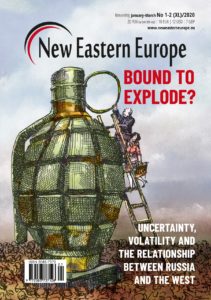
Illustration by Andrzej Zaręba
The term West meant “Western European states” for the last time in history. The First World War and its continuation, the Second World War, could not have been concluded without the US’s involvement. After 1945, the political West was rebuilt with the US playing a leading role.
Wind of change
Since the end of the Second World War the term “West” began to take on a new meaning. It started to include the US and Canada, Western European states (including Greece), as well as Australia and New Zealand. This new, bigger West sealed victory over the Germans in 1945 and forced its de-Nazification (similar processes took place in Italy and Japan). Unfortunately this new West did not manage to overcome the power of the Soviet Union. The latter was necessary to defeat Hitler but the USSR soon became the key adversary of the West.
It was only in 1989-1991 when the West, or the US to be more precise, managed to defeat the Soviet empire, which was in fact the second state responsible for the outbreak of the Second World War – and even to this day the Kremlin denies that before 1941 the USSR was actively co-operating with Nazi Germany, and half a century later it lost to the West. Yet this is precisely where the new belle époque of the wider transatlantic West began. Each of these epochs was a prefect mixture of vivid cultural and technological advancement, economic prosperity, and an extended period of peace. In 1990 the German rock band The Scorpions released their hit ballad “Wind of Change,”in which they solemnly announced the changes that were going to come after the collapse of the Soviet bloc and the USSR. In its place, and in place of the former Yugoslavia, 30 new states emerged.
After the First World War, US President Woodrow Wilson did not finish his work of implementing a grand change for Europe. The US Congress did not accept the provisions of the Treaty of Versailles, while the League of Nations did not become a platform of co-operation for smaller nation states. Today, its failure is still used as an argument by American isolationists as an example of a failure of trans-national activities. The success of the European Union and NATO are, in turn, an argument of the internationalists who claim that there are possibilities to effectively coordinate the works of many states with the consent of their citizens.
After 1991 US President George H. W. Bush did not repeat the mistakes of his pre-war predecessor. After the fall of the Iron Curtain, the US did not withdraw from Europe and thereby helped this new belle époque for the West emerge: the states that were coming out of the totalitarian and authoritarian systems were even given a chance to join the EU and NATO. Almost all of these 30 new states, during their transformation, received an offer of assistance. The question as to how they used this opportunity is another topic for discussion. Nevertheless, the new belle époque was again a period of economic growth and prosperity. But more than anything else, it was also the birth and development of the internet, a revolutionary innovation on par with the inventions of the post-1871 period.
Prophecies
In just three decades these new technologies revolutionised the media and people’s access to information. They changed trade, banking and people’s lifestyles. What would today’s production look like – and how much lower would profits be – without the information technologies that allowed it to be more effective and to maximize distribution and consumption? These new technologies also gave rise to the emergence of artificial intelligence (AI). Along with ongoing social changes, they are leading us towards huge and unique civilizational changes.
In the Old Testament the prophet Jeremiah foresaw Jerusalem’s destruction. The success of the last belle époque, however, had from the very beginning its own Jeremiahs. Among them was Zygmunt Bauman who, in 1988, demonstrated the scale of the dangers of what he termed “fluid modernity”. In 1992 the influential book by Francis Fukuyama, titled The End of History and the Last Man,was published. It is often interpreted as presenting the end of liberal democracy. Yet Fukuyama also foresaw the future role of nationalism in less modernised regions of Europe and the deep crisis of liberalism in democratic states. It was Fukuyama who prophesied that people will turn against the culture of “rational consumption” and against the idea that they are members of a “universal homogeneous state”; that, in other words, they will get bored with democracy.
The world did not need to wait long for this prophecy to be fulfilled. On September 11th 2001 the international community became paralysed by the news of a terrorist attack on the World Trade Centre in New York City and the Pentagon outside Washington, DC. The attacks were carried out by Islamic terrorists inspired by Osama bin Laden, a co-founder and leader of Al-Qaeda. As a result of the trauma that came in their aftermath, the American public, through its political representatives, agreed to a restriction on its civil liberties via the passing of legislation popularly known as the Patriot Act. It quickly turned out that the new belle époque of the West was taking place at a time when many people around the world did not support western ideals or values.
At the same time, the late Walter Laquer, in his 2007 book, The New Order: Last Days of Europe,illustrated the scale of changes taking place in the European West, highlighting its departure towards a political non-existence. In his view, the latter was caused by, among other things, the demographic crisis. Laquer argued that due to low birth rates the previously large and important industrial areas in Europe are now turning into a kind of Disneyland for more sophisticated tourists from India, and China as well as colonies for an increasing number of Muslim migrants. The three Jeremiahs of the end of the liberal order – Bauman, Fukuyama and Laquer, – all, in their own way, proved to be correct in their predictions.
The spectre of oligarchy
In recent decades western societies became used to the fact that politicians are elected based on experience, activities and their electability as candidates. In the ideal model, there is transparency of those in power; democratically-elected leaders can be asked any question about their family, money, holidays, etc. Opposite to this model is oligarchy, which is one of the oldest forms of governing as described by Aristotle in Politics.
The commentators of our time share the view that a characteristic feature of politics today is populism, a term which remains difficult to define. But maybe it is not? Maybe it is not populism, but a return of oligarchy and its sick vision of rebuilding empires. Maybe this is the key characteristic of the collapse of the West? Clearly, populism is one of the instruments that oligarchs use to gain power, but populism is not the essence of what is to come.
The context of the return of oligarchy can be seen in the following way. First, in the last three decades the post-Soviet space saw the emergence of huge oligarchic fortunes which – with time – became so powerful that they started to play an important role in the political life of the West. It can happen that a single individual, whose name ends up on the list of the richest people in the world, can – through his companies, banks and business operations, as well as access to modern techniques of manipulation – make a huge impact on society as a whole, not just state structures and political parties. The liberal structures of the West have no protection against a new generation of Eastern European oligarchy. Even more, it has turned out that the greatest achievements of the West – globalisation and the transfer of capital – are available to all, especially the wealthy. Hence, new technologies have allowed Eastern European oligarchs to infect, like a virus, the West. It is symbolic that London, one of the hearts of western liberal democracy, is a centre of this oligarchy. The idea of London as a city of Eastern European tycoons has been implanted on many people’s minds thanks to the TV series Londongrad and books like Londongrad: From Russia with Cash.
In addition to the transfer of great fortunes from the post-Soviet space to the West, a similar trend is taking place in Southeast Asia and China. The latter have created a very unique type of oligarchy which is controlled by the Chinese Communist Party and provides a group of its wealthiest with certain opportunities. The internet and social media, as described above as the great inventions of the last belle époque, allowed these oligarchs, with almost unlimited opportunities, to impact voters outside the traditional political structures. This process has clearly accelerated in the most recent years.
American paradox
Our belle époque started with America’s dominance and America will likely bring its end. The calm period of the “end of history” was not threatened by an external enemy. The obstacle that hindered the West was the revival of oligarchy in the West, enforced by supplies from Eastern Europe and Asia. This process affects the West at its core – its democratic conviction of equal opportunity for all. It is also a signal to the people that what matters is no longer politics, but money. In the West, the oligarchy was legitimised by Donald Trump who came to power by criticising the democratic establishment (his well-known slogan was to “drain the swamp”) and who built his support through social media. In this way, he reached out to many Americans with his populistic messages, operating outside the framework of the Republican Party which – in the end – capitulated to support his candidature for president. Even during the 2008 presidential campaign of Barack Obama, anti-Beltway rhetoric was present, however its scale and speed in 2016 was unprecedented.
We cannot also exclude that Trump was financially supported by Russia. Evidently, after becoming president he refused to reveal data on his fortune. In policies towards important allies like Ukraine he was driven – as testimonies of his staff suggests – by personal, not state, interests. On top of everything, his own son-in-law became a top member of the president’s staff, much like what we see among oligarchic regimes in Eastern Europe.
The current paradox of the US system lies in the co-existence of the neo-oligarchic office of the president, with the parliamentary structures which are partially in opposition to the president (the US House of Representatives) and the structures of the “deep state” which are trying to survive the current presidency. At the moment it is difficult to say whether, in the long-term, the US will see a takeover by the neo-oligarchy or whether traditional democratic mechanisms will prevail. One thing, however, is certain. The whole world has noticed that at the centre of the post-1989 order we have now a power model which can be used as justification for anti-democratic processes to develop throughout the West more broadly. What comes to mind here is Prime Minister Andrej Babiš in the Czech Republic, who is the wealthiest Czech citizen and an employer of thousands of his voters. The same can be said about the Hungarian Prime Minister, Viktor Orbán, who is clearly trying to build “a new oligarchy” around himself.
Oligarchic forms of government have become the norm in the post-Soviet space; both in larger countries and smaller ones. In Georgia, nearly all decisions are made by billionaire Bidzina Ivanishvili, while in Moldova the political process is a reflection of a battle between a few of the richest men with wide political and business influence. Meanwhile, a unique system of oligarchy has developed in Ukraine. There the wealthy tycoons control one another and compete with each other. The latest protests in Hong Kong have also oligarchy in the context as they were driven by the collapse of the middle class.
The mechanisms of the oligarchy’s growing strength are similar everywhere. In the beginning there is criticism (at times very justified) of the democratic elite. Then comes support for a candidate (often a very wealthy citizen) who becomes the face of this criticism. At the next stage there is a wide wave of populist criticism (a fight against the elite) which uses social media as its tool. As a result of this mechanism, which is based on manipulation, the oligarchic structures have been getting stronger in more countries in the West. This process was also well-illustrated by Volodymyr Zelenskyy’s coming to power in Ukraine, but overall it is a quite universal matrix of the activities of the wealthiest players who act behind the politicians’ backs with slogans of “fighting the oligarchy”.
S: The imperial spectre
After three decades of the belle époque western societies seem to have become somewhat bored with the calm life where international law decides on everything and borders are “permanently” demarked. This boredom is accompanied by uncertainty, a lack of belonging, fear of climate change and refugees. All these emotions are further emphasised by the populists. Possibly one of the strangest reactions to the belle époque, and a sign indicating its end, is the nostalgia for the old imperial order, one that was built by strong states that were able to demand the subordination of other states based on their means of impact: political, military or economic, but never in accordance with international agreements. Their role was to provide citizens with a sense of stabilisation and security. This kind of mechanism explains why so many in the United Kingdom have opted for Brexit.
The mark of the post-war period in western history, and especially after 1991, was the multilateral diplomacy and strong international organisations which became a forum to determine states’ interest and whose agencies were also respected by strong players who could, theoretically, put pressure on smaller actors outside the framework of international institutions. After the First World War the weakness of the League of Nations turned out to be problematic. After the Second World War the strength of the West lied in its ability to keep the United Nations as a platform for agreements on the global scale. However in terms of keeping the West’s cohesion, the EU and NATO have proved to be particularly important. These organisations, through their structures, clearly eliminated imperial sentiments that were present in the functioning of many states. Thus, the headquarters of NATO and the EU were not placed in London or Paris, but in Brussels, which symbolically marked the non-imperial nature of the West’s new institutions.
It appeared that this order was widely accepted by western citizens. However, this turned out to be largely an illusion. What has proved to be true, instead, is that perception is more important than facts. Thus, many people started to view the EU as an institution that is not sufficiently democratic and too technocratic – an artificial power which is limited by certain conditions and dependencies which are incomprehensive to the average person. Possibly for this reason imperial sentiments have become an important motor in attracting voters in many western states.
Donald Trump openly criticises multilateral institutions. He stresses that for the US it would be most effective to negotiate with other states separately. The “make America great again” mantra is a populist promise to regain America’s imperial power, without co-operation with other western partners in search of a global consensus. This slogan, like it or not, was positively accepted by a vast number of American voters. Brexit, similarly, is also based on the illusion that a return to empire is possible; while the neo-Guallist policies of Emmanuel Macron are plain references to the neo-imperial sentiments which were so deeply implanted in French politics after the Fifth Republic lost Algeria.
Recep Erdoğan in Turkey, which is the second largest NATO member state, is openly implementing a policy of symbolically bringing back Turkish imperial influence. The idea of Turkey’s integration into the EU was replaced by the paleo-imperial idea of a return to former influence. In Hungary, 2020 is proclaimed to be the year of national unity in the sense of the unity of Hungarians living on all territories that were within the Hungarian borders before 1920, when the Treaty of Trianon was signed.
This essay is too short to cover the complex issue of Russia’s neo-imperialism which Vladimir Putin has masterfully developed in the last several years. Thus, I only focused on the examples where the imperial idea plays an important role in western states which are members of NATO or the EU. In this way, there are many indicators that just like when the first belle époque ended because of the many bad decisions made by the West, the current one will also see its end come not from external powers, but because it is not able to maintain the narrative of values and universal human rights.
S: * * *
After the end of belle époque the western world will be shattered and less relevant than before. It will be less susceptible to wars, but it will be vulnerable to external influences, especially those coming from large non-western powers (i.e., China and Russia). The illusions that former western metropoles hold of their return to previous glory are not going to be fulfilled, as was predicted by Laquer (demographic crisis) and Bauman (identity crisis).
Much of what we see today indicates that one thing is paramount. Our democracy is at risk as a result of large scale manipulation which takes place with the use of new technologies. The paradox lies in the fact that the best period in western history, that is, the years after 1991, which gave us the internet and artificial intelligence, also paved the way to the rule of a new oligarchy. Nobody knows what will happen next. It could even be that societies will opt for tyranny, just to free themselves from the oligarchs…
Translated by Iwona Reichardt
Paweł Kowal is a member of the Polish parliament (Sejm) and an adjunct professor at the Institute of Political Studies of the Polish Academy of Sciences. He is also a post-doctoral fellow at the College of Europe’s Natolin campus. He is a member of New Eastern Europe’s editorial board.