
The drama of the Polish outsider
The Polish psyche is affected by the tragic conflict between what is ours and not ours. This huge dissonance stems from the fact that the outsider is a native: both come from the same country, share a nationality, live among their own people and, at times, inhabit the same person. Hence, Poles’ attitude towards others, to a great extent, arises from their inner struggle with “the outsider within”.
“Pretty. Shame it’s not ours.” This sentence is uttered by one of the characters of Zimna wojna (Cold War), a film directed by Paweł Pawlikowski. An audience unfamiliar with the intricacies of Polish culture will find it hard to recognise the drama lurking behind these seemingly innocent words. Ours, in this context, is Polish, not ours is part of the Lemko people’s cultural heritage.
January 28, 2020 -
Krzysztof Czyżewski
-
Issue 1-2 2020MagazineStories and ideas
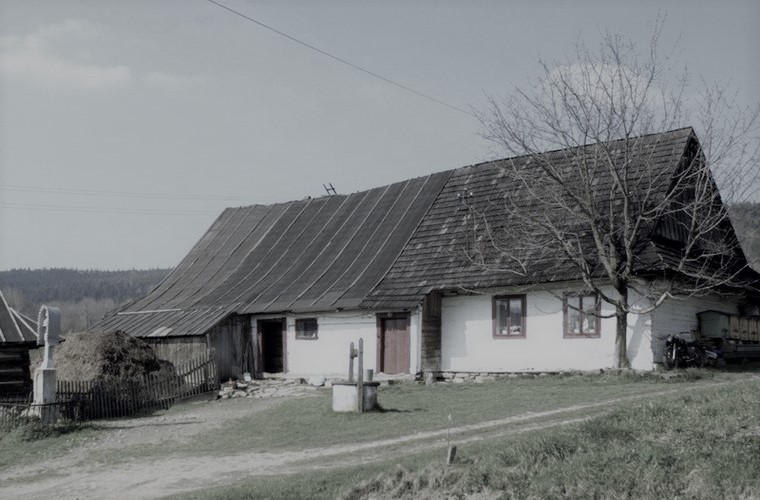
A typical Lemko style hut. Photo: mzopw (CC) commons.wikimedia.org
Lemkos are an ethnic group, a majority of whom inhabit Poland, though some also live in Ukraine and Slovakia. Some consider themselves Ukrainians speaking their own dialect, others believe to be a separate nation. A considerable number live in the diaspora, as portrayed in the opening scene of the film The Deer Hunter showing a Lemko wedding which takes place somewhere in Pennsylvania. Yet, in the scene people are singing a Soviet military song, Katyusha, which presents a disconnect from reality and the tragic plight of the Lemko people fiercely persecuted under the communist regime. Still, Lemko culture is known for beautiful, polyphonic songs. It is one of those songs that is regarded as “pretty”.
Fate
Pawlikowski’s film opens not long after the end of the Second World War. The audience follows Irena and Wiktor, a couple of distinguished choreographers and composers whose task is to create a folk and dance ensemble from scratch. To build a compelling repertoire, they embark on ethnographic expeditions to various regions in Poland. They are captivated by Lemko songs recorded on tape: in one of the scenes, while driving in a military car, they play one of them and relish the polyphony of voices, virtually absent from Polish songs. “Pretty. Shame it’s not ours”, interjects their driver, someone by the name of Kaczmarek.
This is set against the historical backdrop of fighting “Ukrainian nationalists” long before the communist authorities would announce Operation Vistula (i.e., the forced resettlement of the Ukrainian and Lemko population). They were driven from south-eastern Poland to the so-called Recovered Territories: a large swath of land in the north and west which, following the Potsdam Conference, was incorporated into Poland. The film does not depict these historical events, the story goes in a different direction. Nevertheless, the Polish audience is aware of this background and understands perfectly why it is unthinkable to include a Lemko song in the repertoire of Polish musical ensemble which, incidentally, is quickly transformed from a folk group into a state-endorsed national ensemble. During the Polish People’s Republic (PRL) period, the word “Lemkos” would be censored. Only after the anti-communist movement was born in 1980-1981, was it possible for Tygodnik Solidarność (Solidarity Weekly), which was issued briefly in – approved by the authorities – circulation of half a million copies, to publish an article whose subject was the Lemko people, their history and the suffering they experienced as Polish citizens.
The fate awaiting the three people conversing in the military car is truly telling. Wiktor is not able to feel at home in post-war Poland and soon emigrates to the West. In Paris, a PRL consul tells him he is no longer Polish. The woman he loves is the reason why he decides to come back to the country where he is later imprisoned, humiliated and where, in the end, he commits suicide. Irena remains in Poland but she does not become successful. We can only assume that her uncompromising adherence to the values she holds dear and to what she considers “pretty” leads her to the circles of the democratic opposition. Both of them share an understanding that culture is not limited to the ethnic borders within which they live. Thus, they become outsiders in their own country. The person behind the wheel, Kaczmarek, in turn, is going to be deemed “one of our own”. His future is bright, a brilliant career is ahead of him and within a short time he will be in charge of the national song and dance troupe.
Kaczmarek, as bitter as it sounds, is an important figure in Polish culture. Importantly, did he enter the scene only after 1945? The communist government assured the public repeatedly that they were creating a new world and expressed disdain for Poland of the interwar period. I am convinced, though, that Kaczmarek would make an equally successful career before the Second World War by subscribing to the policies of the day: persecuting national minorities and condoning the adoption of ghetto benches. Also, I would not be surprised to see him marching side-by-side with the pro-fascist militants of the ONR (the far-right National-Radical Camp). These are the people to whom Czesław Miłosz alluded to in his narrative poem Treatise on Morality: “the Party is the successor to the ONR”.
Naturally, Kaczmarek belongs to the Party (i.e., the Polish United Workers’ Party). He is the embodiment of the propaganda-fuelled hoax existing under the guise of the “friendship of nations” catchphrase (widespread in the socialist bloc countries) and the alleged rejection of nationalism; it can be likened to the criminal who shouts “Catch the thief!” to draw people’s attention away from himself. Kaczmarek’s cultural nationalism was his gateway to career success in the PRL. One wonders how would he fare in present-day Poland?
Tragic conflict
“Pretty. Shame it’s not ours”. The intention behind quoting this line in an essay about culture is not to go back in time, even though I deemed it necessary to give those words a historical context. Indeed, they are mentioned because they are alarmingly and strikingly relevant to the present day. In this respect, Cold War is not a historical film as much as it is an example of socially-engaged cinema, a fact which, I dare say, not only Polish audiences are able to acknowledge. Moreover, I believe that the decision to name it the best European feature film of 2018 was not based solely on the central love story depicted in it, which, as it turns out, is inherently burdened with the stigma of otherness carried by the protagonists.
Ultimately, these words convey something more crucial than their timeliness. I am inclined to believe that they touch upon the essence of the tragic conflict that has profoundly affected the Polish psyche and, by extension, the country’s cultural, social and political life since Poland regained independence. Who is “one of us” and who is “one of them” in this young country, reborn within newly delineated borders in 1918? Kaczmarek exists in its subconscious, sometimes making his presence known. He can be found among the proponents of far-right and pro-fascist ideologies as well as populist politicians, whose careers are built on “our people” and who would not be able to stand on their own two feet without propping themselves against a scapegoat. He is also present among those afraid to lose their sense of Polishness in a world of open borders and tolerance, those opposed to taking in immigrants, those shouting “Poland for Poles” and among militants of the reactivated ONR.
Similarly, Kaczmarek lives among those who detest him and do not give him the right to exist; those who fail or do not want to understand where he came from, what historical and social circumstances, what kind of taboo trauma and the neglect of elites contribute to his strong presence in the Polish psyche. Kaczmarek thrives in a closed-off world, among those convinced they are on the “right” side of the river and who think that the development of human civilisation lies in building a bridge for people on the other side: lost souls who should simply join them. One way or the other, this reveals – the still hidden in shame or repressed – underdevelopment and ignorance of contemporary culture: the belief that bridges are built this way.
Why is a bridge essential here? The answer is that questioning the point of its existence and more so, destroying it, constitutes the source of Kaczmarek’s resilience and vitality. If there is a way to rebuild the bridge, it means not only that Kaczmarek has grown weak and that the weapon has been knocked out of his hands, but that he has essentially undergone inner transformation. The Polish psyche is affected by the tragic conflict between what is ours and not ours. This huge dissonance stems from the fact that the outsider is a native: both come from the same country, share the same nationality, live among their own people and, at times, inhabit the same person. Hence, the Poles’ attitude towards others, defined as newcomers, immigrants or other “guests”, to a great extent, arises from their inner struggle with “the outsider within”.
It is not hard to imagine how tempting it is for political populists, religious demagogues and cultural conformists to take advantage of that. At the same time, confronting this Polish doom and going beyond the divide it imposes requires courage, a whole-hearted attempt at spiritual self-improvement and mastering the art of dialogue. As far as I am concerned, this discord has been conducive to some outstanding artistic achievements of authors who feel part of Polish culture. The sense of belonging to Polish culture is essential in this context as it crosses boundaries, redraws them and is contingent on personal choices, the political situation, and how one interprets the phrase “our culture”.
If it were otherwise, the following meaningful story about Isaac Bashevis Singer, a writer in Yiddish, would not exist. After being awarded the Nobel Prize in Literature in 1978, Singer gave an interview in which he was asked about books on which he was weaned. His reply was Polish literature which confounded the American interviewer. He then asked Singer to provide examples. The writer mentioned Isaac Leib Peretz, Sholem Asch, and Itzik Manger. Singer was familiar with their works since they were published in Yiddish in the Polish press and by various publishing houses in Poland; also, he could come across any of them in interwar Warsaw. He considered them part of Polish culture. However, it does not mean that the mention of Singer himself, as well as the authors he admired, can be currently found in student textbooks as far as the history of Polish literature is concerned. It is not impossible, though, that such textbooks will be written in the future.
Nativeness
Basel, the summer of 1931. Three students from Vilnius, which belonged to Poland at the time, have gone to the West for the first time ever. They dreamt about it for years. They read books in French and were fascinated with the French Revolution. They scraped some money together, got to Prague where they bought a kayak, then crossed the Alps, went across Lake Constance and down the Rhine… Finally, they reached a bridge leading from Basel to the French town of Saint-Louis: “France – our spiritual sister – welcomed us. The [inscription on a] sign prohibited Gypsies, Poles, Romanians and Bulgarians from entering the country. The scornful glances we exchanged took care of our western allies. We crossed the bridge.” One of those students was Czesław Miłosz, the author of Native Realm and the quote is an excerpt from that book.
What Miłosz describes here is one of those moments that can shape the attitude to life of a Kaczmarek in the making. It fuels his fear of openness to the world, his national and cultural complexes deepen, which in turn makes him harbour even more resentment towards others, particularly outsiders. As a result, he starts to show proclivity to blindly defend himself and his own people, mistaking it for the expression of human and national dignity. What is more, he starts thinking about revenge and dreams about putting up similar signs at the borders of his own country, mistaking it for patriotism.
What about Miłosz? He goes on to write an autobiography, titled Rodzinna Europa (Native Realm, literally: Native Europe), which is unparalleled in the way it shows community-based foundations of European culture. The book was published in the 1950s, at the time when nobody wrote about Europe in a similar manner. Translating the title into Western European languages alone was a challenge: it became Other Europe in French (Une autre Europe) and Spanish (Otra Europa); Western and Eastern Lands in German (West und Östliches Gelände); My Europe in Italian (Mia Europa), Mitt Europa in Swedish; Child of Europe in Finnish (Euroopan lapsi), and finally, Native Realm in English.
Nativeness, according to Miłosz, does not belong to anyone and neither does it reinforce divisions; it is European, thereby grounded and welcoming, self-critical and open to dialogue. It provides an answer to the question “who am I?” by getting to know the other and by fostering good relations with one’s neighbours. These are only some areas in which the author of Zniewolony umysł (The Captive Mind) had to grow and improve himself to render the environment which shaped him powerless and to defeat his inner-Kaczmarek. The fact is, he was not immune to his influence. As a young man, he was exposed to antisemitism at home and at school. Importantly, overcoming it resulted in something more profound than being an impartial observer of solving “the Jewish problem” – Miłosz is one of the first non-Jewish European poets who bore witness to the horrors of the Holocaust, addressed in his poems “A Poor Christian Looks at the Ghetto” and “Campo di Fiori”; both written in 1943. The death of Europe witnessed in the two world wars does not turn him into a nihilist or nationalist. On the contrary, he advocates the spiritual rebirth of Europeanness. If only the architects of post-war unity had carefully read Native Realm, they would have gone a step further than creating a coal and steel community, and later on launching a political project.
This speculating makes sense seeing as we are still suffering the consequences of the original sin inherited from the process of unification – the fact that the European Union has not brought culture to the core of its activity yet, or otherwise, has pushed it to its fringes. Thus, culture has been relegated to the realm of competence of each state. Viewed in this light, its focus has shifted to preserving its own legacy, defending national identity as well as expressing individual freedom. These, indisputably, are fundamental issues. However, for Miłosz, and owing to his cultural tradition, this idea of culture is wholly insufficient.
Invisible bridges
The tradition I have in mind here is associated with the notion of “borderland”, which proves as difficult to translate as European nativeness. Borderland does not pertain to an area divided by a border – in fact, an external border does not cut through it; furthermore, it is not multicultural – understood as a constellation of separate cultural groups in nature. Borderland considers borders to be part of its own territory. It encompasses diverse communities living together – people speaking different languages and following various religious and national traditions and customs. They live according to an ethos that turns the “other” into “ours”. They have the ability to combine caring for what is separate, at the risk of exclusion or extinction, with creating and regenerating a “connective tissue” that binds people together.
In practice, it translates into exploring the art of building invisible bridges. A person who is “native to borderland” poses the direst threat to Kaczmarek’s mentality, most than a nationalist on the other side of the front line. The plight of people known in Sarajevo as sarajlija during the war in the former Yugoslavia serves as a harrowing example of that. Sarajlia, for whom social conscience and human rights were more important than national or any other divide, were the most loathed “other” by national extremists. Ever since the war broke out, the crisis of multiculturalism in Europe has deepened. The more widespread the crisis becomes, the more the “connective tissue” disappears. Unfortunately, the efforts to strengthen this bond in the sphere of culture appear to be one of the most underfunded initiatives in the area of European integration.
The borderland’s cultural heritage found expression in remarkable phenomena of contemporary Polish culture: the poetry and essays of Czesław Miłosz; the prose and drama of Witold Gombrowicz; the poetry of Wisława Szymborska and Jerzy Ficowski; the theatre created by Jerzy Grotowski and Tadeusz Kantor; the films of Krzysztof Kieślowski and Tadeusz Konwicki (as well as his novels); the art of Magdalena Abakanowicz and Jerzy Nowosielski; the music of Grażyna Bacewicz and Wanda Wiłkomirska; the philosophy of Leszek Kołakowski and the priest Józef Tischner; Janusz Korczak’s pedagogical thought; the psychology of Antoni Kępiński; and the sociology of Zygmunt Bauman. This cultural tradition has been kept alive by those creating today, including the new generation of artists, whose “borderland-like quality” permeates new spheres of empathy towards nature, non-human animals, sexual minorities, immigrants and other groups that have been excluded.
Futility
“Pretty”, says Herszełe on hearing the Polish word daremność (futility) for the first time. It is Natan who explains its meaning to him: “It is when all your efforts are in vain, when you build on sand, when you draw water with a sieve, when the money you get in exchange for your hard work turns out to be fake.” From now on, the young man, who has “a knack and gentleness of a woman for caring for others”, adopts the word daremoność as his own. As a convert, he has to assume a Polish name as well as change his religion, which he does not mind: he believes that Judaism, Christianity and Islam are different guises of the same path leading to the one and only God. However, in his native Yiddish there is no such word describing futility.
The Polish word he considers pretty is uttered a considerable number of times during a sermon delivered by a bishop. It takes place in a cathedral, to which the body of a wise Jewish man, who “came to the cross” is brought – in an open casket, as Catholic tradition dictates – in the presence of a crowd gathered to participate in the burial of a convert in sacred ground. It was futile to believe, as Herszełe did, that Jacob Frank is the new Messiah and that death would not have dominion over those who pledge allegiance to him.
This above is a fragment of a story told by Olga Tokarczuk (recently awarded the Nobel Prize in Literature for 2018) in Księgi Jakubowe (The Books of Jacob), a novel that delves into the history of Frankists, a heretical splinter group whose activity led many Jews who lived on the territory of Poland to convert to Catholicism. In 2015, the book won the most prestigious literary prize in Poland – the Nike. The novel, which comes to nearly a thousand pages, sold 100,000 copies within the first year after it was published. Poles read it as a story of borderland, perceived as a counter narrative to the novels of Henryk Sienkiewicz, Kaczmarek’s favourite author. Kresy (the Eastern Borderlands, the territories to the east of Poland’s current border which are part of modern-day Lithuania, Belarus and Ukraine), to which Sienkiewicz makes constant reference, where “ours”, meaning Polish, and replete with tales praising the glory of the Polish army and the assimilative power of Polish culture, irresistible to its neighbours. Tokarczuk transcends this interpretation turning Kresy into a rich landscape of cultural polyphony, in which otherness is ours yet deeply hurt. Kaczmarek would find it shocking to hear a Polish lady who, travelling from the central region of the country in a horse-drawn carriage, reaches Kresyfor the first time in her life and – being completely at a loss hearing a myriad of languages (i.e., Ukrainian, Armenian, Turkish and Yiddish) – cries out frantically: “Does anybody here speak Polish?!”
Recently, The Books of Jacob has been one of the most important journeys deep inside the Polish psyche that is marked by the tragic conflict between what is ours and not ours. One of the narrators is Natan, who chronicles Jacob Frank’s travels across Poland. The words quoted below are his and their power to express the universal human condition arises from broader tension over what is and what cannot be ours. The funeral of the Jewish master, referred to previously, ends; Frankists make sure that the funeral rites are performed according to Catholic tradition. However, the moment they leave the cathedral marks a shift. Jacob told them to grab his long Turkish garb, which they mindlessly clutch; their faces are wet with tears, they resemble strange insects, and the despair born out of futility isolates them from the locals: they turn into the other all over again.
That is when Natan writes down these words: “There is something appealing about being an outsider, you can delight in its taste as there is sweetness to it. It is good not to understand the language, not to understand the customs, gliding like a ghost among people who are distant and unrecognisable. A particular wisdom awakens – an aptitude for understanding the implied and grasping the ambiguous. One becomes shrewd and perceptive. An outsider gains a new perspective and, by force of circumstance, becomes some sort of a wise man. Who convinced us that it is so great and wonderful to belong? Only an outsider will understand what the world is truly about.”
Translated by Monika Ajewska
Krzysztof Czyżewski is a Polish intellectual and essayist. He is the founder and director of the Borderland of Arts, Cultures, and Nations Centre in Sejny (Poland).