
Text resize: A A
Change contrast

Rough road ahead for Belarus

Politically, 2019 was a very important year for Belarus. It was dominated by two trends: the authorities pursuing relations with the West and pressure by the Kremlin to deepen the integration of both states.

Growing tensions between Minsk and Moscow, as well as continued attempts to normalise relations with the West, are the main reasons we can call 2019 a ground-breaking year when it comes to the level of meetings that Belarusian officials held with western politicians. On surface they may seem like routine activities of a sovereign state, but in the case of Belarus each meeting sends a signal to the Kremlin.

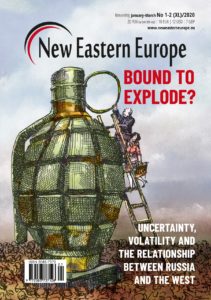
January 28, 2020 - Maxim Rust - Hot TopicsIssue 1-2 2020Magazine

Illustration by Andrzej Zaręba

Breakthrough visits

The year began with Mikhail Myasnikovich’s February visit to Warsaw. Myasnikovich was then the chairman of the Council of the Republic of Belarus, the upper house of parliament. It was an important event not only in bilateral Polish-Belarusian relations, but also a form of demonstration of Minsk’s intention to increase contacts with the West. The high level of participants of the meetings determined the weight of this trip as did the fact that for many years Poland had not hosted any Belarusian high-level official. Myasnikovich was the head of Alyaksandr Lukashenka’s first presidential administration and is considered, if not the second most important person in Belarus, then at least an influential player with direct access to the president. While some specific results of this visit may be hard to indicate, the fact that it took place suggests that the Belarusian authorities have become interested in attracting partners from outside the “Russian world”. They need them in the political game with Moscow.

Last August the US National Security Advisor, John Bolton, visited Minsk. The announcement of his planned trip generated huge media attention in Belarus with some official outlets calling it a “breakthrough” or “historical” visit. These labels were justified, of course, considering that Bolton was the highest ranking representative of an American administration to visit Minsk over the past 25 years. The last visit of an American head of state took place in 1994. At that time, President Bill Clinton did not meet Lukashenka, but Stanislau Shushkevich, who was acting president and chairman of the Supreme Council. After 1995 came a period of cooling down and sanctions caused by the political changes within Belarus. The US reaction was to limit visits to the level of deputy advisors or Congressional delegations.

Thus, the normalisation of relations with the US is an important goal for Belarusian officials, and one that now looks achievable. Eventually, it is envisioned that this should lead to the removal of US sanctions, which were already loosened in 2015, but they still play a large obstacle in the development of economic relations between the two states. With sanctions removed, Belarus could improve its economy which desperately needs cheap loans and foreign investment.

Another important step in improving relations with the US would be to build regular diplomatic ties. Since 2008 the US has had no ambassador stationed in Minsk. Following Bolton’s visit, the state department announced that a US ambassador will return to Belarus and full-scale diplomatic mission will be re-established. This could, of course, become a foundation for the reactivation of relations between Belarus and the US. Such a declaration of support for Belarus’s independence and sovereignty by a global player, which was issued by Bolton, are of course very desirable in Minsk, which increasingly feels pressure coming from Moscow.

Here comes NATO

By the end of last year other less obvious contacts between Belarus and NATO also intensified. In October Antonio Missiroli, NATO’s Assistant Secretary General for Emerging Security Challenges, arrived in Minsk. Later in December a delegation of Belarusian politicians, experts and journalists paid a visit to NATO headquarters in Brussels. In the aftermath of these two events, Oleg Belokonev, a Belarusian general who is the chief of general staff of the armed forces of Belarus, announced that his country is ready to conduct joint military exercises with NATO. Apparently talks about the potential format of such co-operation are under way. Clearly within the Alliance some members will be against the decision to deepen co-operation with Belarus, treating it, quite justifiably, as Russia’s “mole” in western military structures. At the same time, the Kremlin will not be thrilled that Minsk is strengthening military ties with Russia’s greatest rival.

The last important event in last year’s Belarus foreign policy was Lukashenka’s visit to Vienna. This took place in mid-November and was labelled by Belarusian media as a historic event. Indeed, it has been a decade since Lukashenka set foot in the European Union. However before his trip to Austria he refused to visit Brussels and Riga which was interpreted as a decision not to irritate Moscow. The Vienna visit could have been an attempt to change his image and a demonstration of independence in foreign policy. However Austria has always been a good partner for Belarus. Thus, this visit was more symbolic than anything else. It also did not generate any spectacular change in relations between Minsk and Vienna; or Minsk and Brussels for that matter. What is significant, however, is that it took place right before the parliamentary elections.

A sterile parliament

In mid-November Belarus held parliamentary elections. The new elected parliament does not have, among its members, a single representative of the opposition. There were no mass protests nor demonstrations that would accompany the elections or their results. Regarding the latter, most analysts had no illusions about their fairness and transparency. The biggest question was whether the authorities would allow any independent candidates to enter parliament, as happened during the previous term. These elections were also a test for the Belarusian state system and whether the authorities will use the administrative apparatus and repressions against their political opponents.

Like before, the pro-government “candidates” played the roles they had been assigned. Representatives of the Belarusian opposition and democratic movements split even before the campaign began. While some of them were of the opinion that the changes that have taken place since 2014 offered them an opportunity to promote some of their ideas by participating in the campaign, others opted for boycotting what they called pseudo-elections. Out of more than 700 potential candidates to the 110-person parliament, the Central Electoral Commission registered 560. One third of them were candidates representing opposition parties and movements, but a majority were those who were less known. Two figures who were members of the opposition during the previous term, Alena Anisim and Hanna Kanapatskaya, were not allowed to run this time.

The voting lasted for six days. In addition to the actual voting date, November 17th, early voting took place between November 12th and 16th. It is something that has been raising a lot of questions from independent observers for many years now. Officially, the turnout was over 77 per cent with almost 36 per cent being recorded in the early voting period. Independent and international observers argued that the elections had significant breaches of international standards. There were forgeries in the counting of votes, pressure from authorities, and manipulation with turnout numbers. After the election count, the Central Election Commission announced that the elections were run in accordance with Belarusian law and international standards, and that none of the opposition candidates received a single mandate. Lukashenka later said that “he himself would like it if five to ten oppositionists would get into parliament, but it did not happen because they are too weak”. Western institutions clearly did not recognise the president’s sense of humour but nobody brought up an idea of new sanctions.

One of the noticeable changes that came with these elections was the rise in the number of party candidates. The number of MPs who have no party affiliation dropped from the previous elections from 94 to 89. But this is only a cosmetic change, as the parliament is still deprived of political parties – the only “party” MPs are the ones who represent pro-government positions.

The OSCE’s mission, even though they noted that the elections took place in a peaceful atmosphere, made it clear that the elections were not transparent and did not allow for fair competition between the candidates. However regardless of its composition and representation of different forces the truth is that, despite the recent relative political thaw, the opposition parties have not managed to create a real alternative to the ruling elite. Among the main problems that prevent this from happening are internal divisions and an unwillingness to compromise. While it may seem that the debate in which the opposition engages in is deep, stormy and dynamic, in reality it does not go beyond the borders of online bubbles and social media. They still have not been able to come to terms with the fact that the only possibility for their survival and wider recognition is to work out a coherent, common message and at least pretend to be a unified voice.

Nonetheless, the Belarusian parliament is sterile. This sterility means that it has no members who are either openly pro-western or pro-Russian. And this is exactly the kind of a political institution that the current political elite, with Lukashenka as its head, needs.

Incorporation?

Last December also saw key summits between the heads of state of Belarus and Russia. The goal of these meetings was to direct and formalise Belarus’s integration with Russia within the framework of the Union State treaty which was signed in 1999, but has not been implemented. The Union State treaty foresees the eventual creation of a one-state federation of Belarus and Russia. In the weeks prior to the meetings, independent media began publishing alarmist articles suggesting that Russia will eventually devour Belarus. This narrative quickly spread across western media. Despite the noise that accompanied the two meetings between the leaders (first in Sochi and later in St Petersburg), not much happened.

Yet the integration of Belarus and Russia within the framework of the Union State project, which has been dead for the last 20 years, has gained impetus over the last year. Towards the end of 2018 the Russian prime minister, Dmitry Medvedev, decisively forced the Belarusian authorities to set up working groups to tackle all aspects of the integration process. At that time Medvedev announced that Russia’s support of the Belarusian economy would depend on the integration process. Officials in Minsk were even talking about Russia’s willingness to incorporate Belarus altogether. The Kremlin, of course, denied these accusations, but tensions between the two states deepened, leading to disputes over Belarusian gas prices. For the last year Belarus has been dealing with the so-called tax manoeuvre that was introduced by Russia. This entails a gradual elimination of customs on Russian petrol which before were not affecting Belarus, thus allowing the country to buy Russian oil at cheaper-than-market prices. According to the calculation of experts, an introduction of this would lead to a billion dollar loss to the Belarusian economy.

As the number of disputes increased, Moscow could sense the weak negotiating position of the Belarusian authorities, and systematically increased the pressure. This can explain the rise in pro-western gestures among the Belarusian authorities. Even before Bolton’s visit to Minsk, there were rumours about Belarus’s interest in purchasing petroleum from the US. Reports indicated that the Belarusian national oil company hired American lobbyist, David Gencarelli, to obtain support towards this process. Even though the issue of petroleum exports from the US is far in the future, and its purchases with the tax manoeuvre in place makes no economic sense, it nevertheless sent another signal to the Kremlin.

There is no doubt that signing a new Belarusian-Russian agreement on the 20th anniversary of the establishment of the Union State would have been a symbolic success for Moscow. The fact that no new integration agreement was signed is not only evidence of the failure of the integration summit in Sochi, but failure of this project as a whole. At the moment, both sides are sticking to the formal stipulations of this agreement, explaining the delays with legal reasons. Overall, both governments still have to develop and agree on 31 integration road maps, but in some areas the working out of a consensus seems impossible. This is true in regards to the unification of customs codes, which in practice would mean that Belarus would be affected by Russian sanctions that were placed on western goods.

The “integration bogeyman” has been a part of Belarusian-Russian relations for many years. By the end of last year it was more intense than ever. Yet the events that took place also illustrated that Lukashenka’s position of maintaining sovereignty has paid off. At the same time, it should be noticed that the integration summit was accompanied by numerous demonstrations in Minsk against further integration with Russia. Organised by the opposition and independent NGOs, they were not dissolved in a way that was traditional for Belarusian security forces. The arrests and court trials aimed against protest participants and leaders began only in the beginning of this year, already after the “peak hour” in the Russian-Belarusian negotiations. Ironically, some state-owned media even presented them as signs of the Belarusian nation’s support for the president’s policy.

2020 and beyond

The results of the pro-West policy became visible already in the early days of 2020. For example, US Secretary of State Mike Pompeo’s visit was planned for January. Had it taken place, it would have indeed been a historical event. It was moved because of the earlier unexpected escalation in the US-Iran conflict. Instead a telephone conversation took place between the US secretary of state and the Belarusian minister of foreign affairs. During this talk, Uladzimir Makei indirectly supported the US more than his state’s traditional ally – Iran. In addition, in early January Belarus and the EU signed a visa facilitation agreement which simplifies the visa procedure and lowers the price of a Schengen visa for Belarusian citizens, something that has been over a dozen of years in the making.

Moreover, this year we will witness the most important political show in Belarus, namely, the presidential election. Yet some questions remain. What will be the format of this election and will the authorities allow opposition candidates to run? Will they limit the race to Lukashenka’s traditional sparring partners? Looking at the results from last year’s parliamentary elections, I would point to three main factors which may determine the political course in the months to come.

First, the most important trend will be the presence of unfavourable external factors (pressure from Russia and a decrease in the EU’s interest in Belarus), as well as the more complicated internal situation (lower living standards and lower social trust towards authorities). Lukashenka and his closest circle will have to make real efforts to ensure that his multi-wing policies continue to be effective.

Second, the critical assessment of western institutions will not influence the impasse in relations between Minsk and the West. Most likely, there will be standard “expressions of deep concern” on the part of international institutions and calls for the introduction of democratic reforms. Lukashenka is fully aware that no matter what the election results are, they will not influence the dynamics of Belarus’s relations with the West. The geopolitical change that has been taking place in Belarus since 2014 will continue to bear fruit. The power elite knew that even “bringing in” a few opposition candidates to parliament would not bring new gains to Minsk. Thus, the approach that assumes that “Lukashenka in Minsk is better than Russian tanks on the Polish border” will continue to work and the status quo will continue.


The third and most important factor is that last year’s parliamentary campaign was a test for the forthcoming presidential elections. The president and his advisers are aware of the sensitivity of the situation in which Belarus finds itself. On the one hand, the economy is worsening and social discontent is on the rise, even if it does not yet translate into support for the opposition. On the other hand, the spectre of further integration with Russia will not stop hanging over the government’s head. That is why the authorities will stay united, maintaining the image of Lukashenka as the sole guarantor of Belarus’s independence and sovereignty.

Translated by Iwona Reichardt

Maxim Rust is a political analyst and researcher of political elites in post-Soviet area. He has a PhD in political science from the University of Warsaw. He is also a contributing editor with New Eastern Europe.

, , ,

Partners

Terms of Use | Cookie policy | Copyryight 2026 Kolegium Europy Wschodniej im. Jana Nowaka-Jeziorańskiego 31-153 Kraków
Agencja digital: hauerpower studio krakow.
We use cookies to personalise content and ads, to provide social media features and to analyse our traffic. We also share information about your use of our site with our social media, advertising and analytics partners. View more
Cookies settings
Accept
Decline
Privacy & Cookie policy
Privacy & Cookies policy
Cookie name Active
Poniższa Polityka Prywatności – klauzule informacyjne dotyczące przetwarzania danych osobowych w związku z korzystaniem z serwisu internetowego https://neweasterneurope.eu/ lub usług dostępnych za jego pośrednictwem Polityka Prywatności zawiera informacje wymagane przez przepisy Rozporządzenia Parlamentu Europejskiego i Rady 2016/679 w sprawie ochrony osób fizycznych w związku z przetwarzaniem danych osobowych i w sprawie swobodnego przepływu takich danych oraz uchylenia dyrektywy 95/46/WE (RODO). Całość do przeczytania pod tym linkiem
Save settings
Cookies settings