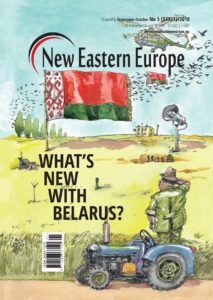

Uncertainty and risk in Lukashenka’s times
The last 25 years in Belarus should not be seen as a period of development that was based on some predetermined plan. Rather it is a story of maintaining power, local successes and the failures of one man.
The history of a country can be divided into periods of growth and decline, euphoria and insecurity, crises and rebuilding. In Belarus, however, the past 25 years can be described as the time of Alyaksandr Lukashenka. Yet, a true picture of this period is much more blurred and nuanced. It is therefore difficult to make a clear, one-sided, assessment of the last quarter century and call it a period of decline or growth.
November 13, 2019 -
Andrei Kazakevich
-
AnalysisIssue 6 2019Magazine
Illustration by Andrzej Zaręba
We cannot even say that it was a period of strengthened sovereignty or increased external dependencies, a period of development or the weakening of national identity. The history of this epoch is a history of contradictory strategies, and that is why its main outcomes are worth a deeper look.
Strong authorities, weak institutions
Already at the very early stages of his rule, Lukashenka managed a full grab on power. His political programme was based on the promise of a strong government, and this is what 44.8 per cent of citizens wanted when they voted for Lukashenka in the first round of the 1994 elections. At that time, Belarusians were clearly exhausted from the economic crisis, corruption and political instability that haunted the state since it gained independence after the fall of the Soviet Union. The second round of elections brought Lukashenka even greater success with over 80 per cent of the vote. The 1996 referendum, which presented changes to the constitution and consolidated Lukashenka’s support, was condemned as undemocratic by the Organisation for Security and Co-operation in Europe (OSCE) and western powers. Nevertheless, it allowed Lukashenka to implement his programme and gain full control over the executive branch. This in turn led to a situation where his decrees and orders became more powerful than laws that were passed by parliament. The last stage of consolidating Lukashenka’s regime – which included an exchange of the ruling elite, an exclusion of opposition from politics and decision-making, and control of the information space – took place in the aftermath of the 2001 presidential elections.
The political system that was introduced still exists today. First and foremost, it does not suppose significant co-operation with political opposition and civil society and their visible representations in state bodies. Since the 2016 parliamentary elections, only two MPs could have been called forms of opposition, which is still better than between 2004 and 2016 when there was not a single one. In regional councils, which have around 18,000 deputies at different levels, there are probably around ten representatives who could be associated with the opposition. The opposition’s participation in executive power, even the holding of secondary posts, is out of the question at this time. It is the president who nominates ministers and heads of state committees, regional executives and judges. Even deputy ministers and heads of large state-owned enterprises are nominated by Lukashenka.
This organisation of the political system has one special characteristic. Namely, an exceptional weakness of state institutions. Clearly, the president has never showed an interest in participating in the game of politics. He has never built a coalition nor any political organisation or party. As a result, Belarus now has a system that is very simple. The president remains the only guarantee that the rules of the game are followed, that conflicts are solved and the main decisions are made.
This weakness of institutions is actually a very unique characteristic. In most authoritarian regimes, various forms of collective political activities can be identified. In Belarus, on the other hand, they are simply absent. The Belarusian parliament has no fractions, nor political groupings. There are no political groups in local councils. Deputies to the parliament initiate less than three-five per cent of laws per year. Since 1996, when the referendum took place, parliament has not vetoed a single presidential decree; while in the past decade no bill proposed by the president and cabinet of ministers has been refuted. The role of the local councils is even more marginal.
Interestingly, no political party representing Lukashenka has been created. Political parties – those that both support and oppose the regime – operate on the peripheries of political life. In the current parliament, only 15 per cent of deputies are affiliated with political parties, which is actually a record number since 2000. The same can be said about the Belarusian civil society. A majority of active NGOs are perceived as disloyal towards the government which, in turn, limits their opportunities of working with the authorities. The largest, publically funded organisations, such as the Belarusian Republican Union of Youth or the Belarusian Union of Women, are essentially part of the bureaucratic apparatus.
Following the Soviet model, Lukashenka has developed quite an effective bureaucratic structure which is centralised and loyal. This administrative “vertical” concentrates all political power. The state machine is thus quite different from what exists in other post-Soviet states. It is characterised by a high degree of steering, which is used to guarantee relatively effective public services and a small degree of petty corruption. Ultimately, this system of stability and obedience depends on one man. All other political institutions, apart from the administrative vertical, are extremely weak. This makes the system fragile and unpredictable, especially in a situation where an opportunity to change power arises – should it be an internal conflict, or an intervention from outside. Being a prolongation of the Soviet system, the Belarusian system is incapable of solving this problem.
Foreign policy
In July 1994 when Lukashenka came to power, Belarus was an independent state for less than three years. Its foreign policy was still at a very early stage of development. It was haunted not only by problems of weak state institutions, personnel shortages and lack of experience, but also by the lack of public consensus in regards to the direction of foreign policy.
Like domestic policies, the government did not want to engage in a complicated and balanced game in terms of foreign relations. It chose Russia as the priority and directed its efforts there. It is difficult to say to what extent this decision was driven by economic interests and political values and to what extent it reflected populistic tendencies and personal ambitions of Belarus’s president on the Russian political scene. Nonetheless, all efforts were put into the pursuit of this strategy.
Consequently, in April 1996, Lukashenka and Yeltsin signed an agreement on the creation of the Belarusian and Russian “community”; while in April 1997 a “union” was sealed to become, in 1999, the Union State. The latter directly assumed that Belarus would renounce part of its sovereignty. However, from the very beginning, closer relations with Russia were pure improvisation without any concrete plan. The Belarusian authorities showed they had ambitious plans to participate in the Russian political project and to profit from it, mainly with access to cheap Russian gas and markets. The Kremlin, in turn, wanted to have Belarus in its political orbit and to use integration to increase its popularity at home.
However, once Vladimir Putin became president of the Russian Federation, this model of relations became outdated. Lukashenka’s goal was to use Russia as much as possible in order to increase revenue. He wanted to achieve this without losing power or the state’s sovereignty. For Moscow, meanwhile, it was crucial to keep Belarus dependent on Russia and, at the same time, decrease its support of the Belarusian economy. The political game between Belarus and Russia has always been non-transparent. Both sides never fully trusted one another and the real effects of their common actions were rarely in line with the earlier declared goals. Regardless of all of that, Moscow has managed to keep Minsk within its political network and economic dependence. Belarus, in turn, has managed to maintain relations with Moscow without fully surrendering its sovereignty. Relations between the two states depend on the relations between their leaders and informal agreements.
Russia has many mechanisms to influence Belarus. These include a visible domination of Russian media in Belarus, economic dependence, and pro-Russian attitudes within the Belarusian political elite. Russian influences are also to be found within the security and military agencies, which creates the risk of external manipulation.
Since 1996, Belarus has been generally isolated from the West. However, after 2008 – and even more visibly since the 2014 Revolution of Dignity in Ukraine – the authorities took some serious steps to diversify its foreign policy and find a counterbalance to Russian dominance. As a result, Minsk’s relations with the West gradually improved. The initiative to host negotiations over the conflict in Donbas was considered Lukashenka’s success. In 2015-2016 the European Union relieved the majority of its sanctions against Belarus, while the US removed sanctions in 2015. But the consequences of long-term isolation are still felt. The intensity of co-operation with the EU and US is relatively new and limited when compared to engagement with Moscow.
Consequently, Belarusian foreign policy remains asymmetrical. The level of co-operation and dependence on Russia significantly outweighs all other political and economic alternatives. An attempt to find counterbalance in the West, China or elsewhere has only brought limited results. At the same time, relations with Russia remain non-transparent and unpredictable. All this poses a serious threat to Belarus’s independence.
Economy: crisis, growth and stagnation
There is no other issue that would cause as much discussion over Belarus as the economic successes and failures of Lukashenka’s government. For many post-Soviet leftists who feel nostalgic towards the Soviet past, Lukashenka remains a symbol against neoliberalism. The same is true the other way round – for liberals, he is an anti-hero, one who kills entrepreneurship and business initiatives. Yet this contradiction is no longer valid. Over the past decade Belarus has adopted market-based policies, even though the role of the state in the economy remains dominant. Lukashenka’s strategy includes retaining large state-owned industry, subsidising the rural economy, large social transfers, as well as healthcare spending. Thus, inequality remains relatively low and there is not much of a gap between the rich and poor. Given all of this, salaries are not high. Large unproductive branches of the economy are being kept afloat which is accompanied by a low level of entrepreneurship and an insufficient use of new technologies and research.
Lukashenka has managed to retain much of the Soviet economic legacy and social programmes, but has had less success in building new enterprises and branches of the economy. In the last decade, development in the information technology sector has not compensated for the losses generated in traditional branches of industry, mainly in machine-building.
As mentioned above, during Lukashenka’s time Belarus has been through a few periods of economic growth and decline. This includes the economic crisis of the mid-1990s followed by a period of stable growth and prosperity in 2002-2008. Certainly, the latest global financial crisis hit Belarus much harder, and since 2012 its growth has slowed down. As a result, the country was hit by a recession in the years 2015-2016, while what took place in the next number of years resembled stagnation more than development.
Strong ideology, weak identity
Lukashenka’s activities in the area of culture and history have always been inconsistent. They are not based on any concrete strategies. In the early years of Lukashenka’s rule, there was a clear focus on Russia (its culture, language and history) with a constant emphasis on “unity” and “closeness” between the Belarusian and Russian nations. The two nations were said to have been united by the legacy of Soviet history. The turning point came with a 1995 referendum which made Russian the official language of Belarus, while historic Belarusian symbols (like the white-red-white flag and the Pahonia coat of arms) were replaced by modified Soviet emblems. The true Russification was taken one step further when practically all Belarusian schools were closed in urban areas. Russian became the language of politics, business and higher education, while the Belarusian language started to be treated as a sign of political disloyalty.
This policy became problematic in the early 2000s. The sole focus on Russia, Russian history and culture started to hinder the resilience of the Belarusian state. As a result, a new tendency emerged which included clearing culture and political ideology from Russian nationalism and filling it up with the “ideology of the Belarusian state”. The centre of the new system was to be built around such terms as “nation-state” and “sovereignty”. Officially, the new policy entered into force in March 2003. The search for a “Belarusian model of development” and a “Belarusian path” was accompanied by hundreds of articles, television programmes, and many books and conferences. Apart from the intellectual component, the new policy included wide information campaigns and the creation of ideology departments in all state agencies. Despite this, attempts to create a culturally neutral “ideology” did not succeed. Starting around 2008, there has been a careful inclusion of different elements of Belarusian culture its and pre-Soviet past into the official ideology. This tendency called “soft Belarusanisation” received a new impulse after the Russian Federation invaded Crimea in 2014 and war broke out in eastern Ukraine.
Since then the usage of Belarusian in social and business life lost its political sensitivity. Belarus’s history from before the Soviet period received more representation in museums, school curricula, historical research and state media. The authorities even allowed the erection of monuments to such historical figures as Tadeusz Kościuszko (in 2018), Gediminas (in 2019), and even to celebrate the 100 years since the establishment of the Belarusian Soviet Republic.
Yet despite these changes, Lukashenka’s record of building a Belarusian identity is full of contradictions. The programme to support the Belarusian language has not yet been approved, while the official historical narrative is still based on the Soviet period and the glorification of the Great Patriotic War (1941-1945). Russian media and popular culture have not lost their dominating position either. In the last 25 years of Lukashenka’s rule, the many problems of Belarusian identity remain unresolved.
Lukashenka’s rule is not the past yet, although we can point to some characteristics of his rule. Certainly the last 25 years should not be seen as a period that was based on some predetermined plan. Rather it is a story of maintaining power, and the local successes and failures of one man. In addition, Belarus has established quite an effective state apparatus, one that guarantees political stability and lacks serious internal conflicts. It is also clear, however, that the country has paid a heavy price for stability that includes weakness of political institutions, the breaching of political rights, and the lack of democratic rule.
The history of Lukashenka’s rule is thus characterised by contradictions and the future remains uncertain. The stability of the country’s economic and political system solely depends on one man, which will generate a huge risk when a transfer of power takes place, be it as a result of an internal crisis or external intervention. All this could have unpredictable results not only for Belarus, but for the region as a whole.
Translated by Paulina Siegień and Iwona Reichardt
Andrei Kazakevich is the director of the “Political Sphere” institute which researches and analyses Belarusian politics and foreign policy. He is also the founder and head of the Organizing Committee of the International Congress of Belarusian Studies.