
Text resize: A A
Change contrast

Shadow of a bear. How Viktor Medvedchuk turned from a marginal man into a grey eminence in Ukraine

Since the collapse of communism, Viktor Medvedchuk has been a prominent face in Ukraine’s political scene. His higher ambitions, however, have never come to be realised. He is now back in the parliament raising new questions of a political comeback.

On August 29th 2019 the first session of the new Ukrainian parliament since the July elections was convened. Now, the majority of the Verkhovna Rada is held by President Volodymyr Zelenskyy’s Servant of the People party which holds 254 of the 450 seats. The second largest fraction is the pro-Russian Opposition Platform – For Life; with 44 deputies, it cannot pride itself on having much influence. As a matter of fact, neither can any of the other opposition parties.

November 13, 2019 - Petro Bilian - AnalysisIssue 6 2019Magazine

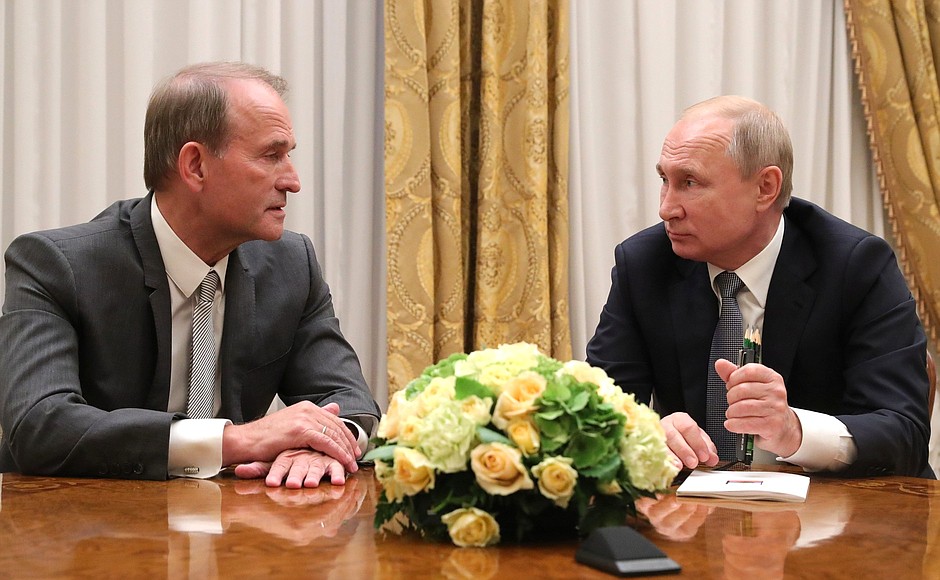
Viktor Medvedchuk (left) meeting with Vladimir Putin in 2019. Photo (CC) http://en.kremlin.ru/events/president/news/61041


This, however, does not mean that the 65-year old Viktor Medvedchuk, who is the most influential representative of the Opposition Platform, has stopped hoping he can have impact on the game, particularly if an opportunity arises.

Medvechuk became involved in Ukrainian politics a quarter of a century ago when he ran for a seat during the 1994 parliamentary elections. He then competed in a fierce contest against Viktor Morozov, who was the first minister of defence in independent Ukraine. Medvedchuk lost the race, but gained important political experience.

From the bottom up

Viktor Medvedchuk was born in 1954 in Siberia. His father was sent there as punishment for his co-operation with the Nazis and membership in the Ukrainian Insurgent Army during the Second World War. Needless to say someone with such a background could not dream of a decent career in the Soviet Union. Yet in the mid-1960s, the Medvedchuk family returned to Ukraine, where the young Viktor finished his education. As a calculating and ambitious young man, he started to dream of a career in the militia. Medvdechuk’s first steps to fulfil this dream failed, however. In 1971 he was not accepted into police school because of his “improper” past. Interestingly, however, a year later the 18-year old Medvedchuk was accepted into the Department of Law at the Taras Shevchenko National University in Kyiv, one of the best universities in Ukraine. How come the young Medvedchuk, with his tainted background, was given the chance to study at university?

Dimitry Chobit, Medvedchuk’s first unofficial biographer, claims it was at this time that Medvedchuk became a secret informant for the militia. He was very active as a student and became the chairman of a Komsomol division which recruited militia volunteer assistants. In the Soviet Union, this meant helping keep public order at public dances and on the streets. Militia assistants could also drive away hooligans. It is possible that Medvedchuk took this role too seriously when, during one of the interventions, he struck a teenager. And it just happened that that the boy who was hurt came from a very influential family and the case ended up in court.

In 1974 Medvedchuk received his verdict – two years of imprisonment. He was dismissed from the university. Back then something like this really meant the end, but not in Medvedchuk’s case. A few months later the verdict was reversed, and Medvedchuk was allowed to return to university. From this moment on, things went well and Medvedchuk graduated. He passed the necessary exams and became an attorney-at-law. Soon afterwards he became a defence lawyer in two very high-profile trials that involved Ukrainian dissidents: Yuri Litvin and Vasyl Stus, both of whom were imprisoned and later died in Soviet labour camps.

Explaining his role in these two cases, Medvedchuk has claimed that the trials were staged by the KGB, and as an attorney he did not have any influence on them. However, it is well known – and evidence can be found in the archives to support it – that in the two cases he was acting in favour of the prosecutor. Regardless of this experience, or maybe because of it, Medvedchuk, at the age of 35, became chairman of a law office in the Kyiv district. One year later, in 1990, he became a chairman of the Union of Attorneys of Ukraine. He was also a member of the Union of Attorneys of the Soviet Union which had a seat in Moscow.

Success and failure

In 1991 the Soviet Union collapsed and Medvedchuk’s dream of a career in Moscow seemed to have all but disappeared. Or maybe not? The collapse of communism and the emergence of an independent Ukraine created unprecedented business opportunities in Kyiv and other Ukrainian cities. Medvedchuk, who became a member of an informal group called the Kyiv Seven, also saw opportunities. The group gathered people like Valentyn Zghursky, who was the former mayor of Soviet Kyiv and as such had an extremely wide network of contacts, and Hryhoriy Surkis, who was soon to become the owner of the famous football club, Dynamo Kyiv, and a future vice president of the European Football Association (UEFA).

The group quickly gained political influence which allowed Medvedchuk to take part in the 1994 parliamentary elections. As mentioned above, he unsuccessfully ran for parliament. The Kyiv Seven also faced failure during the presidential elections which took place in Ukraine in June of that year. Looking at them now, one can identify a certain paradox – Medvedchuk and his friends openly supported Leonid Kravchuk, the nationalist candidate. Thereby, they were against Leonid Kuchma who was calling for closer ties with Russia and maintaining Russian as the official state language of Ukraine. Yet it was Kuchma who won the elections. As president, he did everything to remove his rival’s supporters from the political scene.

Yet, this was not the case for Medvedchuk and his friends. Medvedchuk even became an advisor to Kuchma for some time, and managed to build a strong political organisation – the Social Democratic Party of Ukraine – before the subsequent elections in 1998. During the campaign, the party not only built on the success of Dynamo Kyiv, but also had its election list open with the former President Kravchuk to be followed, in second place, by the former prime minister (and former head of the Security Service of Ukraine, and the first deputy of the republic’s KGB during the Soviet period), Yevhen Marchuk. Third place was given to Medvedchuk.

The party described itself as a group of professional-patriots and pragmatics. They created an image of themselves as those who were not capable of extreme action. Their active media campaign may not have brought much success, but the party did get into the parliament. The flexible attitude of party activists attracted new members and the fraction’s size doubled. Consequently, Medvedchuk became a deputy speaker in the parliament.

Success, personal ambitions and the oncoming presidential elections led to disarray in the party ranks, however. Marchuk had presidential ambitions, and in 1999 decided to pursue this goal. However many party members were not excited by this idea and Kravchuk proposed Medvedchuk as the party’s candidate. Despite support in many regional divisions of the party, Medvedchuk refused and convinced his colleagues to support Leonid Kuchma. At the same time, he was already looking to the next election in 2004.

Velvet takeover

During the 1999 election campaign, President Kuchma promised economic reform and a pro-European trajectory for Ukraine. This was actively supported by his supporters, including Medvedchuk and his party. From today’s viewpoint, Medvedchuk’s behaviour is hard to comprehend. But back then, he was intensely involved with the notion of Ukrainian nationalism to the point that he wrote a doctoral dissertation on it. Thus when Vladimir Putin in 2017 called Medvedchuk a nationalist, to a certain degree he was right.

During the 1999 elections, Kuchma promised that once he wins, he will be a renewed Kuchma. For this to happen, he first had to beat the communist, Petro Symonenko, who was advocating the need for improved relations with Russia, breaking ties with the West, and a complete nationalisation of the domestic economy. Kuchma beat Symonenko but did not have strong support in the parliament. Since the majority was unstable and closer to centre-left, Kuchma understood that he would need the help of Medvedchuk’s organisational talent and legal skills. And, indeed, Medvedchuk masterfully managed to break up the centre-left majority and assemble a new one in its place. This time around it gathered democrats and centrist parties. It also included the renegade left wing which supported the president and was ready to vote for his economic reform and co-operate with the International Monetary Fund. In order to describe what was happening in parliament, Medvedchuk used the term “Velvet Revolution”, even though it more resembled a takeover of power than anything else.

Although Medvedchuk and his party colleagues were the engine of the overthrow, they did not become its beneficiaries. The rapid popularity of the Social Democratic Party of Ukraine started to raise concerns among its political rivals, particularly President Kuchma. For this reason, Medvedchuk did not become the chairman of parliament. Instead, he had to accept the position of first deputy. That was only half the battle, however. That majority which Medvedchuk built would soon start working for the government of Viktor Yushchenko, who had just moved from being the head of the National Bank to become Ukraine’s prime minister.

Unplanned catastrophe

In 1999 Ukraine was on the edge of bankruptcy. There were regular stoppages in the supply of electricity, and salary payment delays for public sector employees. Yushchenko, as the newly elected prime minister, proposed a surplus budget which would force big businesses to pay taxes and which assumed a resignation from the barter-based system in the energy sector. This new management style overlapped with an increase in prices for Ukraine’s main export goods on global markets. In effect, the sale of metals and other goods brought about an astonishing six per cent growth. Because of this success, Yushchenko went from being Medvedchuk’s political rival to his personal enemy. He was the man who destroyed Medvedchuk’s political dreams.

Obviously, Medvedchuk did not want to surrender, it was not in his nature. After his initiating of a series of intrigues around the government and the National Bank, as well as a scandal that arose around Kuchma’s involvement in an orchestrated plot to kidnap and kill a journalist in April 2001, an anti-government majority started to emerge in parliament, which eventually led to the dismissal of Yushchenko. Despite that, Yushchenko’s popularity seemed untarnished and he managed to create a powerful opposition bloc called Our Ukraine. In 2002, his party won the parliamentary elections and Yushchenko could start seriously thinking about becoming the prime minister again and perhaps run for the presidency two years later.

Things did not seem to be going so well for Medvedchuk, however. Even if he had defeated Yushchenko in the first round, he would not have been able to permanently remove him or deprive him of important positions in Ukrainian politics. It was around this time that Medvedchuk started to look shady, resembling Cesare Borgia, the Duke of Valentinois who became an inspiration for Machiavelli’s The Prince – a man of unquestionable talent but also someone who could be quite scrupulous. It was also around this time when Medvedchuk’s role in the Litvin and Stus trials resurfaced, as well as the speculation about his co-operation with the KGB. In light of this, it was hard to expect strong support from voters or any sort of victory in presidential elections. The situation became even more complicated with the rise of another ambitious politician, backed by the Donetsk clan. In autumn 2002 the governor of the Donetsk oblast, Viktor Yanukovych, became the prime minister, someone who also had presidential aspirations.

Murky genius

At this time, Medvedchuk came up with the idea of political reform. He envisioned that Ukraine should transform from having a presidential system to a parliamentary one. This plan assumed a departure from the presidential elections based on the popular vote to a system where the president is appointed by parliament. This idea appealed to Kuchma who, in June 2002, nominated Medvedchuk as head of his administration. In August of that year in a speech on the Day of Ukraine’s Independence, Kuchma publically spoke about the reform. But the public’s reception of this idea was ambiguous. Yushchenko and his supporters, not surprisingly, were against depriving future president of his prerogatives. Since Yushchenko held a clearly pro-western position, his opponents – willingly or not – joined the pro-Russian group.

At that time, the “fat years” had just started in Putin’s Russia. The surplus of gas that Russia was selling on international markets provided it with the resources to initiate integration projects on the post-Soviet space to compete with the West. Medvedchuk quickly started to understand that it was not enough to have good relations with the Russians. Relations required friendship, which was something he was good at. As head of the administration of the president, he often met with his Russian counterpart, Dmitry Medvedev, and sometimes even Vladimir Putin. In 2004 Putin became the godfather of Medvedchuk’s daughter. This is probably the best memory Medvedchuk has from this year, which will in the end turn out to be very challenging for him. First, it turned out there was not enough votes for his political reform, and later the protests on the Maidan, which were provoked by massive forgeries in the elections leading to the Orange Revolution, destroyed Medvedchuk’s political ambitions once again.

Yushchenko and his supporters did not fully succeed either. The negotiations which took place after the forged elections in 2004 were supervised by international intermediaries and pushed for a compromise. It was agreed that the elections would be repeated, but the constitution would be changed to limit the powers of the president.

Stuck in a trap

When Yushchenko came to power, Medvedchuk moved to the opposition which was strongly against the president’s pro-European direction and his aspiration to join the European Union and NATO. In this new role, he managed an aggressive anti-NATO campaign and criticised Yushchenko’s decisions. This, however, did not stop him from developing warm relations with Prime Minister Yulia Tymoshenko, who was seen as Yushchenko’s ally during the Orange Revolution. These relations were warm to the point that, in 2005, Tymoshenko proposed Medvedchuk as a candidate for either the deputy prime minister or Ukraine’s ambassador to Moscow (hoping that she could use his relations with Putin). However, this plan proved unsuccessful.

Viktor Yanukovych’s coming to power in 2010 did not change much for Medvedchuk. The new president may not have wanted Ukraine’s integration into NATO, but he pursued EU integration. What complicated matters for Medvedchuk was Yanukovych’s decision to reverse, with the help of the Constitutional Court, the political reform, resulting in presidential powers becoming more executive in nature. Medvedchuk, in response, created a movement called the “Ukrainian Choice” which aimed at promoting direct democracy. He demanded a separate status for the Russian language, the federalisation of Ukraine and, of course, closer ties with Russia.

During Yaunkovych’s presidency, Medvedchuk did not have any spectacular success. New opportunities came his way after the 2014 Revolution of Dignity, the Russian annexation of Crimea, and the outbreak of war with Russia-backed separatists in Donbas. First, the oligarch, Ihor Kolomoyskyi came up with a proposal to nominate Medvedchuk as a governor, arguing that he could help install peace in Donbas. This did not happen. Instead, then President Petro Poroshenko, decided to use Medvedchuk’s services as he wanted to have someone with access to Putin and who could help him organise an exchange of prisoners. This task was assigned to Medvedchuk who accomplished it with limited success; he also used every possible occasion to criticise NATO, the EU and the West.

Now, after the July parliamentary elections this year, Medvedchuk has returned to parliament. For the moment, the leading party, Zelenskyy’s Servant of the People, does not leave much room for political intrigue. Hence Medvedchuk remains in the shadows. Yet, as always, he appears ready to come back and promote a legal change to Ukraine’s political system, establish direct democracy and repair relations with Russia. Time will tell if he will ever succeed.

Translated by Paulina Siegień and Iwona Reichardt

Petro Bilian is a Ukrainian journalist who has been working in different media for 17 years. Apart from his main job at Delovaya Stolitsa, he also runs a YouTube channel called “Petro Chtyvo” which is dedicated to reviewing socio-political literature.

,

Partners

Terms of Use | Cookie policy | Copyryight 2026 Kolegium Europy Wschodniej im. Jana Nowaka-Jeziorańskiego 31-153 Kraków
Agencja digital: hauerpower studio krakow.
We use cookies to personalise content and ads, to provide social media features and to analyse our traffic. We also share information about your use of our site with our social media, advertising and analytics partners. View more
Cookies settings
Accept
Decline
Privacy & Cookie policy
Privacy & Cookies policy
Cookie name Active
Poniższa Polityka Prywatności – klauzule informacyjne dotyczące przetwarzania danych osobowych w związku z korzystaniem z serwisu internetowego https://neweasterneurope.eu/ lub usług dostępnych za jego pośrednictwem Polityka Prywatności zawiera informacje wymagane przez przepisy Rozporządzenia Parlamentu Europejskiego i Rady 2016/679 w sprawie ochrony osób fizycznych w związku z przetwarzaniem danych osobowych i w sprawie swobodnego przepływu takich danych oraz uchylenia dyrektywy 95/46/WE (RODO). Całość do przeczytania pod tym linkiem
Save settings
Cookies settings