
Text resize: A A
Change contrast

A cold summer in Russia. A new wave of repressions and the rise of solidarity

The scale of repression in Russia is now more serious and terrifying than in 2012. At the same time, the Russian public has become more mature and fearless. Independent groups of lawyers provide free legal advice, journalists and activists defend human rights, and various crowdfunding campaigns provide financial assistance to those detained. As a result, prisoners feel encouraged even when they face the brutality of the system.

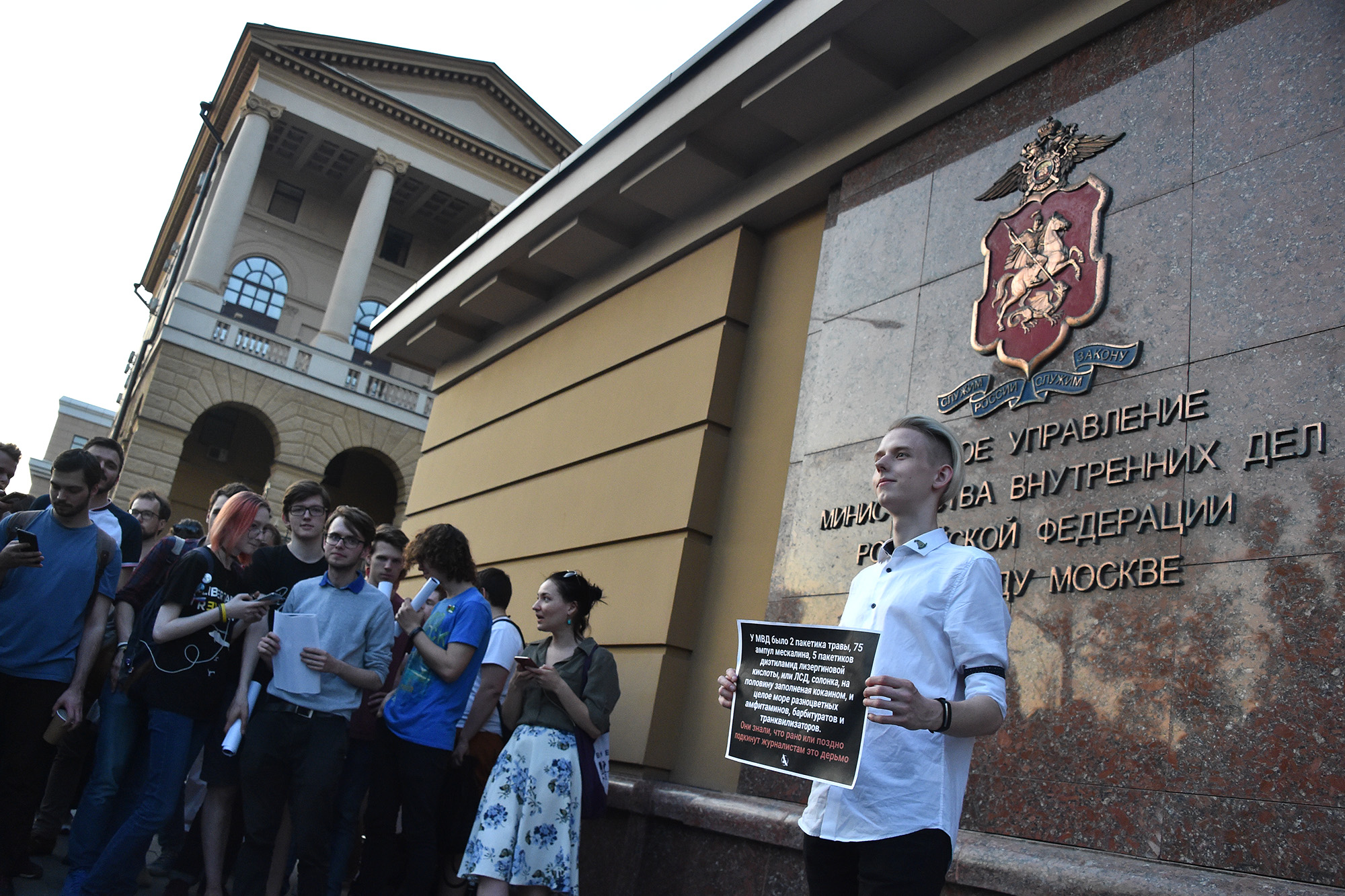
This summer was marked with a series of unprecedented political protests in Moscow, which started on June 12th and finished on September 29th. First, Russian citizens demanded justice for investigative journalist, Ivan Golunov, who was absurdly charged with the possession of an illegal substance with intent to distribute. Golunov was released days after the charges as a result of pressure from journalists, human rights activists and protesters on the streets of Moscow.

November 13, 2019 - Artem Filatov - Hot TopicsIssue 6 2019Magazine

A lone picket protest for detained journalist Ivan Golunov in Moscow last June. Golunov was absurdly charged with the possession of an illegal substance with intent to distribute. Photo: Vasily Maximov (CC) commons.wikimedia.org


Then in July a larger campaign started with the demand to register independent candidates for the Moscow City Parliament elections. All these protests were brutally suppressed with batons and mass arrests – on July 27th alone, 1,373 citizens were taken to police detention.

The authorities opened a number of criminal cases against protesters but civil society has effectively demanded the release of a number of the jailed protesters. At the end of the season, on September 29th, more than 20,000 Russians gathered in a sanctioned rally with the request to stop the repressions. It was the first time in Vladimir Putin’s Russia that diverse political movements made a show of solidarity with those in jail. Does this mean that the Russians are strengthening and maturing enough to contain Putin’s authoritarian rule?

Price of activism

This is the second time in a decade the Kremlin has reacted to a wave of protests in a criminal way. The previous one was the notorious “Bolotnaya Square case” in 2012 when the investigative criminal committee of Russia qualified the mass gathering as criminal, alleging that the protesters were violent against the police. It was a day before the inauguration ceremony of Putin when protesters came to central Moscow to express their anger, and the police failed to provide security (as recognised by the European Court of Human Rights and other international organisations). More than 30 people faced criminal charges in 2012 and the protest movement was shocked and demoralised by this brutal reaction.

A number of laws had been introduced and adopted in Russia since then in order to stave off protests. Protesters now face administrative fines from 10,000 to 300,000 roubles (140-4,200 euros) if their actions are not sanctioned by the authorities. Protesters can be arrested and held for up to 30 days in jail. But there are also more severe forms of punishment for those who face these administrative measures. The latest example is the unprecedented brutal case of Moscow activist, Konstantin Kotov. He was charged with the repeated violation of public assemblies because he was attending protests and was sentenced for four years in prison in September 2019. Kotov did nothing violent or harmful, he was peacefully attending rallies in Moscow and was detained by the police and fined several times. His case shows what the real price is for political activism in Russia today.

At the same time, one cannot ignore the fact that several thousand Russians were ready to attend unauthorised rallies in Moscow and risk facing these serious consequences during the summer. This illustrates that a real demand for change is now growing and the authorities are unable to change the public mood with repressive means or with shows on state-controlled television which are widely attributed by many Russians as “Kremlin propaganda”. What is more, the older generation is particularly angry due to the recent pension reform which has increased the age of retirement for both men and women, and decreases in social welfare payments. Younger people are also unhappy with a drop in life standards, and the lack of opportunities offered in Russia.

Yet despite all these factors, it was still very difficult to predict the Moscow summer protests. The trigger was the government’s refusal to register independent candidates in the Moscow city Duma (city parliament) elections. Since the 1990s this parliament was described as one of the weakest in Russia, with a very small number of functions and limited decision-making authority. The most powerful body in Moscow (of course not mentioning the Kremlin) is the Moscow city government and its mayor, Sergey Sobyanin. The elections in the Moscow Duma were never perceived as important for the opposition.

For a significant number of Moscow citizens it was a situation of taxation without representation. I had a chance to discuss this with opposition leader, Lyubov Sobol. According to her for many Russians aged 18-35 it is absurd not to have a choice in elections. Older people have experienced life in the Soviet Union where choice was very limited: one single news programme on television, one brand of shoes, etc. But for the younger generation, it is natural to choose between different brands – they do not want to tolerate a lack of political choice.

Growing protest mood

This past summer in Moscow many well-known independent public figures and politicians decided to take part in the regional elections. It included Lyubov Sobol from Alexey Navalny’s Anti-corruption Foundation, Ilya Yashin, Yulia Galyamina, and many others. All these candidates have a proven record of being in opposition to the Kremlin, and, without access to state media, they received mobilising supporter.

It was the team of Moscow mayor, Sergey Sobyanin, who fuelled the crisis in the Russian capital. The authorities decided to block independent candidates from participating in the elections. According to Russian media, the decision had been taken after opinion polls data highlighted the popularity of opposition candidates in the central districts of Moscow. At the same time, the opposition had overcome significant administrative obstacles in order to be registered. Candidates were able to collect the necessary number of signatures of potential voters for their support. Nevertheless, the Moscow election commission disqualified the signatures of approximately 100,000 citizens claiming they were fake. It almost immediately led to outbursts of anger on the streets.

The first authorised rally gathered around 20,000 people, while the subsequent one on July 27th was declared unauthorised by the city administration. Among the 15,000 participants, 1,373 were detained at the rally – a new post-Soviet record. Most of the unregistered candidates for the Moscow city Duma elections were handed administrative sentences up to 30 days in prison. The Russian investigative committee opened a criminal probe into an alleged “mass riot” during the events of the 27th. Despite all this, citizens attended another protest on August 3rd. Riot police and military units blocked citizens on the streets, mobile internet coverage in central Moscow was limited and 1,000 people were brutally detained by special forces. Next was the authorised rally on August 10th which gathered approximately 60,000 protesters; it was considered to be the biggest protest event since 2011-2013.

These events significantly changed public attitudes towards Sobyanin, Moscow’s mayor. Prior to the large-scale police operation on the city streets, Sobyanin was perceived as a rather progressive mayor who effectively transformed the post-Soviet city into a comfortable and modern megapolis. But many young people demand more – not only new recreation areas and public spaces, but real representation in public bodies.

 In August this year Sobyanin appeared on television and expressed his support for the brutal police operation. This made him even less popular among Moscow’s middle class and younger generation. One of the examples of scorn towards Sobyanin was a YouTube video by popular rap singers who praised Sobyanin. This received more than 1.5 million dislikes on YouTube and was eventually removed as it has become one of the most disliked video ever published on the internet in Russia.

Unprecedented tactics

This new wave of protests was the longest in a decade especially taking into account that summer is when Russians usually go to their dachas or on vacation and pay very little attention to politics. The crisis in Moscow was interpreted by officials as an organised threat to the ruling system. From the very beginning, it was crucial for the “siloviki” – which includes heads of Russian investigative committee, Alexander Bastrykin, and the chief of Rosgvardia special squads, Victor Zolotov – to show their ability to tackle the problem.

The broad criminal case against protesters was opened three days after the protest rally on July 27th. Dozens of investigators began working on the case. The authorities reported that demonstrators attacked police forces and created a dangerous situation in Moscow. In fact the situation was the opposite: citizens were beaten by the police. Seventeen protesters were prosecuted or given significant prison sentences. Prosecutors dropped some of the charges after a public backlash.

The aim of the Russian authorities was to uncover a foreign influence as there is a general belief among the ruling class that such events are always inspired by the West. One of the targets for investigation was the Anti-corruption Foundation opposition leader, Alexey Navalny. A money laundering case had been opened against him and the offices and homes of activists were raided in more than 40 regions.

Finally in October the Anti-corruption Foundation was officially labelled as a “foreign agent NGO” the title which in Russia leads to limitations according to the current law. By coincidence the decision was declared by authorities on October 9th, the birthday of opposition leader Boris Nemtsov who was murdered in front of the Kremlin. Several days later according to Navalny, the prosecutor’s office asked the court to confiscate the only flat of the Navalny family. It was after Russian police forces demanded opposition leaders pay back a hefty amount of 18 million roubles (around 250,000 euros) in “damages” following the summer protests. The judge refused the prosecutor’s request.

Media were also the target of officials as the State Duma hosted hearings regarding “foreign manipulation”. A Duma parliamentary commission accused the Russian service of German public broadcaster Deutsche Welle inspiring protesters in Moscow via social media and interference in internal affairs.

The main aim of the authorities was to isolate the protesters and to raise the cost of participating in unauthorised rallies. Efforts to take children away from protesters were a new tactic. There are two such cases: the families of Dmitry and Olga Prokazov, and Petr and Elena Khomskikh. The parents came to the rallies with their young children and the prosecutors argued they abused their parental rights and endangered the lives of their children by taking them there. The authorities claimed that the young Khomskikh daughters were “very close to a large group of aggressively-minded demonstrators”.

After the court proceedings, both couples received a formal warning; in the Khomskikh case, the prosecutor’s office still insisted on stronger punishment for the parents. Their lawyer told the press that this decision was politically motivated and that it limits the ability of adults with children to protest in Russia.

Less fear, more solidarity

The scale of repression is now more serious and terrifying than in 2012. At the same time, the Russian public has become more mature and fearless since then. There are independent groups of lawyers ready to provide legal advice for those detained, and journalists and activists who defend human rights support those arrested by coming to the court. Various crowdfunding campaigns have also provided financial assistance. As a result, prisoners feel encouraged even when they face the brutality of the system. Maria Eismont, the lawyer for activist Konstantin Kotov who was sentenced to four years in prison for attending unauthorised protests, has said the lawyers are now unable to release innocent people from prison because judges pay no any attention to the facts. At the same time, with help of the campaigners, lawyers give publicity to the imprisoned activists and they are able to bring their cases to the European Court of Human Rights.

The case of 21-year old student, Egor Zhukov, mobilised students for a broad campaign. Zhukov studies political science at the Higher School of Economics in Moscow and hosts a YouTube show about Russian politics. He was detained and charged with participating in mass riots. After Zhukov was jailed, students started a series of one-person pickets in front of Moscow’s police headquarters. His supporters published an open letter with a call to release Zhukov and organised a crowdfunding campaign to collect money for his legal defence. As a result of the campaign, Zhukov was released from prison and taken under house arrest until the end of December; he is now charged with a different crime – “extremism,” which has a very broad definition in Russian law.

The government’s harsh reaction to the protests has provoked public anger from groups who rarely criticise the authorities. In mid-September the Moscow court sentenced the young actor, Pavel Ustinov, to three and a half years in prison. According to the prosecutors, he allegedly injured a riot police officer. Yet according to a video, Ustinov was just gazing at his phone near a metro station. This evidence, however, was ignored by the court. Several days later dozens of people, in front of Putin’s administration offices in central Moscow, were queuing for one-person pickets in support of Ustinov. Famous Russian actors and YouTube celebrities demanded the immediate release of Ustinov. Afterwards even state television hosts and ruling United Russia Party officials made statements about justice for the young actor.

At the end of September, a day after a rally demanding the release of all political prisoners, the Moscow city court overruled Ustinov’s prison term. His original sentence was replaced with a one-year suspended sentence. Some of the others arrested were also released after calls from various members of society, including Orthodox priests, teachers, psychologists, journalists and film stars.

The main message coming from the Kremlin is that it wants to control what is happening on the streets and in elections. At the same time, the authorities are ready to change their mind regarding some specific cases when faced with public outcry. But it seems that  officials consider such decisions as a weakness of the system. The court verdict in the Ustinov case shows that the arrested protesters are perceived as guilty no matter what the situation is. It is like “Russian roulette” for the protesters as they could easily be put in jail. At the same time, more people show their readiness to protest despite the risks they may face.

The bad news for Putin is that his propaganda is no longer effective and he needs more and more police to control the situation. The bad news for the protesters is they still have no solid agenda and they lack strong leadership.

The demand for change is high. This is what can be heard from opposition figures, such as Navalny and Mikhail Khodorkovsky, prominent economists like Sergey Guriev, and Moscow taxi drivers. The most likely scenario is that confrontation will continue until the parliamentary elections in 2021 and the presidential elections in 2024. But the main lesson from this summer is that citizens are learning fast, while the system may provoke a large-scale crisis even when it is not expected.

Artem Filatov is a Moscow-based journalist, covering the recent protests on the ground as well as various human rights issues in Russia.

, ,

Partners

Terms of Use | Cookie policy | Copyryight 2025 Kolegium Europy Wschodniej im. Jana Nowaka-Jeziorańskiego 31-153 Kraków
Agencja digital: hauerpower studio krakow.
We use cookies to personalise content and ads, to provide social media features and to analyse our traffic. We also share information about your use of our site with our social media, advertising and analytics partners. View more
Cookies settings
Accept
Decline
Privacy & Cookie policy
Privacy & Cookies policy
Cookie name Active
Poniższa Polityka Prywatności – klauzule informacyjne dotyczące przetwarzania danych osobowych w związku z korzystaniem z serwisu internetowego https://neweasterneurope.eu/ lub usług dostępnych za jego pośrednictwem Polityka Prywatności zawiera informacje wymagane przez przepisy Rozporządzenia Parlamentu Europejskiego i Rady 2016/679 w sprawie ochrony osób fizycznych w związku z przetwarzaniem danych osobowych i w sprawie swobodnego przepływu takich danych oraz uchylenia dyrektywy 95/46/WE (RODO). Całość do przeczytania pod tym linkiem
Save settings
Cookies settings