
Georgia’s long and uncertain road to NATO membership
Georgia’s membership of NATO lies at the core of its foreign policy. The ambition is beyond the line of ministries and state bureaucratic apparatus, as it represents the utmost desire of the entire country.
Recent polls in Georgia suggest that support for the country’s membership of NATO is at more than 70 per cent. Euro-Atlantic integration is Tbilisi’s near-term objective. The longer-term strategy is to move closer to NATO is non-negotiable for the state. Considering its geographic location, in the company of a hostile neighbour, Georgia adamantly wants to gain security by joining the Alliance. However, NATO is not only a security choice for Georgia; it is also a reflection of its political values and foreign policy.
August 26, 2019 -
Giorgi Goguadze
-
Hot TopicsIssue 5 2019Magazine
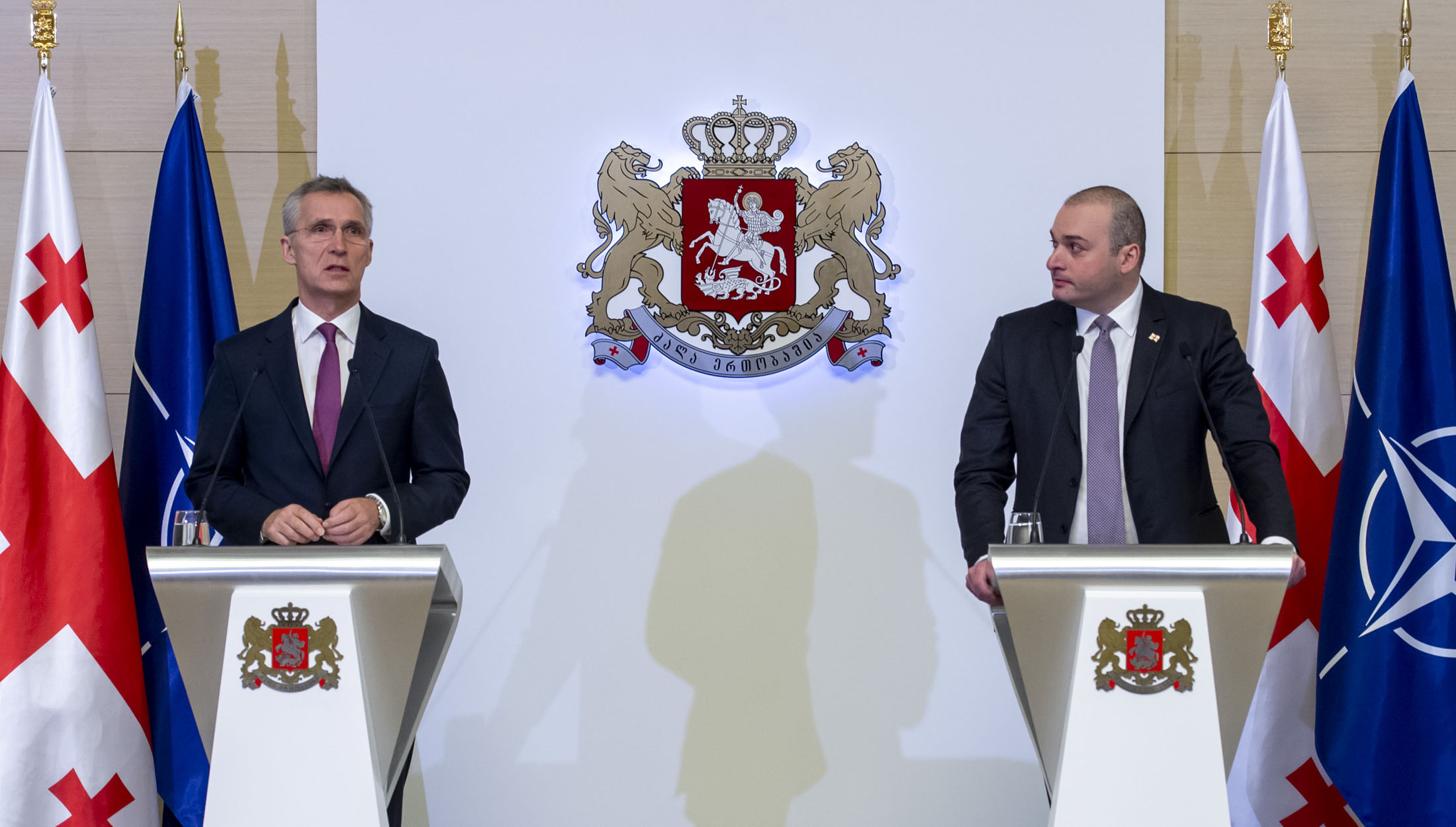
Secretary General of NATO Jens Stoltenberg (left) meeting with Georgia’s prime minister, Mamuka Bakhtadze, during a recent visit to the country. Recent polls in Georgia suggest that support for the country’s membership of NATO is at more than 70 per cent. Photo courtesy of NATO (CC)
The echo of history
In order to see the bigger picture of Georgia-NATO relations, one should first step back to recent history and examine the first steps Tbilisi took towards NATO. NATO-Georgia relations have been of great importance for Georgia’s foreign policy for decades. After the collapse of the Soviet Union, Georgia was dragged into bloody conflicts, triggered by the Russian Federation. The dramatic decline of economic welfare, the disintegration of territorial control, and the weakness of state institutions posed serious challenges to the development of the country, especially its foreign policy. Moreover, Georgia naturally fell under the strong influence of Russia which was visible until the very end of the 1990s. Yet, even then, Georgia found windows open to start relations with NATO, which still looked blurry in the eyes of Georgian decision-makers.
Attempts to establish relations with NATO took place during the government of Eduard Shevardnadze (1992-2003). The very first steps were taken when Georgia joined the NATO-run North Atlantic Cooperation Council in 1992 (NACC) and the Partnership for Peace (PFP) programme, signing the agreement on March 23rd 1994. In 1997 Georgia signed onto the Euro-Atlantic Partnership Council and ratified the Status of Forces Agreement (SOFA). In 1998 official relations were established between Georgia and NATO that revealed an open diplomatic mission. And in 2002 Georgia formally announced its aspirations to join NATO.

The new millennium was a period of accelerated relations between Georgia and NATO. The partnership level increased in its quality and aspirations. In 2002, during the NATO summit in Prague, Georgia expressed its desire to take part in a new programme called the “Individual Partnership Action Plan”. In December of 2003 a draft of the Individual Partnership Plan of Georgia was drawn up and submitted the following year. Georgia thus moved on to the so-called second stage of the Euro-Atlantic integration. The Rose Revolution and the assignment of a new government is also a pivotal point in these relations. The idea that the only way for Georgia to prosper as an independent, sovereign and functional state is through western partnership was cemented in the hearts and minds of the nation. The cycle of reforms led to a strategic decision by NATO in 2006 where member states agreed to offer Georgia “Intensified Dialogue”, which raised the membership perspective to the upper level and covered a full range of political, military, financial and security issues relating to possible NATO membership.
Positive public opinion of NATO was further stirred by its aggressive and hostile policy towards Russia. Every step towards co-operation with NATO was seen by the Kremlin as a threat and thus it took action against Georgia, such as an economic embargo, mass deportation of ethnic Georgians from Russia and the sabotaging of critical infrastructure (including gas pipelines which led to a heat shortage during the winter in Tbilisi). The 2008 NATO summit in Bucharest was expected to be a potentially major turning point in Georgia-NATO relations. Supported by the United States, the United Kingdom, and a number of Eastern European member states, the idea of an eastern enlargement did not find support amongst other continental powers, such as Germany, France, and Spain. However the summit did shift Georgia’s status to that of an aspirant country with member states pledging that Georgia would one day become a full member.
In August 2008, Russia finally sealed its vision on the existence of a sovereign Georgia by triggering a full-scale war and occupying two strategic regions of the country. One could argue that the war became possible after Georgia and its allies fell short of convincing NATO member states to grant the Membership Action Plan (MAP) to Georgia. However another interpretation suggests that leaving Georgia without an MAP gave the green light for Russia to attack.
Practical and political co-operation
At the Wales’s summit in 2014, Georgia was granted an important tool – the Substantial NATO-Georgia Package (SNGP) aimed at improving its defence capabilities, increasing resilience, enhancing interoperability with NATO, and supporting the NATO membership preparation process. Currently the SNGP consists of the following initiatives: the NATO-Georgia Joint Training and Evaluation Centre, the Defence Institutional Building School, co-operation in areas like logistic capability development, intelligence sharing, secure communications, aviation, air defence, special operations forces, military police, maritime security, cybersecurity, strategic communications, crisis management, and counter mobility. Each of these priorities strengthens the institutional capacity of the country and its defence institutions.
It is important to highlight that over the years Georgia has transformed from being a consumer of security benefits to an active contributor of stability and peace internationally. Georgian troops participate in various NATO-led missions and play a crucial role in legitimising the state’s ambition to join the Alliance as an active supporter of the organisation’s core principles and objectives.
Georgian forces also participated in the NATO-led Kosovo Force mission from its inception in 1999 until 2008. Georgian forces had already enjoyed a strong reputation for its participation in the International Security Assistance Force (ISAF) mission in Afghanistan. It has also indicated a willingness to participate in the post-2014 follow-up Resolute Support mission to train, advice and assist the Afghan National Security Forces after the ISAF mission has concluded. Georgian forces are involved in NATO Rapid Reaction Force which further boosts the country’s interoperability with the Alliance. In addition, Georgia participates in the counter-terrorism effort, Operation Sea Guardian (former Operation Active Endeavor), in the Mediterranean Sea which was launched in response to the 9/11 terrorist attacks against the United States in 2001.
The annual military exercise of NATO members in Georgia highlights the importance of the high political and military co-operation that is taking place. Furthermore, in 2016, Georgia hosted another meeting for the North Atlantic Council chaired by the Secretary General, signalling significant support to NATO-Georgian Commission and general co-operation between the subjects.
Enthusiastic and sceptical allies
One could say that Georgia now faces the reality of dealing with enthusiastic and sceptical allies. It enjoys high support from a particular group of countries but struggles to convince others to include it as part of the Alliance. Georgia is viewed as a strategically important partner by all three Baltic states (Estonia, Latvia and Lithuania) and the Visegrad Group (Poland, Hungary, Czech Republic, Slovakia). Since Georgia embarked on an active process of reform, aiming to consolidate democracy and become a constituent part of Euro-Atlantic institutions, relations with it has become a key priority for each of the other country’s respective foreign policy.
The US remains a key ally of Georgia in its path towards NATO membership. Georgia and the US have close bilateral relations which serve to further the interests of both parties. Considering that NATO’s enlargement in general has been largely driven by US policy, it is important that Georgia’s Euro-Atlantic aspiration enjoys bipartisan support in the US providing for a sustainable and reliable support in the long run.
Another crucial partner is Germany. However, when it comes to NATO enlargement, it is clear that Berlin is more cautious. Georgian diplomats and stakeholders still have to make better inroads with Berlin’s policymakers. While Germany does not principally object to Georgia joining NATO, Berlin has no clear idea how to deal with Georgia’s aspirations to become part of western institutions. Since Germany remains unconvinced in the short term about Georgia’s Euro-Atlantic future, especially in regards to granting Georgia an action plan, it feels more comfortable fostering the sustainable economic development in Georgia and supports the long-term Europeanisation of Georgia through various projects. France, in two critical moments, has played a central role in EU policy towards the Eastern Neighbourhood: it acted as a peace-broker in the 2008 Russian-Georgian war, and, with Germany, it is currently co-leading the mediation efforts in Eastern Ukraine. It is important for Georgia to gain a better grasp of France’s preferences and factor them into its foreign policy.
Obsolete Russian policy
Using brutish force, Russia attempts to mark its sphere of influence in its immediate neighbourhood. Shortly after the August War in 2008, then Russian President Dmitry Medvedev signed decrees recognising the independence of the breakaway regions of Abkhazia and South Ossetia as sovereign states. This move marked an important change in Russia’s approach as it now openly started to support separatist regions and used these conflicts as political leverage for influencing Georgia’s foreign policy. The Kremlin views this process as an attempt by post-Soviet countries to escape Russian influence. As stated in the 2015 Russian National Security Strategy report: “A determining factor in relations with NATO is the unacceptability for the Russian Federation of the Alliance’s increased military activity and the approach of its military infrastructure toward Russia’s borders”.
The Kremlin sent a clear message to the Alliance that any further integration, such as granting membership to Georgia, will result in increased destabilisation and even direct annexation of Georgian territories (i.e. South Ossetia and Abkhazia). The threats are an important deterrent for the West which fears the further deterioration of relations with Russia and the creation of new unstable zones, like in Ukraine. Therefore any move towards greater integration would require a lot of work from the side of Georgia vis-à-vis NATO members to strengthen their support and to influence attitudes of those who seem to be against it.
There are different scenarios which could lead Georgia to unconventional ways of joining NATO. The dominant way among security policy experts foresees inviting Tbilisi into the Alliance without Article 5 commitments (which states an attack on one state is an attack on all) towards the occupied regions; at least before any official jurisdiction of Georgia is restored on Abkhazia and the Samachablo regions. In this way, NATO would only take full security responsibility for 80 per cent of the country.
However, one should not limit the options and the West should re-think and consider how much has changed since the first Washington Summit in 1949. The emerging hybrid threats and rising populism pose serious questions of the integrity and dedication of the Alliance. It is high time to prove that NATO is committed to its decisions, especially its Open Door Policy.
Giorgi Goguadze is a director at the Georgian Center for Strategy and Development (GCSD), a prominent think tank in Georgia. His professional work focuses on conflict studies, supporting the development of foreign security policies and foreign policy research.