
Little change in the Belarusian economy
For years the Belarusian economy has faced the same challenges. The main input to state coffers comes from a few gas enterprises and the military industry, while many branches of the economy remain ineffective. Heavy dependence on Russia is also a serious problem. The only cure is structural reforms. Yet, seemingly there is no political will for their quick implementation.
According to official projections, Belarus is to reach 3.5 per cent GDP growth this year. Less optimistic is the forecast of the IMF which believes growth will be at only 0.7 per cent. The National Bank of Belarus, in turn, assumes inflation will not pass seven per cent. Regardless of the source, the predicted growth is not going to result in any form of structural change to the Belarusian economy. Rather it will be a reflection of global economic prosperity and higher gas prices.
September 1, 2018 -
Anna Maria Dyner
-
Articles and CommentaryIssue 5 2018Magazine
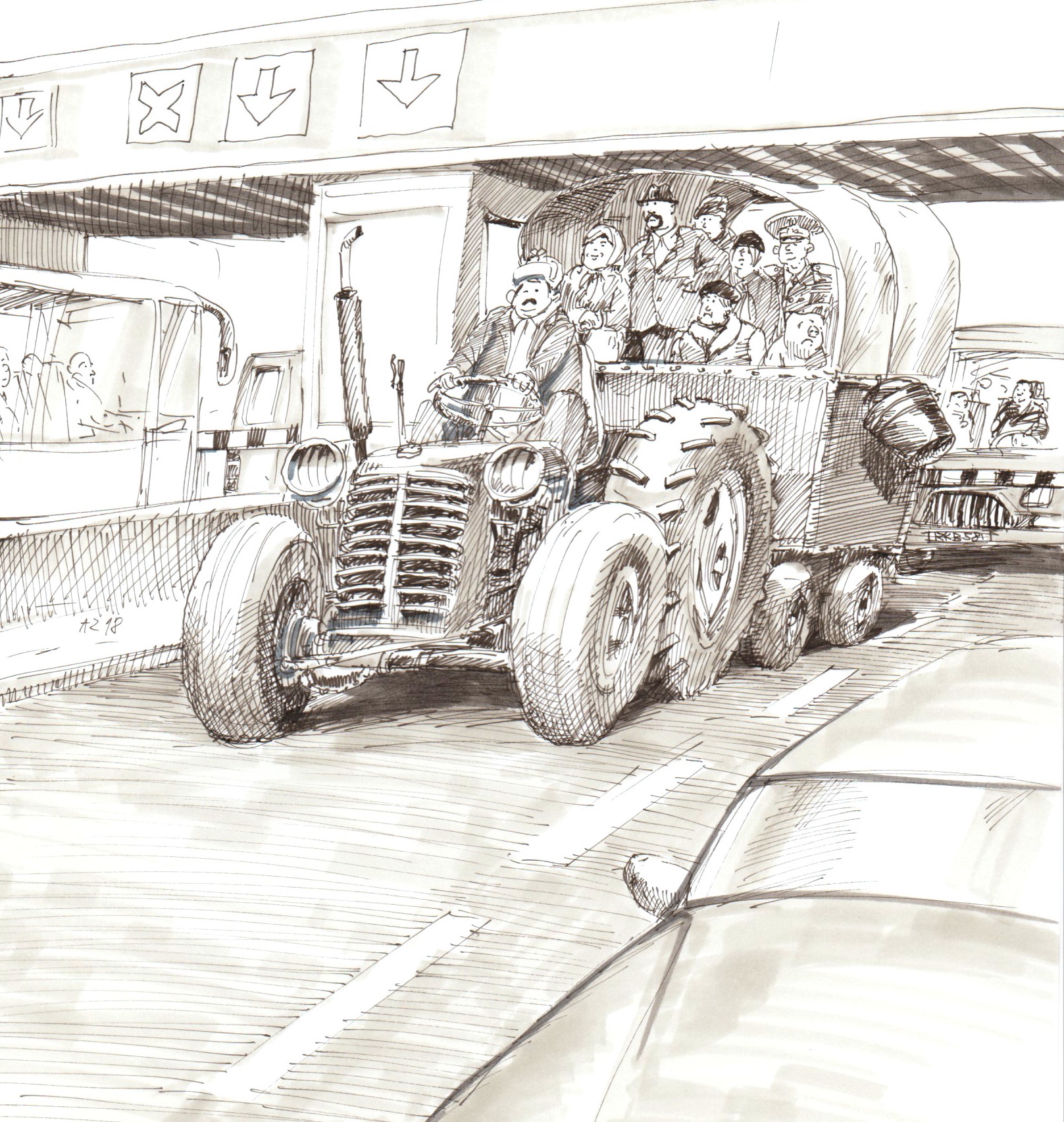
Illustration by Andrzej Zaręba
Dependency
Unquestionably the most profitable area of the Belarusian economy is the processing industry. It generates around 20 per cent of the GDP. Yet, like the refinery sector, which brings the biggest input to the state coffers, it is vulnerable to fluctuations in price of natural resources. It is also subject to Russia’s decisions regarding taxes and customs on oil and oil products. With oil prices influencing the price of export tax, input from that source (based on the stipulations of an agreement with Russia) nicely fuels the Belarusian budget at present. In 2016 it amounted to 600 million US dollars, which is a significant amount considering that the total income of the Belarusian state was around 18 billion US dollars. However, this situation could change if Russia decides that income from export tax on oil products made from Russian resources should go directly to its own coffers.
Exports of weaponry and military equipment are also growing in importance. This is evidenced by a recent report by the Stockholm International Peace Research Institute, which in recent years has placed Belarus among 20 of the world’s largest weapons exporters. According to the institute’s estimate, the value of Belarusian armament sales could have reached up to one billion dollars in 2017.
With Belarus being one of the world’s largest producers of nitrogen and potassium fertilisers, the sale of mineral fertilisers is another income generator. However, these products are produced by obsolete enterprises whose modernisation remains a challenge. This is especially true for Grodno-Azot where the cost of the company’s upgrading was estimated to be, at minimum, 400 million dollars. And since companies like Grodno-Azot and Belaruskali (another large producer of mineral fertilisers) depend on cheap gas from Russia, fluctuation in gas prices have an effect on their profitability.
Overall, Belarus’s economy is dependent on a few state-owned enterprises. Their profits support other, less effective, branches. One is agriculture which, until today, is based on the kolkhoz (collective) system. Thus, the sale of oil products or armaments that help Belarus gain foreign currency needs to pay off foreign debt or reimburse Russia for natural resources. Assuming that even only a few of the abovementioned companies start to face difficulties, it would have an impact on the whole economic system. Recent history has also shown that heavy dependency on Russia is bad for the Belarusian economy. Paradoxically, its development is blocked by cheap resources from Russia. Clearly, the huge benefit that Belarus receives from their processing has allowed the state to function calmly, thereby discouraging the authorities from introducing any socially-expensive reforms.
Eurasian Economic Union
Integration into the Eurasian Economic Union (EEU), which was launched in 2015, was envisioned by Belarus as one of the methods to improve its economic situation and diversification of revenue sources. During the multi-stage preparations, which included the establishment of the Customs Union and Common Economic Space, government experts and media commentators stressed the benefits that Belarus would enjoy from joining the Russian-led economic project. Prices of Russian hydrocarbons were expected to decrease which was to help ease the budget. The creation of a single market was perceived as an opportunity to entice more investors who would initially gain access to three large markets (Belarus, Kazakhstan, Russia) and later on two more (Armenia and Kyrgyzstan). Up till now, these expectations have not been met, which has both economic and political explanations.
Nonetheless for the EEU to become a true economic union, the five member states should create a common customs code – one that includes common agricultural standards – and reach an agreement on the free transfer of goods, services, capital and labour. So far none of this has been achieved. Even though the EEU Commission has the necessary competence to create adequate regulations, its control has been left to the member states. In practice, it means that the EEU states can block the transfer of goods. What is more, the EEU member states indicate that there are still around 200 different barriers they face in economic exchanges. Their elimination should increase trade between the five member states by around 25 per cent. At a time when hydrocarbon prices are balanced out, this would mean a GDP increase of up to 12 per cent for the Belarusian economy. Talks in these regards are already under way, although there seems to be little chance of any quick resolution. Russia, whose large economic potential allows it to enforce rules on other states, remains the main obstacle here.
In addition, the development of the EEC is hindered by politics, including a significant worsening of EU-Russia relations which was caused by Russian aggression in Ukraine. Russia’s imposing of counter-sanctions on EU products as a response to EU sanctions, introduced in 2014, significantly limited trade within the EEU. More specifically, in order to block food imports from Belarus, Russia often used the argument that the products originated in the EU and were repackaged in Belarus. Russians also blocked trade between Belarus and Kazakhstan, claiming that some of the goods were not reaching their Kazakh recipients, and often remaining inside Russia. This explains why the Belarusian business sector is today less enthusiastic about seeing the EEU as an open and free economic opportunity.
So far there has also been no increased interest in foreign investment, even though the ease of doing business in Belarus ranks higher than Russia and Kazakhstan. Some of the advantages include the small number of procedures required to set up a company, the short time period for registering a business and the low amount of capital required.
Growing importance of China
Belarusian authorities are putting more faith in China’s New Silk Road initiative. They perceive the Chinese-led initiative as a chance for economic development and a way to reduce its dependence on Russia. In their view, it could be an opportunity to develop the transport infrastructure and large logistics centres (such as the Great Stone, which is located 25 kilometres from Minsk and hosts 33 firms from eight different states). Belarus, above all, is interested in attracting Chinese investment in industry. The authorities also believe this could be the way to increase Belarusian exports to China. Agricultural exports are especially tempting considering that Russia – the current main purchaser – plans to limit imports. Belarus has already had its first success in this area. It is the only EEU state that exports beef to China. The increase in Chinese investment is already noticeable. In the last three years, for instance, it has reached 180 million dollars (even though only two per cent of it comes from direct investment).
Belarusian authorities have already offered the Chinese an opportunity to invest in around 20 companies that produce chemicals and machineries. However, the initiative has faced some problems, including the transfer of some companies to the Great Stone technological park. It has also become quite clear that both sides have different expectations. While the Chinese want to maximise profit, Belarus wants stability of production and secure financing of their social security. Considering China’s interest-driven policies in different countries, it is hard to expect that co-operation will become a real alternative for Belarus. Yet it will help generate some revenue.
High tech
Recent declarations by Belarusian authorities on their attempt to digitalise the economy and investments in the high tech area have drawn wide attention. Of key importance here is the decree that was issued by the president last December. Not only does it give the green light to the development of modern technology, it is also the basis for the legalisation of crypto-currency in Belarus. As a result, companies that have been registered in Belarus can now freely use blockchain technology. Nonetheless, these declarations should be treated as an attempt to run forward and search for new income sources. There is, to be sure, still a lot of fear related to the implementation of reforms in traditional branches of the economy (this is especially true for agriculture and heavy industry).
In theory, it also helps the development of the private sector and modern technologies which could be used by the state-run industry. This is how the Belarusian authorities are trying to omit the existing technological barriers in their industry and do it without using their own resources. Paradoxically, until now, the IT sector has been doing very well in Belarus. Its activities are not subject to state regulations which facilitated the establishment of diverse initiatives. The popular and well-known video game World of Tanks, which was created by a Belarusian design company, belonging to Wargaming.net is a good example. However, considering the current management structure of the Belarusian economy, which is based on central planning, it is difficult to expect anything radical to be implemented, especially in the short-term. This does not mean, however, that Belarus’s potential in this regard is not significant.
New-old challenges
As said earlier, the greatest threat to the Belarusian economy is its strong reliance on Russia – especially Russian resources. Foreign loans are also quite burdensome: this year they equalled around $3.7 billion. Officially, instalments are paid by the state. However the size of the loans is so significant that Belarus is forced to take out more credit. Therefore last year it issued seven- and ten-year bonds, all at the purchase amount of $1.4 billion. In addition, the Eurasian Fund for Stabilisation and Development, which operates within the EEU framework, offered Belarus an $800 million loan. Its payment is divided into three instalments. On top of that, Minsk received a separate $700 million loan from Russia.
The remaining challenge is the state of relations between Russia and the European Union. Evidently Belarusian food companies have been negatively affected by the counter-sanctions that Russia imposed on EU products. In addition, the lack of stability in the region discourages potential investors from starting businesses in Eastern Europe – including Belarus. However, the artificial growth of production (which later cannot be sold for a long time) and increase of wages – usually introduced before presidential elections and not related to an increase in work effectiveness – are also quite problematic.
The lack of political will is certainly a factor that hinders the prospect of structural reform. The reasons are quite obvious. Clearly, the Belarusian authorities are afraid of the social costs of such a transformation, being aware that many of the enterprises are simply not profitable. Their entry into the free market and privatisation would lead to increased unemployment. This could result in much stronger social unrest than what took place in March 2017 when people came to the streets to oppose the implementation of the “social parasite” laws that would fine those who were unemployed. Other fears are related to increasing privatisation of the economy. This is especially true for the small and medium-size enterprises, which – wanting to function better – may call for not only economic, but also political, liberalisation.
All in all, the challenges faced by the Belarusian economy have not changed much in recent years. Based on a centrally-planned structure, it remains ineffective and unable to respond to the demands of today’s capitalism. It continues to depend on Russia, which uses it as a tool of political influence trying to “discipline” Belarusian authorities with all kinds of “wars” – be it gas, or milk or meat.
Translated by Iwona Reichardt
Anna Maria Dyner is the head of the Eastern European programme at the Polish Institute of International Affairs (PISM).