
Culture in a conflicted region
The Republic of Abkhazia is a partially-recognised small de facto state located in the South Caucasus between the Russian and Georgia. In 2014 the first contemporary art initiative of its kind emerged here – the cultural project SKLAD.
The history of Abkhazia is complex, multifaceted and quite dramatic. A small landmass on the Black Sea, Abkhazia has been historically located between the vast Roman, Byzantine, Ottoman and Russian Empires. This explains not only its multi-ethnic population, numerous historical and cultural monuments, and international trade, but also the number of conflicts it has experienced. The most recent conflict was the Georgian-Abkhaz War of 1992-93, the result of which was the declaration of independence by Abkhazia as an autonomous republic. This conflict, directly linked to the collapse of the Soviet Union, is known in the newly created republic as the Patriotic War of the People of Abkhazia.
April 26, 2018 -
Anton Ochirov
-
Issue 3-4 2018MagazineStories and ideas
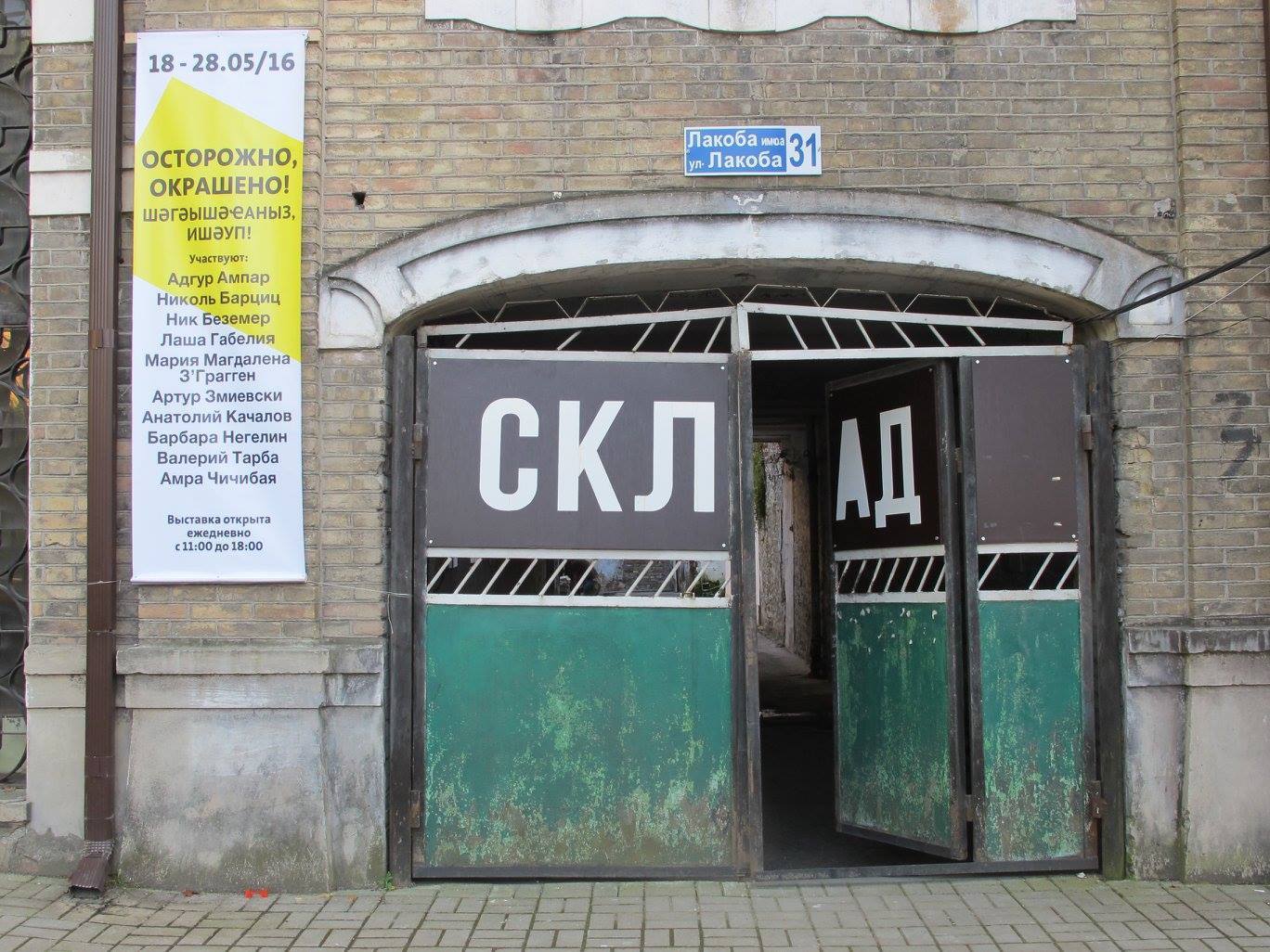
The SKLAD cultural site in Sukhumi, the capital of Abkhazia.
As a result of the war, Abkhazia, an economically developed territory in the Soviet era, suffered considerable damage. Its infrastructure was severely damaged, it experienced mass emigration, and it suffered an international blockade. The blockade from the Russians was eased only in the early 2000s. In 2008, the Russian Federation recognised the independence of Abkhazia (other states who recognise Abkhazia include Venezuela, Nicaragua and the island nation of Nauru). Nevertheless, Abkhazia remains unrecognised on the international level due to the policies of the United States and the European Union, who declare support for the territorial integrity of Georgia.
Origins
Once a place of active cultural, intellectual, scientific and commercial exchange, Abkhazia reduced its cultural activities after the war. For more than 15 years there was not a single cinema in the republic; the “houses of culture” (doma kultury), built throughout the 20th century, remained closed in the villages, and neighbouring Georgia made it difficult for Abkhazian artists to travel abroad. Gradually Abkhazia restored its cultural potential. The Abkhazian Theatre put on its performances in St Petersburg, various music festivals took place in Sokhumi (the capital of the republic) and renowned international opera stars visited the country. Yet the number of international cultural ties and contacts remain small and they are mainly limited to Russia.
In 2014 a project called “Young artists of Abkhazia / young artists of Basel (Switzerland)” took place in Abkhazia. The author and organizer of this project was Dagmar Reichert, a professor at Zurich University of Arts. In November of 2014, a group of six Abkhaz artists visited Basel, Switzerland, where another joint exhibition was held.
“The gallery where our exhibition took place was part of the programme Regionale 15 and hundreds of people came to the opening. The artworks turned out to be very diverse with classical paintings, graphics and photos, as well as many different installations and videos. The Swiss approached the Abkhazian theme in a very sensitive way and their own works were even nostalgic. Particularly impressive was the audio installation based on Abkhazian songs, translated into three languages. It reminded all of us of our home and introduced another culture and the oldest language to a Swiss audience,” said Tatiana Ergunova, a participant of the exhibition and the future curator of the SKLAD initiative.
The Zurich-based Artas Foundation (opened in 2011) is a Swiss non-profit foundation specialising in art from conflict regions. The foundation also conducts the postgraduate programme called “Art and International Cooperation” at the Zurich University of Arts. The main ideal held by this organization is that art is a purely peacekeeping cultural practice. The foundation believes art is a human need and could be a uniting activity in post-conflict areas.
In the context of co-operation with the Zurich fund, the SKLAD cultural space appeared in Sukhumi in October 2015. It hosted the First Exhibition of Contemporary Art in Abkhazia (themed “The Circumstances of Place and Time”) and was the third joint exhibition of Abkhaz and Swiss artists. The exhibition space was originally a warehouse for the Abkhazian Theatre – the origin of the space’s name (the English word for SKLAD is “warehouse”). Initially, it was believed that only one exhibition would be held there. But gradually the renting of the space became long-term. The Artas Foundation helped raise funds to pay for the rent of the SKLAD cultural site, and it has now existed for more than two and a half years.
The curator of the exhibition, Asida Butba, stated, “We found a convenient place, invited several artists to participate, got support from friends and art lovers, gathered materials and equipment from everywhere, cleaned up the hall ourselves and practically without any budget created this event.”
In search of something new
The initial feedback was not as expected. The audience, which understands art in a traditional way, failed to comprehend the presented works and perceived them as unprofessional and strange. Some pieces turned out to be too problematic for the perception of the Abkhazian audience, as they allude to unhealed wounds connected with issues of borders, disputed territories and wars. On the other hand, the exhibition space with its contradictory, emotional, chaotic, diverse and free creativity, turned out to be quite attractive for some visitors. The curators said that many visitors had come during their free time.
“The free creativity of this exhibition, that many of the visitors did not like, made it possible to speak without censure. When the artists’ works show only the objects that are in line with one institution or a certain viewpoint, it is hard to imagine how the cultural process can go any further,” said Butba. “I think there are a number of young people who are sick of using this ‘archaic’ language, but there is no other language. They are not criminals and they do not want to be businessmen, but they have nowhere to go. There are some thoughtful people who do not adhere to any particular direction: artists who need a certain environment.”
Some works at the exhibition deserve special attention. For instance, Borderlands, the work of a young Swiss anthropologist named Aron Rossman-Kiss is one such work that should be singled out. His piece was a 12-minute slideshow of photographs taken during trips to border regions of different countries. He examined the Georgian-Abkhazian and Georgian-Ossetian border, the Greek-Turkish border, the borders of Kosovo, Cyprus and Kurdistan, the borders of the refugee camps in Greece and Bulgaria. All of these sites were all painfully similar to each other.
“The main thing I learnt from this project is an even greater reassurance that art is very broad and we must not stick to one framework. We must understand that apart from painting and sculpture, there are other tools, forms and ways of expression that can also get to the feelings of a person,” said Beslan Tarba, a young Abkhazian artist.
At the end of 2015, a second exhibition opened at SKLAD. It was a personal exhibition of the Sukhumi sculptor, artist and personal puppet theatre master named Arkhip “Sipa” Labakhua. Labakhua is known for a series of charming urban sculptures depicting the characters of Abkhazian writer Fazil Iskander. These sculptures fit organically into the space of Sukhumi and are major tourist attractions. The ideas of Labakhua’s exhibition, however, were ambiguous. The artist’s playing with the half-empty hall, different lighting sources, mannequins, small graphic sheets and space-unifying theatricalised symbolic game passed unnoticed in the mass media.
Perceptions
The 2016 exhibitions at SKLAD were largely determined by the proposals of the Swiss partners. The projects were mostly interactive and playful and were connected both to the social and communicative functions of art (“Caution, painted!”) and to various game practices within the art field (“Outdoor Games”). One project that deserves to be highlighted is the “Institute of the Visionauts”, implemented in co-operation with the Berlin architectural bureau Raumlabor. This project included research in the sphere of urban environment. It included interactive dream mapping with the participation of Sukhumi residents as well as artistic intervention in the urban space. For a few days, the half-abandoned Guma railway station in the centre of the city was turned into a laboratory of utopian practices. Paradoxically, the project became rather controversial, pointing out problematic issues of perception. Many citizens really thought that all those dreams about a better city they shared with the Berlin architects would come true and were disappointed to find out that it was only art.
In addition to showcasing various forms of physical art, SKLAD is also quite active online. It is present on many social media sites. People can subscribe to the mailing list and SKLAD’s website has pages in English. Yet it is still quite difficult to get accurate feedback. It is often unclear what exactly attracts or repels visitors. Throughout its existence, SKLAD has performed a kind of field experiment – even when it did not have enough resources or manpower to analyse and record the results. People who work with SKLAD do it without any payment. So, the initiative also takes on the peculiar role of “cultural urban activism.”
In 2017 the international residence for artists was opened at SKLAD. For the first time the Republic of Abkhazia appeared in international artistic and cultural databases. The curators of SKLAD, unexpectedly for themselves, received a storm of applications from around the world, including Western Europe, the US, New Zealand, Canada, Hong Kong, Thailand and Russia. In total, there were more than 100 applications. Unfortunately, due to the current financial and organisational limitations only two participants could have been chosen. The SKLAD programme could not cover travel expenses for the participants, and they only provided assistance during their stay in the country, such as an interpreter, transportation, exhibition space, assistance in obtaining a visa and organising artistic events.
Nevertheless, such a high interest in Abkhazia leads to a curious and even critical look at the activities of the Abkhaz authorities. The importance of broad international recognition is declared as a core priority of the authorities, yet it is not easy for outsiders to come to the place. This is not just because of an inefficient bureaucracy, but also because there is no one that can provide assistance to outsiders, almost no one speaks English. As a result, international contacts are limited and significant moments of interactions between ordinary people are often missed.
Memory, untitled
The residence project was initiated by Rossman-Kiss. He proposed a unifying theme for the first year of work, titled “archive”. It is connected to the story of the national archive that was burned down by Georgian troops when they occupied Sukhum during the Georgian-Abkhaz war. The destruction of the state archive is a tragic moment in the history of Abkhazia and is perceived as an attempt to deprive the Abkhazians of their memory.
Within the framework of the residence programme, Rossman-Kiss implemented the first participatory art project in the history of Abkhazia – a multimedia installation titled Memory, Untitled dedicated to the destiny of the destroyed national archive. Direct participation of the audience in the process of the work minimises the distance between the audience and the artist, between art and life. Abkhazians were invited to send their memories – anything that was significant for them and connected with Abkhazia. This call was regularly broadcasted by one of the partners of SKLAD, the Sukhumi-based SOMA FM radio station.
When Rossman-Kiss described the exhibit, he exclaimed, “The world deserves to know Abkhazia and Abkhazia deserves to know the world. Abkhazia will only benefit if it opens up to the world. A metaphoric reconstruction of an archival space incorporates memories submitted by locals through an open call, historical videos, audio and photographic footage as well as descriptions of dreams. Underlined by a multi-layered soundtrack, this complex material is dispersed between two screens, three monitors, shelves and library catalogue cards and card holders; the different methods of classification and presentation echo multiplicity of voices and materials found in any archive. The space created is intimate and universal, comforting and troubling – thus allowing visitors to explore it freely depending on their own interests and rhythm.”
Memory, Untitled was one of the most important international exhibition projects implemented on the site of SKLAD. It also clearly pointed out the main problems of perception of contemporary art in the para-state. Even when working with local material, art communicates using its own language and this language may be incomprehensible for the unprepared viewer, even if he is involved in the creation of the work. Even though a large-scale multimedia installation created a complex active environment that affected the perception of the viewer directly, the viewer did not have the language to build the connections between the objects inside the installation and his or her own feelings from the exhibition space. It turned out that the Sukhum audience generally lacks the habit of feeling and perceiving the environment as such: they simply move from one object to another, examining them.
It soon became evident that the Abkhaz audience is used to the traditional museum exhibition format, therefore it is difficult for them to comprehend the interactive multimedia style. A solution could be found in the archiving of the exhibition material. For example, the memories that people sent for the project have a lot of value and could be printed as a book. They contain military memories, dreams, memories of parents and loved ones, memories of the sea and even memories of food. Contemporary art can change formats without losing its meaning, and also become even more accessible.
The second exhibition on the topic of “archive” faced similar problems. Elisabeth Deys and Tareq Daoud (France/Switzerland/Turkey) whose application was reviewed by the curators of SKLAD within the framework of the residence programme, choose to work on an important topic for Abkhazian society — repatriation. The tragic events of the Caucasian War in the late 19th century led to the forced migration of many of the Abkhaz people – a phenomenon known as “muhajirism”. As a result, the Abkhaz-Adyg diaspora – which is a part of the Cherkess diaspora – have been living in Turkey and the Middle East (mostly Jordan, Syria, Lebanon and Palestine) for four generations. Deys and Daoud engaged themselves in research art. Their project, titled Deletion Marks, was dedicated to the complex relationship between Turkey and Abkhazia. The artists visited Abkhaz villages in the Turkish provinces of Duzce and Sakarya where they talked to locals about their historical memory and filmed it. In Abkhazia the authors of the project met with those who returned from Turkey, people with both Abkhazian and Turkish citizenship.
The findings were presented during an exhibition at SKLAD. The complexity of the project’s conceptual language ultimately led to an extremely low attendance of this exhibition, which made it necessary to rethink the importance of the topics raised in society. There is a lot of discussion about repatriation in Abkhazian society, but very little interest in real life. What does this mean? At least it demonstrates a strong discrepancy between the declared desires and reality.
Putting Abkhazia on the map
One can say that SKLAD occupies a unique place in the cultural life of a country that is recognised by only a handful of other states. Despite its short existence, its reliance on activists and minimal funding, it has become known for participating in significant international projects that have the potential to put Abkhazia on the map. Indeed, due to its non-political nature and adherence to cultural values, SKLAD has been able to achieve much more for the state than the authorities ever could.
SKLAD encounters both a conservative public that it is not very interested in contemporary or experimental art, and is misunderstood by the local officials. This is to be expected. The society is rapidly changing and consists of people with very different cultural backgrounds and often antagonistic viewpoints. The unique thing about SKLAD is that it has emerged out of the demand for a separate cultural environment in post-war Sukhumi. The initiative, in the end, had to create this environment alone, using both the democracy of contemporary art and the significance of its international relations.
Engaged in non-profit activities, civic social and cultural activism, SKLAD certainly faces funding challenges (support from cultural funds, at the moment, only covers rent and materials for the exhibitions). The solution for these problems lies in expanding the number of like-minded people who would support the initiative and in spreading more information about their activities. The question of how to transform a local platform into of a full-fledged republican art institution remains open. In fact, the example of the SKLAD institution reveals the many difficulties and challenges facing civic institutions in such a young, troubled and partially-recognised state.
Translated by Natalia Smolentceva
Anton Ochirov is a poet and a member of the editorial board of Translit – a literary critical journal. He is the author several books and poetry series. He lives in Sukhumi, Abkhazia.