Confronting the Romanian church’s cumbersome past
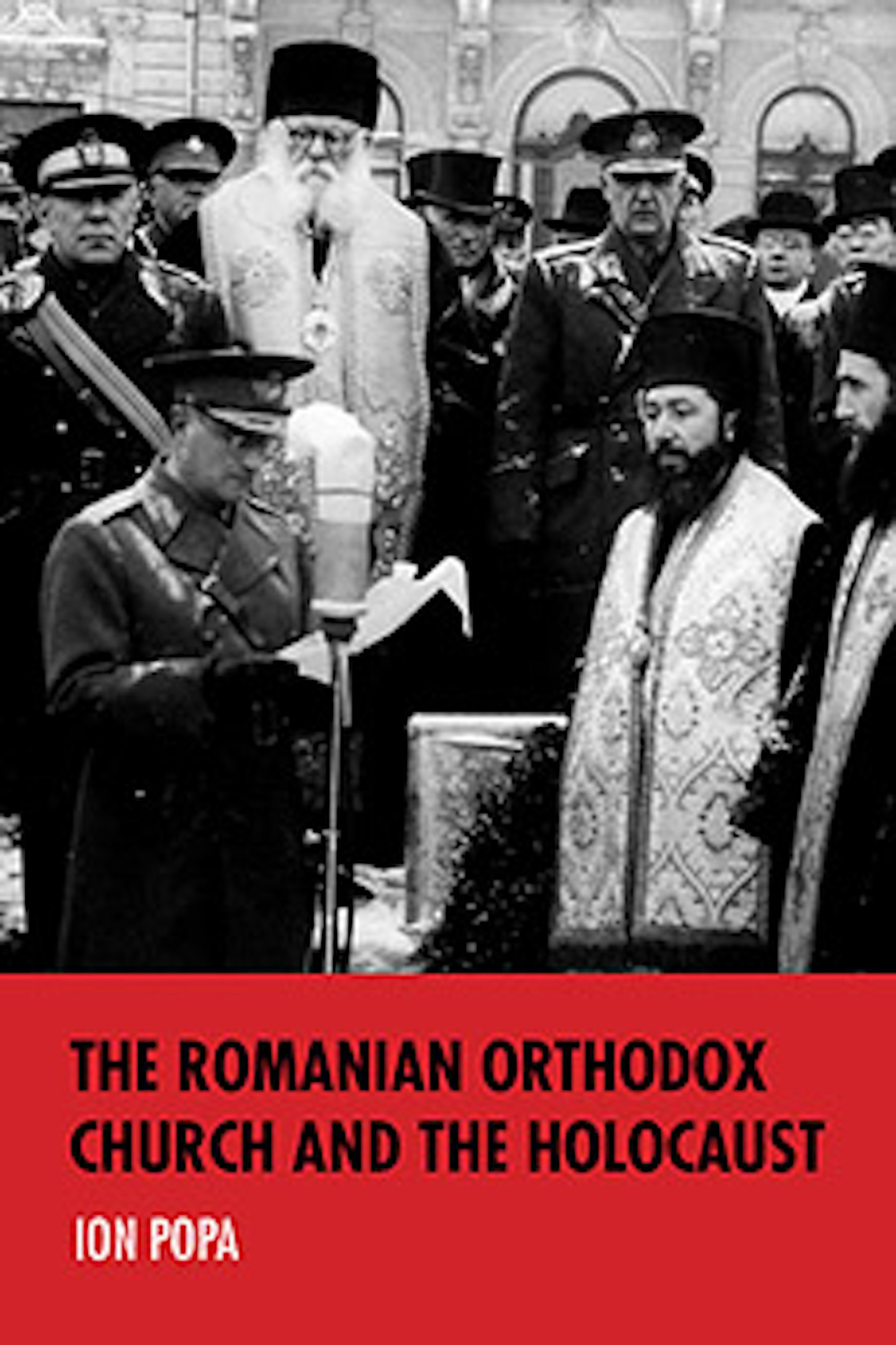
A review of The Romanian Orthodox Church and the Holocaust. By: Ion Popa. Publisher: Indiana University Press, Bloomington, Indiana USA, 2017.
In the summer of 2017, the Romanian media was rocked by a series of scandals relating to the Orthodox Church. These scandals, which were a stroke of luck for journalists who would normally be reporting on how Romanians spend their holidays, centred on acts of sexual impropriety perpetrated by figures in the upper echelons of the Orthodox Church, including one celebrity priest-cum-musical superstar. The Bishop of Huşi and Father Celestin of the Prislop Monastery of Maramureş were discovered to have engaged in same-sex sexual activities; the bishop was even caught on video being intimate with a theology student. These revelations were compounded by the fact that the musical superstar and priest Cristian Pomohaci was accused of having abused young boys who worked on his farm. Several young men came forward testifying that they were abused at the hands of Pomohaci. The journalist who broke the story first contacted officials within the church in reference to Pomohaci but received no response. Confronted with the church’s inaction, he finally went public.
April 25, 2018 -
Alin Constantin
-
Books and ReviewsIssue 3-4 2018Magazine
Painful memory
The Romanian Orthodox Church, which is state funded and plays an important role in politics, has opposed LGBT rights for a long time; the church sees them as a threat to traditional family values. Yet these scandals, which bring to mind an all-monk equivalent of the Castle Anthrax scene in Monty Python and the Holy Grail, contradict, at every level, the Church’s long-held claims. It responded by issuing a rather bland condemnation of paedophilia and child abuse. Yet more importantly, the church threw itself into another scandal concerning the removal of a bust of the person after whom a high school was named after. The figure in question was Mircea Vulcănescu, one of Romania’s leading theological thinkers during the interwar period, who died in prison after being sentenced by the post-war communist authorities.
Vulcănescu had served in the Nazi-allied government of Marshal Ion Antonescu and was charged with the economic spoliation of Romanian Jewry, a task he carried out with utmost diligence. Seeing how Vulcănescu was condemned as a war criminal, the Elie Wiesel National Institute for Studying the Holocaust in Romania asked for public institutions to stop honouring his memory. After the protest of a series of nationalist and conservative personalities, wholly backed by the church, the local authorities refused to make the change, in spite of the fact that the elimination was guaranteed by law. Victorious, the church claimed it has rescued the legacy of a martyr for Christ. But Vulcănescu was condemned for his participation within an antisemitic and genocidal regime, not for his faith. How could such a false statement be proclaimed?
For all those who want to understand the contradictions which rest at the heart of such a statement, Ion Popa’s The Romanian Orthodox Church and the Holocaust will be a vital resource. Based on the author’s PhD thesis at the University of Manchester, the book consists of a careful study of the history of the Romanian Orthodox Church in the 20th century and the consequences of its actions for the 21st century. Rich in archival materials from several countries, a mastery of the existing secondary literature and a familiarity with the overall history of the Holocaust, the volume is the first of its kind to subject the church’s wartime activity up to scrutiny, beyond its self-serving myths.
Popa begins his story in the interwar period when the church supported antisemitic parties such as the National Christian League and the Iron Guard. Despite its antisemitic credo, the National Christian League still stuck to a belief in parliamentary representation and democratic elections. By contrast, the Iron Guard was a fully-fledged fascist movement whose ideology combined antisemitism, anti-communism, xenophobia and support of Orthodoxy. It was openly anti-democratic and its members carried out terrorist attacks against politicians who criticised it. Numerous priests came out in support of the Iron Guard and many even joined the movement. In 1923, Romania was the last European country to emancipate the Jews, an act which the Iron Guard strove to reverse.
Turbulent years
Yet, in 1938, before the Iron Guard came to power and put its plan into action, Romania had a brief government run by the nationalist poet and politician Octavian Goga and the head of the National Christian League, A. C. Cuza. The Goga-Cuza government requested the re-examination of the situation of all Romanian Jews. Those who could not prove that they rightfully acquired citizenship would lose all political rights. The disapproval of Romania’s allies towards the policy led to the regime’s downfall. After King Carol II disbanded the Goga-Cuza government, he put in its place one that was headed by the Patriarch of Romania, Miron Cristea. Cristea not only supported the antisemitic legislation of the previous regime, he called for even more draconian measures.
Cristea’s government did not last longer either, for he was ousted when Carol installed a royal dictatorship. In turn, Carol’s own authoritarian government was ousted when the country experienced massive losses of territory to Hungary in the west, and to the Soviet Union in the east. In its place came a government jointly ruled by the Iron Guard and Marshal, Ion Antonescu, a military figure who had for years built a strong reputation in right-wing circles. It was known as the National-Legionary State. This regime was finally replaced by one solely headed by Antonescu after he failed to agree on policy with the Iron Guard. Throughout this period, however, Romania’s Jews were not spared from antisemitic bursts of violence. The Iron Guard went down by way of a pogrom in the nation’s capital, which resulted in the killing of Jewish men and the rape of women, as well as the destruction of synagogues (an impressive number of Orthodox priests joined in on the action). However, none of it compared to the scale of violence which followed Antonescu’s appropriation of power.
Under Antonescu, Romania became a committed ally of Nazi Germany, becoming deeply implicated in the war against the Soviet Union. Independent of National Socialist rulings, the Romanians began a systematic campaign of persecution against the country’s Jewish population. Hundreds of thousands of Jews were deported beyond the Dniester River to a region called Transnistria (not to be confused with the breakaway region of the same name today), where many died of disease, hunger, and outright murder at the hands of Romanian soldiers and German killing divisions known as the Einsatzgruppen. They were also subjected to economic spoliation, as their money and belongings filled the coffers of the Romanian state. The government prohibited conversion to Christianity in an effort to prevent it from becoming a possible source of salvation for the Jews. The Orthodox Church submitted fully to the will of the state that wanted to protect the purity of Romanian blood from mixing with that of Jews. The church’s support went even further: they championed the antisemitic campaigns at the time. It also acted as a cheerleader for the genocidal war against the USSR, a country that was described as “satanic”.
Whitewashed narrative
After Romania switched sides in 1944 and fought alongside the Allies, the church quietly went along. With the establishment of the communist regime in 1948, the Orthodox Church again landed on its feet, collaborating in the suppression of other Christian denominations. It was at this moment the church began to actively distort its past record, portraying itself not as instigator and perpetrator of antisemitic violence, but as a loyal friend of the Jews. Benefiting from the support of the communist authorities, who realised it would be advantageous to cash in on the church’s popularity as well as the lack of free speech characteristic of a dictatorship, this new whitewashed narrative cemented itself.
Romania’s Jewish community was powerfully affected not only by the devastations of the Holocaust but the continued existence of post-war antisemitism where outbreaks of violence were not uncommon. The new rabbi of Romania, Moses Rosen, entered into a pact with the communist authorities where he hoped to obtain the best deal for Romania’s remaining Jews. He mostly succeeded, but the question whether or not it was worth the price of collaboration remains lingering to this day.
Throughout Popa’s book, the Romanian Orthodox Church appears in a Machiavellian guise, always securing the best conditions for its existence. Far from being the unitary institution it claims to be, gluing the Romanian people throughout the country, the church’s record shows it to be deeply scarred by factional infighting at the local level. While the church’s falsified past went uncontested for decades – in Romania at least – the regime change of 1989 changed this as historians starting chiselling away at the web of untruths.
Importantly, not all Orthodox priests were antisemitic or passive to the violence perpetrated against the Jews, and Popa is careful to document such efforts in his book. Gheorghe I. Petre was listed as Righteous Among Nations for his efforts to help Romanian Jewry. Yet efforts such as Petre’s were done out of individual considerations, without any institutional backing. If people such as him are unknown to Romanian Christians, it is because the church is more focused on honouring people like Mircea Vulcănescu. Sadly, and unlike Orthodox Churches in other countries, the church in Romania has largely avoided taking part in interdenominational condemnations of antisemitism.
Pioneering work
Popa contends that the church’s inability to come to terms with its past, wholeheartedly condemn contemporary manifestations of nationalism which use its symbols and engage in interfaith dialogue, is a due to it being stuck in the Middle Ages. From integration during the war, to the complex balancing act maintained during the years of communism, when the ruling ideology was atheistic, to the recent harnessing of internet support groups, the church appears as anything but antiquated.
While terms such as “collective memory”, “repression” and “forgetting” are abound in the book, Popa pays little attention to their definitions. Historians and sociologists, in recent years, have tried to carefully distinguish the variety of memories, from social to cultural, while others have denied the existence of memory beyond the individual altogether. Irrespective of the approach, the reader could have benefited if Popa specified his classifications more clearly. Since his analysis is multi-layered, going back and forth between the Jewish community and the Orthodox Church, a more theoretically-developed concept of memory could have helped mediate these interactions.
Notwithstanding this shortcoming, Popa’s volume is a pioneering work of scholarship that is ground-breaking in its dedication to the investigation of Romanian ecclesiastical history. One can hope that the church will change its reactionary ways, but in any case, state institutions have a duty to keep in line the church’s flirtations with neo-fascist groups lest it, once again, becomes a hot bed of anti-democracy, antisemitism and xenophobia.

Alin Constantin has an MA from the Heidelberg Faculty of Jewish Studies and will begin a PhD in History at Stanford University.