
Text resize: A A
Change contrast

Ballad of a common soldier

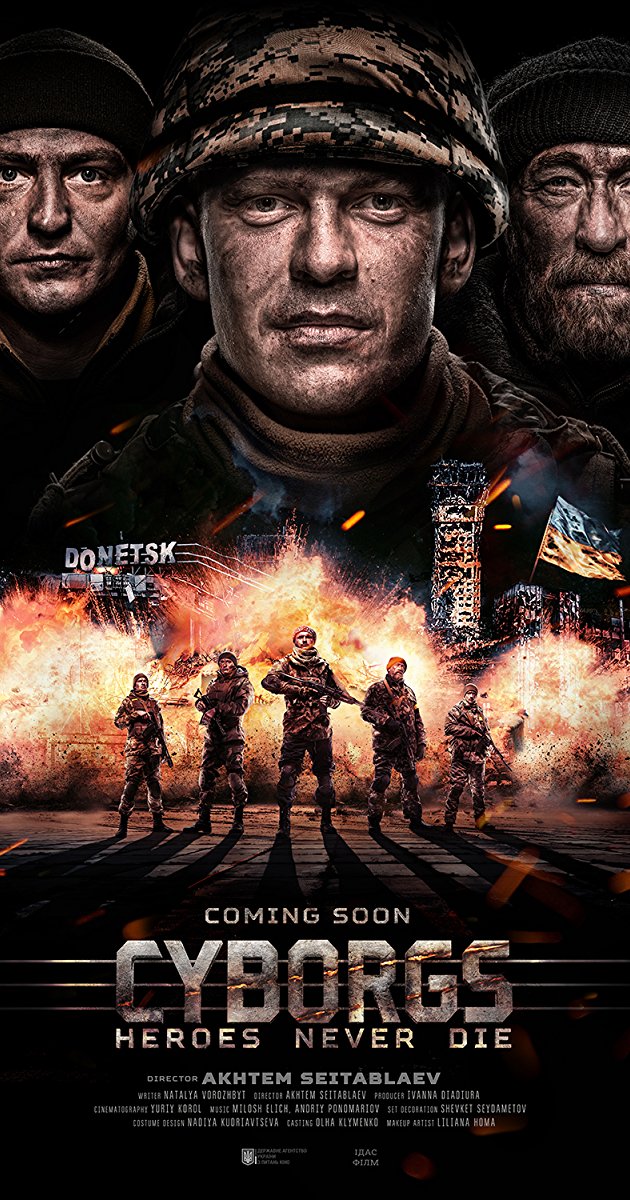
A review of Кіборги: Герої не вмирають (Cyborgs: Heroes Never Die), a film directed by Akhtem Seitablaev, Ukraine 2017.

Released in December 2017, the film Cyborgs: Heroes Never Die is a breakthrough for Ukrainian cinema. The film, as the title indicates, depicts the heroic defence of the Donetsk airport by Ukrainian fighters, popularly known as the cyborgs. It is directed by Akhtem Seitablaev, a Crimean Tatar who was born in Uzbekistan. Seitablaev came to Crimea in 1989 when his family returned to the peninsula. He studied in Crimea and Kyiv and then worked for the Crimean Tatar Academic Music and Drama Theatre in Simferopol.

April 25, 2018 - Piotr Pogorzelski - Books and ReviewsIssue 3-4 2018Magazine
Later, he became a screen actor and then a film director. Seitablaev is previously known for the film Khaytarma (which in English means “return”) a movie that depicts the 1944 deportation of the Crimean Tatars.  

Defending the homeland

Cyborgs, a prime example of war cinema, is a film that is multi-layered. The first of its layers is quite obvious: the story of the 242 day-long defence of Dontetsk airport. The event took place at the start of 2015 – though the film also includes events that occurred in September of the previous year. There are scenes that include combat, soldiers who have Russian passports, the heroic and often irrational behaviour of Ukrainian fighters, servicemen and interrogations of the prisoners of war. Typical for a war film, the inhuman commands are contrasted with honest (and not always subordinate) soldiers. To make the film as realistic as possible, the screenplay writer, Natalya Vorozhbyt, consulted many of the cyborg soldiers. Some of them even participated in the shooting of the film.

The conversations among Ukrainian soldiers create the second layer of the film. As it could be expected, these talks, as well as the interlocutors, are deprived of psychological depth. In this regard, Cyborgs is a mainstream action movie, not a sophisticated drama. Nevertheless, there are some scenes that are very powerful from the psychological perspective – which reveal the fighters’ motivation. As a result, we can see that while some of the cyborgs participated in the fighting or acting in the name of honour (we hear one soldier say: “I pledged an oath, thus I am defending my homeland”), others were driven by more personal matters; like the older man from outside Poltava who said he was fighting because his son had joined the army and because he had to defend his symbolic property: “a cherry orchard near his house”. In some cases, the motivations were more complex. Yet when trying to analyse them we cannot help but ask the question: how could someone defend a state that had given him nothing and whose political elite have been looting everything that was left after the collapse of the Soviet Union?

The trap

The film also shows Ukraine’s generational conflict. There is a story of a young musician who gave up the chance to take part in a prestigious competition in the West, and one of a commander who calls himself a nationalist. He is confronted by the musician who blames the older generation for doing nothing for Ukraine. He accuses them of being silent for so many years and not protesting against the authorities, thereby contributing to the great tragedy that is the war in eastern Ukraine.

With such deliberations, the film is at risk of falling into the trap of pathos and simplified patriotism – something that can be said about Seitablaev’s Khaytarma. In one scene of Cyborgs, we hear a soldier jokingly say: “Oh, and now the propaganda starts”. This trick undoubtedly saves some face for the film. However it is too bad that the same cannot be said about the scene where a priest (played by the Ukrainian minister of culture Yevhen Nyshchuk) prays over the body of a fallen soldier. Here, Seitablaev falls into pathos and artificial patriotic upheaval.

Importantly, Cyborgs touches upon an issue that is often disregarded by Ukrainian media, namely, the composition of the so-called separatist groups. In Ukraine they are often referred to as “Russian terrorist military forces”, which is to stress that Ukraine deals with an external aggression and not – as the Kremlin argues – a domestic civil war. Yet Seitablaev shows that the separatists are not only Russian but also Ukrainian. This case, in turn, generates an unavoidable question: why do these separatists support the Russian aggression? The answer is neither simple, nor to be found in the movie or reality.


Non-Ukrainian viewers, who are often inundated with information on the alleged “radicalisation of Ukraine”, may be surprised that the film shows no glorification of UPA, whose leaders (Stepan Bandera and Roman Shukhevych) could be treated as examples of freedom fighters. As a matter of fact, throughout the film the word “Banderite” is used only once. It is uttered by a pro-Russian separatist taken into captivity; he uses the phrase to describe his enemy captor. He uses it in the very same way that a Russian propagandist might call Ukrainians patriots. Tellingly, when he is finally freed, he dies from a bullet fired by a supporter of the self-proclaimed Donetsk People’s Republic.

Honesty

The last thing that should be addressed with regards to the film is the language used, which is often seen as the Achilles’ heel of Ukrainian cinematography. Theoretically, the state has two widely spoken languages but in reality people speak a mix of the two; it is strange to hear a protagonist speak perfect Ukrainian or Russian. Such instances, however, take place in some films and it comes across as very superficial, especially when Ukrainian is spoken. In Cyborgs the protagonists use both languages not flawlessly, but correctly. They speak more correctly here than what you would normally hear on the streets of Kyiv, Lviv or Poltava. It seems that Seitablaev found a golden middle.

Cyborgs is not a perfect piece of work. However keeping in mind that Ukrainian cinema is still evolving, we can forgive Seitablaev for some flaws. Most importantly, the director avoided the risk of turning the legendary airport fighters into gods. In other words, he did not present them as undefeatable heroes fighting for Ukraine and thinking solely about their homeland. Seemingly, this honesty was appreciated by the viewers. When I watched the film in Kyiv during a weekday the cinema was packed with people, including families with children. It is clear that viewing this film will certainly influence their patriotic upbringing, perhaps much more than history books.

Translated by Iwona Reichardt

Piotr Pogorzelski is a Polish Radio journalist and former correspondent in Kyiv. He is the author of two books on Ukraine: Barszcz ukraiński (Ukrainian Borscht) and Ukraina: niezwykli ludzie w niezwykłych czasach (Ukraine: extraordinary people in extraordinary times).

, ,

Partners

Terms of Use | Cookie policy | Copyryight 2026 Kolegium Europy Wschodniej im. Jana Nowaka-Jeziorańskiego 31-153 Kraków
Agencja digital: hauerpower studio krakow.
We use cookies to personalise content and ads, to provide social media features and to analyse our traffic. We also share information about your use of our site with our social media, advertising and analytics partners. View more
Cookies settings
Accept
Decline
Privacy & Cookie policy
Privacy & Cookies policy
Cookie name Active
Poniższa Polityka Prywatności – klauzule informacyjne dotyczące przetwarzania danych osobowych w związku z korzystaniem z serwisu internetowego https://neweasterneurope.eu/ lub usług dostępnych za jego pośrednictwem Polityka Prywatności zawiera informacje wymagane przez przepisy Rozporządzenia Parlamentu Europejskiego i Rady 2016/679 w sprawie ochrony osób fizycznych w związku z przetwarzaniem danych osobowych i w sprawie swobodnego przepływu takich danych oraz uchylenia dyrektywy 95/46/WE (RODO). Całość do przeczytania pod tym linkiem
Save settings
Cookies settings