
Text resize: A A
Change contrast

Seeking the Eastern Partnership’s greatest integer

In many regards, the 2017 Eastern Partnership Summit in Brussels illustrated that the “old normal” has disappeared. Instead, another disenchanting reality – crisis as the “new normal” – needs to be reckoned with.

The next Eastern Partnership (EaP) Summit in 2019 will mark the tenth anniversary of the project as a joint initiative involving the European Union, its member states and six Eastern European partners: Armenia, Azerbaijan, Belarus, Georgia, Moldova and Ukraine. Perhaps it is for this event that the partners are keeping their solemn and ambitious statements. And, moreover, they are right to do so. After surviving the Riga Summit in 2015, the 2017 Brussels Summit became a sobering moment – and not a celebration. It was the summit where mesmerism met discernment, aspiration met disenchantment and one reality met another reality.

February 26, 2018 - Andriy Tyushka - AnalysisIssue 2 2018Magazine

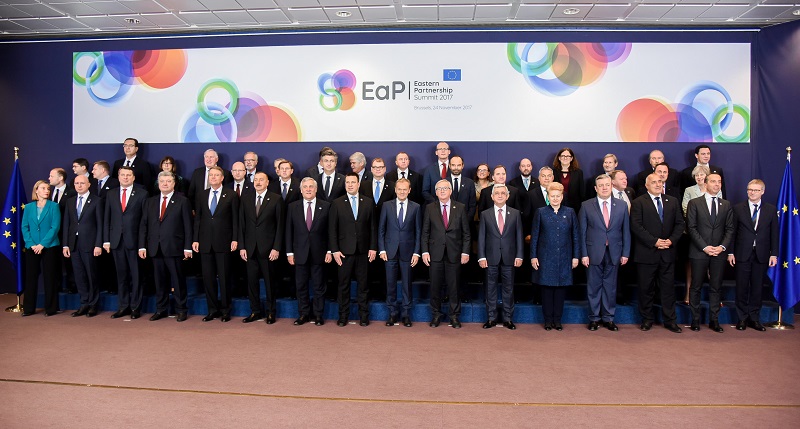
Eastern Partnership Summit, 24/11/2017. Photo courtesy of the European Commission.


For the ceremony master and the virtuous aspirations manager, that is the EU, the lowest common denominator evidently became the preferred solution of the partnership’s multiple inequalities. Beyond this way, the balancing between the feasible and the aspirational was excessively careful. Yet, there is also another solution possible, one that the EU thus far has not been so enthusiastic about: the greatest integer – that is an alternative to the lowest common denominator.

Virtues and vices

The last Eastern Partnership Summit, held in Europe’s capital last November, has proven to be “one of the most successful” for the less-aspiring members of Armenia, Azerbaijan and Belarus. At the same time, it was less inspiring for Georgia, Moldova and Ukraine, who aspire for closer ties with the EU – against all odds. Whether the solutions adopted reflect the lowest common denominator or the greatest integer, there will always be those who are happy with the final results and those who are not. This is the defining feature of the Eastern Partnership project: whereas playing in one league, the six Eastern European partners hardly make a team – and there should be no illusion about it. Georgia, Moldova and Ukraine have firmly – though not seamlessly – pursued their European integration and have signed the Association Agreements which also include the Deep and Comprehensive Free Trade Area component (DCFTA) with the EU, have liberalised their visa-regimes and aligned their foreign policies. Armenia and Belarus, in contrast, became members of the Eurasian Economic Union and allied with Russia under the Collective Security Treaty Organization. Finally, Azerbaijan hardly intends to get deeply involved either way.

Remarkably, and disappointingly, what unites them all is a proneness to conflict – a matter of their shared Soviet past, inherited post-Soviet legacy and protracted transition in the shadow of Moscow’s post-colonial hangover. Paradoxically, this has never been a theme for the Eastern Partnership. Yet while security has loomed large for the Eastern European partners (home to 75 million people), their Western European partners have keenly avoided such concerns – as if the EU has other formats where it could jointly address security issues, holding the entire region back.

Like every policy, the Eastern Partnership features both virtues and vices. To remain a policy of partnership – namely, a two-way strategically co-operative political construct – it needs to showcase a positive balance of virtues for all the partners concerned, taken together and individually. So far, it has largely stood the test. The Eastern Partnership has been beneficial – even though imperfect – for all sides. The EU and its Eastern European partners can take credit for progress in many areas. Ambitious political association and economic integration with Georgia, Moldova and Ukraine have become, since 2016 (late 2017 – for Ukraine), a matter of enforceable state and EU policies under implementation, thus transcending the realm of political declarations and summitry slogans. Conditionality-driven economic and public administration reforms, including legislative and regulatory approximation with something close to 70 per cent of EU laws and standards, have moderately pushed these countries away from the decades-long stalling “transition”. A visa-free regime with the three front-runners has become a reality, defying the gravity of shared bureaucracy and populism as well as transcending the corrosive fatigue on both sides and overcoming Europe’s sensitivity to migration following the 2015 refugee crisis.

Although less ambitious in scope, a renegotiated partnership agreement between Armenia and the EU is becoming a reality. The initialled Comprehensive and Enhanced Partnership Agreement (CEPA) provides for a middle ground in bilateral technical and political co-operation below the level of free trade. Despite Armenia being a member of the Russian-led Eurasian Economic Union, the EU remains Armenia’s number one export market and source of investment. For Armenia, as well as Belarus that is also a member of the Russian-led bloc, a newfound rapprochement with the EU is beneficial not only for financial and technical assistance but also as one of a few available ways to occasionally offset some of Russia’s pressure. The EU’s negotiations for a new agreement with Azerbaijan have made some progress as well – although certainly not crossing the lines of pragmatism shaped by mutual interest. Lastly, the participation of Belarus in 2017, a notable absentee at most of the Eastern Partnership Summits, can be viewed as a result of the détente in relations with the West, especially after the lifting of EU’s sanctions in early 2016.

Eastern Partnership Plus

Thus, a two- or even multi-speed Eastern Partnership has meanwhile consolidated as a disenchanted reality to reckon with. This quite finely reflects an observable trend in the EU itself with part of its membership advancing their integration even further while another part is resisting an ever closer union. Brussels now resolutely embraces “differentiation”, both at home and in the East.

Not surprisingly, ideas of updating the Eastern Partnership project, including its split into two or more small-group formats, have become politicised. Hence, the proposal for the “Eastern Partnership plus” format, adopted by the European Parliament in November 2017. This new approach calls for horizontal programmatic and institutional opportunities for closer co-operation among those eastern partners who are interested in deepening their European integration. Arguably, this updated format could lead to membership – primarily for Georgia, Moldova and Ukraine – in one or all of the European Union’s “four unions”: the Customs Union, Energy Union, Digital Single Market and the Schengen area. It would not, however, necessarily mean full EU membership.

Whereas this parliamentary recommendation was not fully acknowledged in the 2017 summit declaration, Ukraine has already made it explicitly clear that it would like to join all four of these programmes. For this to become a new reality, Brussels would need to find out whether there is a “third way” that can allow states to join the EU without actually joining the EU. Given Brussels’ acute fatigue towards even a hint of offering membership perspective to some of its eastern partners – as evidenced through the entirely unnecessary diplomatic spat over the fate and wording of Georgian, Moldovan and Ukrainian “European aspirations” – the dichotomous vision of the neighbourhood holds firm.

Double-instability equation

A dichotomy also prevails in the EU’s vision of its neighbours’ stability and transformation. The success-or-failure presumption here sways away the importance of the deep-rooted process by trading it for short-term deliverables that might indeed be short-lived, as the EU’s own experience with several member states showcases. Part of proliferating popular sovereignism, the neighbours’ inability to irreversibly deliver here and now on reform is also a tribute to the region’s reality: pervasive corruption and state capture. A minefield for any democratic leadership, reforms are directly proportional to instability and usually reversely proportional to leadership survival.

In the case of the war-torn Ukraine, this presents a double-instability challenge, with real losses of lives and territory. Hapless enough, the eastern neighbours are not yet hopelessly on that track. Right in supporting and demanding reforms from its eastern partners, the EU, however, needs to get real about their domestic pressure and regional realities, including the de-democratisation efforts competitively exported to the EU’s eastern neighbourhood by other powerful actors. The 2017 summit’s vocally promising slogan, “stronger together!”, leaves the hope that the EU hears the neighbours’ concerns and realises that it must provide political support –  along with financial and technical –  for the partners so they can effectively strengthen co-operation in the four priority areas for 2020: economy, governance, connectivity and society. 

Quite evidently, the EU began “talking” to its neighbours. In 2015, it innovatively launched an action plan and taskforce on strategic communications (EU StratCom Task Force East/South), thus fostering a better understanding of the EU’s own expectations, goals, policies and activities in the neighbourhood. The EU has also intensively learned to speak its partners’ languages (quite literally!) in order to effectively communicate with multiple audiences and reduce chances of misunderstanding. Moreover, EU finance ministers approved 800,000 euro for efforts in 2018 to counter hostile information and narrative offensives by third countries and entities, most of all Russia and ISIS (a new equation in international affairs).

Russia: the equation’s only unknown

In many regards, the 2017 Eastern Partnership summit illustrated that the “old normal” has disappeared. Instead, another disenchanting reality – the crisis as the “new normal” – needs to be reckoned with. Although the summit was held between the EU’s 28 members and six eastern partners, it was a third party that dominated the talks: Russia. However, the official 21-page joint declaration does not contain one single mention of it – all as “not to provoke Russia”, as is the required and repeated mantra of Eastern Partnership summits.

Whereas Russia is a key factor in the region and bears direct responsibility for its stability or instability (be it in Transnistria, Donbas, South Ossetia, Abkhazia or the Nagorno-Karabakh) it was not explicitly acknowledged with a single reference. Instead, the “summit participants remain[ed] deeply concerned about the continued violations of principles of international law in many parts of the region”. Understandably, under the lowest common denominator, this is the only formula available for the joint declaration of 28+6 European countries, with their different interests and policies in and towards the region and – more importantly – Russia itself.

Also realistically, Belarus and Armenia, as Russian allies in the CSTO, could not allow any Russia-condemning language – even though the summit featured two other partners (namely, Georgia and Ukraine) who have fallen victim to Russia’s aggression, including military aggression. The EU, too, could not come up with a different formulation since its position hinges upon the two unknowns: the EU’s official Russia policy, and its de facto Russia policy – the Eastern Partnership, which seems to be more of a deep-seated concern of how “not to provoke Russia” than how to make partnership(s) succeed by releasing their full potential.

Russian hybrid aggression in Europe – far and close, overt and covert, militarily, economic, informational and cyber – has triggered new spats in the region and inside the EU itself. Arriving at the summit, the United Kingdom’s prime minister, Theresa May, stated that “We must be open-eyed about the actions of hostile states like Russia who threaten the potential growth of the eastern neighbourhood and who try to tear our collective strength apart.” Just like its eastern partners, the EU is certainly aware of the gravity of the situation but is not certain how to manage it.

EUphoria

Regrettably, there is no time for a political standby, hesitation or a wait-and-see reaction. In the Eastern European regional system of inequalities, the EU’s hesitation would equal Russia’s action – to put it arithmetically. The situation will hardly change after March this year, when the next Putin election will be held in Russia: serving the Kremlin’s domestic self-preservation, Russia’s international gambits near and far will continue to openly follow confrontational strategies just as they will actively (in line with the Soviet-inherited “active measures” doctrine) exploit potential discontents.

In view of the fact that polarisation defines much of the eastern partners’ domestic policies, the pre-given discontents in Moldova, Ukraine or Georgia, with their respective parliamentary and/or presidential elections on the horizon sometime this year or next year will present a new opportunity for Russia to play its favourite “instability game” and reassert hard power in the region. The EU’s strategic ambivalence today emboldens Russia’s assertiveness tomorrow. Thus, what happens in the region is echoed in the EU: European security is indivisible. For that very reason the EU should use this perfect storm to get its eastern policy – first and foremost the EU’s official and de facto Russia policies – right. In terms of its “partnership” policy, the EU should somehow manage to differentiate, tailor and fill in with new impulses as necessary. After all, the EU has a 60-year long track record of integrating, transforming, stabilising and “Europeanising” diverse interests and national diversities (of already 28 members). With the envisioned accession of the Western Balkan states, that record will keep growing.

In the spirit of partnership, the EU should not discount the constructive and constitutive powers of its neighbourhood. Benevolently the new Eastern Europe is becoming a source of unparalleled integrationist drive and EUphoria and is something the EU could utilise politically in the face of rising populism and Euroscepticism from within. With the masks-off after Russia’s invasions in the neighbourhood and its hostile meddling in European domestic affairs since 2016, the aspiring eastern neighbours can help manage the crisis as well as bridge the missing link in the EU’s more than urgent shift from continued drifting and self-disempowerment to a strategic actorness in the region. To this end, the greatest integer – not the lowest common denominator – should streamline the EU’s and its eastern partners’ strategic and political efforts within the next three years to allow for a balanced, meaningful and sustainable management of crises and aspirations, both inherent part of the regional system of inequalities.

Andriy Tyushka is a research fellow at the European Neighbourhood Policy Chair of the European Interdisciplinary Studies Department (College of Europe, Natolin Campus in Warsaw). His research focuses primarily on Eastern European security, the EU’s Eastern neighbourhood, foreign and security policy, including the EU Association Agreements and structural power in the neighbourhood.

Partners

Terms of Use | Cookie policy | Copyryight 2025 Kolegium Europy Wschodniej im. Jana Nowaka-Jeziorańskiego 31-153 Kraków
Agencja digital: hauerpower studio krakow.
We use cookies to personalise content and ads, to provide social media features and to analyse our traffic. We also share information about your use of our site with our social media, advertising and analytics partners. View more
Cookies settings
Accept
Decline
Privacy & Cookie policy
Privacy & Cookies policy
Cookie name Active
Poniższa Polityka Prywatności – klauzule informacyjne dotyczące przetwarzania danych osobowych w związku z korzystaniem z serwisu internetowego https://neweasterneurope.eu/ lub usług dostępnych za jego pośrednictwem Polityka Prywatności zawiera informacje wymagane przez przepisy Rozporządzenia Parlamentu Europejskiego i Rady 2016/679 w sprawie ochrony osób fizycznych w związku z przetwarzaniem danych osobowych i w sprawie swobodnego przepływu takich danych oraz uchylenia dyrektywy 95/46/WE (RODO). Całość do przeczytania pod tym linkiem
Save settings
Cookies settings