
Text resize: A A
Change contrast

The rebranding of Jobbik

The far right party Jobbik plays a significant role in Hungary’s political system. It now has its sights on the 2018 parliamentary elections and has indicated its plans to be a serious challenger to Viktor Orbán. Whether it is really able to move to the centre and appeal to a broader set of voters remains an open question.

Hungary’s Jobbik, a radical right-wing political party, was established in 2003. Its creation was a response to the discontent noted among young voters who felt disappointed with the political situation and was largely related to the right wing’s loss in the parliamentary elections in 2002 when a liberal-left coalition, composed of the Hungarian Socialist Party (Magyar Szocialista Párt, MSZP) and the Alliance for Free Democrats (Szabad Demokraták Szövetsége, SzDSz), came to power.

Jobbik, in fact, emerged from a transformation of a group called the Community of Right-Wing Youth (Jobboldali Ifjúsági Közösség, or JIK for short), that was set up in 1999, after the victory of the Fidesz-Hungarian Democratic Forum (MDF) coalition. JIK was to become a platform for exchanging ideas and working towards consolidating groups with similar right wing and nationalistic views. The group was set up by around 50 people, including Dávid Kovács and Gábor Vona.

October 31, 2017 - Dominik Héjj - Issue 6 2017Magazine

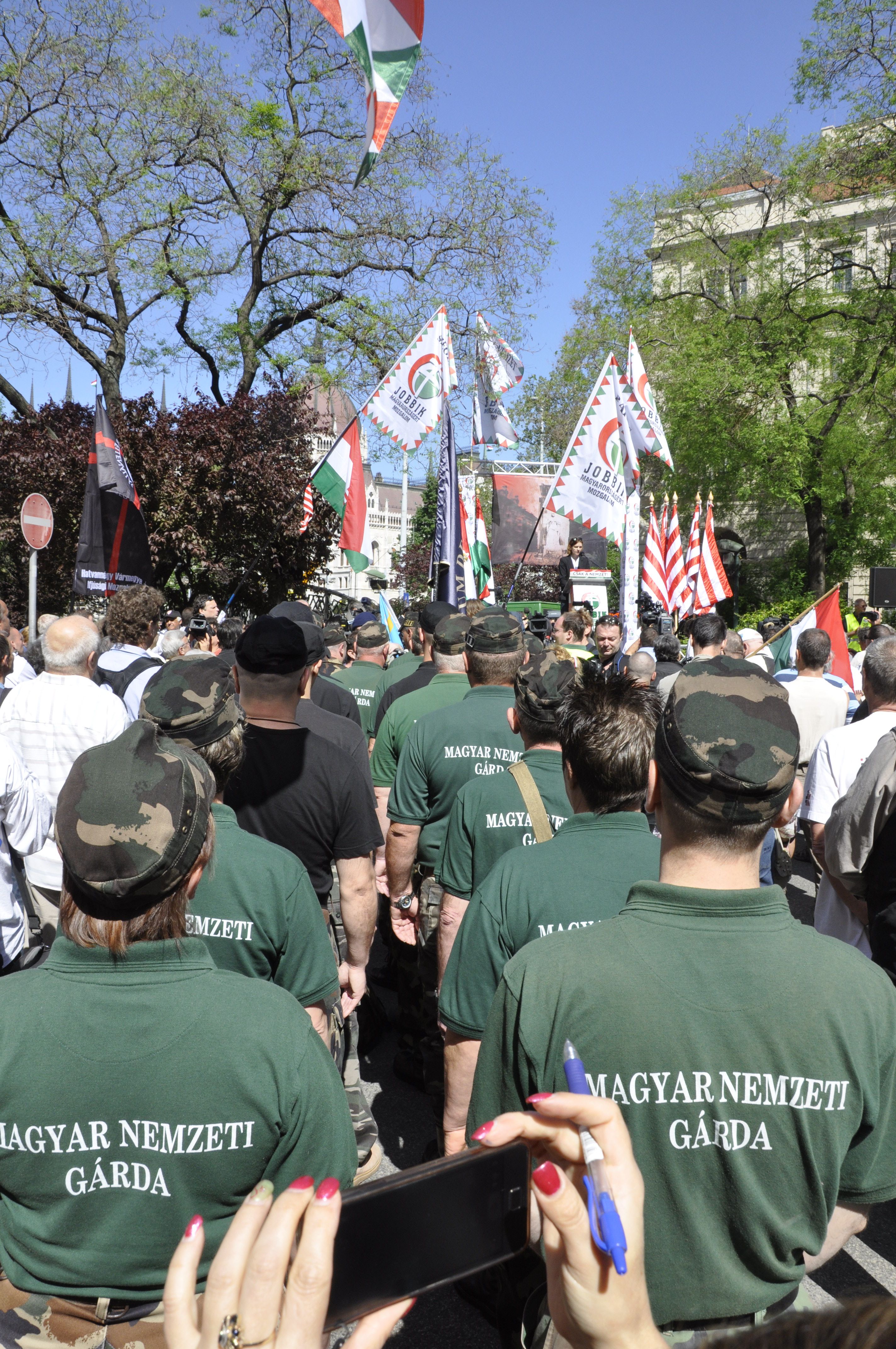
Members of the New Hungarian Guard at a Jobbik rally in 2013. Photo: Michael Thaidigsmann (CC) commons.wikimedia.org


Interestingly, they all studied at the department of humanities at Eötvös Loránd University in Budapest. In 1989 Fidesz was established at that same university, although in a different department, the István Bibó College of Law. JIK’s declaration stated its goal was to make sure that the “communists would never come back and Fidesz would continue to govern”. The postulate to clear Hungarian political scene of post-communists was soon to become one of Jobbik’s main political goals.

Transformations

The year 2006 was a turning point in Jobbik’s political life. In that year, Hungary saw the greatest political and social crisis since 1989. It began in the middle of September when the press published a leaked audio by the then Prime Minister Ferenc Gyurcsány. In a speech delivered on May 26th 2006 (a month after the elections) at a closed-door meeting, Gyurcsány notoriously revealed his group’s murky campaign tactics, denigrating Hungary with the worst possible names and admitting that all this mess needed to be fixed with deep reforms.

Large public outrage brought massive protests and attracted supporters of radical parties to the streets with flags bearing historical Árpád stripes (resembling the flags of the first Hungarian Árpád dynasty in the 12th century). In 2006 Dávid Kovács was replaced by Gábor Vona and remains Jobbik’s chairman today. In an interview this year Vona said: “We needed 2006, it woke up many people.” Indeed, in terms of the radicalisation of Hungarian politics, 2006 was the start and, moreover, many radical online portals and organisations have mushroomed since. Even though it is still politically weak, Jobbik has entered the mainstream.

Overall, Jobbik’s transformation in Hungary’s party system can be divided into four phases: 2003-2006 when the party tried to build structures; 2006-2009 when it introduced new topics into the political discourse; 2009-2010 when it received more interest after the elections to European Parliament; and 2010-present, marked by Jobbik’s presence in the European Parliament. All these phases are naturally related to each other and are an illustration of the group’s development and growth. During the first phase Jobbik did not generate any great reactions even though there were two rounds of elections: the 2004 elections to the European Parliament and the 2006 parliamentary elections. In the former case Jobbik did not participate, it even boycotted the election as an ardent opponent of Hungary’s membership in the EU. The latter elections were won (for the second time in a row) by the liberal-left coalition.

Since 2006, a watershed year, Jobbik has started to attract much greater attention in the media, especially after the Hungarian Guard (Magyar Gárda) was established in 2007. The guard is a para-military organisation that was envisioned as a response to the decreasing trust in the police after it had brutally beaten protesters in autumn 2006. What also generated attention was Jobbik’s lack of inhibition to openly discuss some political taboos, including the Roma minority. Jobbik representatives were eager to point out the lack of Roma integration with Hungarian society and the levels of crime committed against Hungarians (cigánybönőzés). Jobbik emphasised the need to commemorate the memory of Hungary’s heroes, take care of the forgotten graves of the fallen and celebrate the Treaty of Trianon (demanding that June 4th become a Day of National Unity). Jobbik was also unafraid to talk about the victims of the Hungarian Second Army on the Don River at the hands of the Russian forces in 1943.

The electoral success in 2009 gave Jobbik seats in the European Parliament, thus bringing a radical party to the mainstream. The party’s programme was titled “Hungary for Hungarians. Jobbik’s programme, in defence of Hungary’s interest for the creation of a Europe of Nations”, was issued in 2009 and was the first draft of the election programme for 2010. However, in a country where the share of Euro-enthusiasts is among the highest in Europe, Jobbik received 420,000 votes. One could, of course, argue that the result was possible due to the low turnout (36.3 per cent), yet the same result less than a year afterwards left no doubts. In actual numbers, Jobbik amassed 427,773 votes in the elections to the European Parliament, while in April 2010 it received 855,436 votes, which is nearly double. Jobbik’s entering the parliament in 2010 also meant that all of the party’s declared postulates became part of the national political debate.

In 2014 the party again received a mandate in the parliament, and since autumn this year it has been the strongest opposition party in the opinion polls. It was also the second most often mentioned party and one that has had the lowest level of negative electorate.

Wide impact

Broadly speaking, Jobbik plays a significant role in Hungary’s party system. It has introduced topics to the public discourse that had not been discussed before (the Roma issue and the Treaty of Trianon among them) and as a result has forced other political parties to take positions on these issues. Some of their ideas were even partially implemented which, in turn, enabled previously excluded voters to participate in politics, giving them a sense of having a representative at the national level. In this way, Jobbik has made an impression that it has simplified the political process, and thanks to effective political communication, its politicians were shown as ordinary people who were not detached from reality.

Jobbik forced a reconstruction of Hungary’s political scene which was a change of the traditional left-right political axis. By doing so, it has forced Fidesz and the left to take some specific actions. Since autumn 2014 the political choice in Hungarian politics has been limited solely to the right wing. There may be some signs, however, that this trend is slowly reversing. In April 2016, when the Fidesz-KDNP (Kereszténydemokrata Néppárt or Christian Democratic People’s Party) government withdrew its proposal to close all stores on Sundays, a referendum initiative was put forward by the MSZP (the left party) to pursue the issue. As a result, MSZP saw some gains in opinion polling, reaching levels closer to Jobbik.

Nevertheless, there is no doubt that Jobbik has forced Fidesz to change its election strategy and become even more radical. Fidesz understands today that its only competitor is Jobbik and this party can cause a threat to its plan of a governing coalition gaining a constitutional majority in next year’s elections.

Moreover, during the current parliamentary term Jobbik’s position became even stronger. It is the sole partner of Fidesz to create a constitutional majority. This position in the party system increased even more after Fidesz lost a by-election in Tapolca. It was thanks to Jobbik that Fidesz was able to push forward some ideas, including an amendment to the constitution in June 2016 which allows for the government to impose a special legal order in the case of a terrorist threat to Hungary. Finally, Jobbik acts as a kind of barrier towards Fidesz as it is perceived to be a headache not only by some Hungarians but also international observers and partners, such as the EU. Colloquially put, it is better to have a predictable Orbán in Budapest than unpredictable right-wingers, or even fascists, as the West often says when it discusses Jobbik.

Between 2010 and 2016, Jobbik often played the role of an informal coalition partner. The coalition government (Fidesz-KDNP) had a constitutional majority until 2015 but lost it after losing in by-elections. Therefore, Fidesz looks to Jobbik for support on certain issues. In November last year, for example, Jobbik votes were needed to support passing a seventh constitutional amendment aimed at banning on the application of the so-called mechanism of migrant quotas (i.e. their re-location). Jobbik has not yet declared support, arguing that Fidesz’s proposals were not strong enough (the provision does not annul the mechanism of selling residencies to wealthy citizens of the Middle East countries which brought around 5,000 migrants to Hungary between 2013 and 2016).

This moment marked the beginning of a strong dispute with Viktor Orbán’s party and since then both parties have been colliding. Two elements help explain this situation: the specific nature of the political dispute in Hungary and Jobbik’s evolution towards the so-called people’s party. The political configuration in Hungary, as mentioned above, has moved completely to the right. It is now located on a Fidesz-Jobbik axis. Both parties want to keep the status quo as the current discourse marginalises the left and the centre. However, it also generates a threat of conflict where Fidesz could end up dominating Jobbik as voters will opt for the party that has the best chance to win. In the face of a threat, and an enemy that is continuously being created, voters tend to choose the defender who has already proven he can achieve something – and in this race, such a person is Viktor Orbán.

That is why Jobbik has come to the conclusion that if it were to have a chance of winning it should appeal more to centrist voters. The result of this strategy has been Jobbik’s transformation from a “radical party” to a “real people’s party” (valódi néppárt). The most important question, however, is how to interpret the term “people’s party”. In Hungarian political discourse, it was first used in regards to Christian-democrat parties such as the KDNP. Then it was applied to the so-called catch-all parties, whose main goal was to get as many votes as possible by reaching out to the widest possible electorate, something that can be only achieved through “fading out” a clearly defined social or ideological agenda – one that could discourage certain groups of voters.

Jobbik’s current transformation process began during the 2014 election campaign, which Hungarian political scientists described as “candy sweet” (cukikampány). The formal declaration to depart from radicalism, however, was made around the summer 2015. It was completed during the party’s congress in May 2016. At that time Gábor Vona expressed the need to create a conservative bloc which would become a real alternative to Fidesz. Its priorities include: a values-based democracy, national interest, foreign policy based on a Germany-Russia-Turkey triangle, as well as what it calls the eco-social economy – a term created by Jobbik to capture its economic philosophy. It is a blend of two words which derive from the following assumption: the economy that is in the interest of man’s dignified environment (eco-) and a dignified social life (social) and one that is in Hungary’s interest. Jobbik’s leader also stressed that the fruitless war between Fidesz and MSZP was keeping Hungary in the 20th century. Thus Jobbik needs to shake the country up and show voters where the real dividing lines are. It does not go along the right-left divide but rather the 20th-21st century divide.

Building bridges…

Jobbik’s more centre-oriented position will be a natural consequence of swapping places with Fidesz, which in many ways is much more radical than Jobbik. The best example is the parties’ positions towards the EU. While János Lázár, who is the chairman of the council of ministers with Orbán’s government, said in July 2016 (one month after the Brexit referendum in the United Kingdom) that he would not be able to vote for staying in the EU, should a referendum on this issue take place in Hungary. At the same time Vona said that leaving the EU would not be a good idea, admitting that he knew how to reform the EU to become a Europe of Nations. This was the postulate that was put forward by Jobbik during the 2009 elections to the European Parliament.

Jobbik’s change into a more centrist party is not an accident either. Supplementary by-elections, which took place in 2015 in two single-mandate districts in Veszprém (won by MSZP’s Zoltán Kész) and in Tapolca where Jobbik’s Lajos Rig won, showed that there was a possibility that power could change. At that time Jobbik received the first victory in its history in a single-mandate district. In less than two years before the parliamentary elections in 2018, the party started to propagate two slogans: “Building bridges” (Hidat építünk!) and “True National Consultations” (A Valódi Nemzeti Konzultáció). This raises the question: between whom would the bridges be built?  Is it between the existing radical electorate or one more from the centre? Or maybe it is what the consultations are aimed at, with the goal of combining existing social problems to – through a synergy effect – solve them. Building bridges also refers to a campaign declaration which stated that the main goal of the party is to build a bridge between politicians and voters.

It has yet to be stressed that even though Jobbik is showing its milder face today, its leaders include some very radical politicians. A television advert which was made after the party underwent its evolution shows Sándor Pözse sitting with Vona. Pözse is a founder of Magyar Gárda, the paramilitary wing of Jobbik. In the spot he was dressed in the Gárda’s uniform while his picture could be found on the cover of Jobbik’s election programme in 2010. This fact, in my view, is proof that Jobbik’s apparent metamorphosis is only a redecoration of a façade – a slogan used to achieve very specific political benefits. It is a marketing trick aimed at expanding its electoral base. Without a doubt, the change in its communication strategy is to help the party open up to new social groups. Yet, these new slogans do not mean a new political platform. The one that was formulated in 2014 is still binding.

In the current pre-election campaign, which is already hard to miss throughout Hungary, 1,100 lampposts have been used to hang Jobbik posters with the message that “everything has its limits”. This statement is meant to reflect the overall vision that Jobbik is trying to sell, which includes: the exclusion of migrants, an increase of incomes (including pensions) and the imprisonment of thieves. Other posters found on Hungarian streets show Orbán and other high-level Fidesz politicians with a simple caption: “they are stealing”.

The message of these posters is clear: Fidesz is corrupt and its politicians are thieves. Yet when you analyse the programmes of the two parties you can see that their main agenda is very similar. Thus, Jobbik’s “everything has its limits” can also be applied to the Fidesz-Jobbik relationship. The two parties may be doomed for co-existence, however its shape will only be known after the election.

Translated by Iwona Reichardt

Dominik Héjj has a PhD in political science and is editor in chief of www.kropka.hu, a Polish portal dedicated to Hungarian politics.

,

Partners

Terms of Use | Cookie policy | Copyryight 2025 Kolegium Europy Wschodniej im. Jana Nowaka-Jeziorańskiego 31-153 Kraków
Agencja digital: hauerpower studio krakow.
We use cookies to personalise content and ads, to provide social media features and to analyse our traffic. We also share information about your use of our site with our social media, advertising and analytics partners. View more
Cookies settings
Accept
Decline
Privacy & Cookie policy
Privacy & Cookies policy
Cookie name Active
Poniższa Polityka Prywatności – klauzule informacyjne dotyczące przetwarzania danych osobowych w związku z korzystaniem z serwisu internetowego https://neweasterneurope.eu/ lub usług dostępnych za jego pośrednictwem Polityka Prywatności zawiera informacje wymagane przez przepisy Rozporządzenia Parlamentu Europejskiego i Rady 2016/679 w sprawie ochrony osób fizycznych w związku z przetwarzaniem danych osobowych i w sprawie swobodnego przepływu takich danych oraz uchylenia dyrektywy 95/46/WE (RODO). Całość do przeczytania pod tym linkiem
Save settings
Cookies settings