
In search of the enemies of the state
Despite a declaration of religious tolerance, the system developed by President Emomali Rahmon in Tajikistan can be referred to as authoritarian secularism. Religion is pushed to the margins of public and social life and replaced by a new artificially created tradition.
Following the collapse of the Soviet Union and the resulting ideological vacuum, Islam found new ground in Central Asia. Formerly oppressed religious groups began to mushroom with the help of Saudi, Turkish and Iranian funds flowing into the region in support of brothers in faith. Tajikistan, located in the contentious area adjacent to the Afghan border, is considered one of the most religious countries in the post-Soviet Central Asia region. It has a Sunni majority adhering to Hanafi mazhhab and a small minority of Pamiris following the Isma’ili branch of Islam. Religious leaders have played a very important role here and religious families are part of the local aristocracy, influencing both the formal power structure and society. Apart from the mainstream “clergy” (theologians, imams, mullahs), Tajikistan has a network of semi-formal spiritual leaders, including Sufi masters, vagrant mullahs, healers, clairvoyants, as well as female religious leaders (bibi otun/bibi khalifa) who conduct various religious and spiritual services.
Today, however, religion is being pushed to the margins of the public life. Religious and spiritual leaders have become enemies of the system, which mirrors some of the bleakest periods of the Soviet era.
October 31, 2017 -
Anna Cieślewska
-
Issue 6 2017MagazineStories and ideas
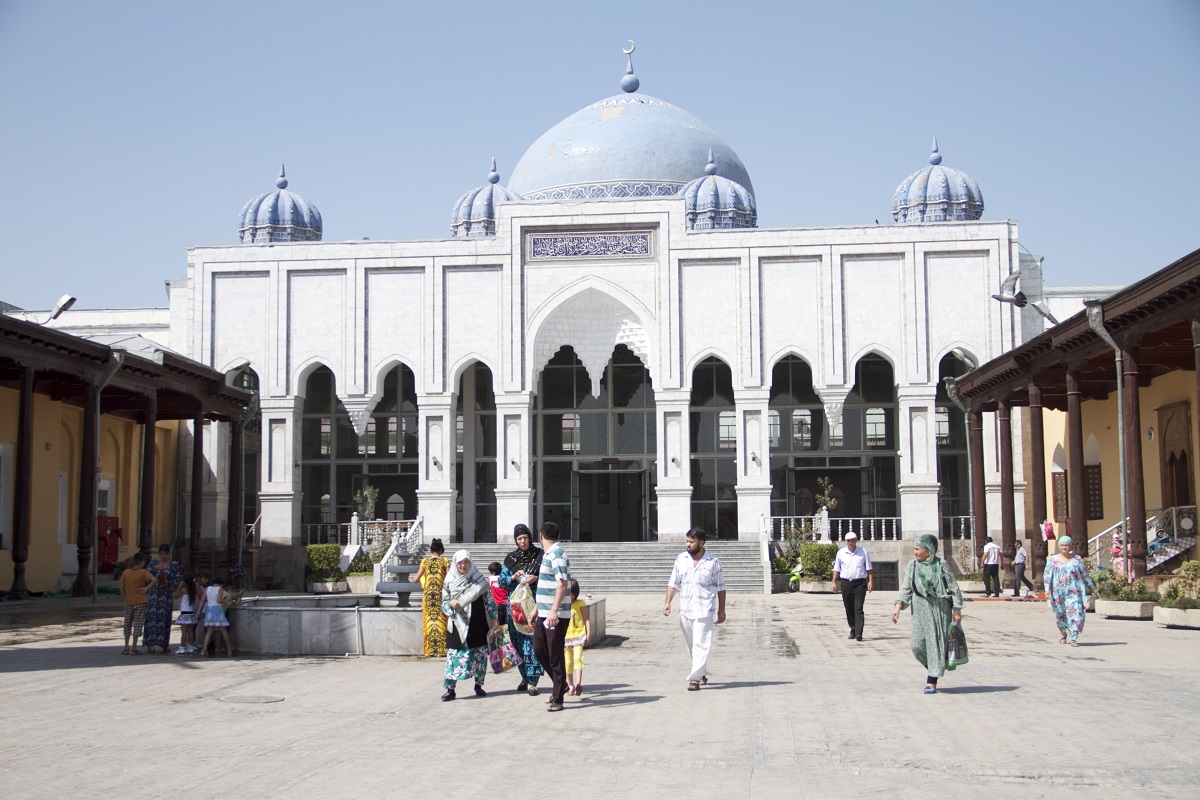
Photo: Agnieszka Pikulicka-Wilczewska
Tightening control
One of the most important factors that has influenced the formation of the various Islamic tendencies in Tajik society was the civil war (1992-97) between the opposition, led by the Islamic Renaissance Party of Tajikistan (or IRPT), and governmental forces. Following the war, religious activists, some of whom were supported by the IRPT, became the key actors shaping the political situation in the country and influencing the main ideological streams. The impact of the IRPT increased over time and the organisation became one of the main political forces in Tajikistan. But the continuing discussions on matters of religion were soon marked by increasing ideological differences between the religious leaders loyal to the state and those departing from the governmental mainstream.
Shortly after signing of the peace agreement in 1997, the government began to undermine the position of the IRPT and its allies (including religious leaders), launching a number of campaigns to diminish the influence of the opposition. Finally, at the end of August 2015 the IRPT was de-legalised and the mass arrest of its members followed. Many activists, including the head of the party, Muhiddin Kabiri, went into exile. IRPT leaders and activists received prison sentences or were forced to renounce their party membership. At the end of September 2015, the high court classified the IRPT as a terrorist group, alleging that the party had been planning a coup.
The dissolution of the party was a symbolic culmination of various government campaigns aimed at tightening control over religious life in the country. In 2009 the government passed a law granting the Hanafi School of Islam a special role in the national culture and spiritual life of the people of Tajikistan, which effectively made it the official denomination. Ever since, the law has been used as a tool to extort control over society. Various forms of legislation have been implemented to curb the independence of religious institutions and religious leaders, while counteracting Islamic extremism – that is, all religious practices the government deems illegitimate, have been cited as the official reason for curtailing freedoms.
Limiting influence
Religious life in Tajikistan is expected to be supervised by the Committee for Religious Affairs (Kumitai Dini). It has branches in all districts as well as municipalities, and controls the Supreme Council of Ulama (Shuroi Ulamo). One of the most important steps undertaken by the committee, supported by the Tajik government, is limiting the influence of religious education.
Domestic education has been banned, which forced Islamic teachers to go underground and organise small secret study groups, as was the case in the Soviet period. Other forms of religious education have also come under increasing pressure. Religion can be taught at registered institutions only, such as mosques or madrasa, although the last one was closed in 2016. There is only one Islamic University in the country, located in Dushanbe, named after Imam Azam Abu Hanifa, and a school for girls attached to this institution.
In an attempt to further constrain Islam’s social impact, the government banned children under the age of 18 from attending mosques and participating in religious activities outside of the family. While women were never welcomed in mosques in Central Asia, the tradition was challenged by the IRPT and other modernists in the post-war period, and a limited number of places became available for women to pray. Now, however, all of them have been closed down by the authorities and women’s religious activities have been again limited to attending holy places (mazars).
In 2010 Tajikistan’s president, Emomali Rahmon, called for all Tajiks studying at Islamic universities and madrasas abroad to return to the country, which he saw as a necessary means to protect the youth from the influence of radical Islamic ideologies. Prior to this decision, there were more Tajiks studying Islam abroad than any other nation from Central Asia. They attended religious schools in Egypt, Saudi Arabia, Pakistan and Iran. Undoubtedly, there were people who studied in madrasas which spread radical ideas linked to some terrorist organisations. However, the purpose of the policy was not to fight extremism, but any potential threat to the authority and influence of local religious leaders.
At the same time, the state has not offered any alternative religious programmes be it at home or abroad. Moreover, the government introduced a ban on religious groups which have been classified as terrorist and extremist, such as the Salafi groups, the Islamic Movement of Turkestan, Hizb ut-Tahrir, and even the proselytic, but quite neutral, Jamaati Tabligh, without an effort to verify the nature of their activities. Recently, the list has also been complemented by the IRPT and Group 24, despite the fact that the latter has a rather loose connection to religion in its programme.
No more beards
In its hunt to locate extremists and enemies of the state, the Tajik government introduced a ban on loud wailing, wearing black clothes and other mourning practices at funerals. Following a campaign against people who have an “Islamic appearance”, such as men wearing long beards, the government banned the hijab in schools, universities and public administration buildings. Occasionally, women are stopped on the streets by law enforcement officers and asked to remove their hijab, and men are sometimes ordered to shave their beards. Nevertheless, in spite of the ban, some women continue wearing the hijab, especially those from more religious families.
To justify the ban, the government claims that the hijab is not a “traditional Tajik dress” and is a sign of the “Islamisation” of the society. While the traditional Tajik kurta (long dress), trousers and scarf tied to the back of the head can hardly be called secular, such attire is promoted as “national” or “traditional”. This fusion of “tradition” and “Islam” in female fashion became a brand of Rahmon’s state, while the “de-hijabisation” campaign has been supported by some representatives of the local educated intelligentsia, who are fighting back against the increasing religiosity in the country. In fact, Tajikistan is probably the only Muslim-majority country in the world with such a negative attitude towards Islamic symbols. The government even imposes the “traditional Tajik costume” on female religious leaders (bibi otun, bibi khalifa) who have always acted informally and are traditionally responsible for teaching Islam and performing rituals. They are expected to wear special green attire that is designed to reflect the Islamic and Tajik traditions. As in the case of male religious teachers, the government is currently trying to create a semi-formal female “clergy” whose members would be loyal to the state.
In order to prevent public gatherings with religious leaders and to trace those who criticise the existing social and political order, the government has put a number of limitations on performing certain rituals. All religious leaders must register in the area where they live, and their actions are closely monitored. In its efforts to discredit religious leaders and political opponents, the authorities have gone as far as to releasing videos with mullahs engaged in extramarital sex.
Yet, despite all government’s efforts, the state-backed clergy is not held in high regard by the population, like in the Soviet times. Especially that, oddly enough, some official Islamic leaders support Salafi-like ideologies, adhering to a rather strict version of Islam and often openly criticise local traditions. President Rahmon’s recent friendship with the Saudis, which offers financial support for Tajikistan, also raises the question of the actual motives behind the forced secularisation and anti-extremism policies. While there is little doubt that they primarily serve to discredit political opponents, the sympathy of the official clergy for orthodox streams of Islam demonstrates double standards in state policy and the ambiguity of the religious situation in Tajikistan.
By excluding critical religious and spiritual leaders from the public discourse, the government seeks to prevent the public from expressing its grievances. It tries to control Islam because it is the only force that can unite society against the unfair social system. Those religious leaders who oppose the rules of the game are forced to leave the country – a majority end up going to Russia. In the long perspective, an alternative centre of Islam for Tajik migrants may develop in Russia, where resistance against Rahmon’s government can be easily formed. Moreover, a lack of Islamic education and respected religious authority has created fertile ground for various ideologies, including extremist ones, which can easily attract people to follow radical groups.
Witch hunt
Following religious leaders, Rahmon decided to also harass healers, fortune-tellers and other “spiritual specialists”. In 2015 he signed amendments to the criminal code in order to impose tougher punishments against witchcraft and sorcery. Those who are accused of being involved in magic can be sentenced to up to seven years in prison. In Tajikistan, as elsewhere in Central Asia, various forms of magic and healing are part of the cultural tradition, which includes healing with plants, rituals, charms and prayers.
Along with the collapse of public services and a deteriorating health care system, traditional folk healing has become increasingly popular. People often combine methods of folk and conventional medicine to ensure “double protection”. The services of local healers are also attractive due to their modest cost compared to the prices that professional doctors charge. Folk medicine is available almost everywhere and is accessible to everyone.
Officially, the purpose of the ban is to prevent illegal and harmful practices. In reality, however, it is aimed at limiting the influence of spiritual leaders, who are held in high esteem by the general public. Rahmon and his government seek to destroy religious networks and undermine the position of various families of noble (religious) origin, especially those who do not want to succumb to the president’s circle. As a result, he attempts to design a semi-secular version of religion based on façade institutions and loyal people.
Despite the declaration of religious tolerance, the system developed by Rahmon can be referred to as authoritarian secularism, where religion is pushed to the margins of public and social life and replaced by a new artificially created tradition. The government and formal Islamic institutions have not attempted to encourage communication among different religious groups. Through limiting various religious activities, including Islamic education, they strengthen xenophobic sentiments. The discussion on the country’s religious life is thus full of empty platitudes, artificial statements and prohibitions. Under those circumstances any dialogue on religion or the nature of Islam remains impossible.
Anna Cieślewska is a researcher at the department of Iranian studies with the Institute of Oriental Studies at the Jagiellonian University. She has spent the last 11 years working on various research and development projects in the post-Soviet space.